Ah… our governments

A collection of views, opinions, facts on what has happened with our governments at federal, state and local levels.

Threatened Species Commissioner

‘Worst it’s ever been’: a threatened species alarm sounds during the election campaign – and is ignored

The Guardian 25 April 2022 Lisa Cox

Gregory Andrews shares he:

“believes the state of the country’s natural wildlife and biodiversity is the “worst it’s ever been” and calls the ongoing destruction of forests and other habitat “crazy”.

…felt restricted due to climate denialism within the Coalition and the refusal to deal with habitat degradation.”

It is also noted:

“In the past term alone, three official reports, two from the Australian National Audit Office plus the independent review of Australia’s environmental laws by the former competition watchdog head Graeme Samuel, highlighted a litany of environmental failures.

A fourth, the five-yearly State of the Environment report, is also expected to highlight the ongoing decline. That report could have been tabled by the Morrison government before the campaign began but has been withheld.”

https://www.theguardian.com/environment/2022/apr/25/worst-its-ever-been-a-threatened-species-alarm-sounds-during-the-election-campaign-and-is-ignored

Management of Threatened Species and Ecological Communities under the Environment Protection and Biodiversity Conservation Act 1999

Australian National Audit Office 17 March 2022

“The department is unable to demonstrate it is efficient. There is limited evidence that desired outcomes are being achieved, due to the department’s lack of monitoring, reporting and support for the implementation of conservation advice, recovery plans and threat abatement plans.”

“…procedural guidance for undertaking listing assessments does not fully capture all relevant requirements of the EPBC Act and is not complete, up to date or consistently implemented”

“Procedural guidance for development needs updating and is not fully followed, and arrangements for review and update are not appropriate”

“Recovery plans, recovery plan reviews, threat abatement plan reviews and changes to the list are not completed within statutory timeframes. The department is unable to demonstrate that its efficiency has improved over time. “

“Measurement, monitoring and reporting arrangements are not sufficient to support the achievement of desired outcomes. The statuses of some threatened species are monitored, but most species are not. The statuses of ecological communities and key threatening processes are not monitored. There is no measurement, monitoring or reporting on progress, or on the contribution of listing assessments, conservation advice, recovery plans and threat abatement plans to their desired outcomes. Available information does not indicate desired outcomes have been achieved.”

https://www.anao.gov.au/work/performance-audit/management-threatened-species-and-ecological-communities-under-the-epbc-act

The spin and secrecy threatening the Australian environment

The Monthly November 2021 Anthony Ham

“This obsession with secrecy, and with the suppression of potential bad news stories, is especially pronounced when it comes to science and the environment.”

“In 2019, Professor Don Driscoll of Melbourne’s Deakin University and immediate past president of the Ecological Society of Australia, surveyed 220 Australian ecologists, conservation scientists, conservation policymakers and environmental consultants. The results, published this year in the international science journal Conservation Letters, found that one-third of government employees who responded had experienced “undue interference” when it came to public communications about their research.”

“Fifty-two per cent of government respondents had been prevented from publicly sharing scientific information. Of these, 82 per cent had been constrained by senior managers and 63 per cent by a minister’s office. For those respondents who had communicated scientific information in the public domain, 42 per cent reported being harassed or criticised for doing so. Just over half of respondents (56 per cent) believed that the suppression of scientific communications had worsened over recent years.”

Quotes from the above survey include:

It feels terrible to know the truth about impacts to the environment, but know you’ll never get that truth to the public and that the government doesn’t care at all. They want us to give them politically supportive information, not science.”

“I feel resentment when I am expected to “toe the line” and support decisions I consider wrong and not in the best interest of the environment and not based on sound scientific data.”

“In the absence of informed and objective scientific participation, said one respondent, fake news often fills the evidence void: “I could see that social and media debate was exploiting the lack of information to perpetuate incorrect … interpretations … to further their own agendas.”

https://www.themonthly.com.au/issue/2021/november/1635685200/anthony-ham/spin-and-secrecy-threatening-australian-environment#mtr

NSW Councillors’ Names & Emails

Please note, tis is pre 2024 NSW council elections, to be updated! – we have yet to capture every council – a “Work In Progress” [in council name alphabetical order]

BLACKTOWN COUNCILLORS

tony.bleasdale@blacktown.nsw.gov.au, brad.bunting@blacktown.nsw.gov.au, chris.quilkey@blacktown.nsw.gov.au, jess.diaz@blacktown.nsw.gov.au, moninder.singh@blacktown.nsw.gov.au, julie.griffiths@blacktown.nsw.gov.au, Michael.Stubley@blacktown.nsw.gov.au, Kushpinder.Kaur@blacktown.nsw.gov.au, Allan.Green@blacktown.nsw.gov.au, kathie.collins@blacktown.nsw.gov.au, susai.benjamin@blacktown.nsw.gov.au, carol.israel@blacktown.nsw.gov.au, Bob.Fitzgerald@blacktown.nsw.gov.au, peter.camilleri@blacktown.nsw.gov.au, Livingston.Chettipally@blacktown.nsw.gov.au

To: Mayor & Councillor Tony Bleasdale, Deputy Mayor & Councillor Brad Bunting, Councillor Chris Quilkey, Councillor Jess Diaz, Councillor Moninder Singh, Councillor Julie Griffiths, Councillor Michael Stubley, Councillor Kushpinder Kaur, Councillor Allan Green, Councillor Kathie Collins, Councillor Susai Benjamin, Councillor Carol Israel, Councillor Bob Fitzgerald, Councillor Peter Camilleri, Councillor Livingston Chettipally

https://www.blacktown.nsw.gov.au/About-Council/How-we-work/My-Councillors

BLUE MOUNTAINS COUNCILLORS:

mgreenhill@bmcc.nsw.gov.au, sredshaw@bmcc.nsw.gov.au, hollywood@bmcc.nsw.gov.au, bchristie@bmcc.nsw.gov.au, kschreiber@bmcc.nsw.gov.au, svanopdorp@bmcc.nsw.gov.au, bhoare@bmcc.nsw.gov.au, cwest@bmcc.nsw.gov.au, dmyles@bmcc.nsw.gov.au, resage@bmcc.nsw.gov.au,mfell@bmcc.nsw.gov.au, nfisher@bmcc.nsw.gov.au

For attention: Cr & Mayor Mark Greenhill, Cr & Deputy Mayor Sarah Redshaw, Cr & Deputy Mayor Romola Hollywood, Cr & & Deputy Mayor Brendan Christie, Cr Kevin Schreiber, Cr Suzie Van Opdorp, Cr Brent Hoare, Cr Claire West, Cr Daniel Myles, Cr Roza Sage, Cr Mick Fell, Cr Nyree Fisher

https://www.bmcc.nsw.gov.au/councillors

BRYON COUNCILLORS

michael.lyon@byron.nsw.gov.au, sarah.ndiaye@byron.nsw.gov.au, alan.hunter@byron.nsw.gov.au, sama.balson@byron.nsw.gov.au, peter.westheimer@byron.nsw.gov.au, duncan.dey@byron.nsw.gov.au, asren.pugh@byron.nsw.gov.au, mark.swivel@byron.nsw.gov.au,

To: Mayor Michael Lyon, Cr. Sarah Ndiaye, Cr. Alan Hunter, Cr. Sama Balson, Cr. Peter Westheimer, Cr. Duncan Dey, Cr. Asren Pugh, Cr. Mark Swivel

https://www.byron.nsw.gov.au/Council/Mayor-and-councillors/Meet-our-Mayor-and-Councillors

CAMDEN COUNCILLORS

cr.fedeli@camden.nsw.gov.au, cr.farrow@camden.nsw.gov.au, cr.acagney@camden.nsw.gov.au,  cr.mclean@camden.nsw.gov.au, cr.campbell@camden.nsw.gov.au, cr.zammit@camden.nsw.gov.au, cr.ccagney@camden.nsw.gov.au, cr.dommaraju@camden.nsw.gov.au, cr.symkowiak@camden.nsw.gov.au

To: Mayor &  Cr Therese Fedeli, Deputy Mayor & Cr Paul Farrow, Cr Ashleigh Cagney, Cr Peter McLean, Cr Eva Campbell, Cr Russell Zammit, Cr Cindy Cagney, Cr Usha Dommaraju, Cr Lara Symkowiak

https://www.camden.nsw.gov.au/council/councillors/

CAMPBELLTOWN COUNCIL

george.greiss@campbelltown.nsw.gov.au,warren.morrison@campbelltown.nsw.gov.au,george.brticevic@campbelltown.nsw.gov.au,john.chew@campbelltown.nsw.gov.au,margaret.chivers@campbelltown.nsw.gov.au,masood.chowdhury@campbelltown.nsw.gov.au,joshua.cotter@campbelltown.nsw.gov.au,marian.george@campbelltown.nsw.gov.au,karen.hunt@campbelltown.nsw.gov.au,masud.khalil@campbelltown.nsw.gov.au,darcy.lound@campbelltown.nsw.gov.au,rey.manoto@campbelltown.nsw.gov.au,riley.munro@campbelltown.nsw.gov.au,meg.oates@campbelltown.nsw.gov.au, matt.stellino@campbelltown.nsw.gov.au

To: Mayor – Cr George Greiss, Deputy Mayor – Cr Warren Morrison, Cr George Brticevic, Cr John Chew, Cr Margaret Chivers, Cr Masood Chowdhury, Cr Joshua Cotter, Cr Marian George, Cr Karen Hunt, Cr Masud Khalil, Cr Darcy Lound, Cr Rey Manoto, Cr Riley Munro, Cr Meg Oates, Cr Matt Stellino

https://www.campbelltown.nsw.gov.au/CouncilandCouncillors/Councillors

CENTRAL COAST COUNCILLORS

Under Administration: “Mr Rik Hart is the Administrator for Central Coast Council”

We suggest emailing the council with Attention to Rik Hart: “The Administrator is here for residents to contact and engage with. The role acts as the Council and undertakes the responsibilities of the Mayor and Councillors representing the interests of residents and our communities. You can contact the Administrator by:

Email – theadministrator@centralcoast.nsw.gov.au

CESSNOCK COUNCILLORS

jay.suvaal@cessnock.nsw.gov.au, paul.dunn@cessnock.nsw.gov.au, james.hawkins@cessnock.nsw.gov.au, jessica.jurd@cessnock.nsw.gov.au, anthony.burke@cessnock.nsw.gov.au, john.moores@cessnock.nsw.gov.au, ian.olsen@cessnock.nsw.gov.au, karen.jackson@cessnock.nsw.gov.au, anne.sander@cessnock.nsw.gov.au, daniel.watton@cessnock.nsw.gov.au, rosa.grine@cessnock.nsw.gov.au, mitchell.hill@cessnock.nsw.gov.au, paul.paynter@cessnock.nsw.gov.au

To: Mayor & Councillor Jay Suvaal, Deputy Mayor & Councillor John Moores, Councillor Paul Dunn, Councillor James Hawkins, Councillor Ian Olsen, Councillor Jessica Jurd, Councillor Anthony Burke, Councillor Karen Jackson, Councillor Anne Sander, Councillor Daniel Watton, Councillor Rosa Grine, Councillor Mitchell Hill, Councillor Paul Paynter

https://www.cessnock.nsw.gov.au/Council/Councillors

COFFS HARBOUR COUNCILLORS

paul.amos@chcc.nsw.gov.au, george.cecato@chcc.nsw.gov.au, jonathan.cassell@chcc.nsw.gov.au, julie.sechi@chcc.nsw.gov.au, rodger.pryce@chcc.nsw.gov.au, sally.townley@chcc.nsw.gov.au, scott.wolgamot@chcc.nsw.gov.au, tegan.swan@chcc.nsw.gov.au, tony.judge@chcc.nsw.gov.au

To: Cr Paul Amos, Mayor, Cr George Cecato, Cr Jonathan Cassell, Cr Julie Sechi, Cr Rodger Pryce, Cr Sally Townley, Cr Scott Wolgamot, Cr Tegan Swan, Cr Tony Judge

https://www.coffsharbour.nsw.gov.au/Your-Council/About-Council/Councillors

CUMBERLAND COUNCIL

Lisa.Lake@cumberland.nsw.gov.au, Suman.Saha@cumberland.nsw.gov.au, Steve.Christou@cumberland.nsw.gov.au,Ola.Hamed@cumberland.nsw.gov.au, Joseph.Rahme@cumberland.nsw.gov.au, Diane.Colman@cumberland.nsw.gov.au, Greg.Cummings@cumberland.nsw.gov.au, Eddy.Sarkis@cumberland.nsw.gov.au, Glenn.Elmore@cumberland.nsw.gov.au, Kun.Huang@cumberland.nsw.gov.au, Sabrin.Farooqui@cumberland.nsw.gov.au, Helen.Hughes@cumberland.nsw.gov.au, Paul.Garrard@cumberland.nsw.gov.au, Mohamad.Hussein@cumberland.nsw.gov.au, Michael.Zaiter@cumberland.nsw.gov.au

To : Councillor Lisa Lake (Mayor), Councillor Suman Saha (Deputy Mayor), Councillor Steve Christou, Councillor Ola Hamed, Councillor Joseph Rahme, Councillor Diane Colman, Councillor Greg Cummings, Councillor Eddy Sarkis, Councillor Kun Huang, Councillor Sabrin Farooqui, Councillor Helen Hughes, Councillor Glenn Elmore, Councillor Paul Garrard, Councillor Mohamad Hussein, Councillor Michael Zaiter

https://www.cumberland.nsw.gov.au/mayor-and-councillors

FAIRFIELD CITY COUNCIL

fcarbone@fairfieldcity.nsw.gov.au, dle@fairfieldcity.nsw.gov.au, gbarcha@fairfieldcity.nsw.gov.au, rbarkho@fairfieldcity.nsw.gov.au, mkarajcic@fairfieldcity.nsw.gov.au, klam@fairfieldcity.nsw.gov.au, clazar@fairfieldcity.nsw.gov.au, kly@fairfieldcity.nsw.gov.au, mmijatovic@fairfieldcity.nsw.gov.au, hmorvillo@fairfieldcity.nsw.gov.au, arohan@fairfieldcity.nsw.gov.au, csaliba@fairfieldcity.nsw.gov.au, msaliba@fairfieldcity.nsw.gov.au

For attention: Mayor Frank Carbone, Deputy Mayor Dai Le, Councillor George Barcha, Councillor Reni Barkho, Councillor Milovan Karajcic, Councillor Kevin Lam, Councillor Carmen Lazar OAM, Councillor Kien Ly, Councillor Michael Mijatovic, Councillor Hugo Morvillo, Councillor Andrew Rohan, Councillor Charbel Saliba, Councillor Marie Saliba

https://www.fairfieldcity.nsw.gov.au/Your-Council/About-Council/Meet-your-Councillors

HORNSBY COUNCILLORS

pruddock@hornsby.nsw.gov.au, tsalitra@hornsby.nsw.gov.au, ntilbury@hornsby.nsw.gov.au, wwaddell@hornsby.nsw.gov.au, mball@hornsby.nsw.gov.au, smcclelland@hornsby.nsw.gov.au, jmcintosh@hornsby.nsw.gov.au, eheyde@hornsby.nsw.gov.au, vgreenwood@hornsby.nsw.gov.au, spillamarri@hornsby.nsw.gov.au

To: Mayor – The Honourable Philip Ruddock, Cr Tania Salitra, Cr Nathan Tilbury, Cr Warren Waddell, Cr Monika Ball, Cr Sallianne McClelland, Cr Janelle McIntosh, Cr Emma Heyde, Cr Verity Greenwood, Cr Sreeni Pillamarri,

https://www.hornsby.nsw.gov.au/council/about-council/councillors

INNER WEST COUNCIL

Darcy.Byrne@innerwest.nsw.gov.au, Philippa.Scott@innerwest.nsw.gov.au, Kobi.Shetty@innerwest.nsw.gov.au, John.Stamolis@innerwest.nsw.gov.au, Liz.Atkins@innerwest.nsw.gov.au, Pauline.Lockie@innerwest.nsw.gov.au, Chloe.Smith@innerwest.nsw.gov.au, Jessica.DArienzo@innerwest.nsw.gov.au, Mark.Drury@innerwest.nsw.gov.au, Dylan.Griffiths@innerwest.nsw.gov.au, Marghanita.Da.Cruz@innerwest.nsw.gov.au, Tim.Stephens@innerwest.nsw.gov.au, Mat.Howard@innerwest.nsw.gov.au, Justine.Langford@innerwest.nsw.gov.au, Zoi.Tsardoulias@innerwest.nsw.gov.au,

To: Mayor – Darcy Byrne, Deputy Mayor – Philippa Scott, Kobi Shetty, John Stamolis, Liz Atkins, Pauline Lockie, Chloe Smith, Jessica D’Arienzo, Mark Drury, Dylan Griffiths, Marghanita Da Cruz, Tim Stephens, Mat Howard, Justine Langford, Zoi Tsardoulias

https://www.innerwest.nsw.gov.au/about/the-council/mayor-and-councillors

KU-RING-GAI COUNCILLORS

jpettett@krg.nsw.gov.au, bward@krg.nsw.gov.au, gtaylor@krg.nsw.gov.au, slennon@krg.nsw.gov.au, sngai@krg.nsw.gov.au, ataylor@krg.nsw.gov.au, ckay@krg.nsw.gov.au, martinsmith@krg.nsw.gov.au, cspencer@krg.nsw.gov.au, kwheatley@krg.nsw.gov.au

To: Mayor Jeff Pettett, Deputy Mayor Barbara Ward, Cr Greg Taylor, Cr Simon Lennon, Cr Sam Ngai, Cr Alec Taylor, Cr Christine Kay, Cr Martin Smith, Cr Cedric Spencer, Cr Kim Wheatley

https://www.krg.nsw.gov.au/Council/Elected-Council/Mayor-and-Councillors

KYOGLE COUNCILLORS

crkylie.thomas@kyogle.nsw.gov.au, crtom.cooper@kyogle.nsw.gov.au, crjanet.wilson@kyogle.nsw.gov.au, crhayden.doolan@kyogle.nsw.gov.au, crjohn.burley@kyogle.nsw.gov.au, crrobert.cullen@kyogle.nsw.gov.au, crmaggie.may@kyogle.nsw.gov.au, crdanielle.mulholland@kyogle.nsw.gov.au, crjames.murray@kyogle.nsw.gov.au

Mayor & Cr Kylie Thomas, Deputy Mayor & Cr Tom Cooper, Cr Janet Wilson, Cr Hayden Doolan, Cr John Burley, Cr Robert Cullen, Cr Maggie May, Cr Danielle Mulholland, Cr James Murray

LANE COVE COUNCILLORS

azbik@lanecove.nsw.gov.au, kbryla@lanecove.nsw.gov.au, bkennedy@lanecove.nsw.gov.au, kmort@lanecove.nsw.gov.au, dbrookshorn@lanecove.nsw.gov.au, droenfeldt@lanecove.nsw.gov.au, msouthwood@lanecove.nsw.gov.au, sbennison@lanecove.nsw.gov.au, rflood@lanecove.nsw.gov.au

To: Mayor Andrew Zbik,  Kathy Bryla, Bridget Kennedy, Katherine Mort, David Brooks-Horn, David Roenfeldt, Merri Southwood, Scott Bennison, Rochelle Flood

https://www.lanecove.nsw.gov.au/YourCouncil/YourCouncillors/Pages/default.aspx

LIVERPOOL COUNCIL

mayor@liverpool.nsw.gov.au, CllrHadid@liverpool.nsw.gov.au, CllrGoodman@liverpool.nsw.gov.au, CllrHagarty@liverpool.nsw.gov.au, CllrHarle@liverpool.nsw.gov.au,CllrKarnib@liverpool.nsw.gov.au, CllrRhodes@liverpool.nsw.gov.au, CllrAmmoun@liverpool.nsw.gov.au, CllrMacnaught@liverpool.nsw.gov.au, CllrKaliyanda@liverpool.nsw.gov.au, CllrGreen@liverpool.nsw.gov.au

To: Liverpool Mayor Ned Mannoun, Deputy Mayor Mazhar Hadid, Councillor Mel Goodman, Councillor Nathan Hagarty, Councillor Peter Harle, Councillor Ali Karnib, Councillor Karress Rhodes, Councillor Richard Ammoun, Councillor Fiona Macnaught, Councillor Charishma Kaliyanda, Councillor Betty Green

https://www.liverpool.nsw.gov.au/council/your-councillors

NEWCASTLE COUNCILLORS

lordmayor@ncc.nsw.gov.au, mail@ncc.nsw.gov.au, dclausen@ncc.nsw.gov.au, jmackenzie@ncc.nsw.gov.au, jchurch@ncc.nsw.gov.au, cduncan@ncc.nsw.gov.au, jebarrie@ncc.nsw.gov.au, cmccabe@ncc.nsw.gov.au, pwinneybaartz@ncc.nsw.gov.au, kwark@ncc.nsw.gov.au, mwood@ncc.nsw.gov.au, drichardson@ncc.nsw.gov.au, eadamczyk@ncc.nsw.gov.au, cpull@ncc.nsw.gov.au

To: Lord Mayor – Nuatali Nelmes, Councillor Declan Clausen, Councillor Dr John Mackenzie, Councillor John Church, Councillor Carol Duncan, Councillor Jenny Barrie, Councillor Charlotte McCabe, Councillor Peta Winney-Baartz, Councillor Katrina Wark, Councillor Margaret Wood, Councillor Deahnna Richardson, Councillor Dr Elizabeth Adamczyk, Councillor Callum Pull

https://newcastle.nsw.gov.au/council/councillors

NORTHERN BEACHES COUNCIL

Michael.Regan@northernbeaches.nsw.gov.au, Sue.Heins@northernbeaches.nsw.gov.au, Jose.Menano-Pires@northernbeaches.nsw.gov.au,

Stuart.Sprott@northernbeaches.nsw.gov.au, Candy.Bingham@northernbeaches.nsw.gov.au, Georgia.Ryburn@northernbeaches.nsw.gov.au,

Sarah.Grattan@northernbeaches.nsw.gov.au, Bianca.Crvelin@northernbeaches.nsw.gov.au, Vincent.DeLuca@northernbeaches.nsw.gov.au, Ruth.Robins@northernbeaches.nsw.gov.au, Kristyn.Glanville@northernbeaches.nsw.gov.au, David.Walton@northernbeaches.nsw.gov.au, Michael.Gencher@northernbeaches.nsw.gov.au, Miranda.Korzy@northernbeaches.nsw.gov.au, Rory.Amon@northernbeaches.nsw.gov.au,

To: Cr & Mayor Michael Regan, Cr & Deputy Mayor Sue Heins, Cr Jose Menano-Pires, Cr Stuart Sprott, Cr Candy Bingham, Cr Georgia Ryburn, Cr Sarah Grattan, Cr Bianca Crvelin, Cr Vincent De Luca, Cr Ruth Robins, Cr Kristyn Glanville, Cr David Walton, Cr Michael Gencher, Cr Miranda Korzy, Cr Rory Amon

https://www.northernbeaches.nsw.gov.au/council/your-elected-council

PARRAMATTA COUNCIL

lordmayor@cityofparramatta.nsw.gov.au, pandey@cityofparramatta.nsw.gov.au, pesber@cityofparramatta.nsw.gov.au, mgarrard@cityofparramatta.nsw.gov.au, kdarley@cityofparramatta.nsw.gov.au, lwearne@cityofparramatta.nsw.gov.au, cmaclean@cityofparramatta.nsw.gov.au, ahumphries@cityofparramatta.nsw.gov.au, gvaljak@cityofparramatta.nsw.gov.au, dwang@cityofparramatta.nsw.gov.au, hgreen@cityofparramatta.nsw.gov.au, pbradley@cityofparramatta.nsw.gov.au, pprociv@cityofparramatta.nsw.gov.au, dsiviero@cityofparramatta.nsw.gov.au, pnoack@cityofparramatta.nsw.gov.au

TO: Lord Mayor Donna Davis, Deputy Lord Mayor Sameer Pandey, Councillor Pierre Esber, Councillor Michelle Garrard, Councillor Kellie Darley, Councillor Lorraine Wearne, Councillor Cameron Maclean, Councillor Ange Humphries, Councillor Georgina Valjak, Councillor Donna Wang, Councillor Henry Green, Councillor Phil Bradley, Councillor Dr Patricia Prociv, Councillor Dan Siviero, Councillor Paul Noack

https://www.cityofparramatta.nsw.gov.au/council/lord-mayor-and-councillors

PENRITH COUNCIL

tricia.hitchen@penrith.city, todd.carney@penrith.city, jim@jimaitken.com.au, mark.davies@penrith.city, karen.mckeown@penrith.city, sue.day@penrith.city, mark.rusev@penrith.city, bernard.bratusa@penrith.city, robin.cook@penrith.city, marlene.shipley@penrith.city, glenn.gardiner@penrith.city, kevin.crameri@penrith.city, ross@rossfowler.com.au, john.thain@penrith.city, jonathan.pullen@penrith.city

To: Councillor Tricia Hitchen – Mayor, Councillor Todd Carney – Deputy Mayor, Councillor Jim Aitken OAM, Councillor Mark Davies, Councillor Karen McKeown OAM, Councillor Sue Day, Councillor Mark Rusev, Councillor Bernard Bratusa, Councillor Robin Cook, , Councillor Marlene Shipley, Councillor Glenn Gardiner, Councillor Kevin Crameri OAM, Councillor Ross Fowler OAM, Councillor John Thain, Councillor Jonathan Pullen

https://www.penrithcity.nsw.gov.au/council/council-business/mayor-and-councillors

RYDE COUNCIL

JordanL@ryde.nsw.gov.au, SYedelian@ryde.nsw.gov.au, BernardP@ryde.nsw.gov.au, KatieOr@ryde.nsw.gov.au, ShwetaDe@ryde.nsw.gov.au, PenelopeP@ryde.nsw.gov.au, RMaggio@ryde.nsw.gov.au, SophieLW@ryde.nsw.gov.au, CharlesSong@ryde.nsw.gov.au, DanielHan@ryde.nsw.gov.au, TrentonB@ryde.nsw.gov.au

To: Clr Jordan Lane – Mayor, Clr Sarkis Yedelian OAM – Deputy Mayor, Clr Bernard Purcell, Clr Katie O’Reilly, Clr Shweta Deshpande, Clr Penelope (Penny) Pedersen, Clr Roy Maggio, Clr Sophie Lara-Watson, Clr Charles Song, Clr Daniel Han, Clr Trenton Brown

https://www.ryde.nsw.gov.au/Council/Councillors/Councillors

SHOALHAVEN COUNCIL

amanda.findley@shoalhaven.nsw.gov.au, paul.ell@shoalhaven.nsw.gov.au, john.wells@shoalhaven.nsw.gov.au, matthew.norris@shoalhaven.nsw.gov.au, serena.copley@shoalhaven.nsw.gov.au, tonia.gray@shoalhaven.nsw.gov.au, evan.christen@shoalhaven.nsw.gov.au, greg.watson@shoalhaven.nsw.gov.au, john.kotlash@shoalhaven.nsw.gov.au, liza.butler@shoalhaven.nsw.gov.au, mark.kitchener@shoalhaven.nsw.gov.au, moo.dath@shoalhaven.nsw.gov.au, patricia.white@shoalhaven.nsw.gov.au

To: Mayor Amanda Findley, Deputy Mayor Paul Ell, Cr John Wells, Cr Matthew Norris, Cr Serena Copley, Cr Tonia Gray, Cr Evan Christen, Cr Greg Watson, Cr John Kotlash, Cr Liza Butler, Cr Mark Kitchener, Cr Moo D’Ath, Cr Patricia White

https://www.shoalhaven.nsw.gov.au/Council/Mayor-Councillors

CITY of SYDNEY COUNCIL

cmoore@cityofsydney.nsw.gov.au, SEllsmore@cityofsydney.nsw.gov.au, WChan@cityofsydney.nsw.gov.au, EDavis@cityofsydney.nsw.gov.au, LGannon@cityofsydney.nsw.gov.au, SMJarrett@cityofsydney.nsw.gov.au, rkok@cityofsydney.nsw.gov.au, LScott@cityofsydney.nsw.gov.au, JScully@cityofsydney.nsw.gov.au, YWeldon@cityofsydney.nsw.gov.au

To: Lord Mayor – Councillor Clover Moore, Deputy Lord Mayor – Councillor Sylvie Ellsmore, Councillor HY William Chan, Councillor (Waskam) Emelda Davis, Councillor Lyndon Gannon, Councillor Shauna Jarrett, Councillor Robert Kok, Councillor Linda Scott, Councillor Jess Scully, Councillor Yvonne Weldon

https://meetings.cityofsydney.nsw.gov.au/mgMemberIndex.aspx?bcr=1

RANDWICK COUNCILLORS

mayor@randwick.nsw.gov.au, rafaela.pandolfini@randwick.nsw.gov.au, kym.chapple@randwick.nsw.gov.au, bill.burst@randwick.nsw.gov.au, noel.dsouza@randwick.nsw.gov.au, christie.hamilton@randwick.nsw.gov.au, andrew.hay@randwick.nsw.gov.au, alexandra.luxford@randwick.nsw.gov.au, joanne.mccafferty@randwick.nsw.gov.au, kathy.neilson@randwick.nsw.gov.au, michael.olive@randwick.nsw.gov.au, daniel.rosenfeld@randwick.nsw.gov.au, danny.said@randwick.nsw.gov.au, philipa.veitch@randwick.nsw.gov.au, marea.wilson@randwick.nsw.gov.au

To: Cr Dylan Parker (Mayor), Cr Rafaela Pandolfini (Deputy Mayor), Cr Kym Chapple, Cr Bill Burst, Cr Noel D’Souza, Cr Christie Hamilton, Cr Andrew Hay, Cr Alexandra Luxford, Cr Joanne McCafferty, Cr Kathy Neilson, Cr Michael Olive, Cr Daniel Rosenfeld, Cr Danny Said, Cr Philipa Veitch, Cr Marea Wilson

https://www.randwick.nsw.gov.au/about-us/council-and-councillors/mayor-and-councillors

TWEED COUNCILLORS

ccherry@tweed.nsw.gov.au, rbyrnes@tweed.nsw.gov.au, rbrinsmead@tweed.nsw.gov.au, mdennis@tweed.nsw.gov.au, nfirth@tweed.nsw.gov.au, jowen@tweed.nsw.gov.au, wpolglase@tweed.nsw.gov.au

To: Chris Cherry Mayor & Councillor, Reece Byrnes Deputy Mayor & Councillor, Rhiannon Brinsmead Councillor, Meredith Dennis Councillor, Nola Firth Councillor, James Owen Councillor, Warren Polglase Councillor

https://www.tweed.nsw.gov.au/council/councillors-meetings/mayor-councillors

WOLLONGONG COUNCIL

EMAIL directly on their webpage ONLY IF YOU HAVE MS MAIL, NO CONTACT FORM

Try phone to obtain emails, even a general council email address (02) 4227 7111

Web chat: http://webchat.wollongong.nsw.gov.au/WebChat/Main.aspx

Mayor & Councillor Gordon Bradbery, Councillor Mithra Cox, Councillor Janice Kershaw, Councillor Richard Martin, Councillor Cameron Walters, Councillor Cath Blakey, Councillor David Brown, Councillor Tania Brown (Deputy Lord Mayor), Councillor John Dorahy, Councillor Elisha Aitken, Councillor Linda Campbell, Councillor Dom Figliomeni, Councillor Ann Martin

https://www.wollongong.nsw.gov.au/your-council/your-council-officials

Have you considered a cat enclosure to keep your kitties safe?

Do you have an outdoor enclosure already?

Are you considering one?

BENEFITS

There are many benefits with cat enclosures, for your cats and for you there is peace of mind.

What’s your favourite reason for keeping your kitty safe?

  • your cat will not be mixing with other pets (health, diseases, wounds, etc),
  • you will be keeping wildlife safe,
  • your cat will be avoiding road or other accidents,
  • you will be ensuring your pet doesn’t “go missing”, and
  • it provides a stimulating environment for your kitties: fresh air with sounds & sights stimulate brains which can be just as good as a physical workout.

There’s so many ideas and products available, even DIY options, and then there is reuse / hacking, keep an eye out for freebies such as reusing aviaries and other units often given away for council pickups.  

Go to PINTEREST and lose yourself for hours or days on ideas from others.

There are endless solutions.

THINGS TO CONSIDER

  • your style eg to match your home,
  • your budget,
  • your DIY skills and tools,
  • any RISKS – how strong you may need to make the enclosure (eg metal mesh versus cat netting, lockable gates), consider other animals may try to get in as well as your own cats trying to get out,
  • you can build in steps or modules – start small, then extend when your budget allows, and you learn what works well for your cat and yourself.

BUNNINGS CAT HACKS

If you need some ideas or advice, then please join the facebook group, it is for everyone in Australia. There’s a huge range of options from members, and suppliers to consider. There’s a Topics option which is helpful.

A few suppliers our team has used include the following (no association with these, other than our team are customers with no discounts).

HARDWARE

Bunnings or other hardware supplier – look for the Rapid Mesh products for animals enclosures, these are metal mesh and can be framed or just panels.

BETTA PET SYSTEMS

They have independent module units, these are versatile and cat be reconfigured to your needs eg placed in a u-shape around doors of windows, are able to be easily installed, dismantled (just nuts & bolts), and relocated to another part of our garden or your next residence.

CAT NETS

Made with special made netting that can cover a frame, be connected from a fence to a roof, or even netting in a whole garden – lightweight and professionally made. They also have several standalone units.

Use one or use a blend of these products, with whatever else you may have. Some folk reuse pre-used flyscreen doors 🙂

REFERENCED INFORMATION

Cat Enclosure ideas plus more FB group for Australia: https://www.facebook.com/groups/250488372605075/

https://www.bettapetsystems.com.au

https://catnets.com.au

Recommendations for improvements for cat ownership & management with the NSW Companion Animal legislation

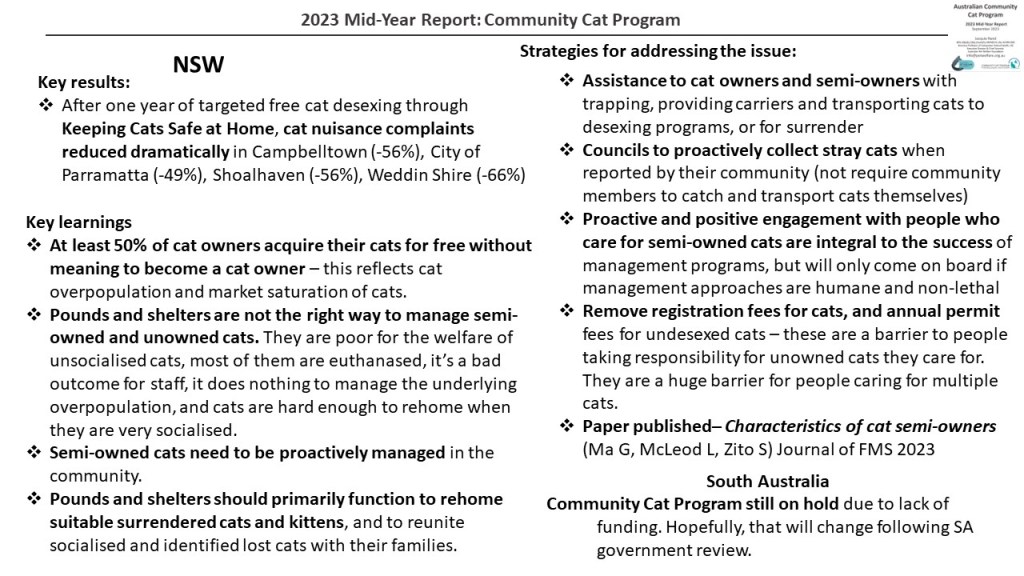
In July 2020, the NSW government introduced a new “incentive” to encourage cats to be desexed before the cats reached 4 months of age.

It also acts as a disincentive for owners who owned mature cats as the extra charge $80 also incurred possible late payment fees, even though a current owner may not have owned the cat at such a young age.

In September 2021, the Australian Pet Welfare Foundation (APWF) provided a set of recommendations to improve cat ownership and management within NSW.

These documents are included at the end of this LRC post as Referenced Sources.

In August 2021, a petition was raised to highlight that the $80 fee for desexing a cat after it reached 4 months of age was “hitting” many people and rescues groups who did not own the cat at such a young age.

This was in fact penalising new owners who were doing the “right thing” and desexing, microchipping and registering their cats.

REFERENCED SOURCES

“To create a stronger incentive to desex cats, from 1 July 2020, annual permits will be required for owners of non-desexed cats.

This means that owners of cats not desexed by four months of age will be required to pay an $80 annual permit in addition to their one-off lifetime pet registration fee. Please refer to the Annual Permits section for more information on this requirement.” https://www.olg.nsw.gov.au/public/dogs-cats/responsible-pet-ownership/faqs/

https://www.change.org/p/nsw-minister-for-local-government-shelley-hancock-stop-nsw-s-unfair-fee-tax-fine-levy-on-desexed-cats

APWF Key issues to consider related to mandated 24/7 cat containment

On 14 September 2022, Hornsby Council included in their meeting Item 5, a motion on mandatory cat confinement, to be raised at the upcoming Local Government Conference (October 23 through 25) for consideration by the NSW state government and all councils.

This post includes and summarises the Australian Pet Welfare Foundation (APWF) response “Key issues to consider related to mandated 24/7 cat containment”, including why this approach has not been found to be effective.

[Our own views are included in square brackets such as this sentence.]

We note that APWF promote, and are not against the use of cat enclosures. [LRC promotes cat enclosures and containment too.]

The key message on mandatory 24/7 containment is the lack of success, and the lack in measureable outcomes to date once implemented and even after 20 years of “application”.

This is supported by evidence from Australian councils and from other countries.

Overview of APWF review & findings

Refer to our Referenced Sources at the end of this post for this document.

  • Why is mandated 24/7 containment promoted by some groups?
  • Is mandated cat containment effective at reducing wandering cats?
  • Why is mandated cat containment not effective at reducing wandering cats?
  • Stray cat population (brief background information)
  • Mandated cat containment perpetuates the failed Trap, Adopt or Kill approach
  • Why is mandated cat containment unfeasible?
  • What are the negative consequences of mandated cat containment?
  • What are evidence based solutions to reduce wandering cats and related issues?
  • What about mandated night curfew?
  • Do domestic cats have an impact on wildlife populations?
  • Summary
  • References

We provide some highlights in this post.

Mandatory 24/7 cat containment legislation does not provide the expected benefits

APWF provides several sources of evidence on the lack of effectiveness at reducing roaming cats, which includes:

  • key findings from three Australian councils: Yarra Ranges; Casey; and Hobsons Bay, the latter who, after 20 years,  rejected cat curfews/containment in 2014  [LRC understanding is that information from councils is limited due to each council’s available information]
  • that a “number of USA jurisdictions have repealed their cat leash laws because they were unenforceable”, and as a result of “more cats being impounded and then killed but without reducing the overall number of roaming cats”,
  • RSPCA Australia in 2018 noted: “Overall, councils with cat containment regulations have not been able to demonstrate any measurable reduction in cat complaints or cats wandering at large following the introduction of the regulations”.

APWF summarises  “Based on data from councils, 24/7 cat containment regulations would not provide any measurable benefit in reducing complaints, cat impoundments, potential wildlife predation… and would instead increase costs to local governments.”

Why isn’t 24/7 containment an effective approach for wandering cats?

APWF includes, based on studies:

  • an owner for the majority of roaming cats cannot be identified to contain the cats
  • owners raised inherent challenges including financial costs, property limitations, and concern for the cats’ welfare
  • roaming cats without a identified/registered owner, may be supported by “semi owners” who may feed the cat(s) [and possibly desex etc]  …but mandatory containment prevents or acts as a disincentive for semi owners to become an identified/registered owners [most likely due to the inherent challenges in our previous summary point]

APWF summarises “Mandated 24/7 cat containment is not an effective strategy to reduce wandering cats” as many do not have an identifiable/registered owner, and some of those cats who do have an owner may be limited to the inherent challenges.

Mandatory cat containment “perpetuates the failed Trap, adopt or kill approach

Where a cat does not have an identified/registered owner, then these cats are impounded by a council.

Based on information and studies (NSW pound reports, RSPCA and more), APWF includes:

  • in areas where there are high populations of roaming cats, then it “results in low-level ad hoc culling, insufficient to override the high cat reproductive rate, immigration of new cats… and increased survival of juveniles”  
  • this becomes a repeating cycle “without reducing the number of wandering cats over time”

The reasons why mandated 24/7 cat containment is not feasible [nor cost justified]
Based on studies /evidence from Australian councils, RSPCA, and a number of USA sources, APWF includes the combination of key factors:

  • enforcement includes trapping resources and labour
    • the scope of work is limited in regulations
    • it is time and labour consuming (often requiring many days or weeks of effort), requiring more paid staff
    • it is costly for facilities eg traps
  • for cats without an identifiable/ registered owner the penalties under infringement notices (funding to cover costs) cannot be applied
  • trapped cats will increase the incoming impoundments and result in increased return to owner, rehoming or euthanasia rates, and funding for these
  • the mental health of AMO staff is at risk with increased negative outcome based workload

APWF summarises “Based on the evidence in Australia and internationally, mandated 24/7 cat containment is essentially unenforceable, rendering [this method] impractical and unfeasible.”
APWF provide 16 negative consequences of mandatory cat containment based on studies/evidence

A summary and grouping of these 16 consequences includes:

  • increases in cat complaints, impoundments, euthanasia of healthy treatable cats, costs (#1, #2, #3, #5)  
  • increases in mental health damage for staff and residents, staff burnout, staff turnover (#4, #6)
  • “continuation of the reactive and ineffective typical approach to domestic cats in Australia” (#7)
  • creates a disincentive for cat ownership: thereby reducing cat adoptions and rehoming opportunities (#8)  [which also prevents companionship for many people]
  • creates a major barrier for the semi owners (#9) and proactively responding to reducing the number of roaming cats
  • criminalises “door dasher” cats for identified/registered owners for ad hoc occurrences (#10) & increased risk for owned domestic cats being incorrectly impounded & euthanased (#13)
  • likely to increase cat surrenders [to council pounds etc] and abandonment [on the streets] (#11) [due to inherent challenges with containing a cat to a property and avoiding future penalties]
  • cats for whom owners are not clearly identified/registered are at significant risk of being euthanased, and there may be a huge emotional (mental health) issue for semi owners (#12)
  • potential that for some contained cats, their welfare, quality of life, and health eg “obesity, mobility” etc and behaviour will be compromised, and therefore also may lead to further surrenders or abandonment to the streets [increase in roaming cats] (#14)
  • “increases risk of cruelty to cats” (#15)
  • Increases the number of roaming cats upon removal of resident dominant cats (#16)

Proactive, evidence based solutions for roaming cats

APWF provides information on these techniques that have been proven successful:

  • Community cat programs, where cats are managed, fed, desexed etc in a controlled manner
  • Nightly routine “bed time feeding” to effectively bring cats indoors when cats and wildlife re more likely to “mix” – not currently widely promoted

Mandatory Nightly Curfews in legislation

APWF also includes information on why nightly curfews are not effective – mainly due to the same reasons as mandatory cat containment.

Roaming domestic cat impacts on wildlife

APWF includes:  

  • there is a lack of measurable evidence (scientific studies) on the domestic cat impact in urban areas on wildlife [LRC notes: that we know cats may be hunters as instinctively drawn to especially smaller mammals such as rats and mice]
  • there are studies drawing from feral cats which “are often wrongly attributed to domestic cats… even though they have different behaviour and ecology”

concern that similar blame is attributed to domestic cats for negative impact on wildlife, where APWF notes that studies have found:

  1. other factors such as “vegetation quality, housing density, distance form bushland and size of bushland were significant factors”, and
  2. domestic cats fed by humans, hunt fewer animals than feral cats

“False blame” appears to be “very dangerous and harmful because it is used as justification for the use of lethal control methods for domestic cats”:

  • perpetuating the old method of trap and killing of cats and kittens, and the mental health damage for council staff and community pet owners or rescuers, and
  • increasing the risk of and justification for animal cruelty [attacks and killing] by the public.

Therefore, the actual quantifiable impacts on wildlife in terms of populations and species diversity is questionable and needs specific measurement studies, and does not justify mandatory cat containment.  

[LRC notes that land clearing and habitat destruction is now recognised as the main risk and concern for wildlife.]

APWF overall summary

  • new decisions for domestic cat regulations need to be scientifically evidence based and humane
  • proactive proven approaches such as the Community Cat Programs and Bedtime Feeding should be supported
  • mandatory cat containment should not be supported
    • as it is not an effective approach for roaming cats nor the related issues
    • due to the mental health damage to council staff and community residents
    • as it acts as a  barrier to people taking ownership of roaming unowned cats (the primary solution to roaming cats)
    • as it is unenforceable for the majority of roaming cats.

[LRC further notes:

1. Cat enclosures and containment should be better promoted and supported by councils.  

Just recently South West Catchments Council (greater Bunbury) has setup a $200 rebate for residents for cat enclosures.

SWCC also ran a “market day” to introduce residents to suppliers.

2. In NSW, 11 councils have been working with the RSPCA Keeping Cats Safe at Home and we are waiting on the outcomes of that program, for which it is expected better promotion of cat containment will be included.]

REFERENCED SOURCES

APWF “Key Issues to Consider related to mandated 24/7 cat containment” which was raised at the Hornsby Council meeting 14 September 2022 APWF Mandated Cat Containment

APFW Community Cat Program News

Community Cat Program News

Hornsby Meeting Agenda

Greater Bunbury Region Cat Enclosure Rebate

https://swccnrm.org.au/our-work/environment/pets/indoor-cats/

The Dark Side of Mandatory Cat Confinement

THE POTENTIAL TO ENCOURAGE A RISE IN CAT HATERS ATTACKING & KILLING CATS

WARNING: some comments we have shared in this post from Facebook (FB) pages may be of concern to read. These comments are copied from various FB pages and have been determined to pass social media standards by FB and the administrators of the pages.

We promote cat enclosures to keep cats and wildlife safe. Confining or containing cats (or other pets) have similar meanings but there are different ways to achieve these.

However, there are several issues with mandating cat confienment/ containment i.e. including requirements in legislation. Cat enclosures may involve significant costs for cat owners, difficult to erect due to other resident complaints, and difficult and costly for a council to enforce.  

We also see the dark side, which may include to incite or encourage violence to cats.

Many councils are aware that a number of owned cats are “relocated” to different suburbs, (sometimes over 20km from their homes).

Or are surrendered to the council pound of their local government area or another local government area.  

This is also commented on Face Book (FB) pages (not included in this post).

Do any councils track and report on these actions?

  • Very few (if any) councils track or report on deaths of cat unless the cat is surrendered to the pound.
  • We are not aware if the NSW government reports on owned cats who disappear.  Some owners may (not mandatory) report their cats as lost on the NSW Pet Registry.

There has been “anecdotal” comments on social media in relation to these actions.

ROAMING CATS BEING ATTACKED OR KILLED

Applying mandatory cat confinement legislation is likely to encourage an increase in these actions by cat haters on the alleged grounds that all roaming cats are ‘illegal’.

In our images are several examples of cats being, or threatened to be, harmed or killed, as sourced from various Facebook pages.

In the past years many of the comments have been more “blunt”. 

The comments that have been copied here, have been determined to pass social media standards.

If some cat haters already consider any roaming cat feral or warranting themselves taking action against all roaming cats…

then what will be the reactions/ actions if mandatory cat confinement is implemented?

High intensity cat desexing works!

High intensity, high volume or mass desexing – what does this mean?

All terms are generally used to describe a focused project to desex (spay/neuter) as many cats as possible, preferably in a rapid time frame in a targeted  geographical area (e.g. suburb or suburbs)  where high volumes of cats have been identified. Several related projects may be performed under a program of works, such as targeting one suburb or location at a time.

We adore cats, but we need to see far fewer cats & kittens from breeding, fewer abandoned, fewer ending in pounds or shelters being euthanased.

Many of us are aware of the benefits for desexing our own cats.

Where a neighbourhood has a large number of roaming undesexed cats, the numbers increase too rapidly. Noticeably, even more rapidly in recent years with warmer conditions related to climate change.

In some suburbs, rescues and residents describe a tsunami of cats and kittens. Then the cats may be viewed as:

  • being forsaken and ownership becomes unclear
  • losing social skills with people, they may incorrectly be labelled “feral”
  • becoming a nuisance and are open to attack by cat haters

Currently in NSW intensive desexing activities are carried out by a variety of groups, including:

  • Small rescues, who are volunteers providing a level of care to a community of cats
  • Several Australian councils, who may work independently or with the assistance of others
  • Large animal welfare organisations eg AWL NSW branches and/or support local rescuers with subsidised desexing; the Cat Protection Society supporting local rescuers or individuals with subsidised desexing or; RSPCA NSW supporting councils

Are you aware of the benefits of high intensity desexing of cats?  

By focused efforts to desex as many cats as possible in an area, the breeding cycle is stopped or significantly reduced. The number of cats can be better managed and further reduced with rehoming practices and education on responsible ownership.

One of the leading organisations on desexing (also known as spay/neuter) is Alley Cats in the USA. We see examples from overseas of high volume desexing of cats in hotspots, and these processes have successfully been kicked off here in Australia.  Let’s take a look at a few…

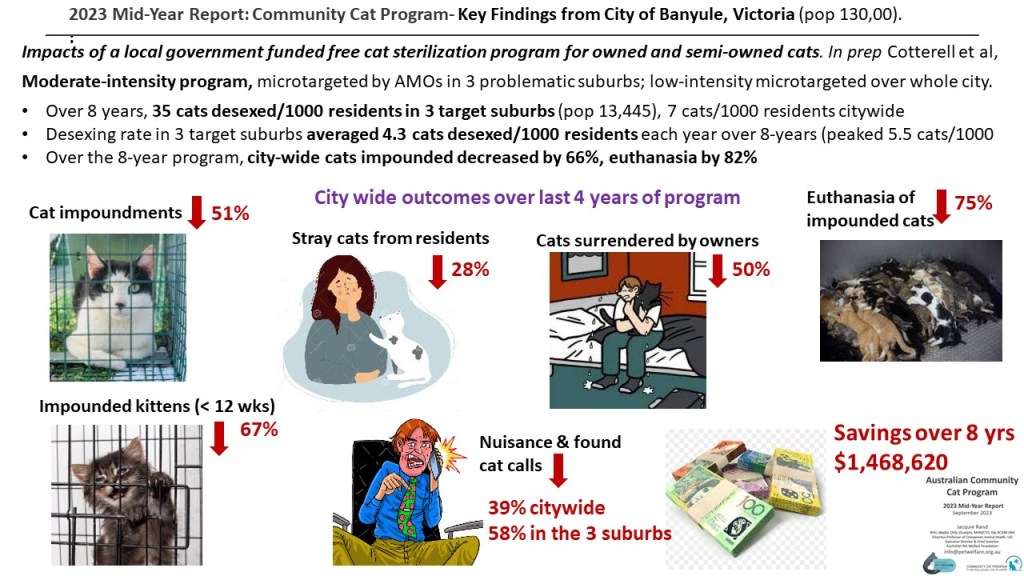
Banyule Council Victoria

The achievements at Banyule were raised in a separate blog item October 2020, which we have included in the Referenced Sources.

As an Animal Management Officer, Jenny saw firsthand the flood of kittens being born and quite often abandoned. As many rescue groups were full, it left no options with the council at the time other than to euthanase.

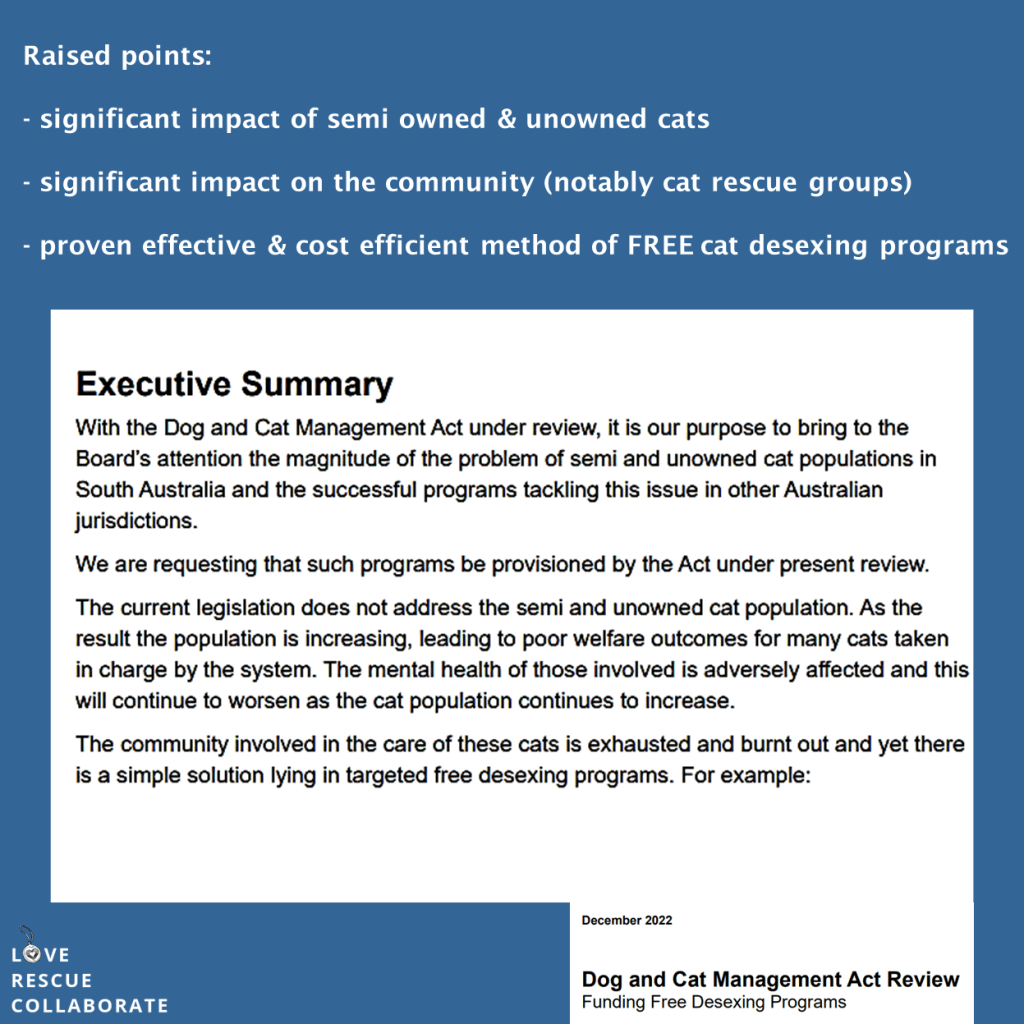
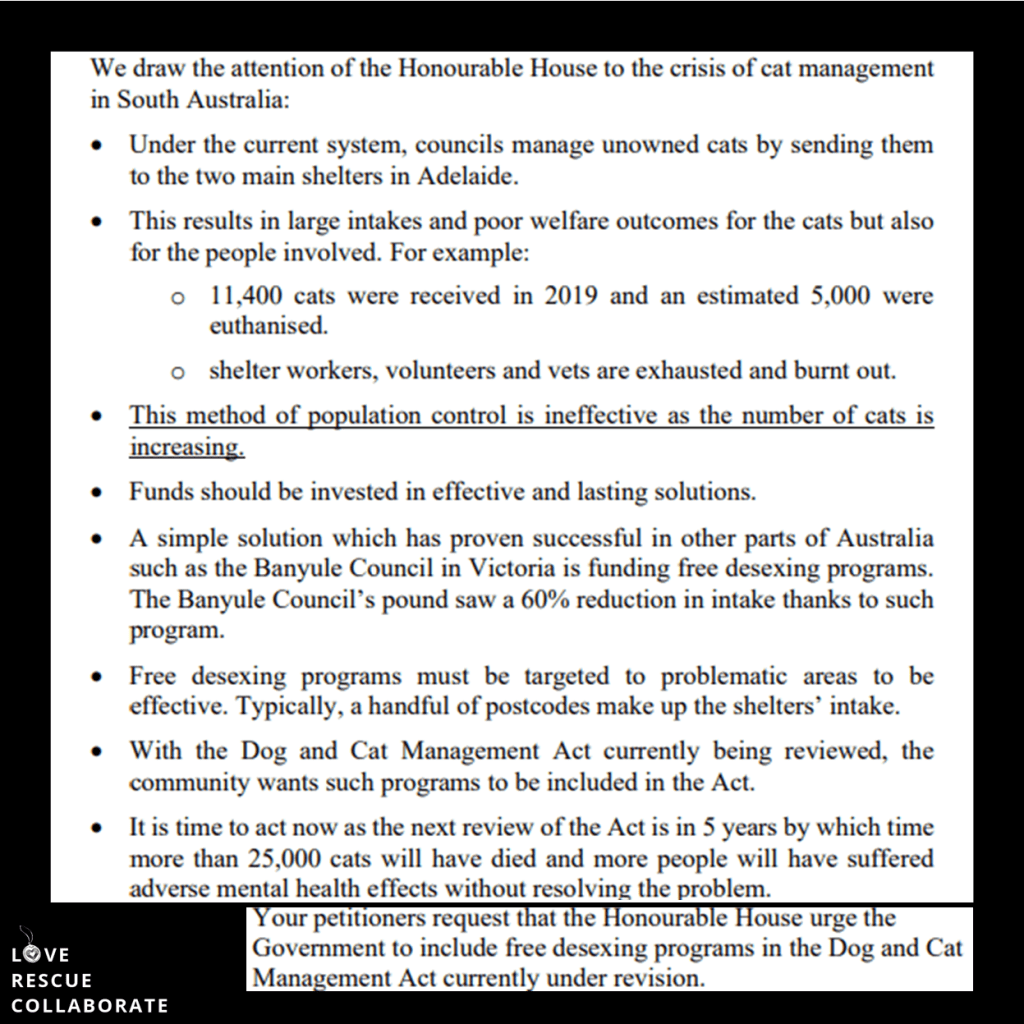
Since 2013 Banyule council has been subsiding free desexing for cats in “hotspots”. The program has been highly successful in reducing the number of abandoned cats and kittens; and reducing the number of complaints made to council in relation to roaming cats.

The yearly program has been provided a more valuable outcome, than the alternative of the council pound dealing with more surrenders, the costs of euthanasia and the emotion and mental stress for the Animal Management Officers, pound staff and vets. The Banyule council example is referenced in studies, and available to other Australian councils.

Onkaparinga Council in SA

In 2020, Onkaparinga announced a two year program to desex 2,000 cats.  The council is currently half way through their targets, ie they have desexed aaround 1,000 cats.

The press release at the time included some very powerful views on the expected success. We have included the original press release in Referenced Sources below.

The Mayor, Erin Thompson expressed key views, including:

  • Increasing desexing rates deliver the biggest benefits for cat management outcomes
  • The number of unwanted litters of kittens were creating problems
  • It was estimated thousands of kittens and cats were surrendered to pounds and shelters each year
  • The council’s three focus areas are:  “desex, microchip and ‘indoors at night’ “
  • They are seeking outcomes which are “good for cats, it’s good for wildlife, and it’s good for neighbours”

Community Cat Program under the Australian Pet Welfare Foundation

This is a unique program in Australia from an organisation we consider a leading authority on what has worked and what hasn’t worked with cat management issues. 

Refer Referenced Sources for the webpage and the 2021 End-year progress report Community Cat Program document.

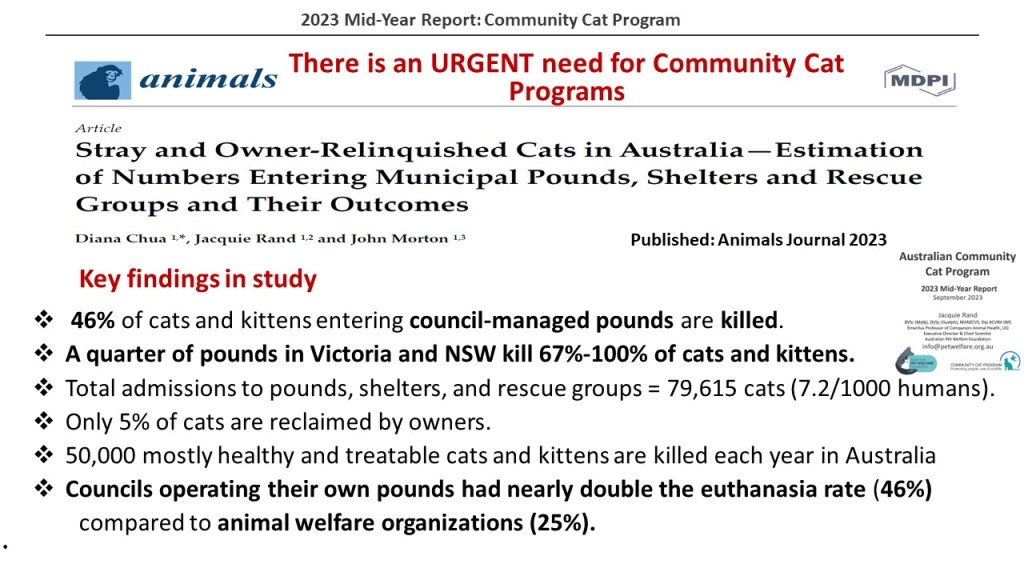
“Most of the animals currently euthanased in Australian shelters and pounds are stray cats from cities and towns. This is because how we currently manage them doesn’t reduce their numbers. It just leads to a constant cycle of breeding, impoundment, then euthanasia. More breeding, more impoundment, more euthanasia…”

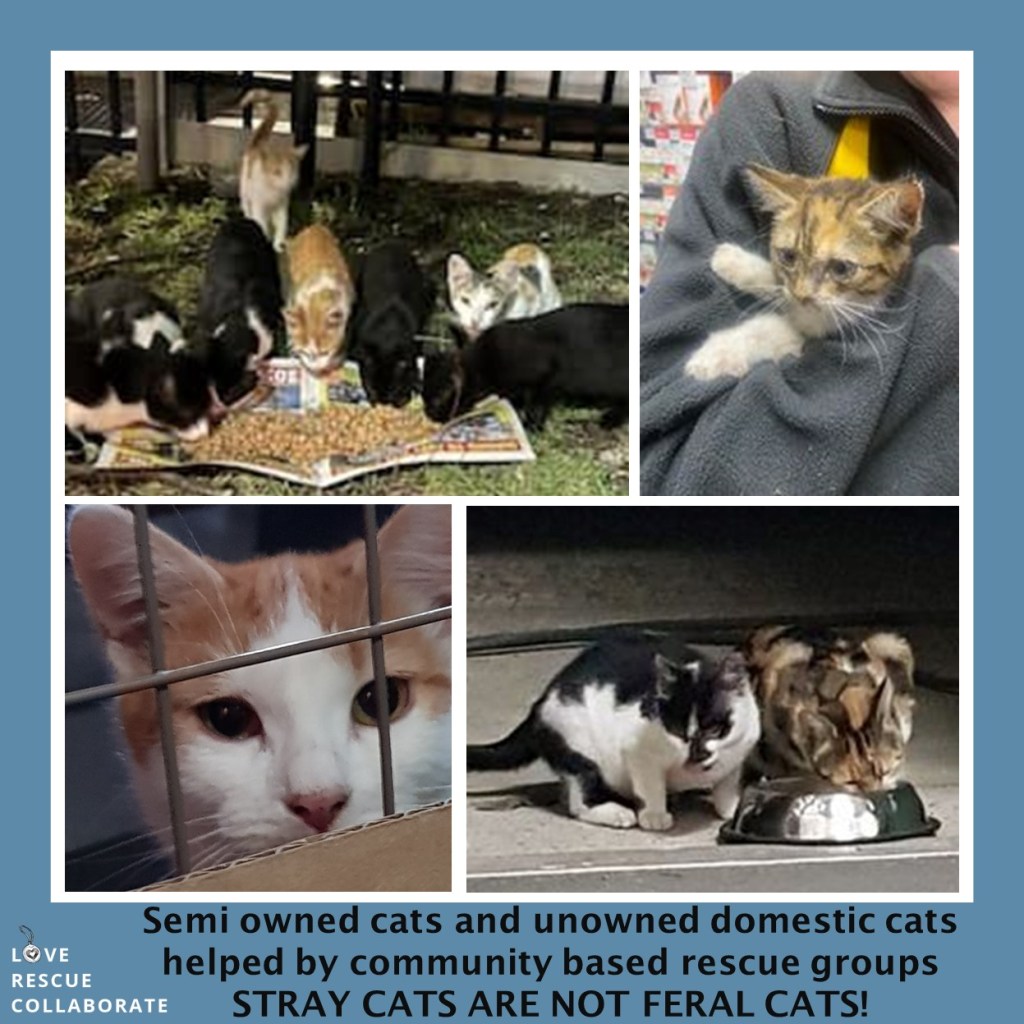
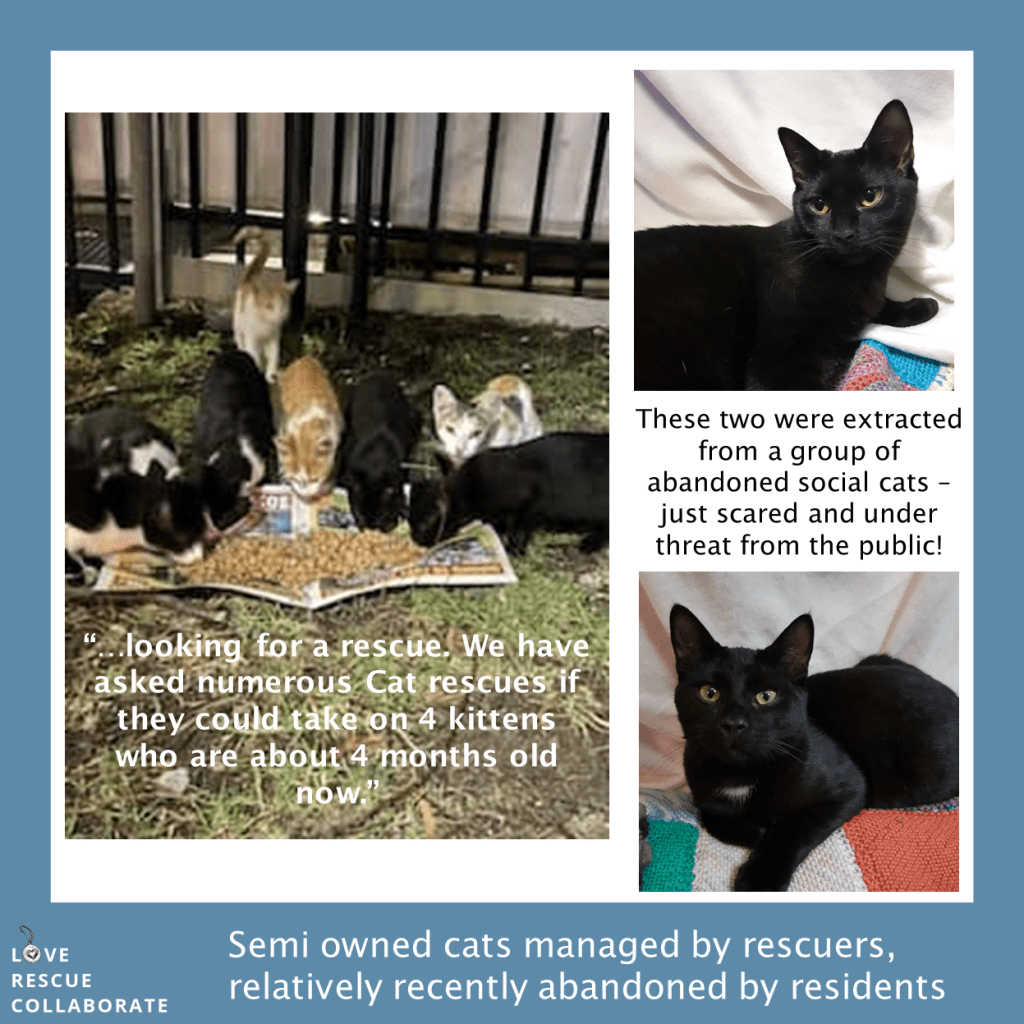
[Photo of undesexed cats c/o LRC Sydney based rescue group]

The APWF approach became an innovative five year trial, to utilise desexing as the main method for managing stray cats in urban areas.

The are several projects in a number of states under this program, and more detail is included in the APWF status report and includes:

Queensland (QLD)

Pilot program completed

Pilot extended to another area

Over 1,000 cats desexed

South Australia (SA)

Onkaparinga has desexed near 1,000 cats

Victoria (Vic)

Banyule Council benefits from some of the lowest figures in the state for impounding and euthanasia following years of intensive desexing in the local government area.

City of Greater Shepparton is ramping up with facility improvements for a high-volume cat surgery to begin high intensity desexing in targeted areas.

Section 4 “Project research aims and interim results” of the status report provides the findings and outcomes

It also includes summaries of related programs by Banyule and Onkaparinga councils, the National Desexing Network (NDN), and RSPCA.

In a nutshell, this program provides measurements showing that with intense desexing, there will be fewer cats being impounded and euthanased at council pounds.

With fewer cats breeding, there are fewer roaming cats and fewer complaints to council.

This also has a roll on benefit to carers, be they paid staff in council pounds or rescuers (ie carers) of community cats.

This may be common sense to many.

The Community Cat Program is providing the evidence.

Investing in high intensity desexing is a wise choice!

Referenced Sources:

https://www.alleycat.org/our-work/spayneuter/

https://www.onkaparingacity.com/Council/Media/Australias-largest-Cat-Desexing-Programme

Cat Rescue Groups: Compassion Fatigue and Pressure

Compassion Fatigue

While there has been research on compassion fatigue for professionals (paid workers with certified training etc.), there does not yet appear to be research relating to volunteers. However, it is to be expected that volunteers with cat rescue groups go through the same if not worse experiences, as cat rescuers have high empathy and are dedicating their spare time, labour, funds for the love of animals. Cat rescue individuals and groups experience both:

  • primary trauma in the form of mental, emotional and sometimes physical abuse from working in adverse, extreme and often dangerous environments (anecdotally cat rescue groups advise their female volunteers to only proceed into some metropolitan areas in groups of two or more as they have been physically threatened for helping and retrieving cats and kittens), and
  • secondary trauma due to frequently being involved with the trauma of unwanted cats (and sometimes their owners) in harsh conditions where many free roaming cats in ill health desperately need assistance, with the numbers ever increasing despite desexing as many as possible.

Generally, cat rescue groups do not have the resources, expertise or funds to proactively address compassion fatigue as do council pounds or large animal shelters. Cat rescue groups find it challenging to take sick leave, find backup staff/volunteers, or make time for training etc. Many operate under respectful conditions within their own groups. Yet engagement with the public may lead to verbal abuse in phone calls, emails or on social media, especially when needs to assist cats exceed the capacity for care.

Escalating Pressure on Cat Rescue Groups

Many rescue groups in NSW are finding it difficult to cope with the number of people requesting their support for stray unowned cats that are breeding.

Anecdotally, a small number of rescues in the Sydney Metropolitan area (who are not Rehoming Organisations) have provided the following feedback. From social media activity and feedback from several cat rescue groups, it appears that the number of people seeking help for cats from cat rescue groups is increasing.

  • There has been a noticeable increase in requests for help for semi-owned or unowned cats and kittens – estimates vary from 30% to much more – in forms of direct requests (phone, email, Facebook messages) and requests on social media on a number of Facebook group pages. Examples include:

“During kitten season 2020/2021 we peaked at 110 cats on board; an increase of over 30% on previous years.”

“We have seen a massive rise in street cat populations… we are seeing an increase of 40%.”

“Normally approx 30… the past 12 months 250” (re cats/kittens taken in per year).

 “We definitely are being hit up more to help cats and we cannot keep up and have to constantly say no – it’s heartbreaking.”

 “We also receive many calls for help and we are just not able to take any more cats on board. Whilst the huge increase in adoptions during Covid means many adoptions in that year, the fallout is that adoptions are now very slow and that means we are not taking on new cats as we usually would.”

“The pressure is extreme too” (pressure from requestors to rescuers for assistance with cats/kittens).

  • The “incoming” rate in colonies is increasing. In areas where unowned cats congregate (most often on private property and less often around schools, hospitals, aged care facilities, government housing and in parks or light industrial areas), referred to as colonies, new cats continue to be “found” at a more rapid rate than previously. This is beyond new kittens being born to cats in managed colonies because these cats have often been desexed. Examples include:

“Everyone we know caring for a colony is reporting new cats arriving in their colonies very regularly; possibly weekly to monthly. There is a high level of frustration that the desexing of these colonies never ends. The colony carers think they have their colony desexed and they find a few more undesexed cats have turned up.”

 “So many new colonies springing up everywhere”

“…we are so pressured with activities for trap/desex and advise mostly locally.”

  • There has been a significant increase in the number of cats surrendered or abandoned (i.e. socialised cats found without an owner in a yard, street, school, park etc.) who are either pregnant females or females with a litter of kittens. Examples include:

“15 years ago mostly we rescued young kittens from unsocialised mums and desexed the mums… In rescue we say each kitten season is worse than the year before but 3 years ago I was utterly shocked at what appeared to be a huge increase in friendly stray numbers. In the last 3 years we have probably doubled the number of very pregnant or lactating mums we have taken on each spring/summer.”

“In the last few years we have received many more requests for subsidised desexing vouchers than previously; especially during Covid as people reported financial stress. Many more people are finding a stray cat or kitten and willing to keep them if they can have some financial help with the vet work. Sadly, because we have so many more cats on board and also the fact that our per cat costs have increased A LOT especially when you take into account the $80 late desexing fee, we have not been able to issue many vouchers this year.”

“We work closely with trappers/colony feeders and the number of community members not desexing then dumping their undesexed cats before or after they have babies is absolutely appalling. We are possibly talking thousands of these cats dumped each year and most of them are breeding.”

“I understand the intention of the ‘Annual permit’ is to encourage people to desex before their first litter, but people who don’t desex their pets don’t microchip anyway.”

 “…once people find out the ramifications of chipping their cats they won’t do it.”

  • There has been a noticeable increase in illness amongst the cats abandoned (unowned or semi-owned cats), either in more cats being ill or more virulent forms of illnesses. Examples include:

“As the number of stray cats has increased over the years, so has the deterioration in their health. As a very experienced carer with a wonderful network of vets, I am getting increasingly frustrated at how much harder it is now to stabilise the health of the kittens/cats and transform them into healthy, robust felines. We are seeing more deformities in the last 3 to 5 years than ever before and other afflictions such as ringworm and the herpes virus are more bombastic and harder to treat. This means the cats are having to stay in care longer as we battle to get them healthy so they can have their vet work and be adopted and it also means they are costing us more money.”

“We are seeing a horrible number of starving and sick cats on the streets now. We are seeing more congenital deformities. In previous years, perhaps we would have 1 cat test FIV positive a year. This year we have had THREE of our mums test positive. This also impacts the number of cats we can rescue as FIV positive cats are very hard to adopt.”

“…in the past two years we have seen a severe increase in ringworm… Cat flu also seems to be more virulent and we do often find dead kittens and we have had more cats with congenital eye issues come onboard “

  • Small rescues are being asked more often to assist vets, businesses and council pounds in taking on the “harder” cases involving ill cats/kittens that need more resources than a business-run facility can take on (based on costs decisions). Examples include:

“…we have also extended our intakes to take strays surrendered to the pound and take strays surrendered to vet practices. We are taking more and more from various vets, even vets we don’t partner with who are just desperate.”

“…now finding more requests more often on social media from “friends of” groups for pounds looking for “rescues only” to assist with ill kittens and cats.”

“We find we are called out more and more to … businesses where the people have no tolerance for the cats.”

NSW Cat Rescue Groups

Our view on cat rescue groups provided here, sets out information and experiences with groups across the Sydney metropolitan area, regional areas, and cat rescues in other states and territories.

There are many misconceptions / misunderstandings of cat rescue groups, and others, involved with the care of urban cats.

This information has been provided to include insights into the value delivered by these individuals and teams. Cat rescue groups are key stakeholders involved with addressing the issues with unwanted and homeless cats. They contribute significantly to desexing cats, and limiting the birth of kittens.

Value of responsible cat rescue groups

There are hundreds of cat rescue groups operating across NSW, ranging from individuals through to complex teams of 30 or more who rehome once abandoned or homeless cats and kittens. These groups operate under a rescue identity (group name) and not under personal names, and house their cats on their own private properties, e.g. foster carer properties.

They are collectively rehoming, microchipping, desexing and registering thousands of cats across NSW each year. Doing “the right thing” as new cat owners, due to their compassion for animals.

Only some councils recognise the efforts of cat rescue groups operating in their Local Government Area (LGA) and help these teams where possible. Anecdotally, each year some of the cat rescue groups are each spending over $50,000 on desexing assistance offered to the public for collectively desexing thousands of cats.

Who& what are cat rescue groups

They are responsible people who are saving cats directly rather than surrendering to council pounds and animal shelters, which may incur a surrender cost, are generally always at capacity, and have to euthanase healthy and treatable animals, based on capacity etc.

These groups are generally funded by the members of the group and through donations. They save council and shelter facilities resources and funds, collectively equating to saving ratepayers/ taxpayers hundreds of thousands of dollars each year.

Cat rescue groups are generally characterised by the following:

  • they operate under a rescue group identity and not personal names,
  • cats and kittens are housed in private properties,
  • they are responsible in terms of desexing, identifying with microchip, registering the cats and kittens in their care, and seeking appropriate vet care when needed,
  • with most if not all team members are volunteers,
  • each is generally small in terms of people power and geographical area they support eg from 3 to 30 foster carers, across one or many Local Government Areas (LGAs),

  • many of their volunteers have
    • professional careers usually in other fields of specialist expertise, while some are retired individuals,
    • had experience either working or volunteering with council pounds, the large animal shelters, vets,
    • completed formal studies with certificates/ accreditation, or have gained extensive practical cat care over decades,
  • where a small proportion are “newbies” being motivated by their love and care for abandoned cats,
  • with few people able to spend the time and effort in meeting intensive administration obligations,
  • often seen as more merciful with lower cat euthanasia rates than council pounds and large animal shelters.

Management structures

  • some rescues are registered charities
  • some rescues are not-for-profit businesses
  • mostly run independently from council pounds
  • have chosen not to be a Rehoming Organisation registered with the NSW Office of Local Government (OLG)
    • as they take in cats and kittens directly from the public or found abandoned on the streets or other urban areas, which in the past has not been condoned under the NSW government’s obligations

Their network relationships vary with vets, councils, pounds and other rescue groups, and are usually reliant on historical personal relationships, being in close geographical areas, working collaboratively on complex or demanding rescues, and/or providing similar services.

Anecdotally, there are a few people claiming to be rescuers who do not act responsibly or not in the best interests of the animals,  generally, these individuals or groups are not respected by rescue groups and are not provided with assistance unless the animals are in mortal danger.

Rescues transitioning to enabling others

  • In recent years, as the need for helping abandoned cats has anecdotally increased with “explosions of breeding in hotspots”, small rescue groups are becoming overwhelmed year round, not just during the summer breeding season.
  • Some cat rescue groups are expanding their services to enable those inexperienced in the community to “DIY” rescue and rehoming, providing practical advice, references to other organisations who may help with resources, offering their own desexing vouchers, food, standard flea and worming treatments, assistance with vet bills, and even lending equipment.
  • Desexing vouchers or similar forms of such assistance are becoming more prevalent with cat rescue groups, who are not able to provide a shelter or enough foster homes for all the cats in need.

Management Structures & Funding

Only some councils recognise the individuals and groups who are seen performing responsible cat rescue and completing the government obligations including microchipping, desexing and registration. These cat rescue groups are not so easily seen by the NSW government.

Some rescue groups are charities and meet the Australian Charities and Not-for-profit Commission obligations for reporting. This includes operating Annual General Meetings and reporting etc to members.

Some rescue groups are Not-for-profit and registered with ABNs, and meet the Australian Tax Office obligations for reporting. Their success rates are generally shared on their own webpages or social media communications.

The funding for these initiatives currently is being provided by cat lovers. Some groups are able to fund most of the costs involved with desexing, vaccination, microchipping, and registration from adoption fees (around $200 – $250 per kitten/cat).

However, the adoption fee usually does not cover weekly care (food, kitty litter, housing in the form of rent, electricity etc.), multiple standard flea and worming treatments which may be required for years for long term cats in care, or any additional medical treatments: vet consults or procedures, antibiotics, medications for common illness (e.g. cat flu or ringworm), or extensive illness or injuries, especially those requiring surgery.

Please support cat rescue groups!

NSW Obligations for Pet Owners

The NSW Companion Animal (CA) Act and the CA Regulations should be reviewed by every pet owner. In addition, your local council webpage should be checked for refinements and additions, as these can be different from one Local Government Area (LGA) to another.

Unfortunately while some conditions in the CA Act and Regulations are straight forward, there are complexities “lurking” that may even challenge a legal advisor.

The NSW Government places obligations on cat owners, including to ensure they complete for their kitten/cat: 

Identification including microchipping with the cat’s & owner’s details submitted before 12 weeks of age or being sold/transferred/given to a new owner,

Desexing before 4 months of age, related to the Annual Permit for owning a cat not desexed or not arranging for your cat to be desexed before 4 months of age.

Registration before 6 months of age with a one off lifetime pet registration $fee, and related to desexing and Annual Permit fee being triggered.

The CA Act includes that registration should occur before a cat reaches 6 months of age.

The CA Regulations include that registration should occur before a cat reaches 12 weeks of age.

In practice, the NSW government communicates that 6 months is the threshold.

Various exemptions and grace periods exist in the Companion Animals Act & Regulations including for:

  • cats from council pounds, RSPCA, AWL NSW, CPS, & Rehoming Organisations’ cats taken in from council pounds;
  • pensioners and others on social welfare as cat owners;
  • cats for whom vets have provided in writing confirmation of medical issues which will delay desexing, and
  • breeders.

RESOURCE LINKS

NSW Companion Animal Act, including exemptions https://legislation.nsw.gov.au/view/html/inforce/current/act-1998-087

NSW Companion Animal Regulations, including exemptions https://legislation.nsw.gov.au/view/html/inforce/current/sl-2018-0441

NSW OLG re the $80 fee for an annual permit for undesexed cats, including those not desexed before 4 months of age

https://www.olg.nsw.gov.au/councils/responsible-pet-ownership/nsw-pet-registry/annual-permits/

NSW OLG FAQs for the introduction of annual permits for non-desexed cats  https://www.olg.nsw.gov.au/wp-content/uploads/2020/05/CA-Annual-permits-faq.pdf