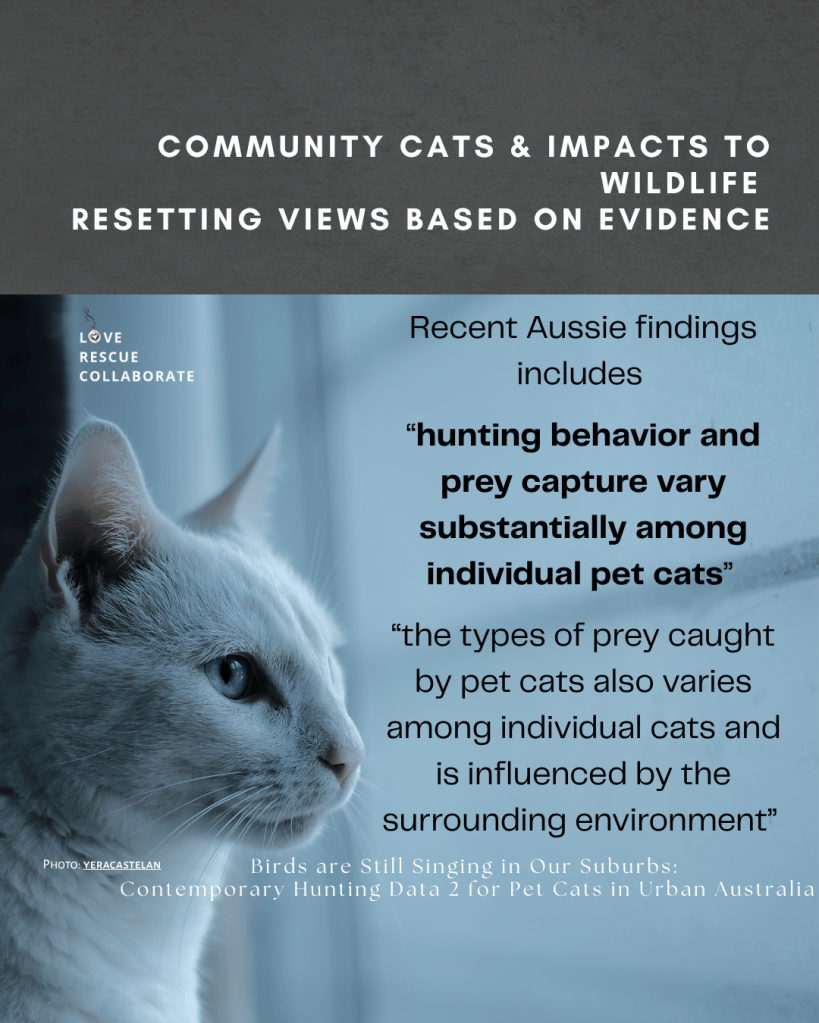
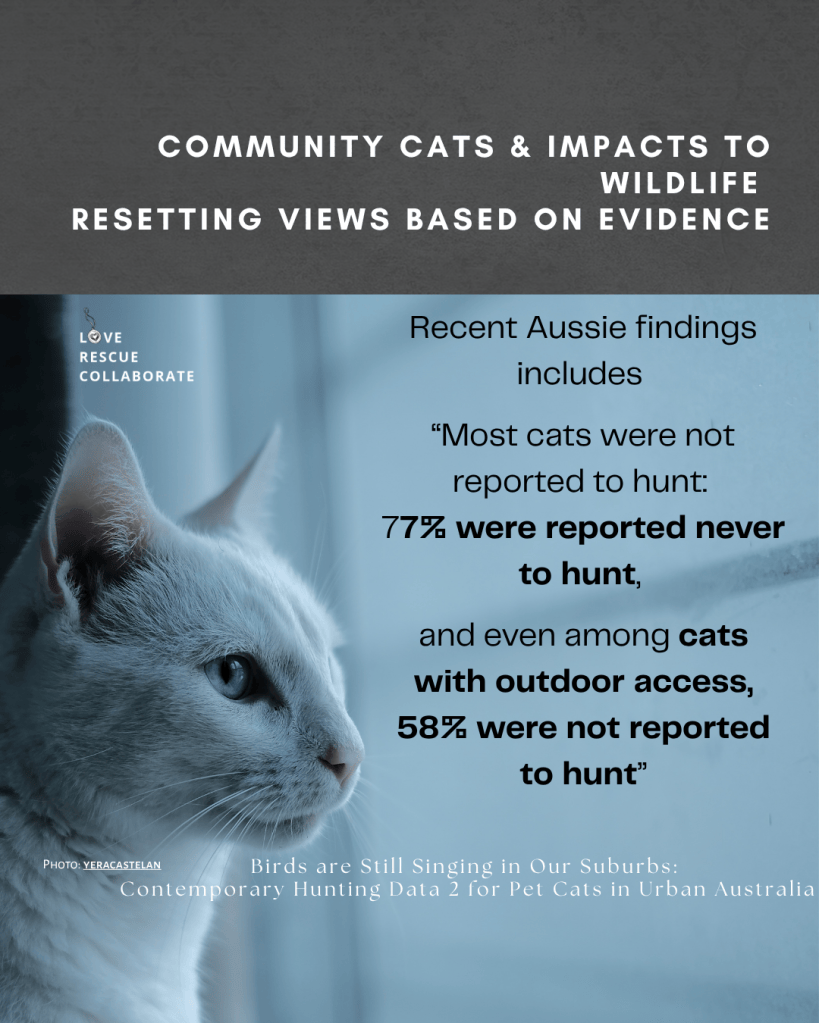
This post briefly summarises the overstated impact of domestic cats in Australia, and what does help in managing, feeding and sterilising domestic roaming cats to reduce impacts to wildlife in cities and towns, i.e. urban and peri urban areas. We rely on research, studies and reports from experts.
Invasive Species Council lobby group and cohorts continue to blur the lines between feral cat impacts and domestic cat impacts, In the past the ISC estimated numbers of native animals impacted by cats has been flawed and overestimated. The latter proven in questions of the old base data, from limited sources, layers of estimates which for the Sydney metropolitan area actually exceed the number of available native animals, animals impacted by a range of threats/ causes.
Brief video for community cats: resetting views on impacts and the benefits of managing, feeding and desexing (sterilisation) for reducing impacts to wildlife
Evaluating the Effects of Managed Free-Roaming Cat Populations on Prey Through Stable Isotope Analysis: A Pilot Study from British Columbia, Canada https://www.mdpi.com/2076-2615/15/21/3204?
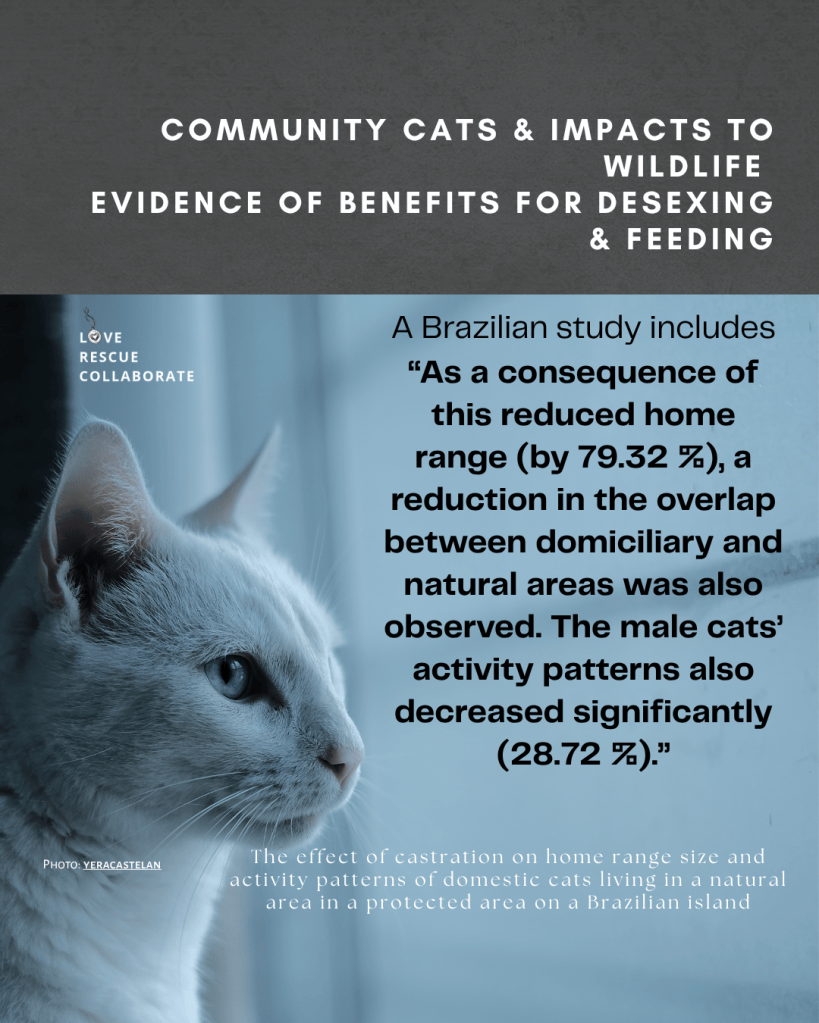
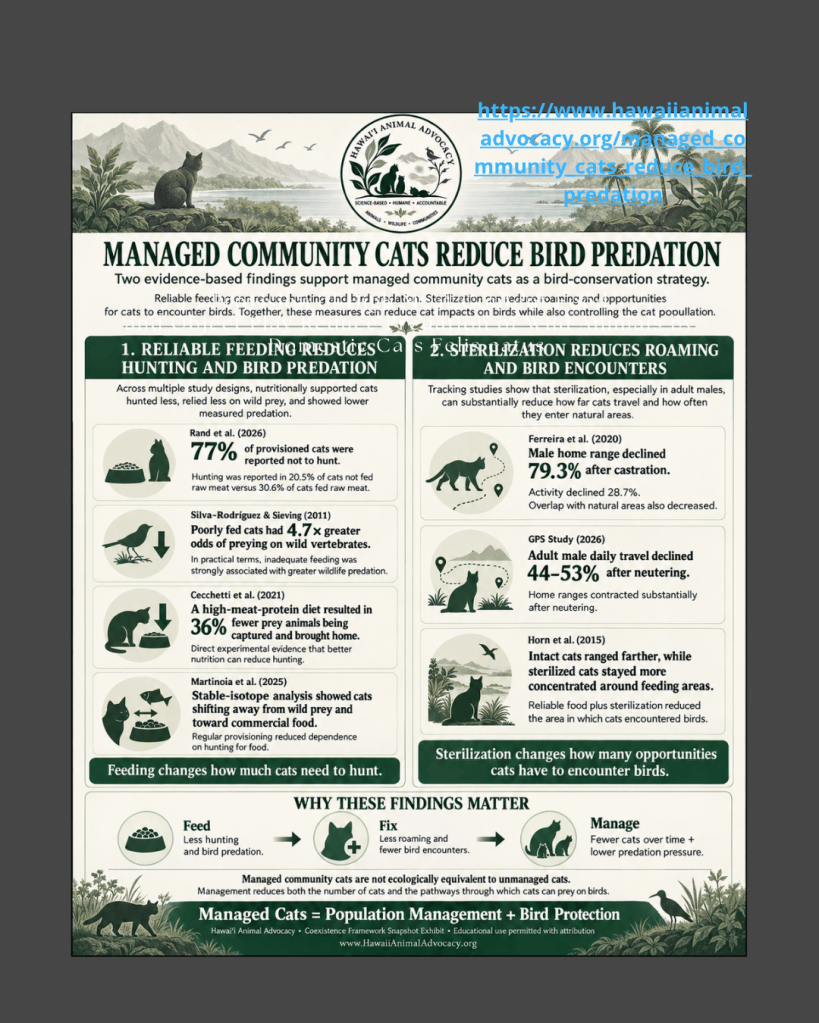
The effect of castration on home range size and activity patterns of domestic cats living in a natural area in a protected area on a Brazilian island https://www.mdpi.com/2076-2615/15/21/3204?
Recently published findings from analysis completed in an Australian suburban area, highlight that many pet cats do not hunt and for those that do, there is likely much less an impact on wildlife than we have been led to believe. These published findings are more robust and reliable than previous decades old data and assumptions that have been used for claims of extreme impacts. The context of the impact of pet cats on wildlife needs to consider other contributing factors that arise from urbanisation, and be practical in terms of the wildlife that exists in these areas.
We seek more reasonable conversations and One Welfare solutions for proactively increasing pet cat containment and addressing issues of abandoned cats through initiatives for cats to stay with their owners.
Birds are Still Singing in Our Suburbs: Contemporary Hunting Data for Pet Cats in Urban Australia recently published study
LRC videos include highlights with quotes, we encourage people to read the report when it is published.
LRC video of key highlights of the published findings of the Birds are still singing in our suburbs
The birds are still singing in our suburbs
Valuable quotes from the study
We strongly suggest everyone views the complete study document. Here’s our selection of a small number of valuable quotes. We recommend if copying these you recognise the authors and/or link to the study source and ensure you respect copyright and intellectual property.
From the Abstract single paragraph, we have included key points of interest and “spaced” these.
“Our study analyzed questionnaire data from 2,405 owned and semi-owned cats enrolled in a community sterilization program in lower-income suburbs of Ipswich, Queensland, between 2022 and 2025. Questionnaire completion was required for enrolment, reducing self-selection based specifically on an interest in cat hunting or wildlife.”
“Of 2,392 cats with hunting information, 77% were reported never to hunt and 23% to hunt sometimes or often. Even among cats with outdoor access, 58% were not reported to hunt. Among cats reported to catch prey, insects and rodents were most common, while bird captures were least common and generally low in number.”
“National predation estimates were calculated using observed hunting prevalence, prey composition and prey counts observed in this study population, with published correction factors applied for prey not observed by owners.”
“Median-based estimates were 0.38 million birds, 3.29 million mammals and 4.07 million reptiles annually, and for birds, the estimated rate averaged across all cats (hunters and non-hunters) was 0.10 birds per cat per year.”
“Our estimates for birds were 161 to 311 times lower than previously published Australian estimates, which exceed the estimated urban bird population of 11 million and annual turnover of approximately 3.6 million birds.”
“These findings demonstrate substantial variation in hunting behavior among pet cats, and show that national predation estimates are strongly influenced by the underlying data and assumptions used in extrapolation.”
From the Conclusion section, we found these partial quotes of most interest.
“…our findings challenge broad claims about the scale of pet cat predation in urban Australia and show that the impacts of pet cats in cities are context-dependent… interpreted alongside stronger drivers of wildlife outcomes in cities, including habitat quality and urbanization”
“Humane, evidence-based policy should therefore focus on practical, achievable measures such as sterilization and realistic containment support, rather than relying on outdated and generalized assumptions about all pet cats.”
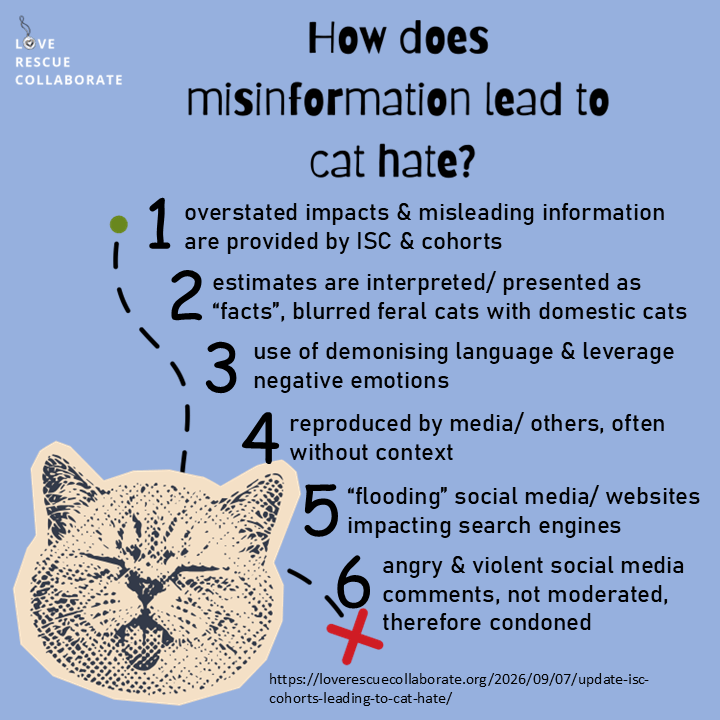
This post is an update on previous work capturing and showing the trail of Invasive Species misleading information on cat impacts through to social media expressions of cat hater, and cruel harm to cats and their carers & rescuers.
The trail starts with overstated impacts due to flaws in the calculations of estimates for domestic cats, based on dated studies and largely feral cat studies.
The detailed examples were captured over a year ago. There will be further updates of example in the near future as this approach to demonising cats can also be found in ISC approaches to other animals, such as our Aussie brumbies.
Based on scientific evidence from a number of domestic cat experts – references to research & experts follows.
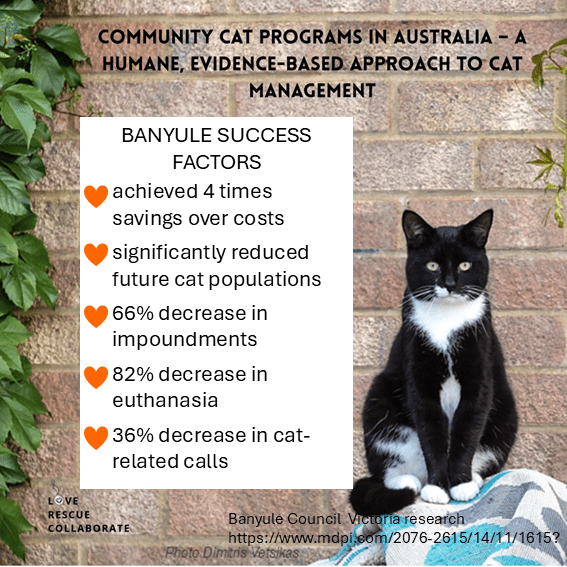
Urban Cat Management in Australia—Evidence-Based Strategies for Success: “Urban free-roaming cats present challenges like noise, urination, defecation, property damage, public health risks, and wildlife predation. Traditional enforcement methods, such as containment laws and impounding, are ineffective, especially in low-income areas, where many free-roaming cats live. These cats are often cared for by “semi-owners”, who feed them without formal ownership. Financial barriers to sterilization for owned and semi-owned cats in these areas result in unplanned litters, sustaining the free-roaming population and burdening local authorities and animal welfare organizations. Cats causing complaints are frequently impounded and euthanized, affecting the mental health of veterinary, shelter, and council staff. This paper critiques punitive, compliance-driven strategies and highlights the success of assistive Community Cat Programs offering free sterilization, microchipping, and registration. In Banyule, Victoria, such a program reduced cat impoundments by 66%, euthanasia by 82%, and complaints by 36% between 2013 and 2021. Two other programs in large cities and rural towns in NSW and a rural town in Queensland have now reported similar results. Based on the One Welfare framework, these programs address the interconnectedness of animal welfare, human well-being, and environmental health. By removing financial barriers, they build trust between authorities and caregivers, improving compliance and welfare for cats, communities, and wildlife. However, following the loss of key program staff and the reintroduction of financial barriers in Banyule, cat intake rose by 140% between 2022 and 2024, demonstrating the detrimental impact of financial barriers and punitive approaches. This underscores the importance of sustained, community-based solutions and legislative reforms that prioritize humane, barrier-free strategies. Understanding the critical success factors for Community Cat Programs is essential for effective cat management.”
Most effective management of cat populations
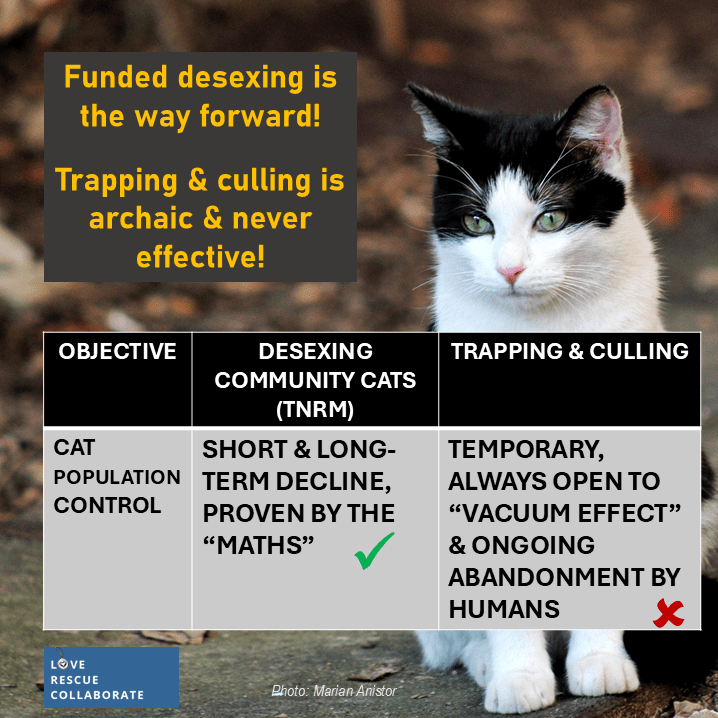
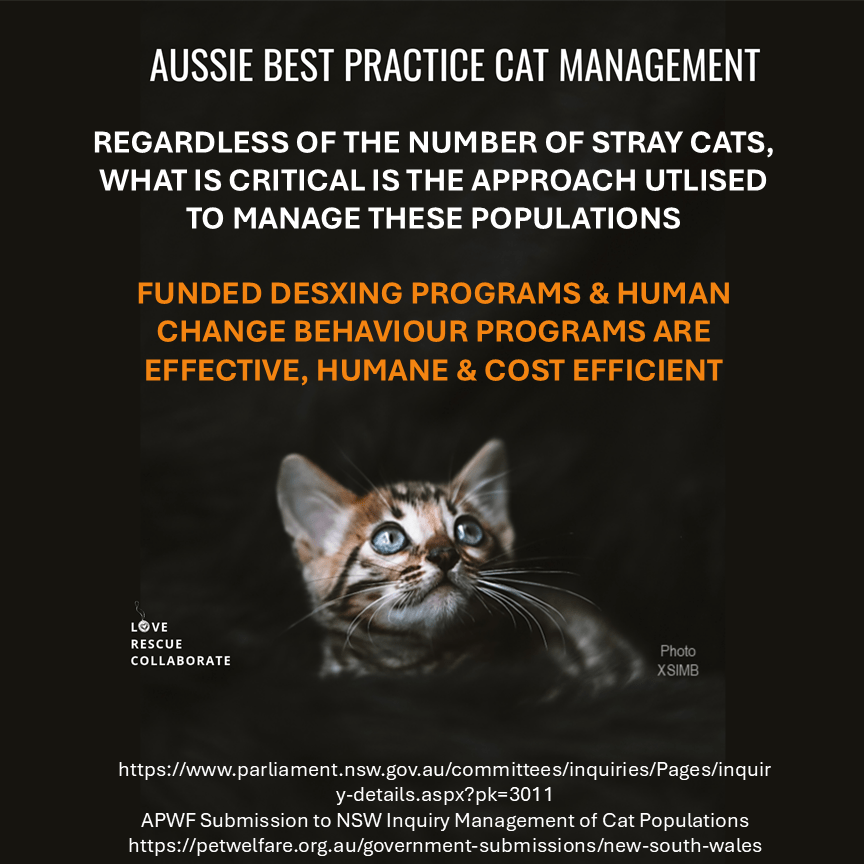
Funded desexing or sterilisation programs have been proven effective in Australia and other countries.
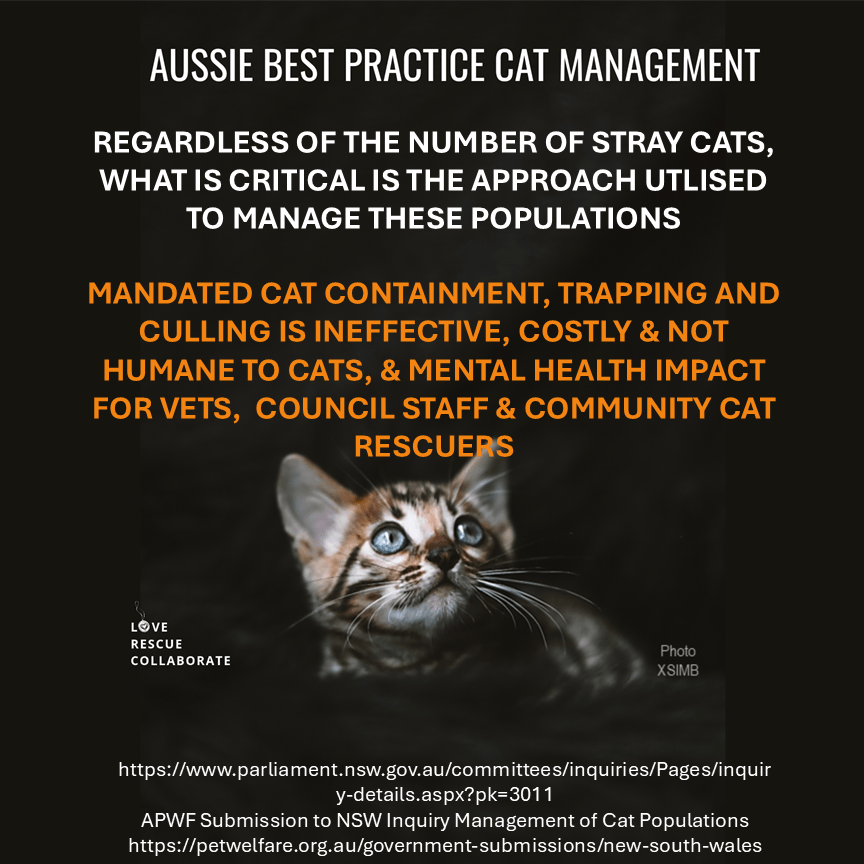
Trapping and culling is considered inhuman, costly and is not a long-term solutions due to the vacuum effect.
Ally Cats: “What is the Vacuum Effect and What Does It Have To Do with Cats? The Vacuum Effect occurs when a portion of an animal population is permanently removed from their home range. These animals may have been killed or removed by people, a natural disaster, or any other means. The result is a temporary dip in population levels.
To be clear, any such population dip will only be temporary. The initial population lived in that location because there were resources such as shelter, food, and water. Once emptied, this still resource-rich habitat, the vacuum, inevitably attracts other members of the same species from neighboring areas. They move in to use the same resources that sustained the first group.”
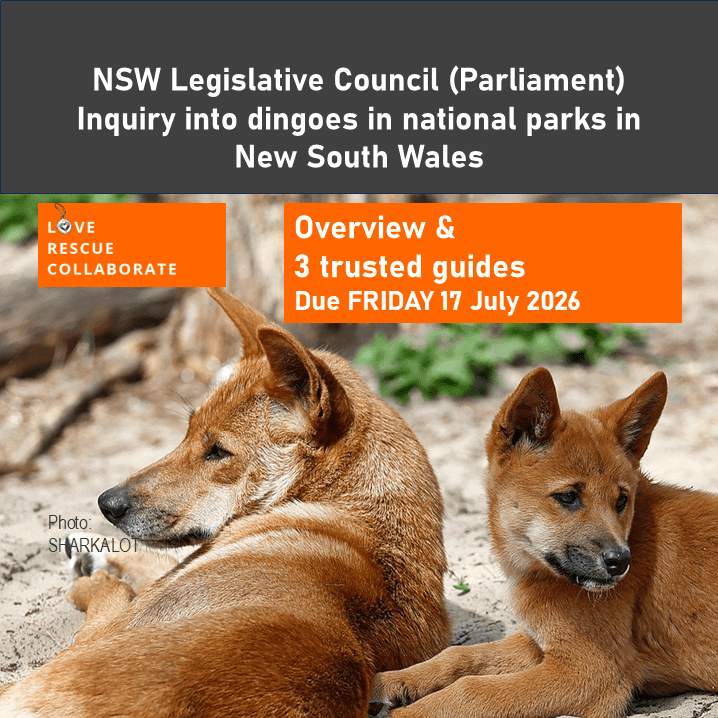
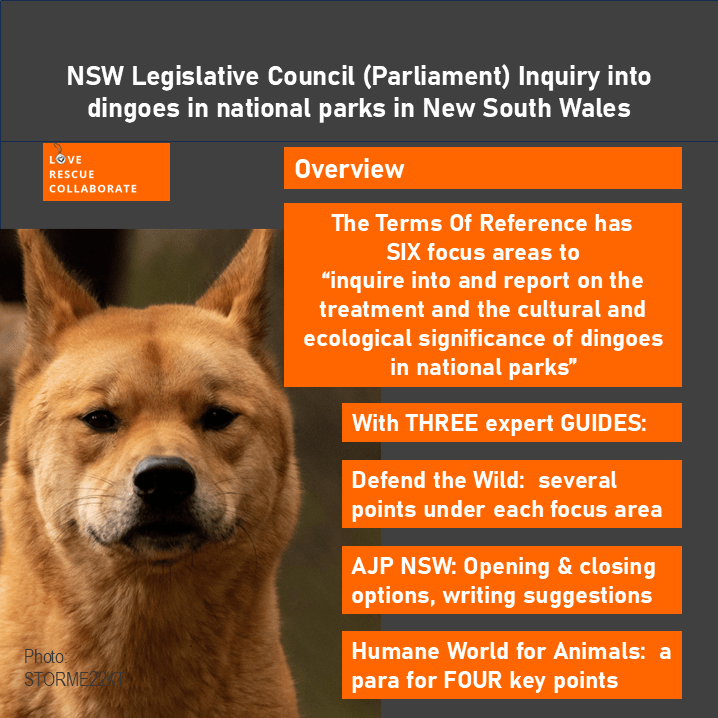
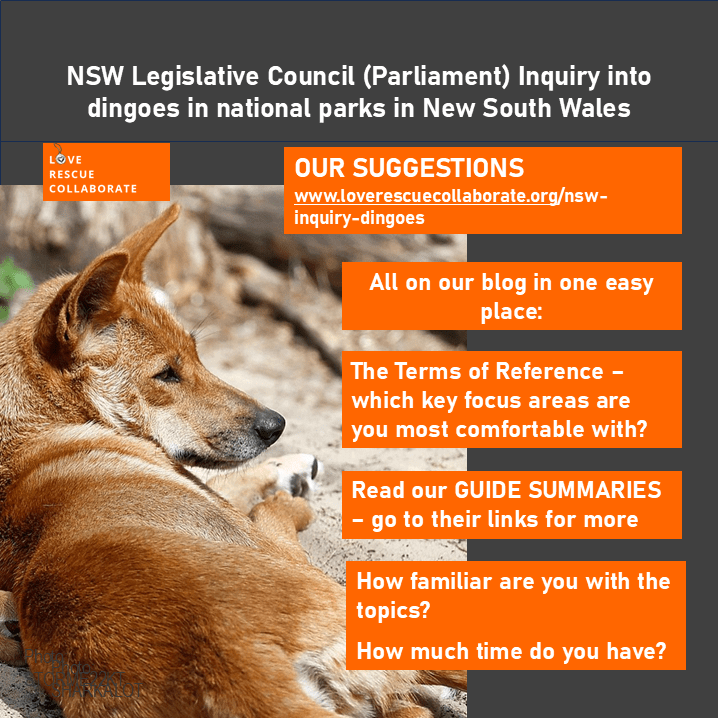
NSW Legislative Council (Parliament): Inquiry into dingoes in national parks in New South Wales originally due 17 July 2026 this was extended to Tuesday 21st. The LRC team provide an overview with links to three guides from animal welfare experts.
Write just one short paragraph or write a document covering each of the key focus areas under the Terms of Reference.
Use the Submission contact form OR upload a separate document.
Individual submissions will be valued above proformas/ petitions, and AI responses if too many are look-a-likes to the original works of others.
The LRC team provides suggestions for producing your own submission. We provide summaries for
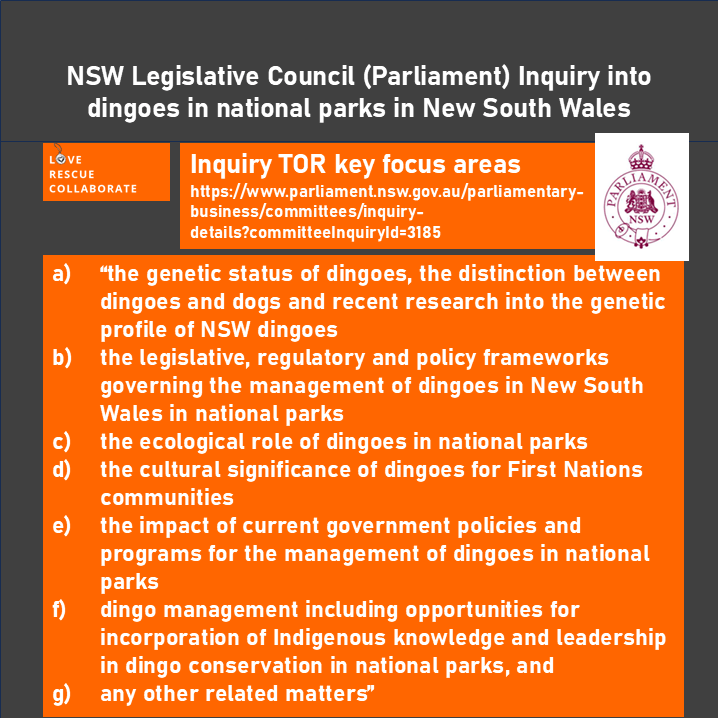
the Inquiry Terms of Reference objective and key focus areas
three expert guides, from Defend the Wild, the Animal Justice Party and the Humane World for Animals.
Scan through these (summaries below) to decide your familiarity with the concerns and recommendations, your preferred level of detail, then tailor a response based on your own writing style!
You do not need to be an expert! Anyone can send in a response, not just NSW residents.
Objective: “inquire into and report on the treatment and the cultural and ecological significance of dingoes in national parks in New South Wales”
Very easy to use, first comes your personal information, then the submission in one online form or an upload of a prepared document.
We always suggest you pre-write your submission, and retain a copy. Just send yourself an email if working on your mobile phone.
Defend the Wild
This is the most comprehensive guide. A wealth of information listed as points under each TOR key focus area, with more links to relevant detailed information.
You may just choose to just use their three main recommendations, and customise to your concerns and feelings.
We suggest you do not directly copy, and do not use AI to summarise / reword their detailed points – we believe this guide is likely to be a base for comparison of submissions.
Don’t miss the date cutoff!! by Tuesday 21 July (date extended from Friday 17th July).
Don’t feel you have to be an expert, there’s plenty of inspiration in the above guides, and you may do your own research (internet searches).
Plan ahead – schedule time in your diary 🙂 from 15 mins through an hour if you have that – there are SIX key focus areas if you can respond to all of these – however just completing one short paragraph will be valuable too!!
PLEASE WRITE IN YOU OWN STYLE/ WAY / “YOUR VOICE”
We suggest you create/ craft your own style/ format first for each of your concerns for example:
I am greatly concerned about (issue or risk) given (negative impacts/ outcomes for dingoes &/OR people).
I strongly recommend for (the government or authorities to take actions) as this will provide benefits (for the dingoes &/OR people).
In recent years, the Invasive Species Council & cohorts’ numbers on domestic cat-based wildlife impacts have been questioned by a number of animal welfare experts. There is strong support for our precious wildlife, we need to shift the focus on generalised overstated numbers to Australian local research based on scientific evidence, not predominantly on feral cats but on domestic cat research in Australian urban areas.
In that way, specific responses can be tailored for the best outcomes with value for money – this will provide more effective results in a rapid way.
We need to halt any approaches from demonising all cats including domestic cats in urban areas, and look at ethical, humane, effective and proven cat management practices.
Aligning the context of cats with bigger issues & risks for our wildlife
We need to humanely respond to the cat crisis with proven effective approaches and align with initiatives to protect wildlife.
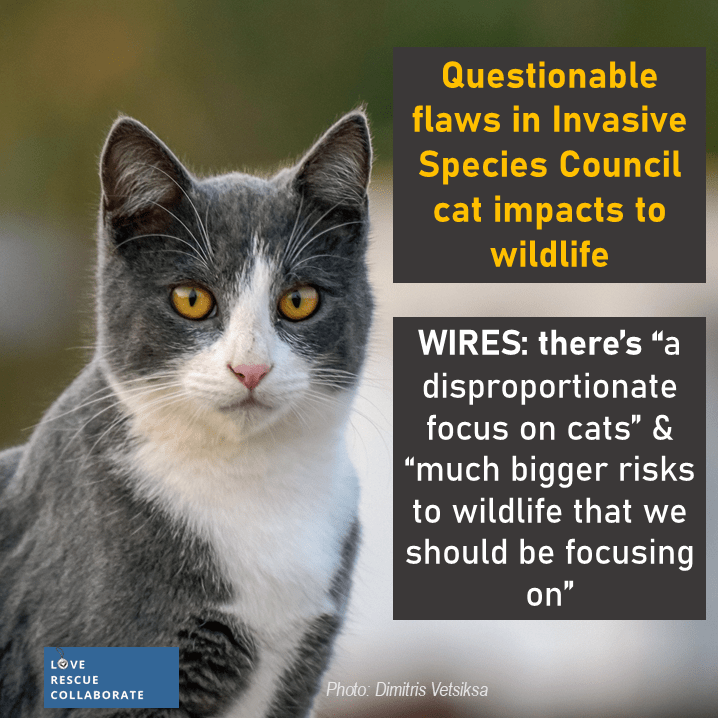
In 2024, Dr Colin Salter, Policy Lead, WIRES, at the hearings for the NSW Inquiry Management of Cat Populations included there is:
“much bigger risks to wildlife that we should be focusing on” “…the key threats to wildlife are habitat destruction and fragmentation… Roads bisecting habitat is a clear impact. Connectivity is probably one of the largest threats in New South Wales”
“a disproportionate focus on cats” “It’s easy go after something like cats. Technically, it’s an easier fix or it’s easier to be seen to be fixing it… Even though cats are a complex problem, climate change and habitat destruction are much larger and more significant”
“a very small number of calls coming through to WIRES in relation to harm caused by cats” “For the Greater Sydney area, we’re talking around 3 per cent of calls are related to cats. About half of that is the Sydney metropolitan area, the largest Sydney metro area.”
These views of a practical context of issues and risks for native animals/ wildlife are substantiated by the Australian national State of the Environment report, which includes the following.
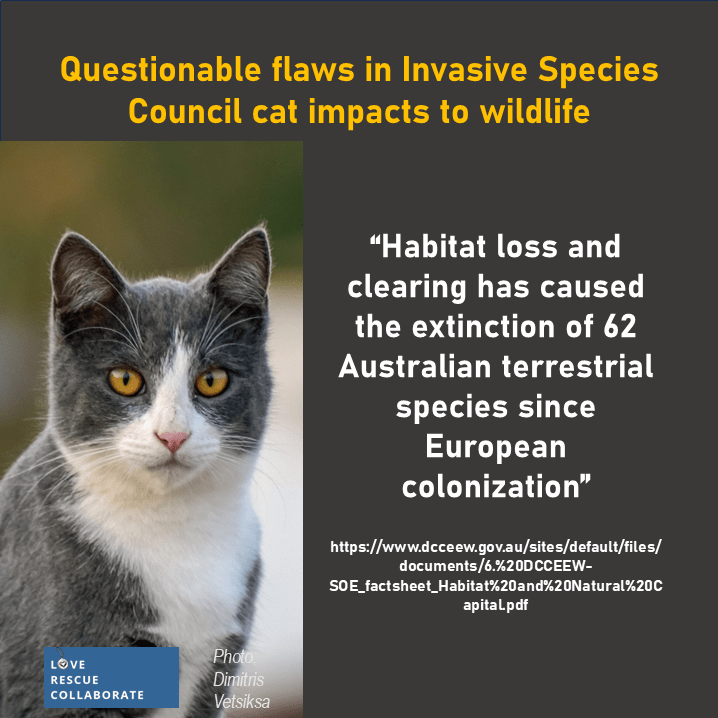
It has been recognised by our government that the biggest threat to wildlife is habitat loss most often due to land clearing for developments (Australia’s State of the Environment Report 2021). https://soe.dcceew.gov.au/biodiversity/key-findings
“Habitat loss and clearing has caused the extinction of 62 Australian terrestrial species since European colonisation… The state of the environment in Australia is deteriorating as a result of cumulative and increasing pressures from climate change, habitat loss, invasive species, pollution and resource extraction… We can expect many ecosystems to undergo sudden, unpredictable and often irreversible transitions to new states leading to biodiversity decline, erosion, loss of soil fertility and an increase in greenhouse gas emissions.” https://www.dcceew.gov.au/sites/default/files/documents/6.%20DCCEEW-SOE_factsheet_Habitat%20and%20Natural%20Capital.pdf
We recognise the issues for cats hunting, we seek a normalised priority and appropriate local responses for best outcomes for wildlife and cats.
APWF predominant flaws in ISC & cohorts’ studies
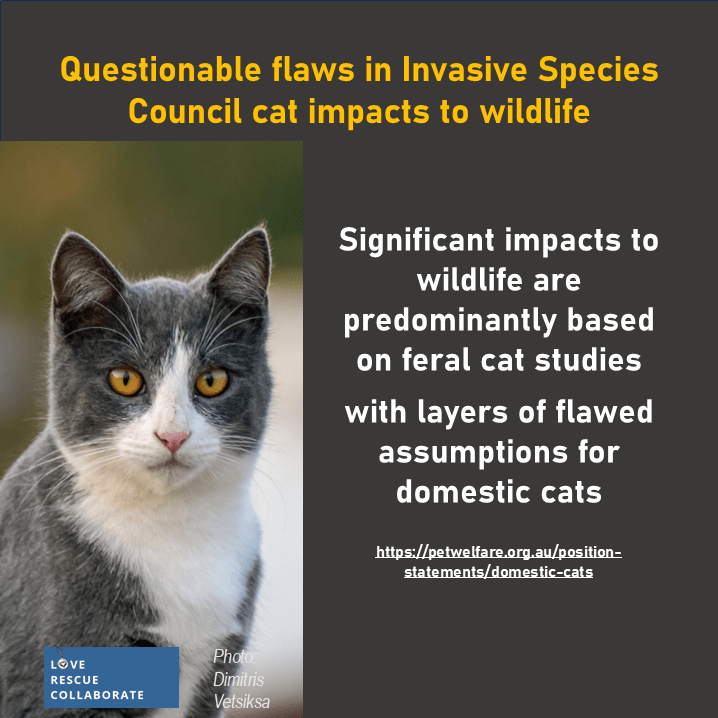
The Australian Pet Welfare Foundation position statement on cat impacts to wildlife provide valid insights based on research and scientific evidence, predominantly Australian and focused on domestic cats.
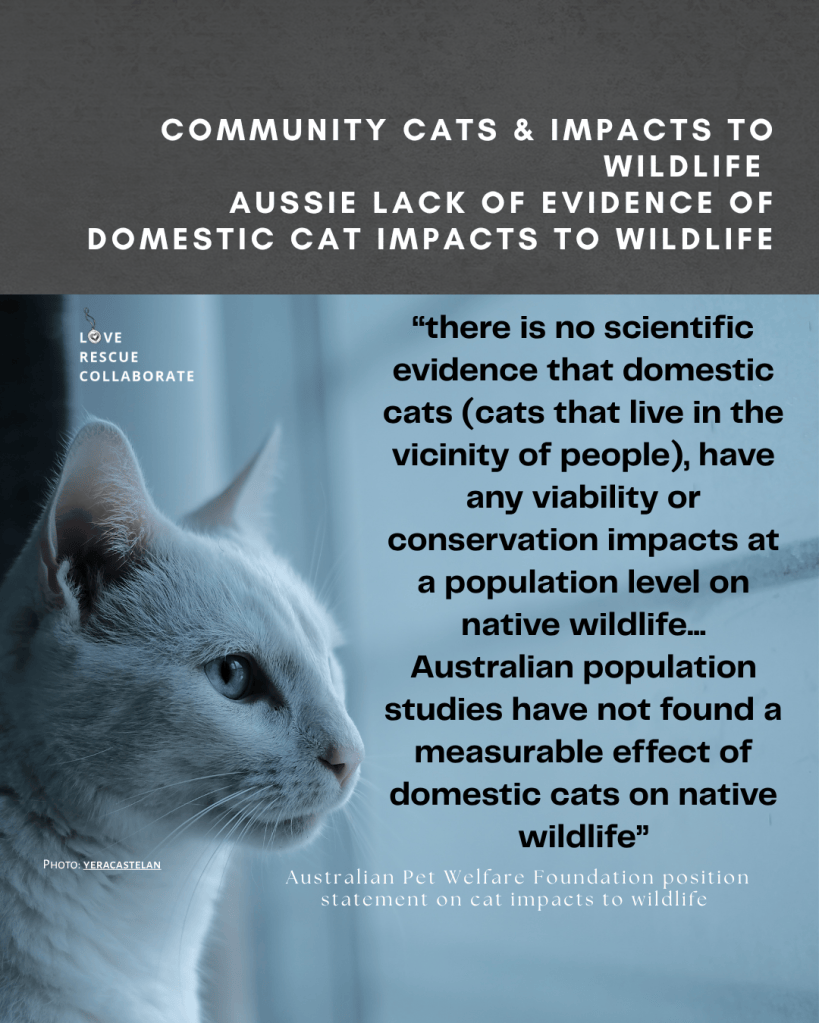
“While the impact of feral cats on Australian native wildlife populations in natural environments is well-documented, there is no scientific evidence that domestic cats (cats that live in the vicinity of people), have any viability or conservation impacts at a population level on native wildlife. In fact, Australian population studies have not found a measurable effect of domestic cats on native wildlife (Barratt 1998, Grayson 2007, Lilith 2010, Maclagan 2018).”
The APWF position statement is supported by an Issues data-based paper, and the most relevant information is contained in the section “Inaccurate estimates of domestic cat impacts on Australian native wildlife populations”.
“Highly publicised impacts of domestic cats on birds (Woinarski 2017), mammals (Murphy 2019), reptiles (Woinarski 2018) and amphibians (Woinarski 2020) are based on extrapolating the findings from stomach and faecal samples of feral cats and surveys of pet cat hunting behaviour.”
When the methods and data are assessed, the results appear with “highly inaccurate conclusions regarding implied population effects of domestic cats in urban areas”.
The issues paper includes assessments of flaws in ISC & cohorts’ studies on significant impacts to wildlife which are predominantly based on feral cat studies with layers of assumptions for domestic cats:
flawed & limited data collection
“the effects of stray cats are extrapolated from just 5 studies, 3 of which were from rubbish dumps in small rural towns, and the other two… only analysed stool samples that contained evidence of wildlife remains and excluded those that had evidence of cat food“
flawed calculations
“then calculated that all 0.7 million unowned cats living in highly modified environments (stray cats) predated similarly to those samples analysed… in no way representative of urban stray cats, the vast majority (>99.9%) are fed intentionally by humans (unpublished data from Australian Community Cat Program 2022)”
flawed study designs
the effects of pet cats were extrapolated from 25 to 30 year old studies of cats that were observed to predate… then assumed that all 3.88 million pet cats predated similarly… estimated that every pet cat, regardless of whether it was contained inside or never seen to predate, killed 15.6 birds a year… resulted in a gross overestimation of pet cat predation, given that many pet cats are confined solely inside, and not all cats predate, particularly older cats”
“then imply this data translates to a population effect… this is erroneous, because birds killed by cats in urban areas are significantly less healthy than birds killed by cars or flying into windows (Baker 2008, Møller & Erritzøe 2000), leading these authors to conclude that cat predation in urban areas represents a compensatory rather than an additive form of mortality… cat predation does not cause a secular change in the overall mortality of bird populations“
estimates & extrapolated estimates: do not represent evidence/ proof
“the inherent biases, inaccuracies, and limitations of the study design of these highly quoted studies by Woinarksi and Murphy mean that there can be little to no confidence in the implied population effects… actual Australian population studies have not found a measurable effect of domestic cats on urban wildlife“
“Barratt (1998), estimates of predation by house cats, particularly extrapolated estimates, should be treated with caution… estimates alone do not prove that prey populations are detrimentally affected, especially in highly disturbed and modified environments such as urban areas“
APWF Submission NSW Inquiry Management of Cat Populations
Response to TOR (a) The impact of cats on threatened native animals in metropolitan and regional settings (page 15) based on evidence based research includes:
“there is no scientific evidence that domestic cats (cats that live in the vicinity of people), have any viability or conservation impacts at a population level on native wildlife”
“Australian population studies have not found a measurable effect of domestic cats on native wildlife”
“feral cat impacts are often wrongly attributed to domestic cats, even though these are two distinct and geographically separate populations of cats with different behaviour and ecology”
“the estimates of pet and stray cat predation of wildlife are based on flawed theoretical calculations that assume all pet cats predate similarly, even if contained inside”
flawed assumptions that “stray cats being fed by people predate similarly to cats in rubbish dumps in small rural towns or in parks with bushland”
Study 1 “…pet cats did not negatively impact the species diversity or abundance of small and medium-sized mammals at these sites and that vegetation characteristics are likely more important. In addition, cat related by-laws, including prohibition of cat ownership, had no measurable benefits on wildlife.”
Study 2: “habitat destruction and degradation were the critical factors affecting richness of bird species, rather than cats or dogs”
Study 3: “hunting by domestic dogs and cats appears to be of relatively minor conservation concern compared with issues such as habitat loss and urban development”
Study 4: “Bandicoot abundance was higher at novel sites where cats were common, than at remnant sites (cats were uncommon), with the highest abundance at the novel site with the most urbanised surroundings”
Study 5: “Stray cats in urban areas are not a significant cause of native wildlife predation but predate introduced rodents”
Study 6: “There was no evidence that stray cats in a regional town were predating native wildlife to provide their energy needs but were predating introduced rodents.”
Highly inaccurate estimates of domestic cat impacts on Australian native wildlife populations (page 19) includes the numbers and methods are based on extrapolating findings from limited studies resulting “in highly inaccurate conclusions”
“the effects of domestic cats are extrapolated from just 5 studies”, 3 “were from rubbish dumps in small rural towns”, 2 “explicitly stated they only analysed stool samples that contained evidence of wildlife remains and excluded those that had evidence of cat food”
“calculated that all 0.7 million unowned cats living in highly modified environments (domestic cats) predated similarly to those samples analysed” and “results are in no way representative of urban domestic cats, the vast majority are fed intentionally by humans”
“the effects of pet cats were extrapolated from 25 to 40-year-old studies of cats that were observed to predate and… then assumed that all 3.88 million pet cats predated similarly… estimated that every pet cat, regardless of whether it was contained inside or never seen to predate, killed 15.6 birds a year”
resulting in “gross overestimation of pet cat predation” as “many pet cats are confined solely inside, and not all cats predate, particularly older cats”
Aussie research: Bella and Charlie Are Not the Problem – It’s Us: The Real Drivers of Wildlife Decline in NSW
Importantly for the current prominent perceptions of cat impacts to wildlife: “all animal attacks combined accounted for 4.4% of threatened species rescues; dog-related rescues were more than three times greater than cat-related rescues, with cat-related rescues comprising 0.6% of all threatened species rescues”.
The current strong public focus on cats and impacts to wildlife “risks diverting attention away from other more major and preventable impacts on wildlife in urban areas. These include habitat loss and fragmentation, vehicle collisions, extreme weather, and hazards linked to roads, buildings, and other human structures”.
Conclusion include:
Companion animal attacks were causing “a small proportion of rescues overall, with dog-related rescues more than three times as common as cat-related rescues”
Gains in conservation “are likely to come from preventing harm before it occurs and increasing survival through early intervention”
Prevention efforts should be focused “on the major human-related drivers identified in this study offers the strongest opportunity to reduce wildlife rescues and improve outcomes for threatened species and wildlife rescuers”
Acknowledging and responding to these factors and drivers “will be essential if conservation policy is to achieve meaningful reductions in threatened wildlife injury and mortality and protect human wellbeing.”
“Overall, threatened species most often entered care due to adverse weather events, unsuitable environment, hazardous materials, and vehicle collisions—suggesting that prevention efforts targeting these causes are likely to avert more harm than a primary focus on pet cats.”
Professor Jacquie Rand APWF @ the Australian Veterinarian Association Conference: Rethinking urban cat management
“…councils keep relying on trapping, impounding and euthanasia to deal with free-roaming cats”
Topic: overstated wildlife impacts
Issues with the main study that is often quoted by Invasive Species Council & others:
“all based on previously collected data by other authors”
“Manual” data collection not verified by other scientists
“The pet cat data is based on six publications from four studies… questionnaires from 1989… 32 to 37 years ago” (Not counted by the scientists)
“Only two out of six were peer-reviewed. Three out of six were from the same data… they were not peer-reviewed”
Issues: Assumptions & flaws in no. of birds per year per cat, with media implying significant impacts to populations
averaged over three studies to 4.5 birds/year, then multiplied by 3 (from another study) to estimate “the average cat catches 15.6 six birds a year”
then multiplied by the estimate of 3.88 million cats in Australia “regardless of whether they were contained inside and regardless of their age” to estimate 61 million birds/year both native and introduced birds
“in the abstract they say this can’t be extrapolated to a population effect, it certainly in the media it has been implied this data translates to a population effect”
The subsequent paper on Legge et al. ‘Bella and Charlie the impacts of pet cats on Australian wildlife’ used the same six publications & other studies “only one third of all the publications again were peer-reviewed and they actually calculated that the average pet cat whether it was contained inside and regardless of age caught 31 birds”
“That means everyone who owns a pet cat on average should see 10 birds a year regardless of whether the cat’s inside or not. So, you know, it really doesn’t pass the pub test” is it a “gross over estimation? Yes. Does it translate to a population effect? No.”
Recent Canadian research on benefits of desexing and regularly feeding a colony of cats to minimise wildlife predation
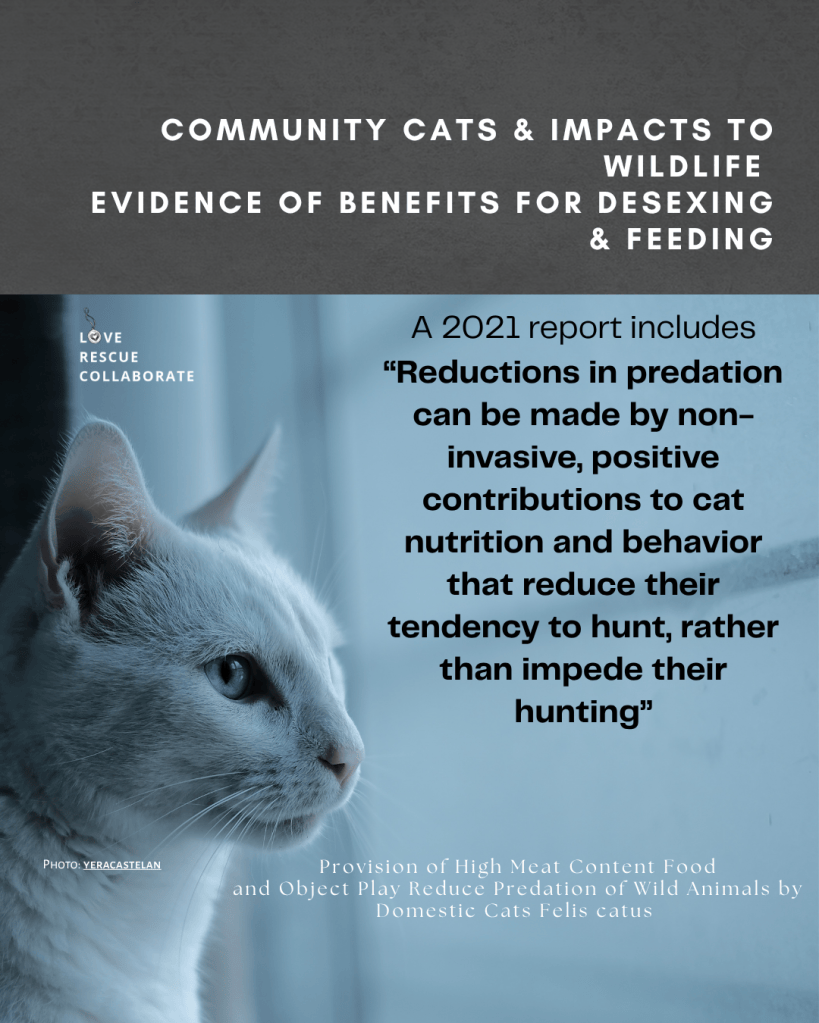
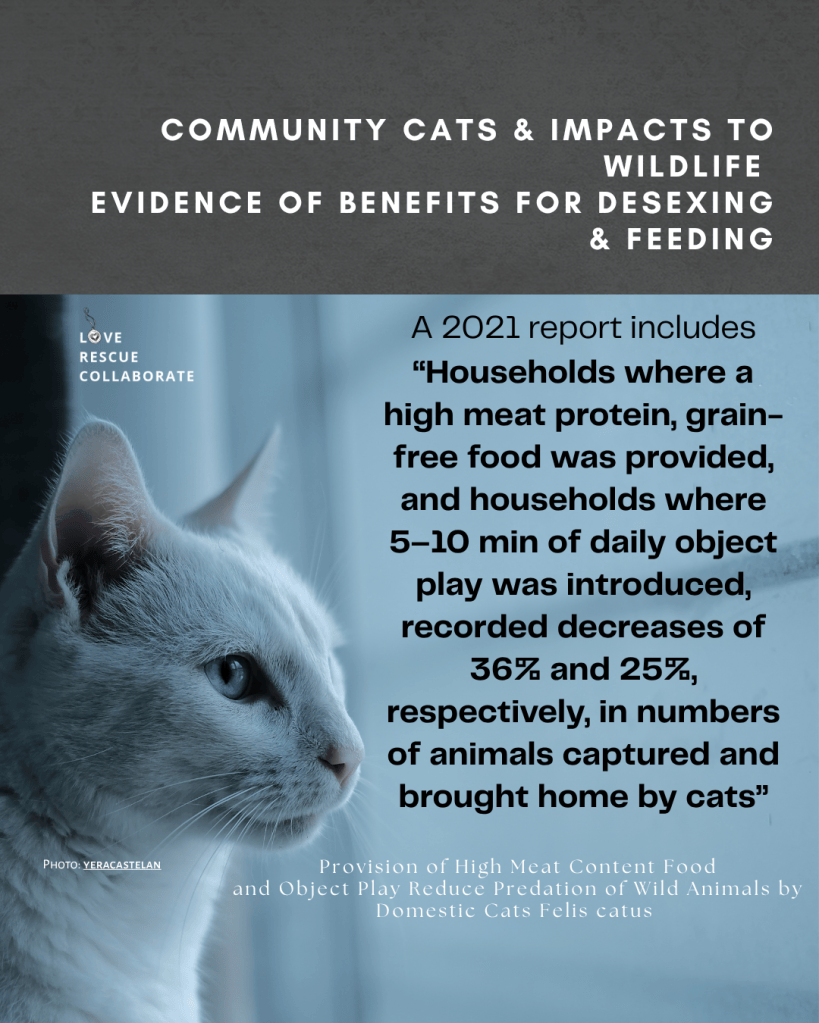
The research Evaluating the Effects of Managed Free-Roaming Cat Populations on Prey Through Stable Isotope Analysis: A Pilot Study from British Columbia, Canada, has a strong alignment with similar conditions in Australia of a farm location near native animals, with a sizeable cat colony dependent on humans for feeding, desexing, monitoring health etc.
“Our findings highlight the value of this [TNR and feeding] management strategy for reducing ecological impacts [hunting esp of native animals] of free-roaming cats while supporting humane population control.”
A small selection of most interesting points from the research includes:
“Free-roaming domestic cats can affect biodiversity through their consumption of wild prey, creating challenges for both wildlife conservation and animal welfare.”
“As TNR programs have become increasingly popular, one of the most common and persistent criticisms is that they fail to protect wildlife from predation [11,12].”
“Before TNR, cats showed clear signs of consuming wild prey, while after TNR and food provisioning their diets shifted to resemble those of indoor cats, relying mostly on commercial food.”
“These findings demonstrate that regular food provisioning in TNR-managed colonies, particularly when combined with broader environmental changes, can significantly alter cat diets and potentially reduce their dependence on wild prey.”
“Our findings have important implications for both animal welfare and conservation policy. They support the position that TNR, when accompanied by systematic feeding and monitoring, can mitigate one of the most persistent criticisms of free-roaming cats: their impact on wildlife through the consumption of wild prey. By shifting dietary reliance away from prey species and toward controlled, human-provided resources, TNR programs can function as effective tools for reducing the ecological footprint of free-roaming cat populations.”
Aussie Study: Do Pet Cats Deserve the Disproportionate Blame for Wildlife Predation Compared to Pet Dogs?
“…substantial attention and blame directed at domestic cats for their hunting behavior is disproportionately large compared to that directed toward domestic dogs, given that our results show that of dogs and cats that catch prey, dogs are more likely to catch native species… hunting by domestic dogs and cats appears to be of relatively minor conservation concern compared with issues such as habitat loss and urban development”
“…median numbers of native animals caught per dog (2) or cat (3) over 6 months were low. Small skinks and lizards comprised the greatest proportion for dogs and cats, but dogs also caught larger native prey (e.g., possums, kangaroos, and wallabies). Most birds caught by dogs and cats were common or introduced (dogs: crested pigeons and lorikeets; cats: noisy miners and rosellas). To design measures that will effectively protect Australia’s native wildlife, thorough understanding of the role dogs and cats play in Australian urban ecosystems is required.”
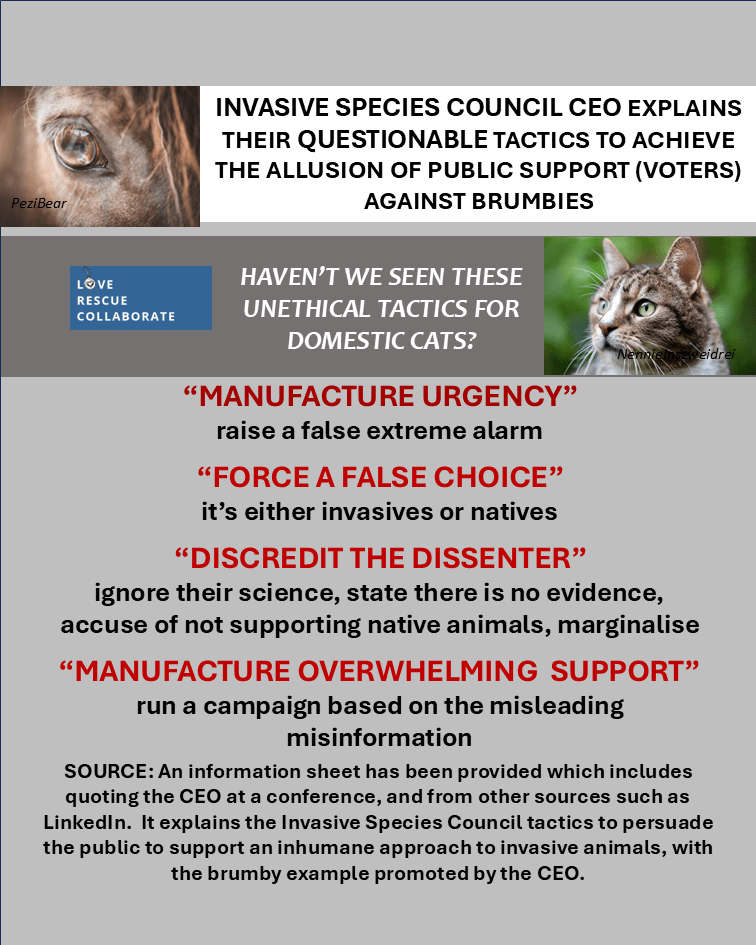
During June 2026, information on the tactics used by Invasive Species Council was provided across social media in relation to the inhumane treatment of brumbies in New South Wales Parks. We believe the information to be substantially true and relevant to the public to understand how misleading information is used by a specific lobby group, as we believe this is ethically questionable. We have evidence of these tactics as applied to domestic cats.
How the Invasive Species Council lobby group persuades Aussies to support the cruel shooting of brumbies
We have yet to verify the original author and the contents of the information on the lobby group manipulating information for brumbies. However, it appears the tactics appear SUBSTANTIALLY TRUE. Noting this generally means that:
the statements need not be exact in every detail
but show an essence of the truth, and
this is important information for the public given the significant relevance and seriousness for brumbies, domestic cats, and other animals which is more important than precise accuracy.
“So the lobby [organisation] does the job for them [the governments] – not on merits, and not by putting the whole picture to people – but by selecting the science that persuades [or possibly ignoring relevant contrary science?] sidelining the people offering alternatives and running a campaign method”. (View of author)
Our assessment of there being substantial truth is based on: ✅1. An AI search as it produced a similar set of tactics from a number of media sources including SBS, and there is the brumby page from the Animal Defenders Office which provides related information. ✅2. Under the NSW cat Inquiry the ISC cat propaganda issue was raised by a rescuer and a supplementary document was provided with evidence and an assessment of the tactics/ methods that contributed to cat hate and harm to cats. ✅3. The LRC team and others have analysed the misinformation and manipulation of ISC webpages and posts on cats, which then is further manipulated through paid media adding emotive opinions and blurring facts, and through social media pages not being moderated for comments on cat hate and cruel acts. Refer our previous web blogs and posts.
In other sections of this blog, we will provide examples of evidence for cats where the same tactics have been applied:
Manufactured urgency
Force between just two extreme solutions
Discredit the dissenter (eg animal welfare experts being labeled activists)
Manufacture overwhelming support (eg we see inaccurate portrayal of RSPCA NSW aggressively supporting mandatory cat containment)
In our examples, these tactics and misinformation appear to be used by ISC and their followers in media, social media posts and comments.
Simple example of Jack Gough spreading misinformation on Bengal cats to ban importing
“Contrary to the misguided beliefs of the Invasive Species Council, the Bengals’ temperament, genetic makeup, and behaviour are domestic. With responsible ownership and containment, the impact on wildlife is zero – which applies to all cat breeds.” Animal Care Australia
Jack Gough tactics and misinformation prior to the total ban
This is a summary of just some of the comments Jack Gough made to News Com in September 2025.
From March 2026 a complete ban for importing Bengal cats was implemented – no Bengal cats will be permitted to enter Australia.
This replaces a 12-year exemption period that previously made it possible with specific conditions. This was one of many alternatives available.
MANUFACTURE URGENCY
Jack Gough “This is sheer lunacy, there’s no other way to describe it,” “It’s something that needs to be stopped.”
News Com on Jack Gough ISC views: “has sparked outrage over fears it would “turbocharge” the nation’s cat crisis… the group warned the move – which would reverse a ban implemented earlier this year – would mean ‘deliberately unleashing more genetic monsters’ on the country’s native wildlife”.
Where in reality Bengal cats are domestic cats and given their high value are usually contained as pets, not free roaming and extremely rarely abandoned as easily adopted by a new family. Further, Bengal cats usually reside in urban areas where wildlife has already been decimated by human developments.
Recent research confirms earlier advice from wildlife rescuers that wildlife in urban areas is more likely to be significantly harmed by humans, road accidents and dogs than cats.
News Com: “A proposal to import a controversial pet cat into Australia has been slammed by a major environment group, who has branded the breed a ‘hybrid killing machine’.”
The previous controls were a reasonable and proven workable option, the ban replaced a 12-year exemption period that previously made it possible with specific conditions.
Jack Gough “cats are ‘“’one of the greatest drivers of extinction’”’ for native animals, with roaming pet cats killing over 300 million native animals every year in Australia, including lizards, frogs, bilbies and small wallabies” – land clearing of native vegetation has been proven the worst impact for native animals “Habitat loss and clearing has caused the extinction of 62 Australian terrestrial species since European colonisation” https://www.dcceew.gov.au/sites/default/files/documents/6.%20DCCEEW-SOE_factsheet_Habitat%20and%20Natural%20Capital.pdf
Jack Gough “Collectively, feral and roaming cats have driven at least 25 species to extinction, including the pig-footed bandicoot, broad-faced potoroo and desert rat-kangaroo” Note – this is not proven by any scientific evidence based research.
It is just feral cats NOT roaming domestic cats who have CONTRIBUTED with many other factors (e.g. land clearing, climate change and other invasive species) to the “extinction of more than 20 Australian mammal species, including the pig-footed bandicoots, lesser bilby and broad-faced potoroo” https://www.dcceew.gov.au/environment/invasive-species/feral-animals-australia/feral-cats
Jack Gough called out those who “think that their desire for a trophy pet is more important than protecting our native wildlife” – just two choices allowing your cat or supporting wildlife. This accusation of caring for one or the other is experienced often.
DISCREDIT THE DISSENTER
News Com “The Invasive Species Council has blasted what it has called a “ridiculous” new application to the federal government to include Bengal cats – designer hybrids of a domestic cats and Asian leopard cats – on the Live Import List as household pets… which would reverse a ban implemented earlier this year – would mean “deliberately unleashing more genetic monsters” on the country’s native wildlife.”
Jack Gough “Bengal cats would ‘inevitably’ escape or breed with feral cats, which would “turbocharge feral cat populations” and kill wildlife already devastated by roaming and feral cats… we’re bringing in genes that will make them more effective and more impactful on our native wildlife”.
Bengal cats are domestic, no more aggressive than other breeds and mainly reside in urban areas and extremely unlikely to be in areas with feral cats.
Jack Gough included the application against the ban was “irresponsible and selfish”.
While a vets advise “…these cats have strict breed standards to limit aggression and favor good temperaments”.
“Bengal cats may look like wild jungle cats but they’re fully domesticated like any other breed of cat. These cats aren’t particularly aggressive or dangerous as a breed”
Animal Care Australia raising issues with the interpretations and ban
“Contrary to the misguided beliefs of the Invasive Species Council, the Bengals’ temperament, genetic makeup, and behaviour are domestic. With responsible ownership and containment, the impact on wildlife is zero – which applies to all cat breeds.”
The ban made in December 2024 and was reviewed in late 2025, was “reported to have been made on the basis that some cats imported into Australia were less than five (F5) generations removed from their wild ancestors which caused concern about potential risks to Australia’s ecosystem and wildlife. There is no information accessible that supports that claim.
The DCCEEW announced there was a detailed policy review, however, neither they nor the Australian Department of Agriculture, Fisheries and Forestry (DAFF) provided a reference for the Review title documentation.
Further “the DCCEEW has not provided statistics showing how many Bengal cats actually entered into Australia who were less than five generations removed, or over what period of time or how DCCEEW identified that this had occurred”.
“It is a misleading statement to classify the current day Bengal cat as a hybrid… these days are at least 5 generations away from the original matings which began in the 1940’s and are considered worldwide to be a domestic cat”.
From the year 2000, “Bengal cats have been classified at domestic cats on a global scale… their heritage lies in a cross mating with the Asian Leopard Cat is so far from the cats bred today”
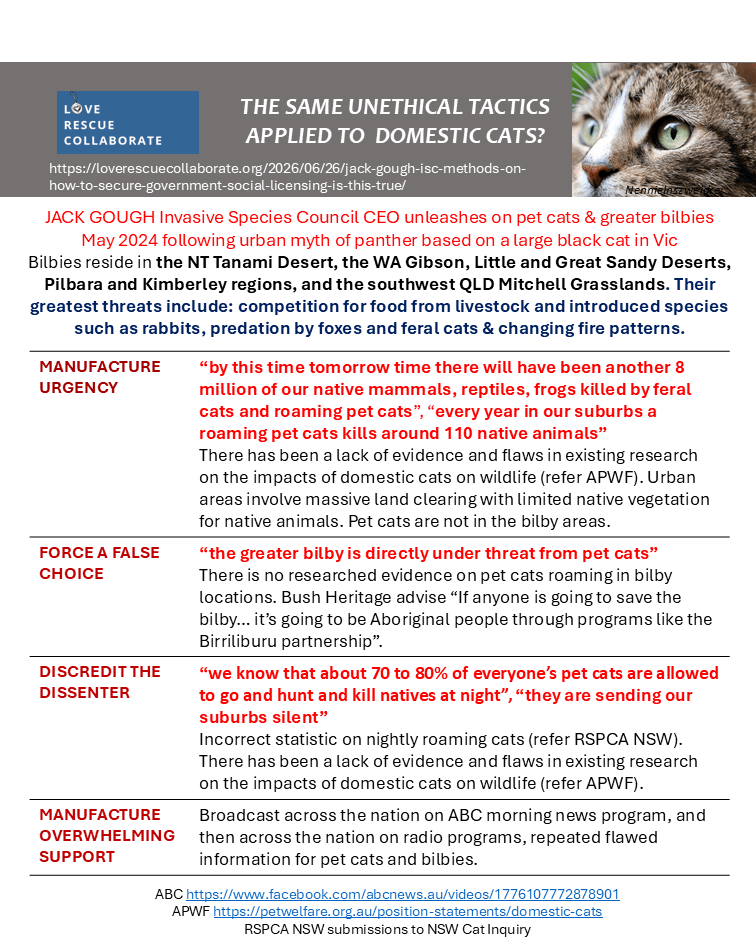
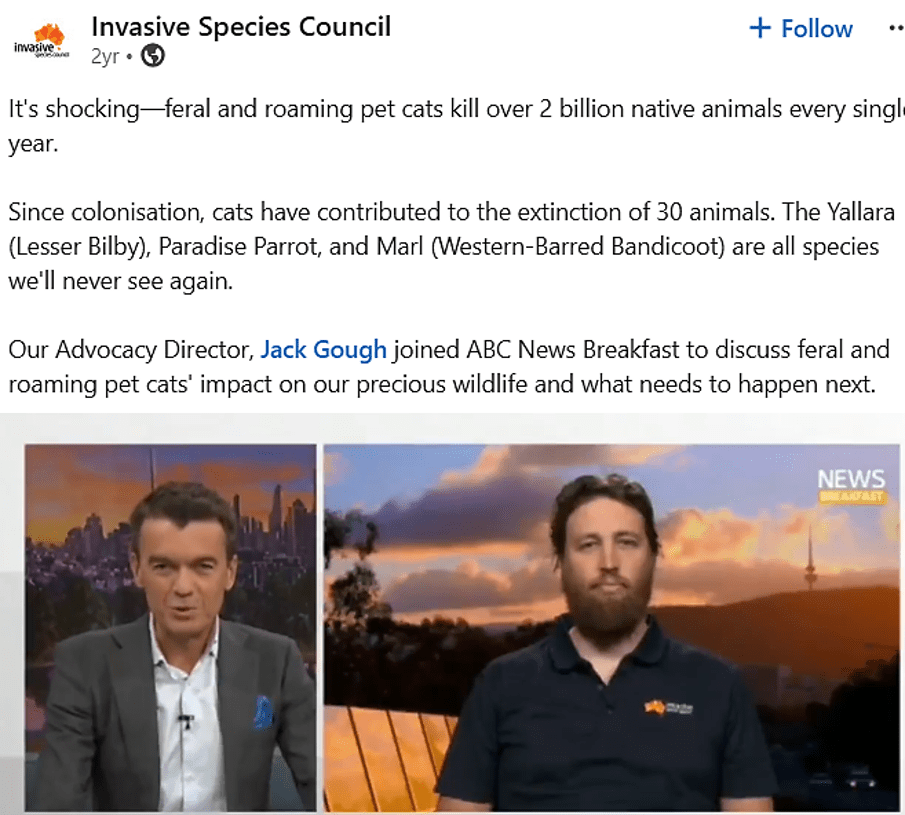
Jack Gough incorrectly blames pet cats for impact to greater bilbies
Jack Gough Invasive Species Council CEO unleashes on pet cats impacting greater bilbies on ABC morning news national program May 2024 following urban myth of panther based on a large black cat in Vic.
It appears that Gough managed to appear based on his experience with “the impact of feral cats an invasive species on native wildlife. However, not far into the segment, Gough turns to pet cats who reside predominantly in urban areas with human owners, and their impacts on greater bilbies who predominantly reside in remote areas mainly deserts.
Bilbies reside in the NT Tanami Desert, the WA Gibson, Little and Great Sandy Deserts, Pilbara and Kimberley regions, and the southwest QLD Mitchell Grasslands. Their greatest threats identified include: competition for food from livestock and introduced species such as rabbits, predation by foxes and feral cats & changing fire patterns. (refer Bush Heritage)
Jack Gough tactics and misinformation on pet cats and bilbies
A common flaw by Invasive Species Council is to blur the lines between feral cats, stray cats and pet cats. ISC do not recognise stray cats as a separate category being domestic and predominantly occurring in urban and peri urban areas. Invasive Species Council and cohorts promote that stray cats are a subclass of feral cats, but this is misleading and not accepted by domestic cat experts (refer 2018 Royal Society for Protection of Animals Australia).
However, stating “the greater bilby is directly under threat from pet cats” is misinformation, misinformation that was broadcast nationally, then repeated in radio programs during the rest of the day by Jack Gough, and the link to the ABC program has been shared by several organisations and Gough’s ISC linked in page.
There is no proven impact of pet cats to bilbies residing mainly in remote areas in Western Australia (WA), Northern Territory (NT), nor Queensland (QLD).
There is an impact from feral cats which is being addressed.
The idea that pet cats will roam and breed with feral cats in this area is not rational based on near impossible probability.
Bilbies have been most impacted by land clearing and other human developments since colonisation.
MANUFACTURE URGENCY
Gough uses a number of variations of the impact of feral and domestic cats on wildlife to create urgency. With extreme wildlife numbers every year, to in each 24 hour period and by every / each roaming cats.
It appears Gough used the opportunity to raise support for funding from the federal government – in the video he concludes with “we had a really good plan put together by the federal Environments Minister Tanya last year… but unfortunately no money was associated with that plan… we are really looking forward to the budget coming up…”.
Gough used false information indicating pet cats were the major threat to bilbies to most likely gain support for the ISC organisation and funding for treatment programs, and to likely support mandatory actions for pet cats such as containment and desexing that ISC promotes.
No other choices were provided which suggest the other choice was totally accepting the false major threat to bilbies, a much-loved native animal now replacing the Easter Bunny with chocolate bilbies in the lead up to Easter Sunday.
The Threat Abatement Plan for predation by feral cats includes the inhumane 1080 based poison as well as programs to shoot feral cats. It also included a questionable overlap for domestic cats, including stray cats (domestic semi owned and unowned cats) under the feral cat class for “organisational” purposes – this was objected by many domestic welfare organisations and experts. This document confuses many across Australia, and causes conflict in real-life and on social media.
DISCREDIT THE DISSENTER
The estimate for roaming pet cats is regarded as an overstated estimate. Pet owners who allow their cats to roam were clearly, incorrectly, assigned blame for threats to bilbies in remote areas.
ISC relies on studies on feral cat experts to determine domestic cat impacts. This has been shown to have several flaws and results in overstated estimates.
The TAP and its Background Document contain a controversial and strongly disagreed definition “A subset of feral cats is found in and around cities, towns and rural properties; these cats may rely on resources that are indirectly (e.g. rubbish tips or abundant rodent populations), or deliberately and periodically, provided by people (e.g. placing food out for cats). These cats are sometimes called ‘stray cats’.”
“For the purposes of this threat abatement plan, a categorisation of ‘feral’ cats and ‘pet’ cats has been used. This corresponds with the differences in the management focus required to address the impacts of cats on native wildlife, and the actions most likely to be in-scope having regard to the management context and location. This is not a prescribed categorisation, rather an organising framework for the information in this plan; it does not override the legal categorisations that apply in jurisdictions across Australia.” https://www.dcceew.gov.au/sites/default/files/documents/tap-for-predation-feral-cats-2024.pdf
MANUFACTURING OVERWHELMING SUPPORT
Gough appeared on national ABC Morning News and then spoke on radio programs across the nation during the day. He was seeking support for funding from the federal government department for treatments for invasive species, and the ISC promoted steps for mandatory cat containment and desexing.
This was based on a Victorian video of a black cat in a rural area. This cat may have been owned by a farm or business, or be semi owned, rather than a feral cat – this was never investigated.
Bush Heritage clarifies locations for greater bilby & feral cats not pet cats
“Bilbies are generalist animals and were once found across 70% of Australia. Today they’re restricted to around 15% – the Tanami Desert of the Northern Territory, the Gibson, Little and Great Sandy Deserts, the Pilbara and Kimberley regions of Western Australia, and the Mitchell Grasslands of southwest Queensland.”
“The two main threats are competition for food from livestock and introduced species such as rabbits, and predation by foxes and feral cats.”
“Greater Bilbies once ranged over three‑quarters of Australia, but declined coincident with the spread of European foxes, along with habitat changes from introduced herbivores (especially rabbits), changed fire regimes and predation by feral cats. Recovery actions have focused on maintaining or restoring traditional Indigenous patchwork fire regimes and controlling introduced predators. Translocations into predator-free exclosures (sic) and a predator-free island have allowed for further increases in population and re establishment into the species’ former range.”
APWF Expert Advice for NSW Inquiry Management of Cat Populations
“Based on data from councils, 24/7 cat containment regulations would not provide any measurable benefit in reducing complaints, cat impoundments, potential wildlife predation or cat-related costs and would instead increase costs to local governments.”
City of Yarra Ranges Vic: increases in complaints 143%, Impoundments 68%, Euthanasia 18%, City of Casey Vic: after 20 years “the number of cats impounded was still 296% higher than baseline”, and City of Hobsons Bay Vic: “mandated 24/7 cat containment is not an effective strategy for reducing the number of wandering cats or associated issues and has rejected cat curfews”
Recent Australian Research on Domestic Cat Impacts to Wildlife
This research is based on a wildlife rescuer database and the scope is on ii\njured wildlife in or very near urban landscapes. Bella and Charlie Are Not the Problem – It’s Us: The Real Drivers of Wildlife Decline in NSW https://www.mdpi.com/2076-2615/16/14/2174
Unraveling the Invasive Species Council overstated estimates for cat Impacts
Please refer our summary of the number of assessments (primarily by APWF) of various parts of the data and methods used by ISC cohorts to develop the extreme impacts of domestic cats in urban areas, environments that have been largely decimated of natural habitat vegetation and native animals due to human developments (e.g. medium and high density urban landscapes). https://loverescuecollaborate.org/2026/07/01/questionable-flaws-in-invasive-species-council-cat-impacts-to-wildlife/
RSPCA NSW Expert Advice for NSW Inquiry Management of Cat Populations
“…research from Queensland published in 2024 indicated that 51% of cat owners contained their cat 24/7 whilst a further 18% contained their cat at night (Rand et al., 2024). In NSW, Ma et al (2023) identified that “65% of NSW residents indicated they currently kept their cat(s) fully contained, with a further 24% containing their cats overnight.”
“Cat containment policies are difficult and expensive to enforce and trapping, culling or impounding uncontained cats are unacceptable, inhumane and ineffective ways to manage these populations”
“Mandatory containment may fuel anti-cat sentiment in the community leading to increased deliberate cruelty against cats.”
RSPCA NSW @ Hearings: “Our research through Keeping Cats Safe at Home demonstrates that the uptake of cat containment is increasing over time, and that this style of cat management is becoming a social norm and community expectation. Programs like our successful Keeping Cats Safe at Home initiative take a human behaviour change approach to encourage this continued shift to containment. We do not recommend mandating cat containment for multiple reasons” Gemma Ma RSPCA NSW
In summary the document provided the chain of misinformation including:
Starts with the cat impacts that include generalised extreme cat impacts – numbers of cat predation on wildlife rolling in overstated estimates for domestic cats from the ISC and related organisations (cohorts), most often using national generalisations that present a dramatic view that does not match evidence in separate locations across our nation.
Omit meaningful context other significant factors, such as “land clearing (habitat loss), climate change impacts (bushfires, floods, droughts), and impacts from other invasive species”. [LRC notes that native predators are also not included which can be major causes when native vegetation has been decimated.]
Use of negative demonising emotive language “terms, adverbs and adjectives) to describe all cats for example “alien”, “villains” and “invasive”, and “cat catastrophe”, has been found to contribute to fear and moral disengagement, leading to support for lethal control methods and reduced concern for animal welfare for feral and domestic cats“
These posts and traditional media forms on social media posts for ISC and cohorts do not have administrators / moderators allowing a wide range of comments from community members / followers, “inflammatory comments and arguments equal engagement on social media – often seen as “click bait”” and owners/ authors are rewarded by the social media platforms in various ways. .”However, biased misinformation may result in forms of animal cruelty being promoted and shown that normally violates community standards, regulations and our laws/ legislation.”
The traditional media articles and social media posts by ISC and cohorts are proliferated across many similar organisations, which “floods the internet and influences the AI/search algorithms to prioritise listing these inaccurate misleading items to be listed before other items” for example the researched quality information on cat impacts.
It was noted that “cruelty to animals is on the rise, reported by RSPCA NSW and RSPCA United Kingdom” which matches anecdotal experiences from cat rescuers and carers.
The discussion and parts of the transcripts was raised as another LRC blog post:
Are some only interested in applying the near same lethal techniques that apply to feral cats in arid areas and native parks to high volume trapping and culling domestic roaming cats in urban areas?
Why are some using intentionally emotionally “scary”, overstated estimates of the number of cats and impacts?
Is that to further demonise cats and use people’s cat hate based feelings for support for lethal actions ASAP?
Following the science in the best practices under the cat Inquiry it appears “bleeding obvious”, just based on rational and cost-efficient methods that these represent the way forward.
Why are ISC & cohorts continuing to demonise of all domestic cats, and lethal methods which are not effective, nor humane, costly and will slow the approach to minimising the cat populations?
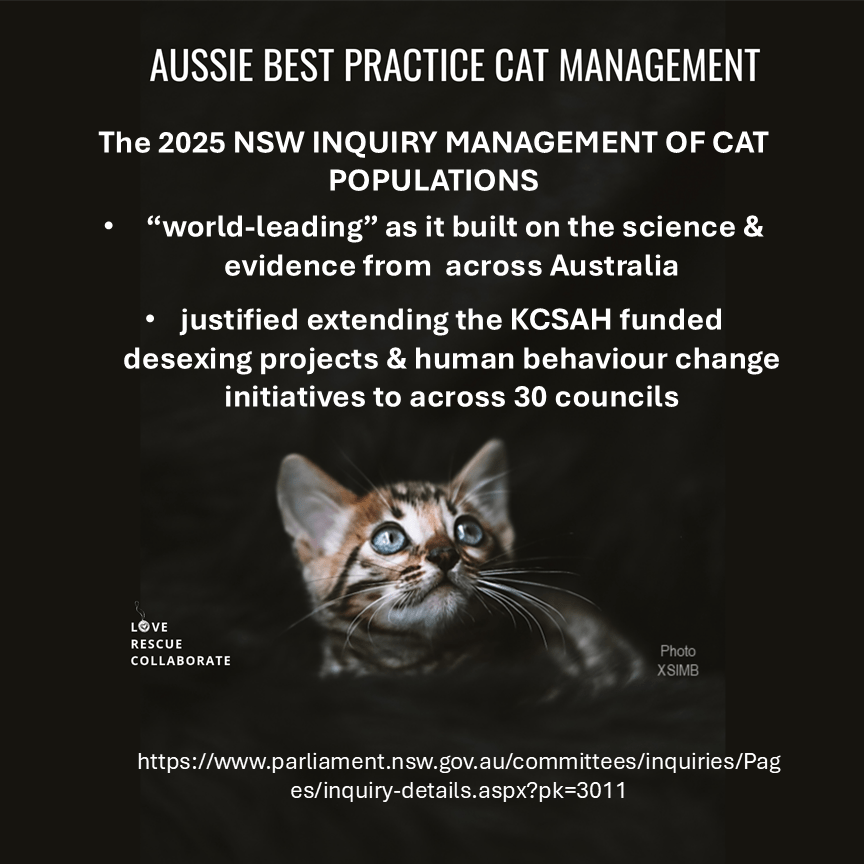
The 2025 NSW Inquiry Management of Cat Populations represents world-leading domestic cat science from Australia.
More researched findings have been released since then.
But why are some staying in the Dark Ages with archaic techniques?
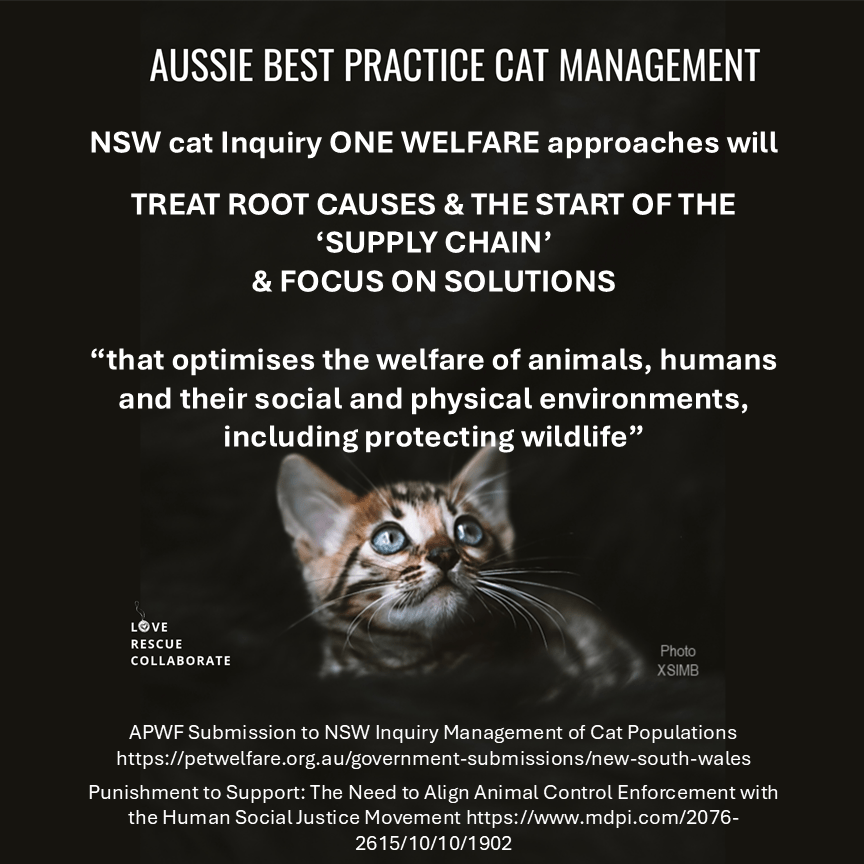
The cat Inquiry included advice, research and recommendations from a number of domestic cat scientists. There is a wealth of trusted information on the best techniques and One Welfare solutions to apply to the cat crisis.
The cat crisis is a crisis due to cost-of-living factors for owners and semi owners, and a lack of action for several years by our governments (state/ territory and local councils). Only a few councils and state funded trials have been completed.
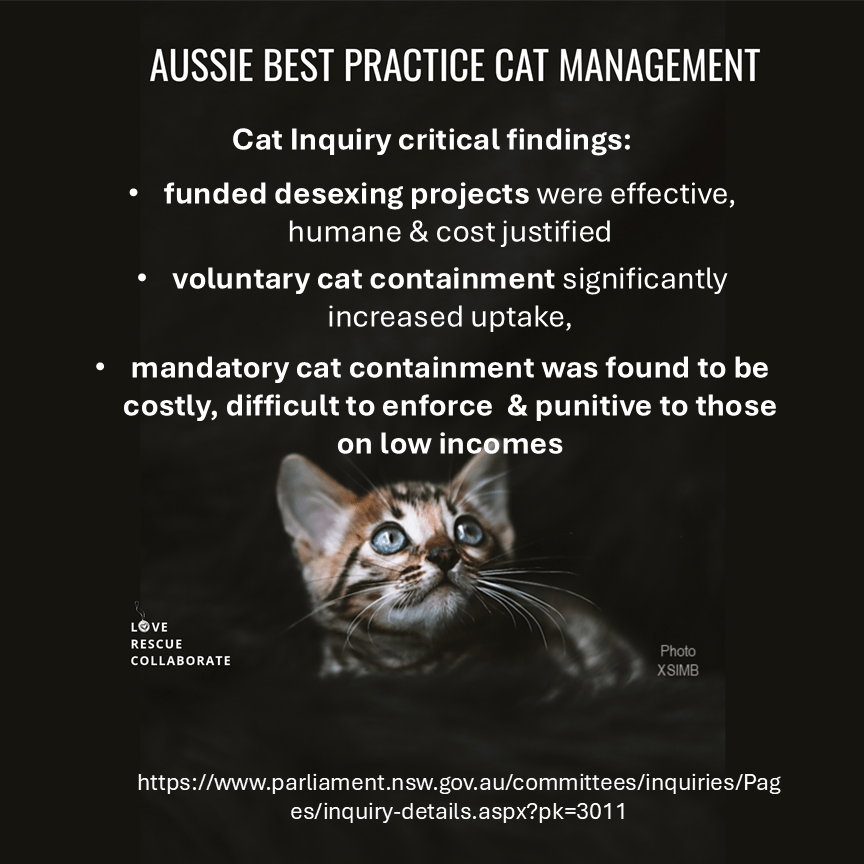
The cat Inquiry provided a number of findings and recommendations. These are just three key focus areas:
funded desexing programs critical to limit further population growth as a humane, effective and cost justified action
voluntary cat containment proven to increase uptake
against mandatory containment as it is costly, inhumane and costly, and basically not effective as it does not treat root causes.
But why are there some who are ignoring the science?
Why ignore the most appropriate and rapid way to minimise domestic cat populations in urban areas?
Are some only interested in applying the near same lethal techniques that apply to feral cats in arid areas and native parks to trapping and culling domestic roaming cats in urban areas?
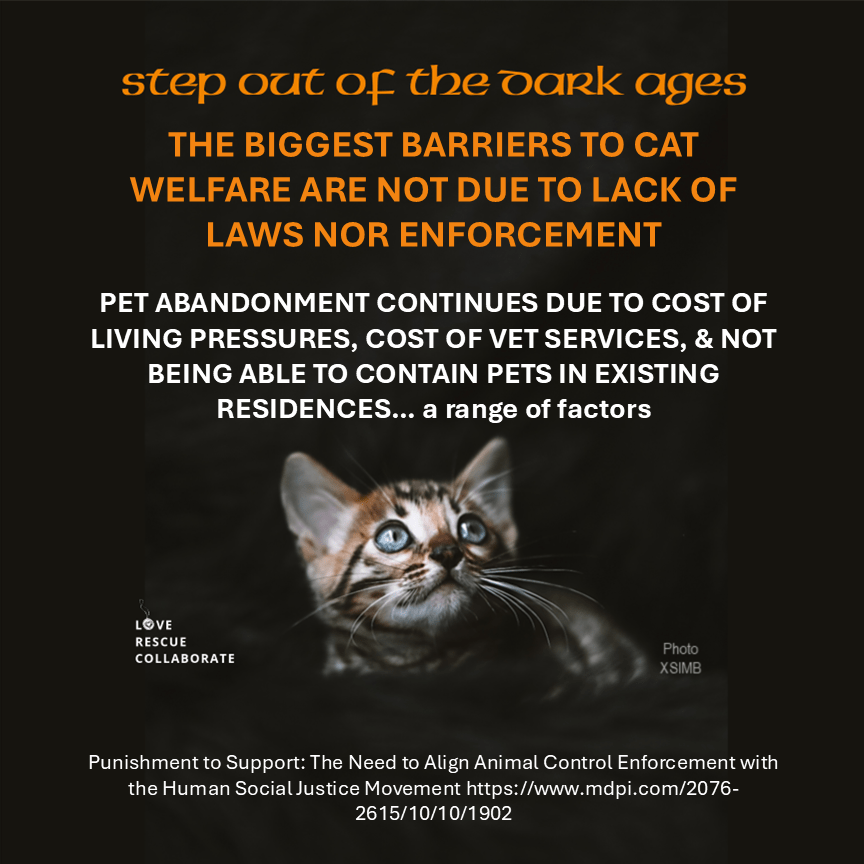
Across Australia and in other countries, it is well recognised that cost-of-living impacts are affecting pet owners very hard, as while food may be near affordable, vet services and government fees and penalties are not.
One of the worst set of costs comes if your pet is impounded as a daily fee (more on weekends and public holidays) is literally a “k*ller” choice. Some owners either avoid microchipping and registration, or quite often deny ownership indicating the pet was transferred to another.
The cat Inquiry committee respected and supported the expert findings and the recommendations for One Welfare solutions.
These are focused on
helping keep pets with owners – one source of abandoned pets
desexing to stop the kittens and cat becoming “unwanted” without new family homes available.
There appears substantial evidence that punitive legislation and regulations are difficult to enforce, costly in terms of labour and time with a major risk of not having substantial evidence, punitive to those on low incomes etc.
Obviously One Welfare solutions have been growing around the world as a cost effective and humane approaches to resolve issues.
The state of Victoria and its councils are often quoted as a reason for NSW to follow for mandatory cat containment.
But this ignores that there are negative consequences such as this approach being difficult to successfully carry out, it is costly in labour and facilities, and usually not humane in separating cats from their owners who have not chipped and registered, and the many semi-owners caring for community cats.
The RSPCA NSW provided a summarised view on the benefits of voluntary cat containment and the negative consequences for mandated cat containment. The RSPCA findings & recommendations were provided in their submissions, hearing representations and several further document – all under the NSW Inquiry webpage.
Why are some ignoring the RSPCA NSW views or misleading the public that the RSPCA NSW supports mandatory cat containment?
Why are some using intentionally emotionally “scary”, overstated estimates of the number of cats and impacts?
Is that to further demonise cats and use people’s cat hate based feelings for support for lethal actions ASAP?
The overstated estimates have been questioned by domestic cat experts.
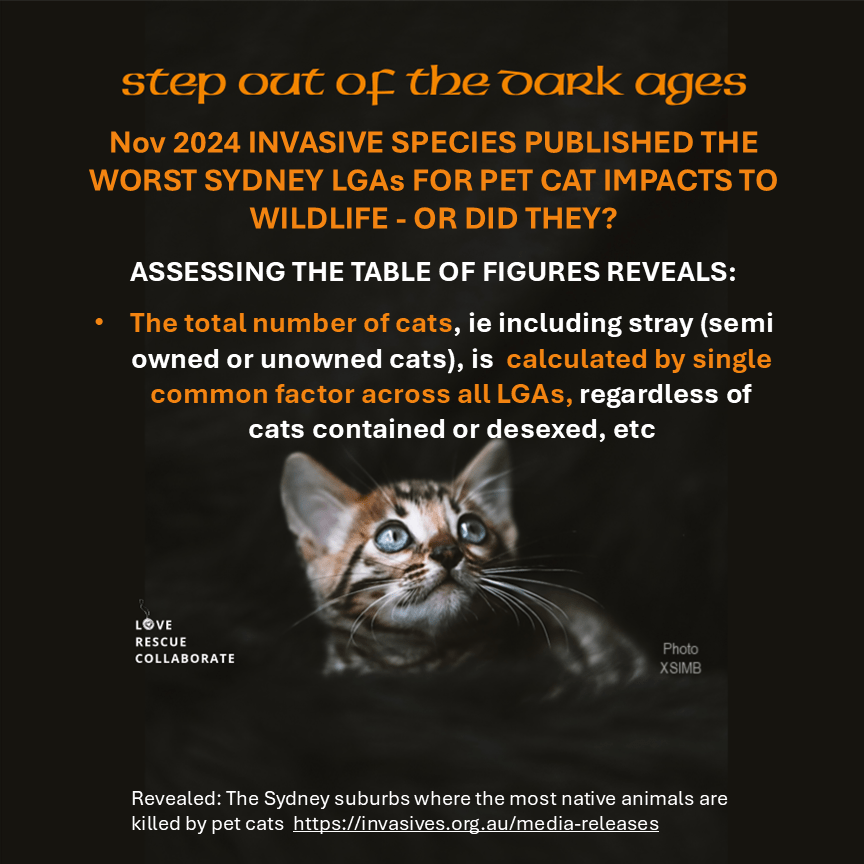
A simple example of how Invasive Species & cohorts calculate their estimate for stray cats and the total of all cats was shown on one of their webpages.
ISC start with the number of pet cats, most likely just those microchipped and registered as these numbers will be contained on the NSW Pet Registry.
It appears that to calculate the estimate for stray cats (semi owned and unowned domestic cats in urban and peri urban areas). a single factor is applied to the number of pet cats.
This single factor has been provided through studies and we have not seen ISC etc research on domestic cats including stray cats.
This estimated stray cat numbers are then added to the owned chipped and registered cats to provide an estimated total number of cats.
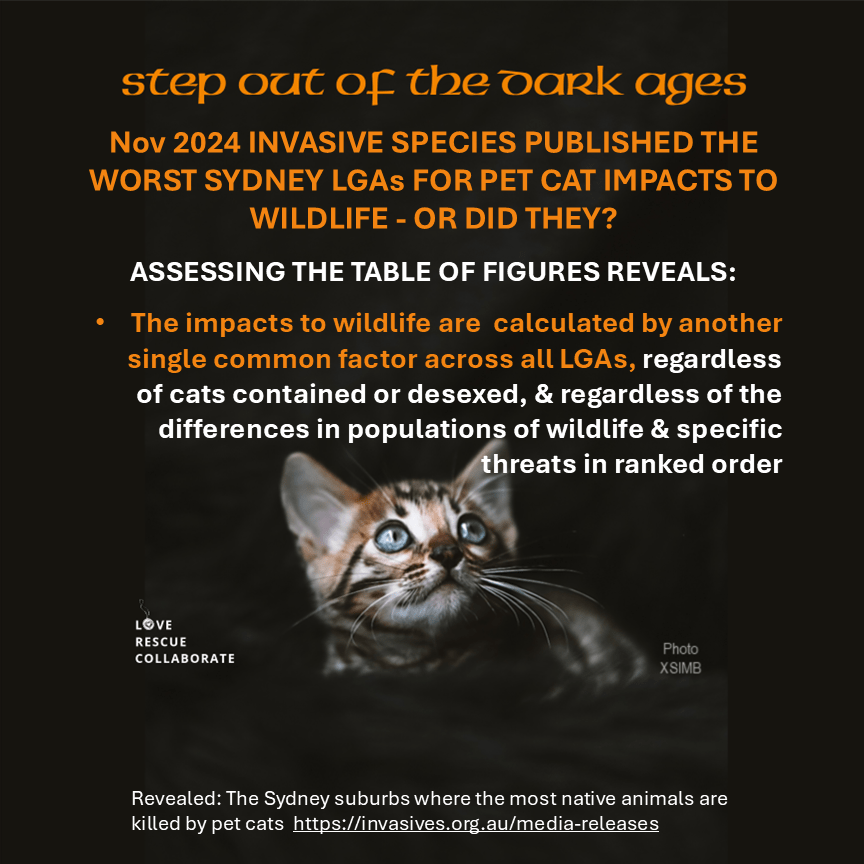
Similarly, ISC & cohorts use another estimated factor to calculate the estimated impact to wildlife in urban and peri urban areas.
These estimates are considered overstated due to flaws in data and methods of calculations, as has been assessed by the APWF and other scientists.
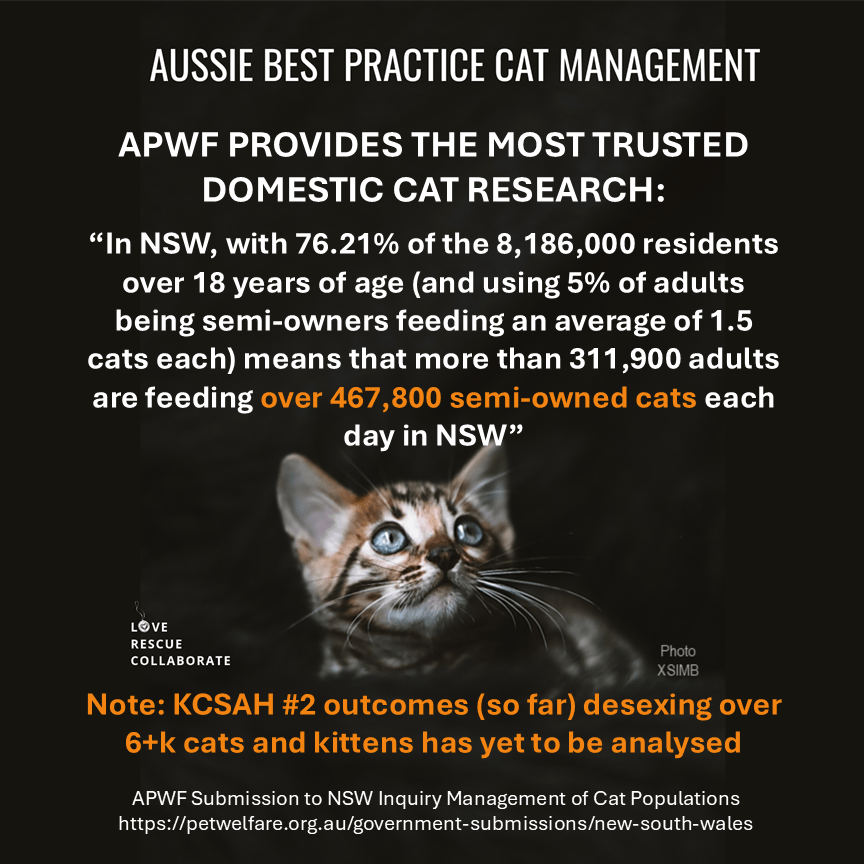
The APWF has provided estimated of the potential number of strays based on their research, and a wealth of information for their community cat programs. There appear several factors involved in this estimate.
The outcomes of the second round of the Keeping Cats Safe at Home program have yet to be published by the RSPCA NSW. It is expected that even this short trial will have improved outcomes for minimising cat populations for owned and semi owned cats.
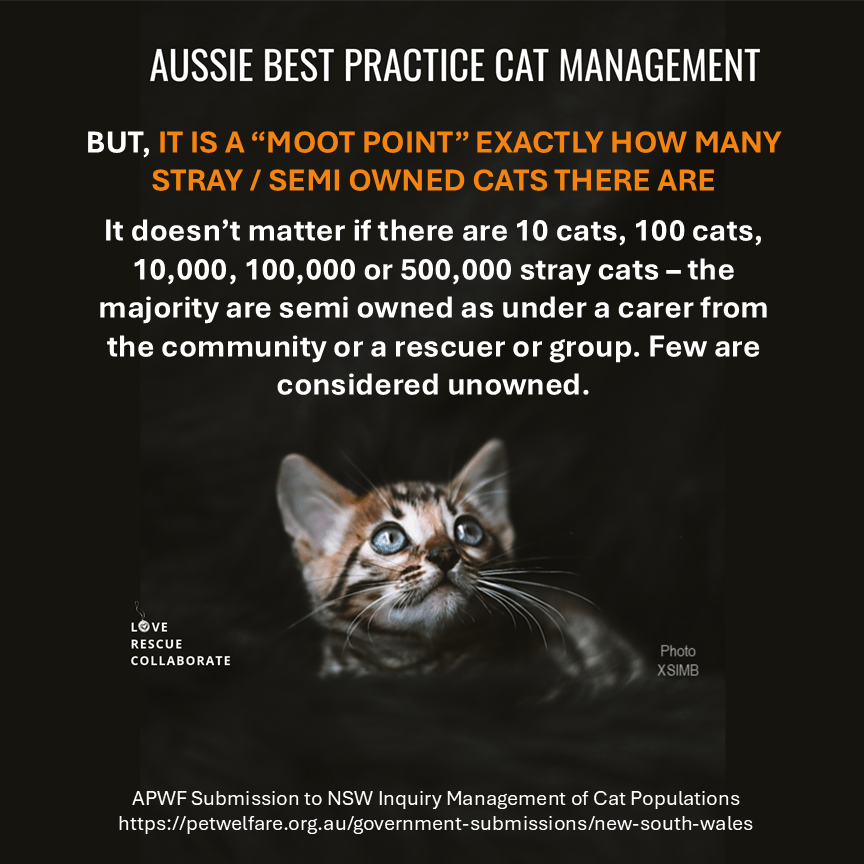
While some, like the ISC often quote their overstated estimates for the extent of the cat crisis in terms of number of cats across the state – this is actually a “moot point”.
What is critical is the best practice approaches being applied regardless of the number.
Having a larger number should NOT justify archaic lethal approaches which have proven costly and ineffective etc.
The Inquiry findings and recommendations focus on what works best!
The Inquiry clearly indicated that “traditional” archaic, lethal methods are not the best way forward!
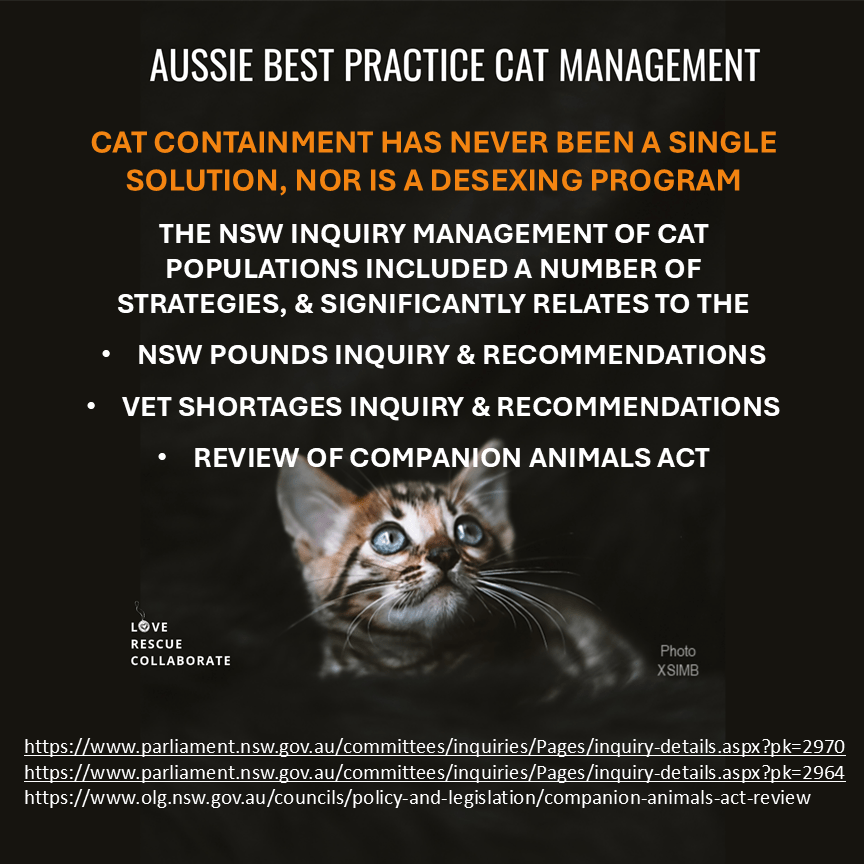
The cat Inquiry included a wealth of information, research and best practices. These findings and recommendations are relation to the other NSW government investigations for improvements:
NSW Pounds Inquiry
NSW Vet Shortages Inquiry
Review of the Companion Animal Act
The actual number of cats and funding the best practice approaches should be based on the need for rapid improvements.
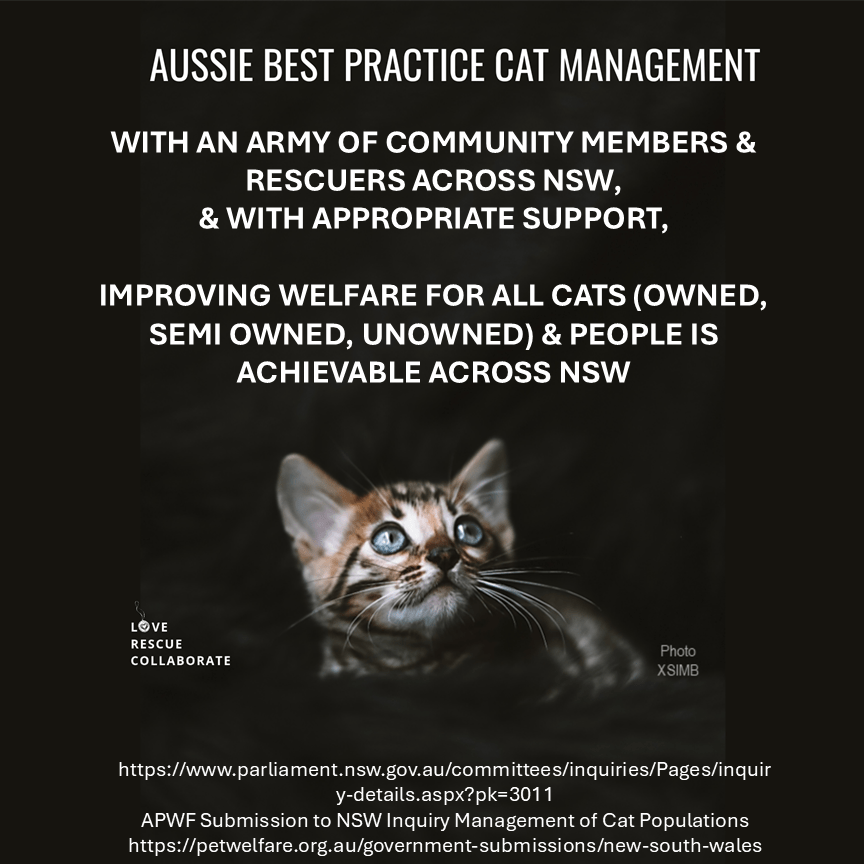
With an army of volunteers and community members currently caring for most stray cats, these efforts are achievable.
Following the science in the best practices under the cat Inquiry appears “bleeding obvious”, just based on rational and cost-efficient methods.
Why are ISC & cohorts continuing to chase the demonising of all cats, and lethal methods which are not effective, nor humane, costly and will slow the approach to minimising the cat populations?
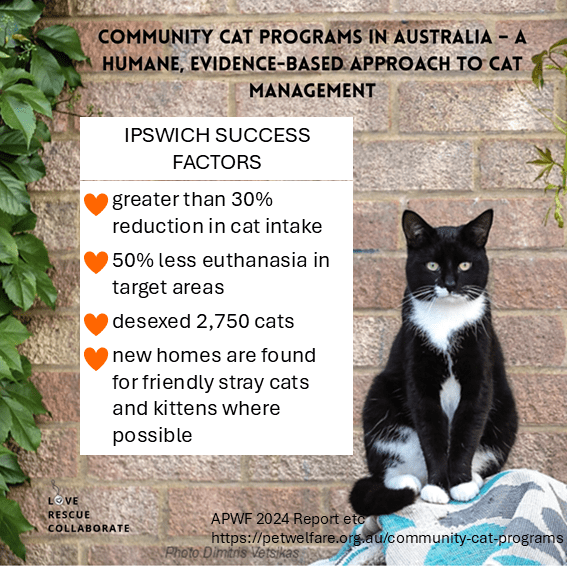
“Community Cat Programs humanely manage urban cats through sterilisation of owned and semi-owned cats, microchipping, owner and carer support, adoption, nuisance resolution, and return to field or working cat options for healthy nonadoptable cats. These evidence-based initiatives reduce shelter intake, increase reunification, minimise euthanasia, and improve animal and human wellbeing.”
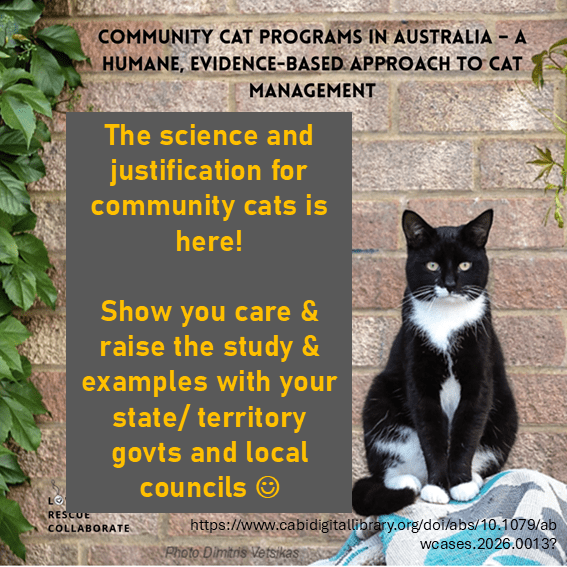
The latest science and justification for community cat programs is here! Based on specific council examples in Victoria, Queensland and New South Wales.
The study does leave open the question of expanding community cat programs extending or overlapping with owned and semi owned cats in low-income areas, as this is where usually the financial barriers and sometimes lack of awareness of responsible ownership may have impacts to the populations of free roaming cats with unclear ownership. This question of scope should be considered by local authorities to achieve the best value for money and optimise benefits for cats and humans.
This study provides the significant relevance of Australian structured community cat programs to critically assist in management of cat populations in urban areas. This proven approach includes high-intensity and targeted desexing, microchipping and most importantly community engagement bringing the wealth of local experience, effort and commitment to the care of cats.
“Community Cat Programs (CCPs) use a holistic, non-lethal approach to managing free-roaming cat populations, grounded in the One Welfare framework. These programs integrate targeted sterilisation and identification (microchipping), support for owners and semi-owners to care for their cats, and for unowned cats to be sterilised, microchipped, and converted to semi-owned cats with a carer. Where indicated, this includes assistance with the provision of cat food and veterinary care. CCPs also include processes that maximise live outcomes for healthy cats unlikely to be adopted, such as return-to-field and working cat programs. However, legal reform is required to achieve sustainable outcomes for cats, communities, and wildlife.”
Critical factors to consider
This study is about domestic urban cats: owned, semi owned and unowned. This study excludes feral cats. To distinguish a domestic cat from a feral cat should be based on the location. Domestic cats will be comfortable or at least have some reliance on humans. Feral cats are wild and avoid humans. Misjudging or applying responses based on flawed assessments between domestic and feral cats will restrict options and damage efforts for humane management techniques.
Unowned cats may easily become semi owned under carers and rescuers. In the field this is very common where newly abandoned cats are even placed with existing known colonies/ groups or locations. Unowned cats are also quickly helped by well meaning community members, even near food businesses where scraps may be purposely left outdoors for roaming cats.
The One Welfare framework in integrated through collaboration between community members and rescuers/carers, and with supporting legislation improvements then the programs and their benefits become a sustainable and humane outcome for animals, people and the environment.
The community members, and rescuers/ carers are an essential key success factor. Community cat programs consist of core components which are critically dependent on carers and rescuers:
desexing and chipping,
addressing treatments & health,
on-going monitoring and management (before, during and after the former), and
rehoming opportunities.
Medical assistance may be provided in a range of services:
Desexing, chipping and vaccination (sometimes the latter may be referenced as TNVR),
Ongoing treatments to prevent parasites and minor illnesses
Triage for very ill or injured cats where all these including surgery are completed by veterinary professionals.
There are well known and proven benefits of community cat programs including:
minimising costs for councils (and therefore ratepayers),
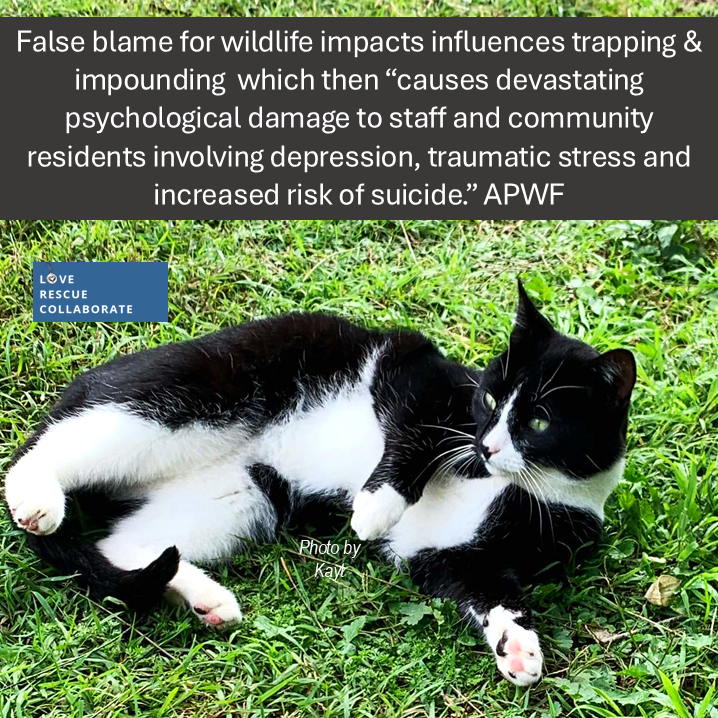
reducing the burden and associated stress (primary and secondary trauma also considered compassion fatigue) on staff, vets and community.
aligning support and welfare of cats, people and wildlife.
If a cat or cats are in a working environment then it is likely their role for vermin control or even as a support animal for workers or visitors/ clients.
Working cat programs or finding a new home/owner for less social cats in businesses should be acceptable and legal if the cat is chipped and owned and it is not a food production facility.
“In disadvantaged areas with lower-density housing, free-roaming cats often include a substantial proportion of owned cats that are allowed to roam and are unsterilised. In contrast, in inner-city environments with high-density housing, free-roaming populations are more commonly composed of semi-owned cats, cats that are regularly fed or cared for by people but are not formally recognised as owned. This pattern is also observed in locations where people work but do not reside, such as industrial areas, schools, and university campuses, as well as in settings where cat ownership is restricted or prohibited, including aged care facilities. Where cat carers are caring for a small number of cats, it is recommended that these semi-owners be helped to take ownership of the cats (McDonald and Clements, 2019). At multi-cat sites where caregivers cannot or are unwilling to take ownership, the cats are sterilised, and carers are supported to continue to care for these cats. This stabilises the population and prevents new litters while allowing these cats to live out their lives under supervision and with care. More rapid decreases in free-roaming cat numbers occur where adoptable kittens are rehomed after sterilisation through shelters, rescue groups, or by the carer. Similarly, if supported by the cat carer, after sterilisation, sociable adults can also be rehomed, and less socialised cats can be placed in working-cat homes to decrease cat numbers at the site.”
Cats’ lives and welfare are improved under community cat programs
through low stress handling by caring people and involving trapped humanely in traps which are covered and kept in quiet locations
cats may be chipped to their carers and rescuers or a group or organisation and as cats and kittens are identified as being social for rehoming, more rapidly reducing the cat population in the colony / group / location
desexing improves ongoing health for the cats and reduces a potential rapid growing cat population,
cats who are impounded but not claimed by owners, however not immediately adjusting to a shelter/ pound environment should be returned to their original location under a carer – interestingly it may be that the cats will return to their owners as studies has shown by Lord et al.,
Effectively addressing the “Cat Crisis”
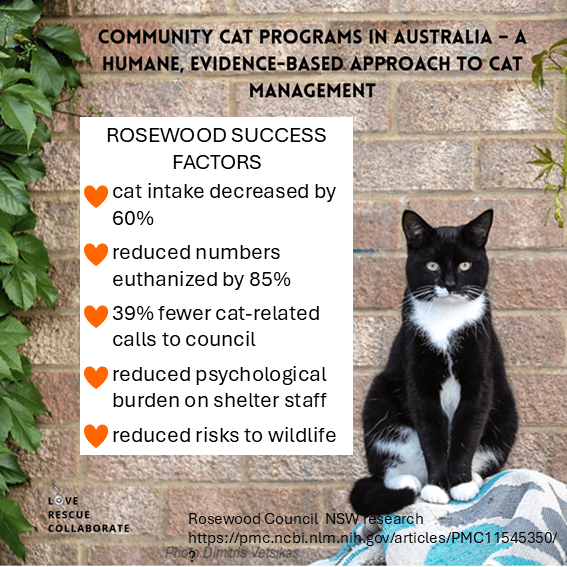
The scientific research data from a range of Australian community cat programs is available from Queensland, Victoria and NSW which all show measurable outcomes with fewer roaming cats, fewer entering pounds costing effort and ratepayers, fewer complaints from the public, reducing council costs and ratepayer funding.
These prove that this One Welfare humane approach breaks the cycle of a rapidly increasing cat population, and largely replaces traditional methods of trapping, impounding and intensely high rates of euthanasia.
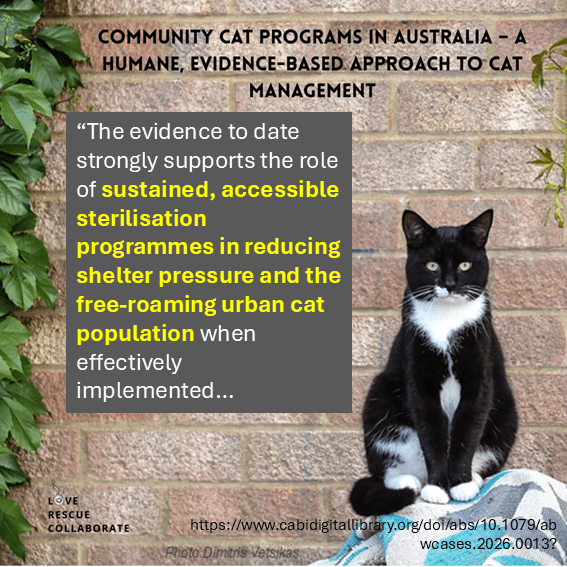
The study and related researched works provide more than adequate scientific evidence on sustained, accessible sterilisation programs providing worthwhile benefits in reducing the burden on shelters and minimising the free-roaming urban cat population.
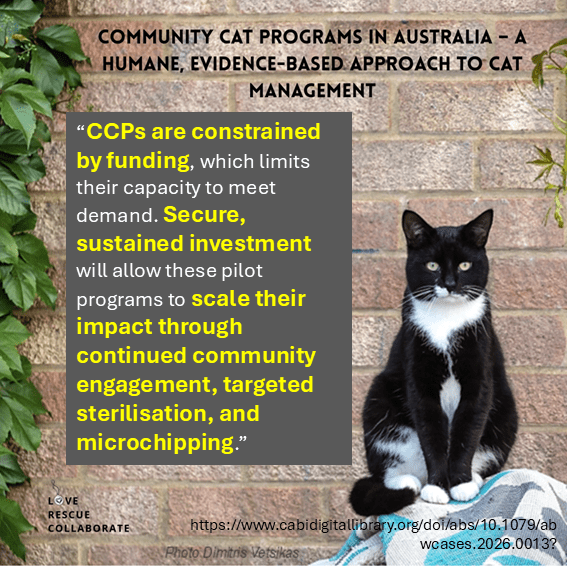
Secure, sustained funding based on cost benefit assessments enable these programs to increase their impact through continued community engagement, targeted sterilisation, and microchipping.
The next steps are to sharing information on the effectiveness with state and local government authorities, welfare agencies, and rescue groups to facilitate increasing implementations and momentum across Australia. Savings achieved can be applied in related companion animal support services.
Cases to justify community cat programs need to be developed working with local and state governments. The benefits will provide savings in ongoing effort and facilities.
The Banyule Council desexing program has been formally researched. It provides a very sound case for consideration by other councils.
If you have not yet, then start contacting your Mayor and councilors to kick off discussions on the issues and the proven success of managed community cat programs.
Seek funding under a trial program, seek advice from the Australian Pet Welfare Foundation.
Sample email for your local government contacts
[Please tailor for your concerns and recommendations]
There is proven value for our council to invest in improved management of community cats currently under the care of a community member, or cat rescuer / carer individual or group. These programs have been proven to be cost-justified, and provide savings over time in reduced burden on council staff and facilities. These community cat programs are a humane approach for cats, council staff, vets and community members. I will appreciate having the opportunity to discuss a similar program in our local government area.
I provide the most recent Australian study and the related research items for your consideration.
“Community Cat Programs humanely manage urban cats through sterilisation of owned and semi-owned cats, microchipping, owner and carer support, adoption, nuisance resolution, and return to field or working cat options for healthy nonadoptable cats. These evidence-based initiatives reduce shelter intake, increase reunification, minimise euthanasia, and improve animal and human wellbeing.”
Importantly for the current prominent perceptions of cat impacts to wildlife: “all animal attacks combined accounted for 4.4% of threatened species rescues; dog-related rescues were more than three times greater than cat-related rescues, with cat-related rescues comprising 0.6% of all threatened species rescues”.
The current strong public focus on cats and impacts to wildlife “risks diverting attention away from other more major and preventable impacts on wildlife in urban areas. These include habitat loss and fragmentation, vehicle collisions, extreme weather, and hazards linked to roads, buildings, and other human structures”.
APWF Position Paper
From Australian wildlife hospitals, past studies have shown consistent patterns: road/traffic collisions, “orphaned or dependent young, disease, and environmental displacement” usually lead the reasons for wildlife entering a hospital.
This is the first state-wide analysis from the NSW Wildlife Rehabilitation Data Dashboard records used from 2013 through 2024. Points of interest follow.
[Note – this new research is under review]
Conclusion include:
Companion animal attacks were causing “a small proportion of rescues overall, with dog-related rescues more than three times as common as cat-related rescues”
Gains in conservation “are likely to come from preventing harm before it occurs and increasing survival through early intervention”
Prevention efforts should be focused “on the major human-related drivers identified in this study offers the strongest opportunity to reduce wildlife rescues and improve outcomes for threatened species and wildlife rescuers”
Acknowledging and responding to these factors and drivers “will be essential if conservation policy is to achieve meaningful reductions in threatened wildlife injury and mortality and protect human wellbeing.”
“Overall, threatened species most often entered care due to adverse weather events, unsuitable environment, hazardous materials, and vehicle collisions—suggesting that prevention efforts targeting these causes are likely to avert more harm than a primary focus on pet cats.”
About this new study:
Data gathered from 52,475 individuals and 158 threatened species
Outcomes include
24.1% of threatened animals were released,
58.5% died, and
17.5% had other outcomes
Rescues due to largely human-related causes:
11.6% Entanglement
11.4% Weather–Drought
10.1% Abandoned/Orphaned
7.3% Unsuitable Environment
5.8% Motor-Vehicle Collision,
although many were Unknown (21.9%).
these six making up 82.1% of threatened species rescues.
Currently online on ABC Newcastle starts around 1h 9mins into the program – link will be in first comment for this post and on our blog webpage.
KEY TAKEAWAYS: – 💜 Due to the extreme claims of domestic cats on wildlife, the recent research paper focuses on what brings wildlife into care… and shows cat attacks are a very small proportion of causes. 💜The research is on cat and wildlife species where humans live and work, including where wildlife and human habitation coexist, (not cats in natural environments). Focused on threatened and endangered species as these are the most at risk. 💜The push for mandated containment, sounds like a simple solution, but the evidence shows it doesn’t effectively reduce roaming cats nor minimise impacts to wildlife – most people who can contain their cat do so, and a number of domestic cats do not predate wildlife, (obviously cats may), 💜 We need to be smart about the responses. Solutions include providing help to owners, especially those on low incomes, and shift from demonising cats and owners, and really be proactive – where are the species most suspectable to dog and cat attacks and how to provide protection for the wildlife. 💜Another response is to leave corridors for the wildlife to safely move from one habitat to another, with tree canopies. Road trauma and identifying hotspots, and adding road fencing, and generic warning signs have not been shown to work very well, but more focused intelligent signs and speed monitors are more useful.