For animal rescuers, working with different community groups to improve outcomes for their companion animals can be challenging. But we are not alone, this is a challenge shared around the world. In our view, One Welfare in a nutshell focuses on providing solutions for pets to stay with owners, instead of trying to enforce punitive laws and more often remove pets from owners, with the pets likely being euthanased.
Australia has a few great examples with: the free desexing program completed within the Banyule Council Vic, where an Animal Management Officer engaged and supported the local community with desexing their pets; and anecdotally we are aware that in Campbelltown NSW local volunteers in a rescue group have performed a similar engagement and assistance for pet owners in a low socio economic area to ensure pets are desexed.
This blog provides an introduction (slim overview) to the One Welfare initiatives and some of the interesting research underway. Think of this blog as a skipping stone, skipping across the top of some of the reference material available.
We’ll start with some more recent interesting findings, which explain why this focus area is of interest. Then, back to basics of explanations by various organisations.
DECISION MAKERS NEED TO CONSIDER SUPPORT SERVICES RATHER THAN ENFORCEMENT
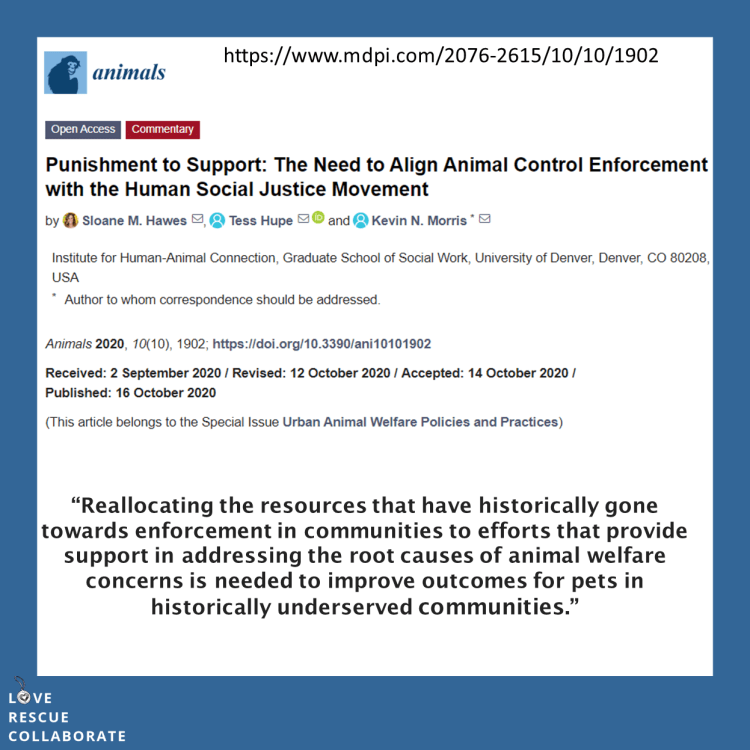
LRC provided a link to a study from the USA in 2020 in an earlier post:
The study (reference below) recommends that is it far better practice to offer support services to enable solutions, rather than enforcing laws/legislation which may be seen as brutal in taking away and euthanasing loved pets. This is important in communities involving low socio economic categories, and/or ethnic groups implying different country of origin cultural backgrounds.
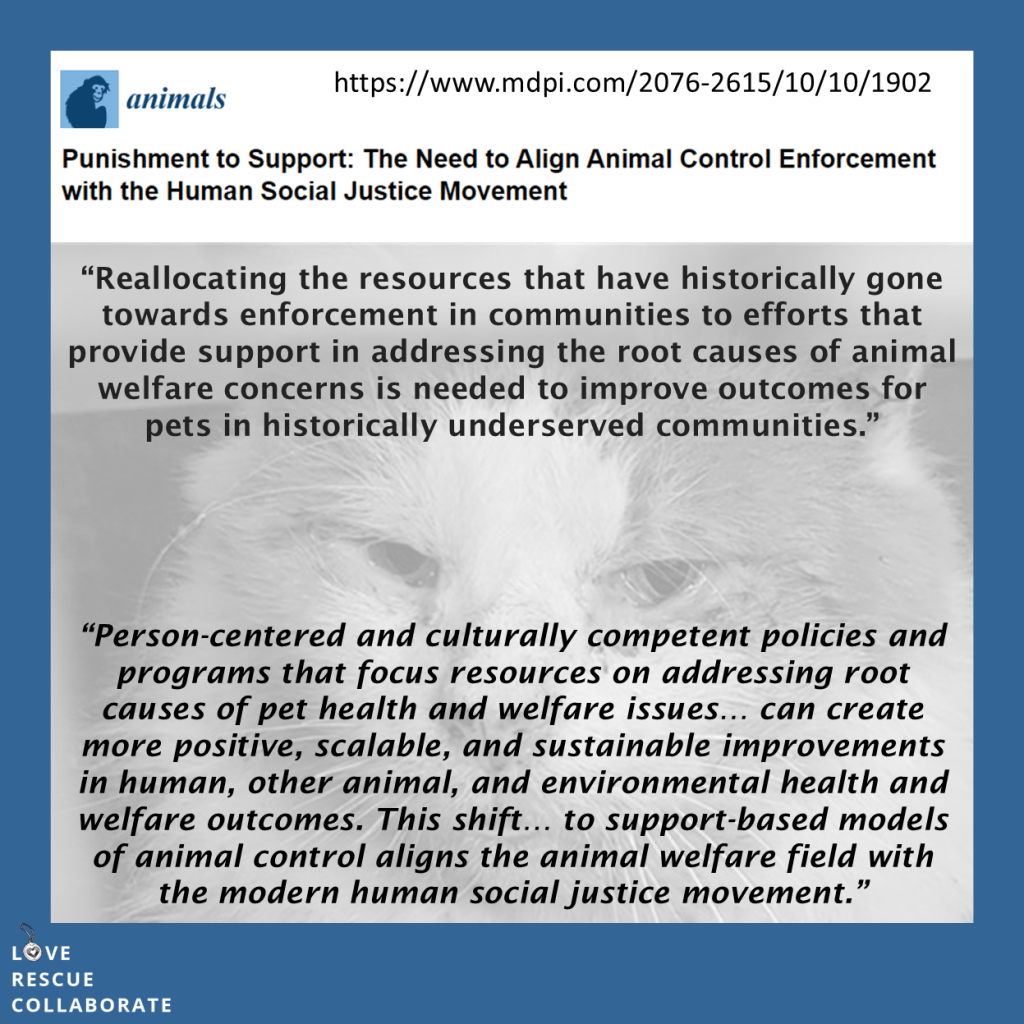
“Person-centered and culturally competent policies and programs that focus resources on addressing root causes of pet health and welfare issues as opposed to an emphasis on code enforcement can create more positive, scalable, and sustainable improvements in human, other animal, and environmental health and welfare outcomes. This shift from punishment-oriented approaches to support-based models of animal control aligns the animal welfare field with the modern human social justice movement.”
“…Shifting animal control policies from punishment to support is intended to act on the recognition of the physical and emotional benefits of the human–animal bond and incorporating animal control agencies into a more robust system that supports pet ownership“
ONE WELFARE FUNDAMENTALS FOR PET OWNERS
“One Welfare serves to highlight the interconnections between animal welfare, human wellbeing and the environment.”
“A One Welfare approach promotes the direct and indirect links of animal welfare to human welfare and environmentally friendly animal-keeping systems.“
One of their initiatives includes “One Welfare Phoenix is a new project designed to support the sustainable development goals and global reduction of violence by supporting the production and dissemination of practical guides to professionals to help identify and report the link between animal and human abuse and neglect, including the relation to their environment.”
RSPCA AUSTRALIA ON ONE WELFARE FOR THE COMMUNITIES / PET OWNERS
“In practice, this concept calls for veterinarians and related animal services such as trainers, an animal’s owner, environmental scientists and human psychiatrists to collaborate and share expertise in order to care for the welfare of both animals and their owners.”
Note that animal owners are an integral role in the approach.
“Community health programs for pet owners – The bond between owners and their pets can decrease social isolation, increase a person’s sense of purpose and bring joy to someone’s life. This is especially true for more socially isolated groups such as elderly people or people struggling with homelessness. However, these circumstances can also make it difficult for these people to give their pets adequate care.”
REFERENCED INFORMATION
Punishment to Support: The Need to Align Animal Control Enforcement with the Human Social Justice Movement
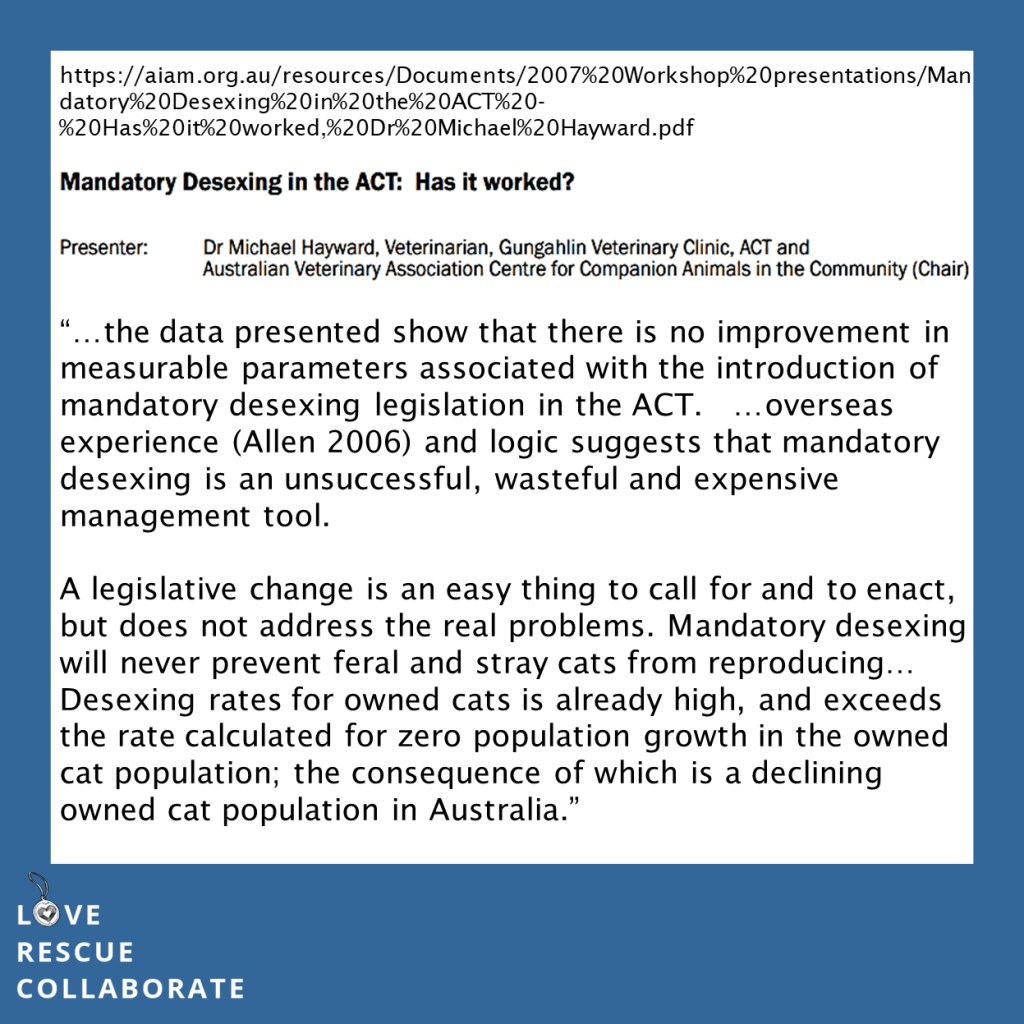
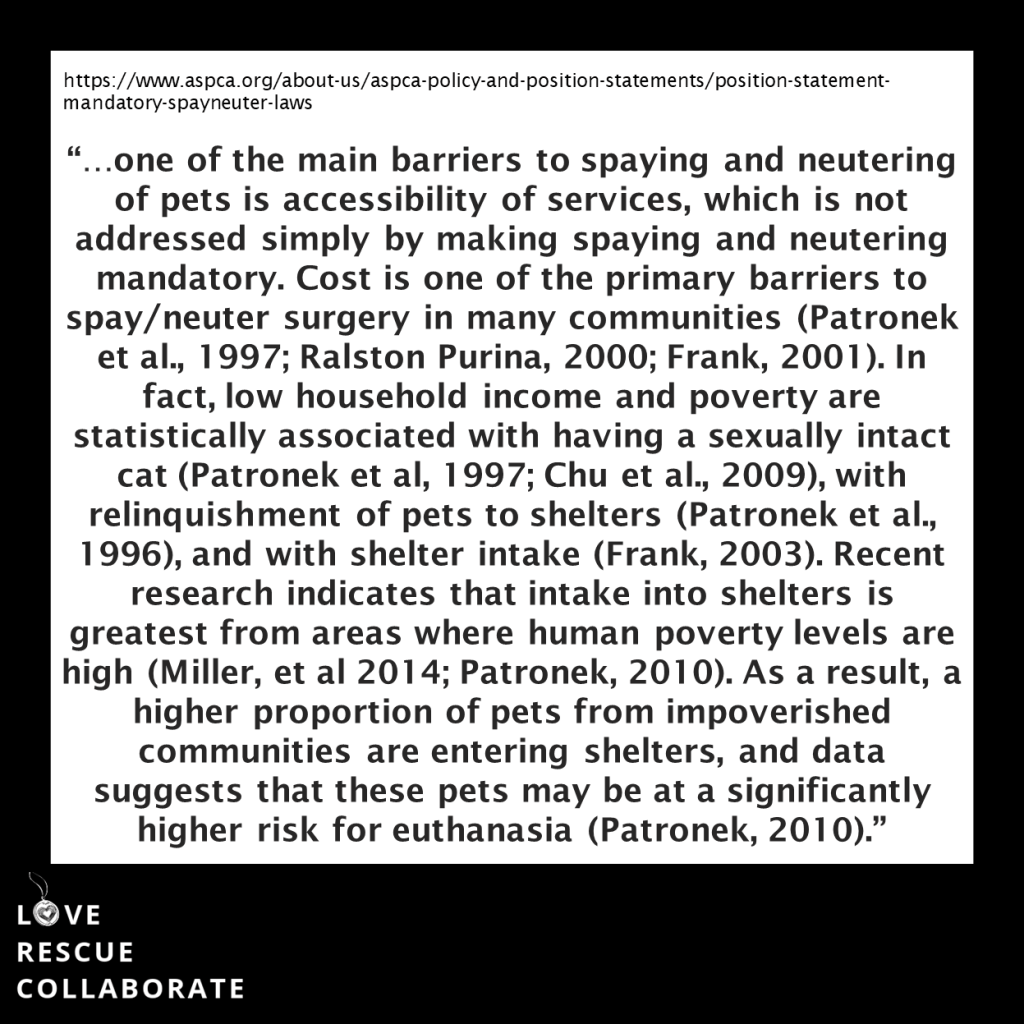
is not support for mandatory desexing in legislation,
are better ways to approach improving desexing rates and reduce the number of abandoned animals, animals allowed to roam and the number surrendered and euthanased in council pounds and shelters, by vets and rescue groups.
The ASPCA supports desexing, however explains that to justify mandatory desexing, an authority needs to be gathering performance measurements for years before and after these rules come into effect to show benefits, but where is this evidence?
Mandatory desexing has been implemented in a number of Australian states and the ACT, and councils, where is there proof of success? When will a council provide evidence before and after these approaches are implemented?
SUPPORT FOR DESEXING (NEUTURING & SPAYING) COMPANION ANIMALS
Many organisations and ourselves support desexing for companion animals (cats and dogs), and we recommend that
desexing should be free for those in financial need and low socio economic areas,
it is critical that free desexing is provided in hot spot urban areas (targeted areas) where there is a significant number of cats breeding.
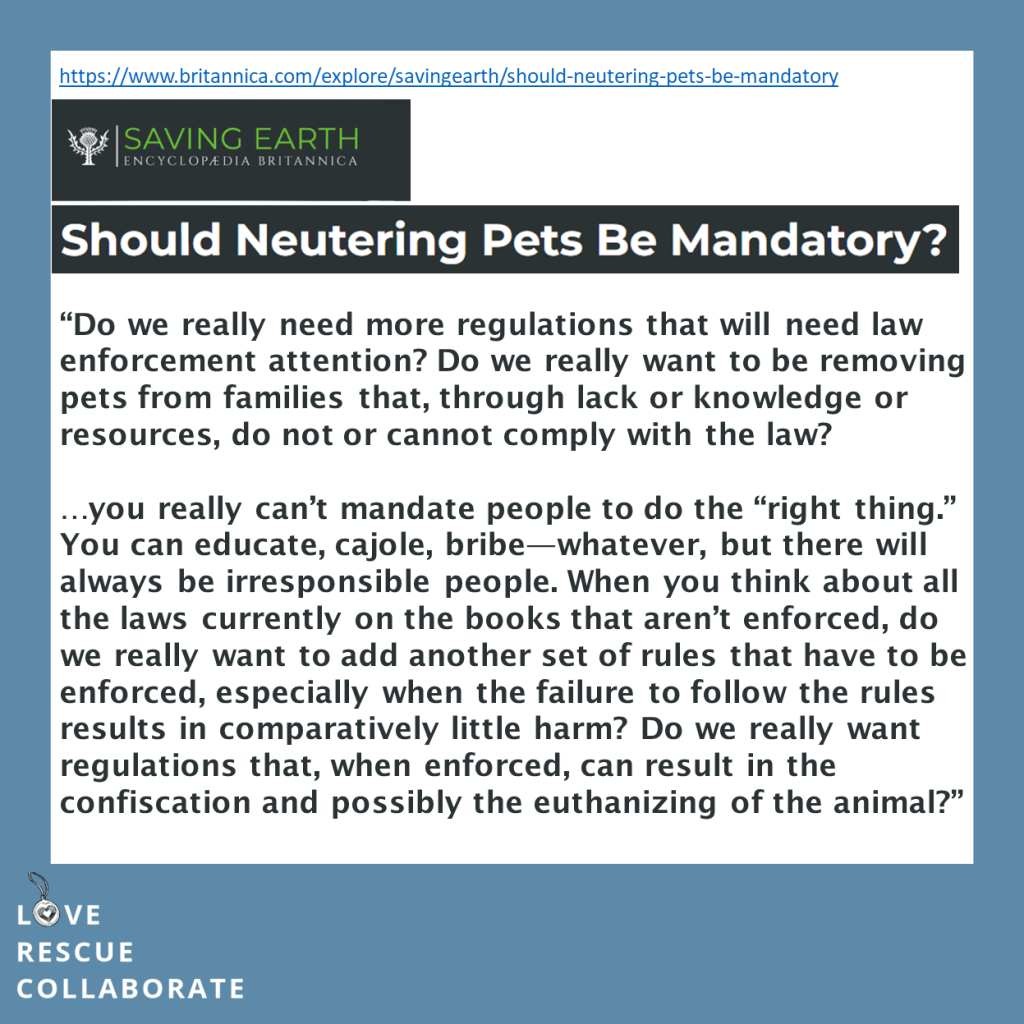
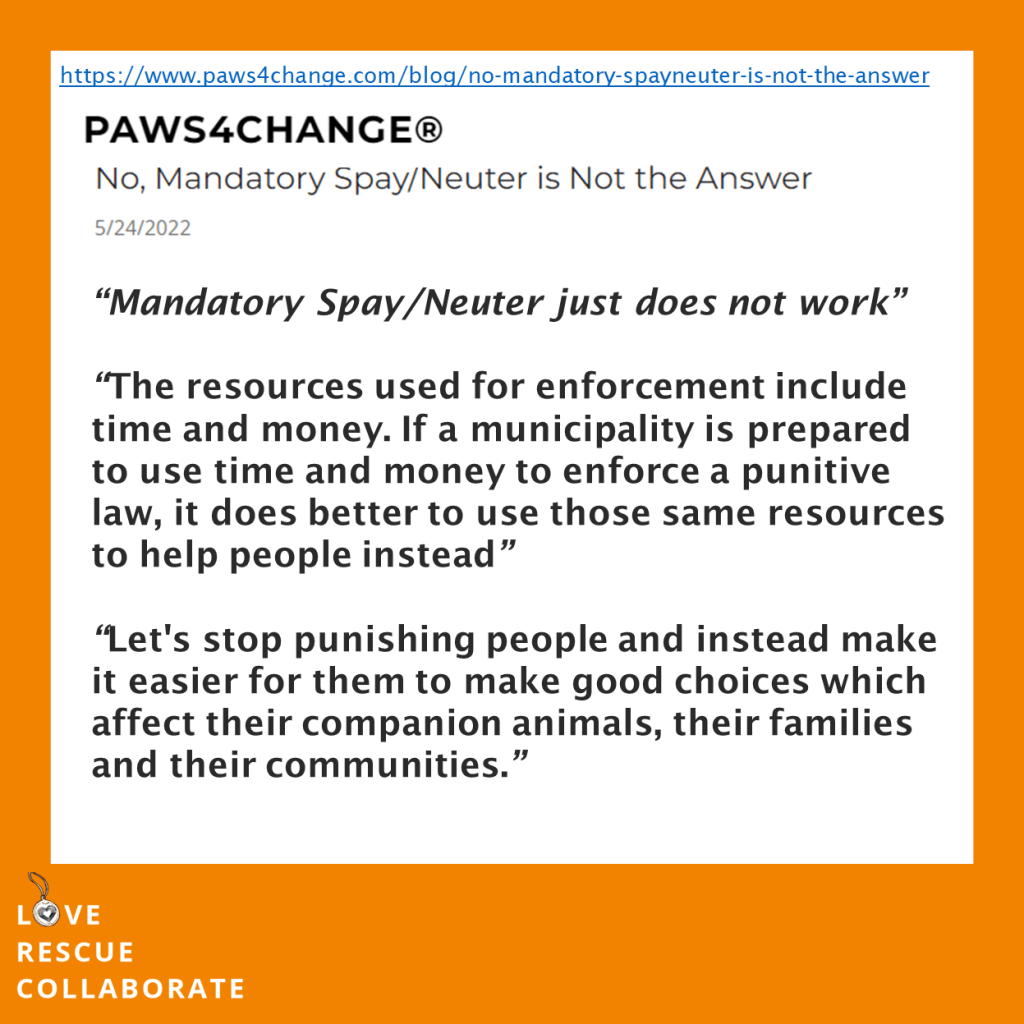
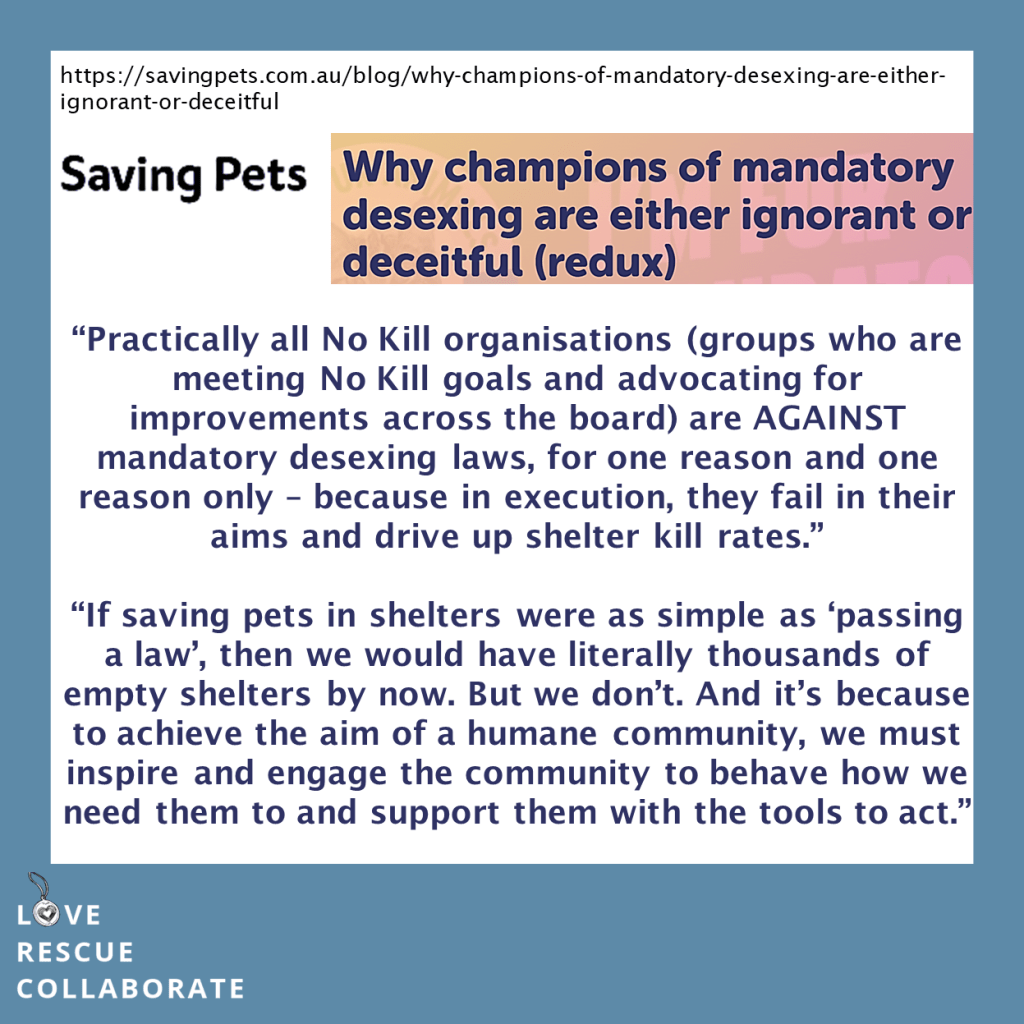
However, there are issues with making desexing mandatory under legislation, as this approach fails to deliver the expected outcomes.
IS MANDATORY DESEXING EFFECTIVE?
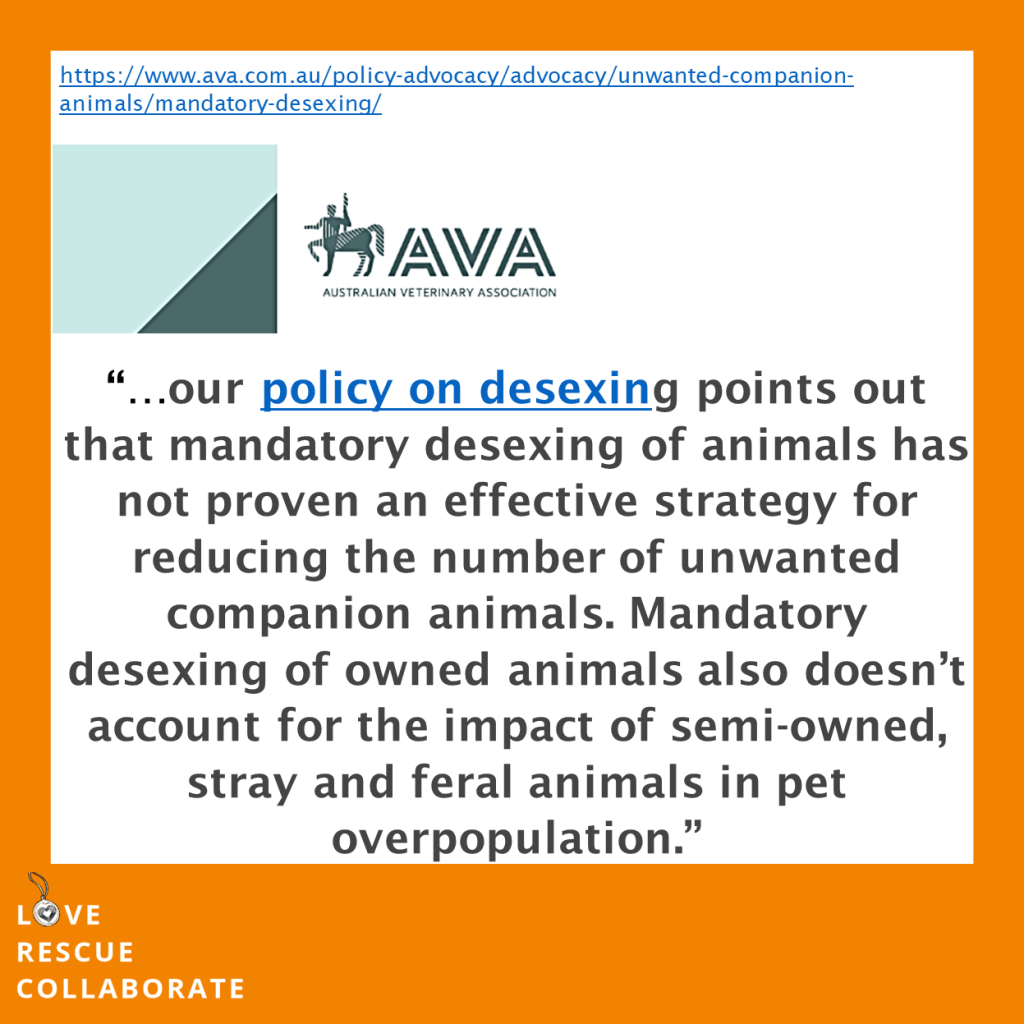
NO from the Australian Veterinary Association (AVA)
NO from Dr Michael Hayward, Veterinarian, Gungahlin Veterinary Clinic, ACT and Australian Veterinary Association Centre for Companion Animals in the Community (Chair)
NO from American Society for the Protection of Cruelty to Animals (ASPCA)
NO from Encyclopedia Britannica Saving Earth, Andrea Toback on Should Neutering Pets Be Mandatory?
NO from PAWS4CHANGE
The are many more animal welfare organisations who agree with these views in Australia and other countries.
Special recognition to Australia’s Saving Pets who raised similar points and relevant references in their blogs including 2018.
WHAT’S A BETTER APPROACH? WHAT DOES WORK & IS SUPPORTED
low-cost desexing (spay/neuter) clinics
free desexing in high intensity in targeted low socio economic areas (eg Banyule council in Victoria)
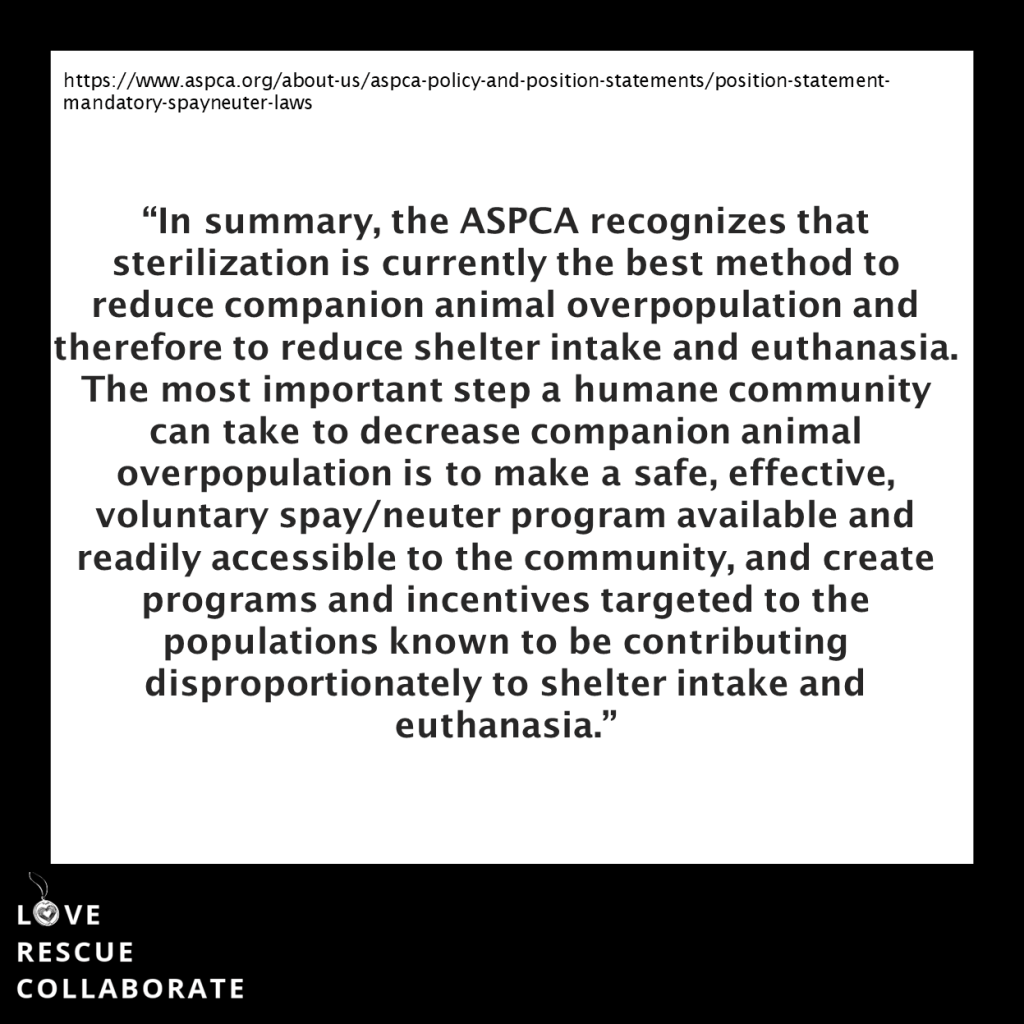
“The most important step a humane community can take to decrease companion animal overpopulation is to make a safe, effective, voluntary spay/neuter program available and readily accessible to the community, and create programs and incentives targeted to the populations known to be contributing disproportionately to shelter intake and euthanasia.” ASPCA
We have yet to see a targeted program for areas where there are significant cultural differences, ie people from other countries retain their country of origin attitudes to animals. When will we see this “elephant in the room” addressed effectively?
(It is covered in the advice from ASPCA.)
ONE WELFARE APPROACH: PROVIDE SOLUTIONS NOT PUNITIVE ENFORCEMENT
This research confirms that for areas of low socio economics, that hard enforcement is not beneficial to the health outcomes for animals and their owners, it is better to provide support services to assist with proactive animal welfare services.
SUMMARY
The majority of these views have been formed for several years, and not questioned nor put into doubt. Mandatory desexing is likely to:
increase pets being abandoned,
increased intakes to pounds/shelters and rescue groups,
ultimately increase euthanasia rates and costs,
increase compassion fatigue (secondary trauma) with staff and volunteers in such establishments with increased euthanasia rates.
Many animal welfare organisations support that implemented mandatory desexing legislation has not proven worthwhile.
Those organisations or politicians who propose mandatory desexing have yet to provide evidence/ proof of beneficial outcomes. Just why does this topic get raised?
Again, special recognition to Saving Pets who raised similar points and relevant references in their blogs including 2018, and several years before.
Better to invest in free and subsidised desexing for owners and pets in need.
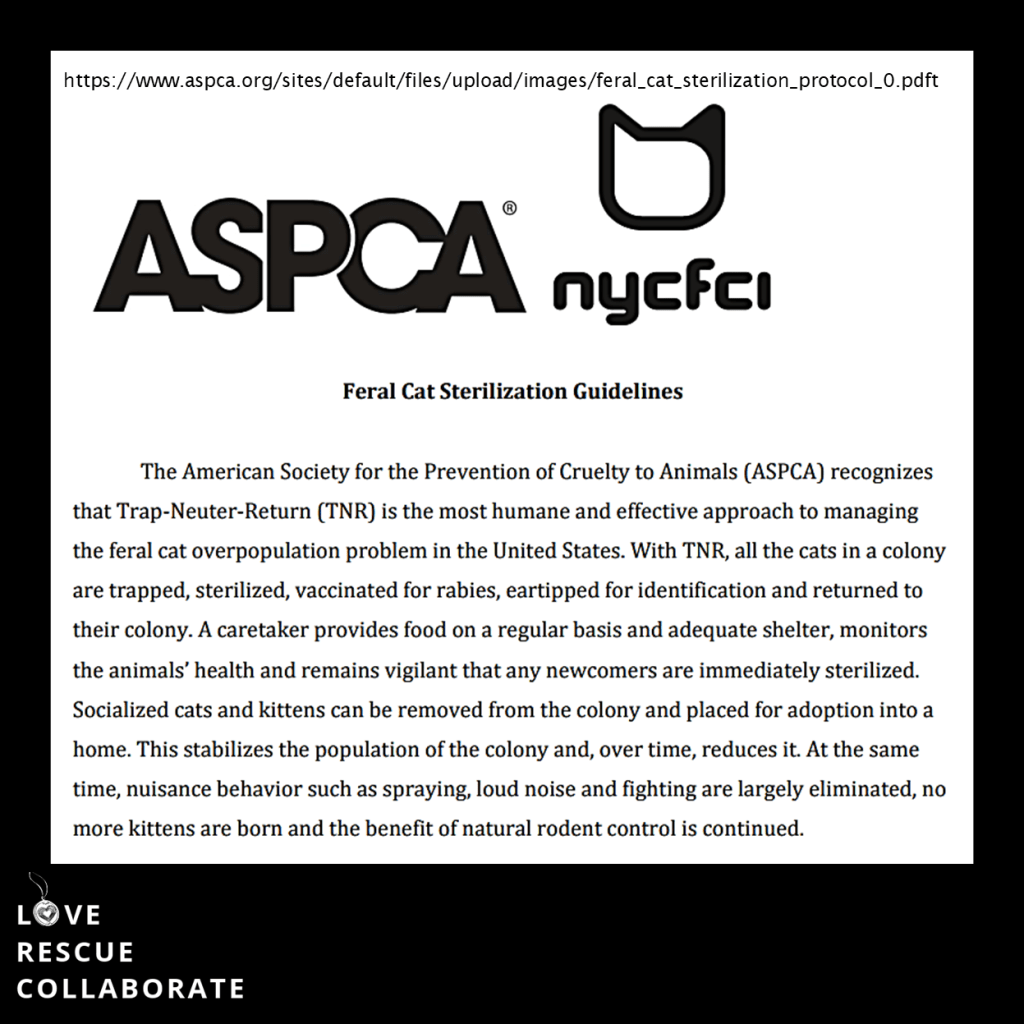
This includes the stray or abandoned cats, who in the USA are often also termed feral cats.
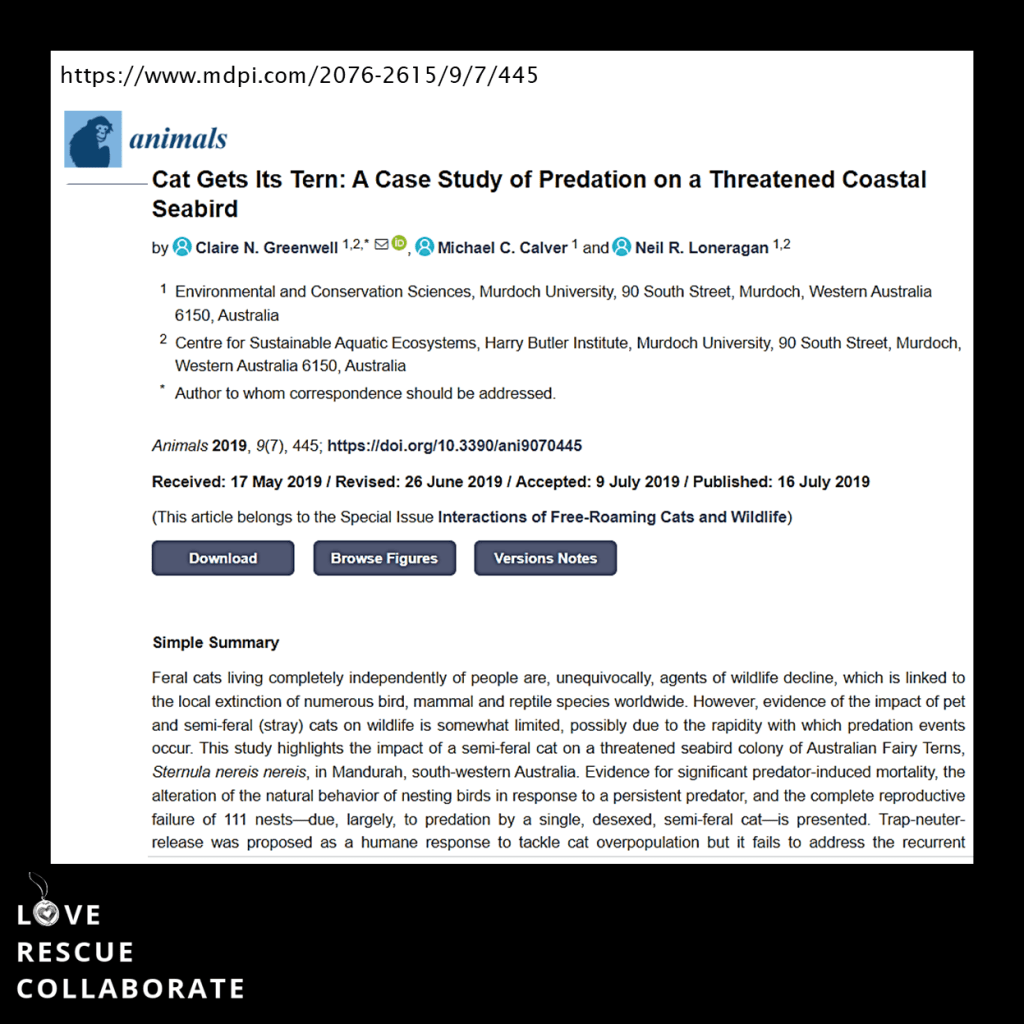
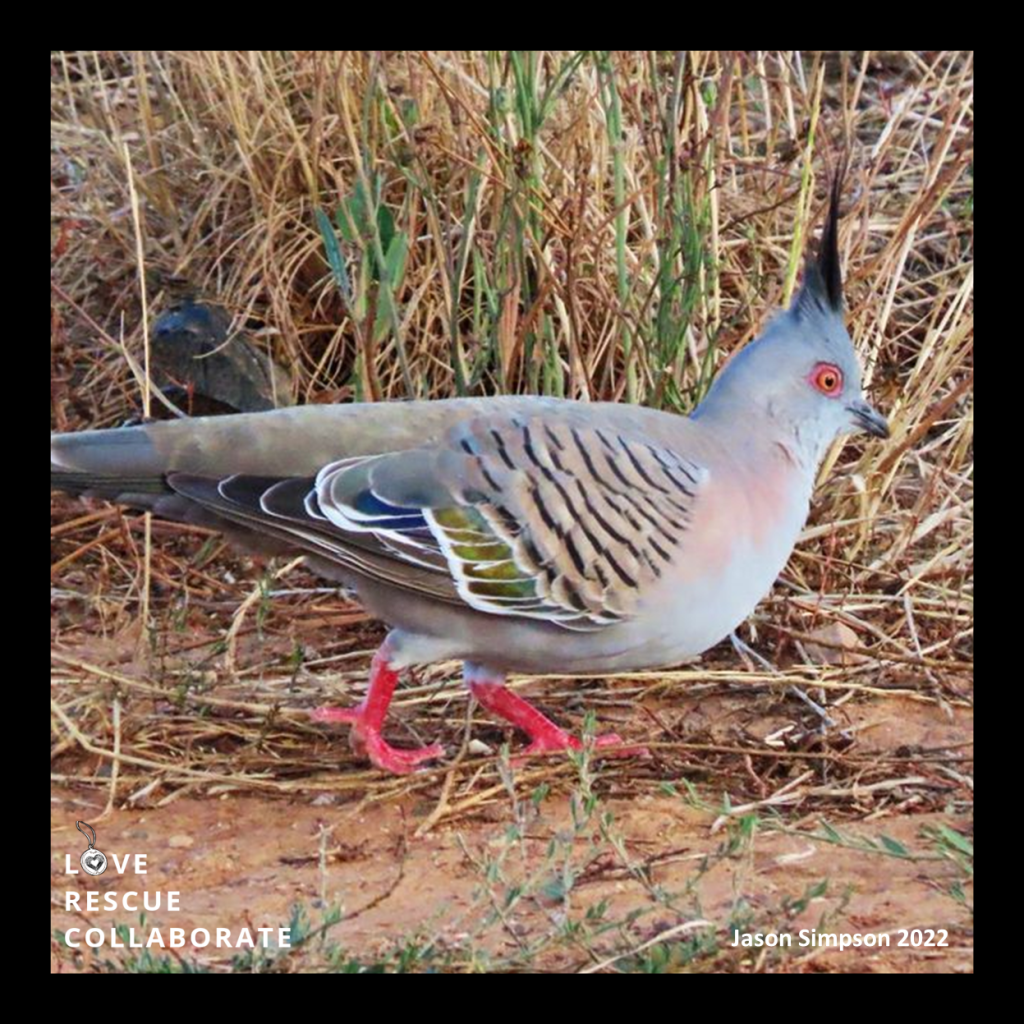
Is “Cat Gets Its Tern: A Case Study of Predation on a Threatened Coastal Seabird” an example of shaky science? We believe there are certainly many valid questions about the findings of the study.
This is a brief set of comments and questions in relation to the Mandurah study presented in 2019 related to two Australian Fairy Tern nesting sites. There are questions on a study which is often cited for anti TNR justification and the Invasive Species social media posts on cats.
Please note that the LRC team supports and promotes cat enclosures, and supports our native wildlife.
The main observation is that there were two nesting sites, and one site did not record the presence of cats yet it also struggled to achieve meaningful breeding success for the Terns.
That is, there were a number of significant threats to both of the two nesting sites in the largest regional city in Western Australia, described as being similar in urban environment like “the Gold Coast in Eastern Australia” (Wiki).
Yet, the study claims it “demonstrates that desexed, free-roaming cats remain a significant threat to wildlife and can lead to swift population declines and the local extirpation of native species” – but does it? Certainly some cats are hunters, some cats seldom hunt as was shown by the grey cat recorded in the study.
For one of the nesting sites, a 1.2m high fence was erected, and it’s side was covered in shade cloth. Were the choices for this 1.2m fence questionable as:
Why was it so short it was easily scaled by a local cat?
Why didn’t it conform with the proven conservation fencing standards?
Was it a contributing negative factor “for such a rapid effect” by a cat as it enclosed the new borns?
Was it a very poor decision for advancing nesting for a native animal at risk?
THE STUDY – RECOGNISED LIMITATIONS
The study includes “evidence of the impact of pet and semi-feral (stray) cats on wildlife is somewhat limited”.
It is recognised in the study that the findings on the impact of two cats was not the primary focus of the original work “the aim of the study was to encourage breeding by Fairy Terns and not on the potential impacts of domestic cats”.
Further, not one alleged single cat kill was recorded by cameras nor sighted by the adhoc or scheduled human monitoring of the sanctuary and adjacent roped off area. Although the white cat is likely to have harmed the baby terns in the enclosured nesting site, there are other considerations that may have contributed to this.
Additionally, the other nesting site where cats were not observed, appeared to also not succeed in increased breeding. That is, there were other factors limiting successful breeding.
Is the term “semi-feral (stray) cat” open to interpretation? We see social posts with any roaming cat, not just strays, being referenced as a feral cat.
Isn’t a cat either feral or not? Does labelling a roaming cat as a semi-feral, in our opinion:
attribute legal interpretations and misunderstandings especially to cat haters who will kill/harm a roaming cat?
include assumptions about the human care which the cat may have been under?
include assumptions about whether the white cat may be timid or less social due to interactions with humans in general or other factors such as the interactions with the people monitoring during the study who were likely to be hostile to the white cat (Table 2 includes that the white cat was shooed away and chased in separate interactions)?
THE STUDY – DOES IT LACK DETAILED EVIDENCE?
Is the study light on detailed information given a number of considerations in terms of visiting cats who were not a subject under the original study?
the two nesting sites are close to medium density urban area including a marina and apartment,
the likely limited size of the sanctuary and the other nesting site in terms of sand area (due to erosion),
the limited number of parenting birds, and
the number of potential predators/ disturbances: humans, dogs, natural predators such as kestrels and gulls, two cats from residents (one assumed abandoned), and the potential of other predators such as vermin (urban rats).
It is possible that abandoned cats may kill native animals to survive. In our opinion, in urban areas, abandoned cats are more likely to prey on vermin who are active at night and possibly during the day.
A SUMMARY OF THE SOME OF THE KEY STUDY FEATURES & FINDINGS
the sanctuary was established on “a parcel of land on Breakwater Parade in the Mandurah Ocean Marina, ‘the sanctuary’… cleared, a 1.2-m-high chain mesh fence lined with shade-cloth was installed to limit human and vehicular traffic”
a second site included the “beach-nesting colony was roped off by the City of Mandurah on 1 November to deter incursions by beachgoers in an attempt to reduce disturbance of the terns”. Yet, the “beach-nesting colony faced a range of threats, including incursions into the roped area by people and dogs (despite it being a dog-free beach)”
a grey cat who was recorded which appeared on at least two nights and did not appear to prey on the terns
a white cat who was recorded and appears to have been attributed to many deaths of terns, although not one “kill” was actually viewed nor recorded, this attribution appears to be based on the remains of birds and chicks (which may have been caused by other animals)
the only viewed kill was by a kestrel
there were other predators such as gulls
at the second site, humans and their unleashed dogs in a nesting area were sighted
at the second site, there was also a significant loss of nesting/breeding, no cats were sighted nor evidence provided
at the sanctuary, the decision to only have a fenced area 1.2m high is questioned, the situation of almost presenting the chicks in a concentrated contained (for the chicks) area, well, is this not like setting up a buffet for a coach load of tourists? (a form of entrapment?)
the decision to shade cloth the sanctuary is questioned, as it appears that “the chicks were silhouetted against the shade-cloth fencing, enabling the kestrel to locate its prey more efficiently” and would this have not also been the case with the chicks inside the sanctuary for all predators?
the terns most likely selected the nesting sites based on historical use, however, did the study investigate a number of protective responses? “Perhaps the most significant threat faced by the terns was erosion of the beach due to the cessation of the annual sand by-passing scheme in early November. Beach erosion forced several Fairy Terns to abandon their nests.”
THE STUDY CONCLUSION ON CONTESTING TNR – IS THAT SO?
One of the conclusions of the study “Trap-neuter-release programs should be strongly contested” is questionable given that the two nesting sites were at significant risk from multiple threats, one of the nesting sites was unsuccessful due to all other threats as a cat was not present, and one of the cats visiting the sanctuary did not appear to hunt.
The study has classed the white cat as “semi-feral”, and has assumed the white cat was previously owned but not currently owned. However it appears this has not been verified and is assumptions. It is possible that cat owners do desex their cats but choose not to microchip and therefore be held to other government obligations and financial penalties. This question for the white cat on ownership and being classed semi-feral questions the use of the hunting activities of a cat which may or may not have been TNRed.
Isn’t it possible that the white cat may have been owned by an owner who is best addressed with education and cultural change? Rather than impounding and euthanasing?
The study also relies on overseas studies which involve situations on islands. Islands with cat management issues have very specific conditions and attributes, and do not suffer from the “vacuum effect”. Doesn’t the Mandurah situation have its own specific conditions and attributes, as would the city / CBD area too?
The study does not explore where TNR occurs in dense urban areas and Mandurah is rated as the largest regional city in Western Australia. It appears that a native animal at high risk has been surrounded by medium density urban development.
The study includes that TNR “fails to address the recurrent depredations on native wildlife that occur post-release”. Does it appear that the study does not appreciate that a managed TNR program often involves:
a rehoming initiative for social and easy to adopt cats and kittens ie reducing the numbers of cats and kittens,
a desexing initiative to decrease the number of cats breeding and kitten numbers,
a feeding initiative to decrease the scavenging, and potential hunting and instincts, and
a focus on abandoned social cats who may have become very timid from being in a hostile urban environment; with a safe temporary “home” in a neighbourhood as pounds and shelters have limited capacity and resources, and where often they euthanase the cats who cannot be rapidly adopted.
OVERALL QUESTIONS THAT NEED MORE RESEARCH
It is critical to complete better research on the impact of humans and other animals including cats on our native wildlife. Especially where the species are at high risk. An abandoned pet cat placed in a situation where it needs to survive will take the opportunity to feed on small animals and scraps from urban “rubbish”. The last of our questions include, how is it best to:
minimise people abandoning pet animals?
reduce the overall number of pets being so easily bred and given away? and
reduce the number of pets allowed to roam, whether this be dogs off leash or cats roaming from their properties into any native animal areas (sanctuaries) at high risk?
develop a holistic approach to all the main threats to our animals at most risk in each local government area, and how does this become integrated in each biodiversity revie and plan?
REFERENCED INFORMATION
2019: CAT GETS ITS TERN: A CASE STUDY OF PREDATION ONA THREATENED COASTAL SEABIRD
It appears that to date there has been little research based on scientific evidence of the impact of domestic cats in urban areas on wildlife. Australian Pet Welfare Foundation & Love Rescue Collaborate promote and encourage cat enclosures etc. However, there is not explicit research nor data gathering to indicate the domestic cat impact on wildlife, especially in urban areas where native wildlife is limited due to land clearing and lack of green corridors.
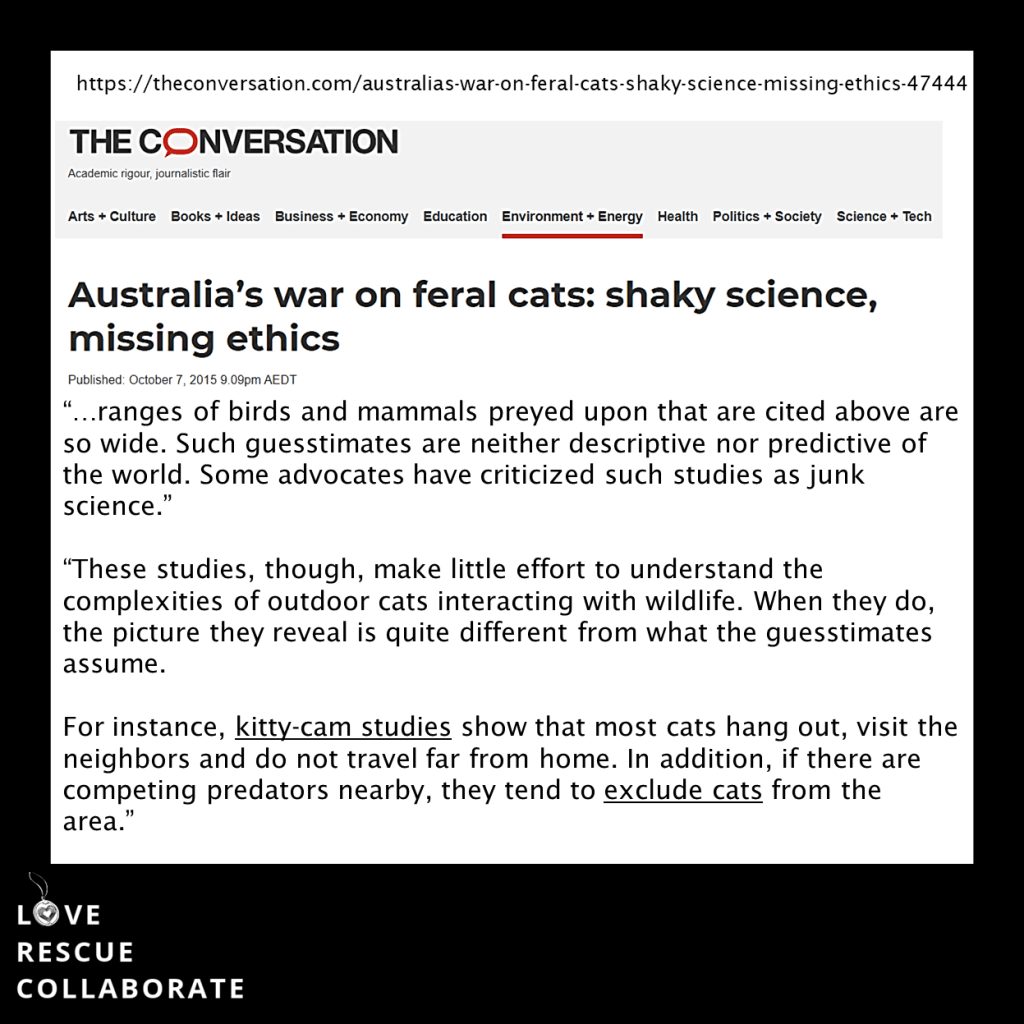
BAD/ POOR/ SHAKEY/ JUNK SCIENCE – too many assumptions, too little research evidence
Therefore, does it appear that “bad / poor/ shaky/ junk” science has been applied with the high level of assumptions and little to no evidence based studies that are being used to spark / incite reactions about cats on wildlife, over other threats?
Are too many non-evidence based studies like the Sara Lea pastry: “layer upon layer” of assumptions?
APWF DOMESTIC CATS AND WILDLIFE POPULATIONS
The discrepancies from evidence based studies has been highlighted in the paper on “Domestic cats and wildlife populations” completed by the Australian Pet Welfare Foundation (APWF). This paper is included under reference information and was initially included for the consideration of Hornsby Council NSW.
“An ongoing issue is that feral cat impacts are often wrongly attributed to domestic cats, even though they are two very distinct populations with different behaviour and ecology”
“…there is actually no definitive scientific evidence demonstrating population viability or conservation impacts at a population level on Australian native animals by domestic cats living around people”
The APWF paper also indicates that the factors that did significantly impact native animals that could be measured in urban areas include:
vegetation quality,
housing density,
distance from bushland and
size of bushland
(from the Maclagan, Lilith and Grayson studies).
So, why is there so much focus on cats and not the other factors?
What about the cat restrictions being favoured by Australian councils?
The APWF paper includes the outcomes of the Lilth 2010 Australian study which analysed cat regulations in suburbs and impacts on species diversity and abundance. In brief, the measured (evidence based) findings include:
in the cat regulated council areas there were no significant differences in species diversity nor numbers for the most abundant medium sized mammals ie the mandatory confinement was not proving to be highly beneficial for wildlife numbers, and
in a non-regulated area, the smaller mardo was found, an animal which is potentially the most susceptible to cat predation, ie where mandatory confinement was not applied, native wildlife was still surviving.
The APWF points lead to the need for scientific measurements before and after trialling any regulations on cats and their owners, to evaluate the value and to have the opportunity to refine any rules or invest in other actions/ responses (e.g. fencing for critically threatened species).
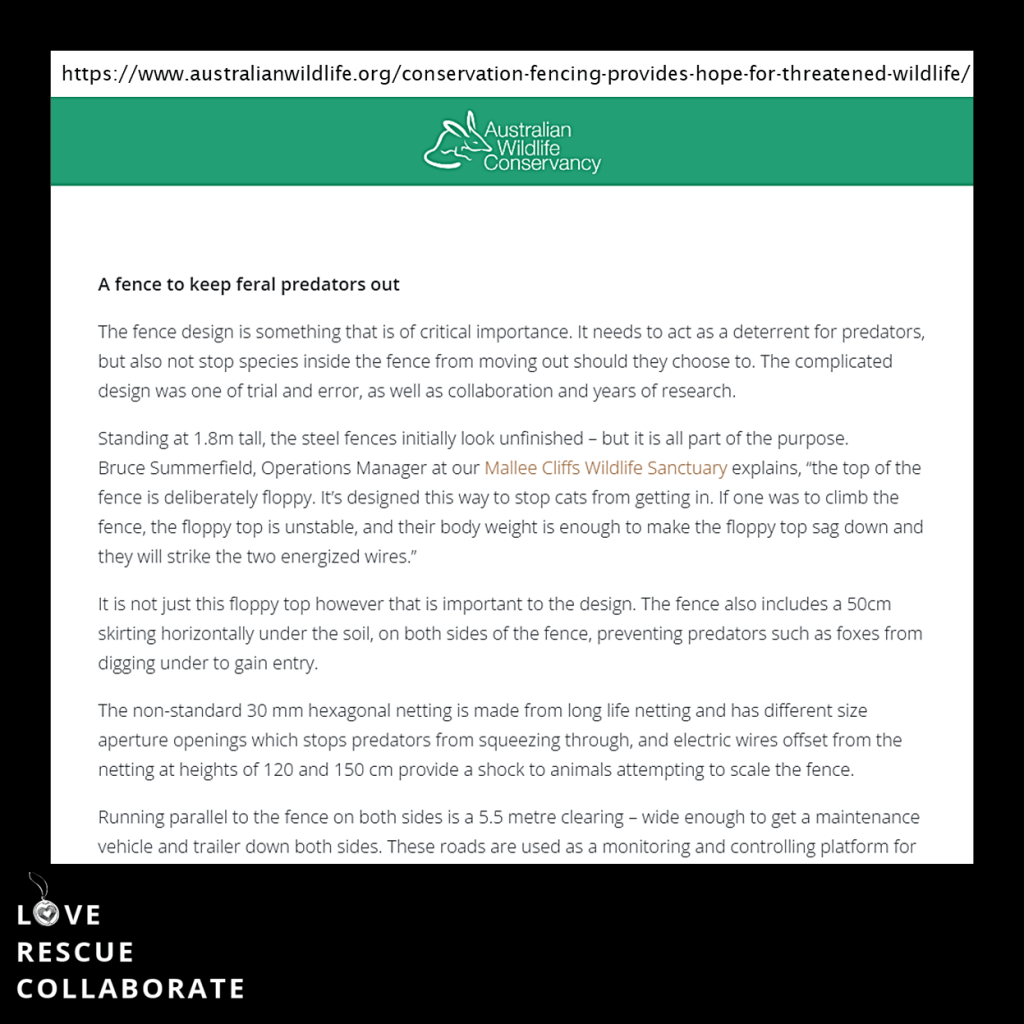
AUSTRALIAN WILDLIFE CONVERSANCY: PROTECTIVE FENCING APPEARS THE MOST SUCCESSFUL TECHNIQUE FOR NATIVE WILDLIFE
“AWC is Australia’s leading proponent of conservation fencing, and have established a network substantial feral predator-free areas across mainland Australia.
Wildlife translocation and reintroduction programs conducted inside these fenced reserves are proven to be the most effective way of keeping native fauna safe and ecosystems intact.”
LRC RECOMMENDATIONS
With more work being completed on which native animals in each state/territory are most endangered / threated, we need to also see a holistic approach and integrated responses:
Biodiversity research for each local government area plotting just where native animals most at risk are located – ie which areas need the greatest protection,
Better responses to our most endangered / threated native animals from the state/territory government who control the allowed land clearing for developments,
Better responses from our federal government, and state/territory, and local governments on climate change and its impacts being droughts, floods, fires, and
Spending resources on techniques which are most successful to care for our native animals such as protective fencing.
Decision makers for cat management approaches need to consider the potential risks to the carers of cats, that is, when harming roaming cats then those who provide ongoing care for the cats are also harmed. We explore relevant research and the recommendations to incorporate in cat management plans and operational (tactical) activities.
The following is provided based on two items of research, one from Australia based on the Newcastle Port culling/ shooting of cats in a colony and the devastating impact on the people who were caring for these cats , and research from the USA on the benefits of proactive solutions over enforecement for handling animal wlefare issues, especially in low socio economic areas. Topics include:
RISKS FOR ROAMING CATS
RISKS FOR CARERS, AUTHORITIES & THEIR CAT MANAGEMENT APPROACHES
DECISION MAKERS NEED TO CONSIDER SUPPORT SERVICES RATHER THAN ENFORCEMENT
CAT CARERS AFFECTED BY THE CAT CULLING AT THE PORT OF NEWCASTLE
THE NEED TO ALIGN ANIMAL CONTROL ENFORCEMENT WITH THE HUMAN SOCIAL JUSTICE MOVEMENT
RISKS FOR ROAMING CATS
Containing cats to owners’ properties is recognised as a way to keep cats safe from others, and to limit a cat from potentially causing a nuisance or harming other animals including wildlife. It is encouraged for all cat owners.
However, we are aware that “door dashers” cats may escape, and some owners are not able to provide enclosures.
Cats found roaming or a colony of cats may be under threat of:
a council’s “cat management” approach for euthanasing over rehoming, and
the public who may “take matters into their own hands” when they believe they are acting within the law under any mandatory cat containment legislation / rules.
The latter is a serious risk as “all roaming cats are feral and should be culled” has been quoted many times on social media.
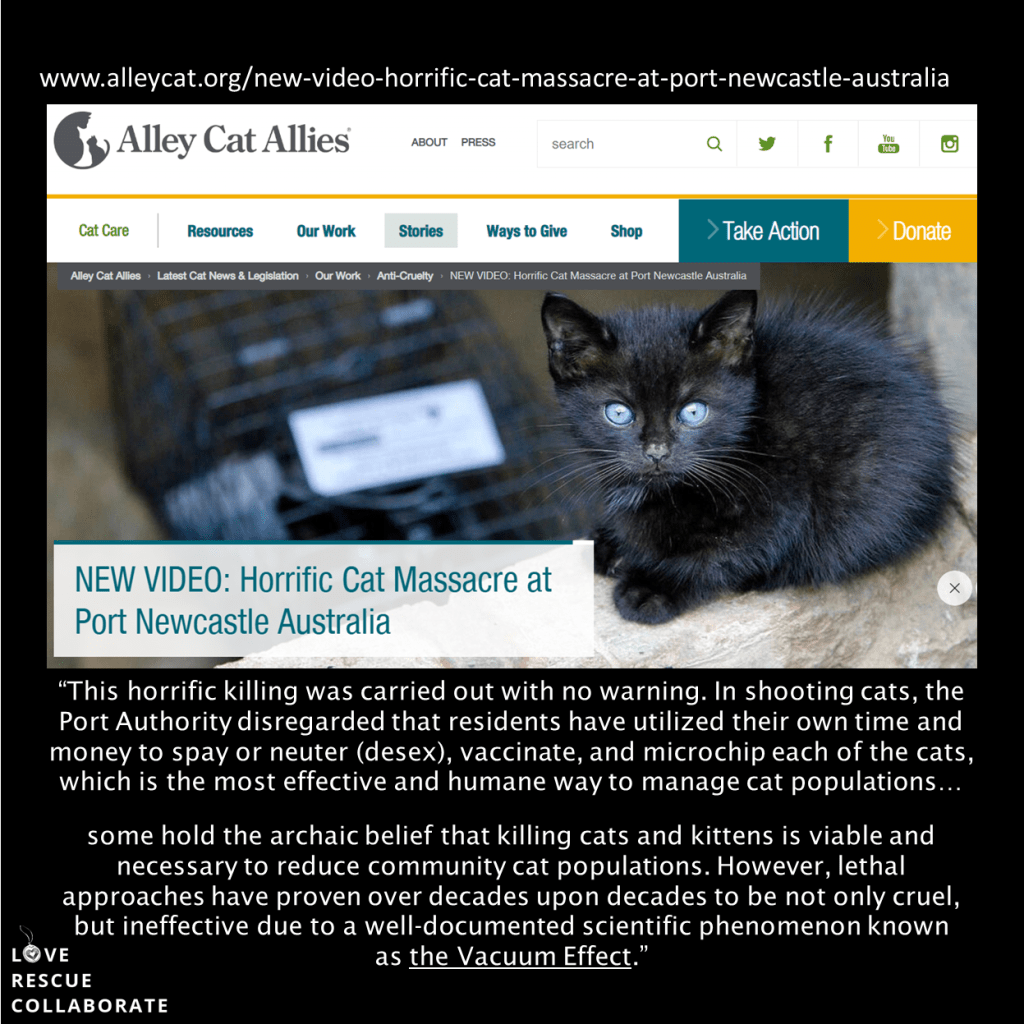
[Reference links are below – eg Alley Cat video on the Port of Newcastle incident shooting cats, and previous LRC posts on the Dark Side of Mandatory Cat Confinement]
RISKS FOR CARERS, AUTHORITIES & THEIR CAT MANAGEMENT APPROACHES
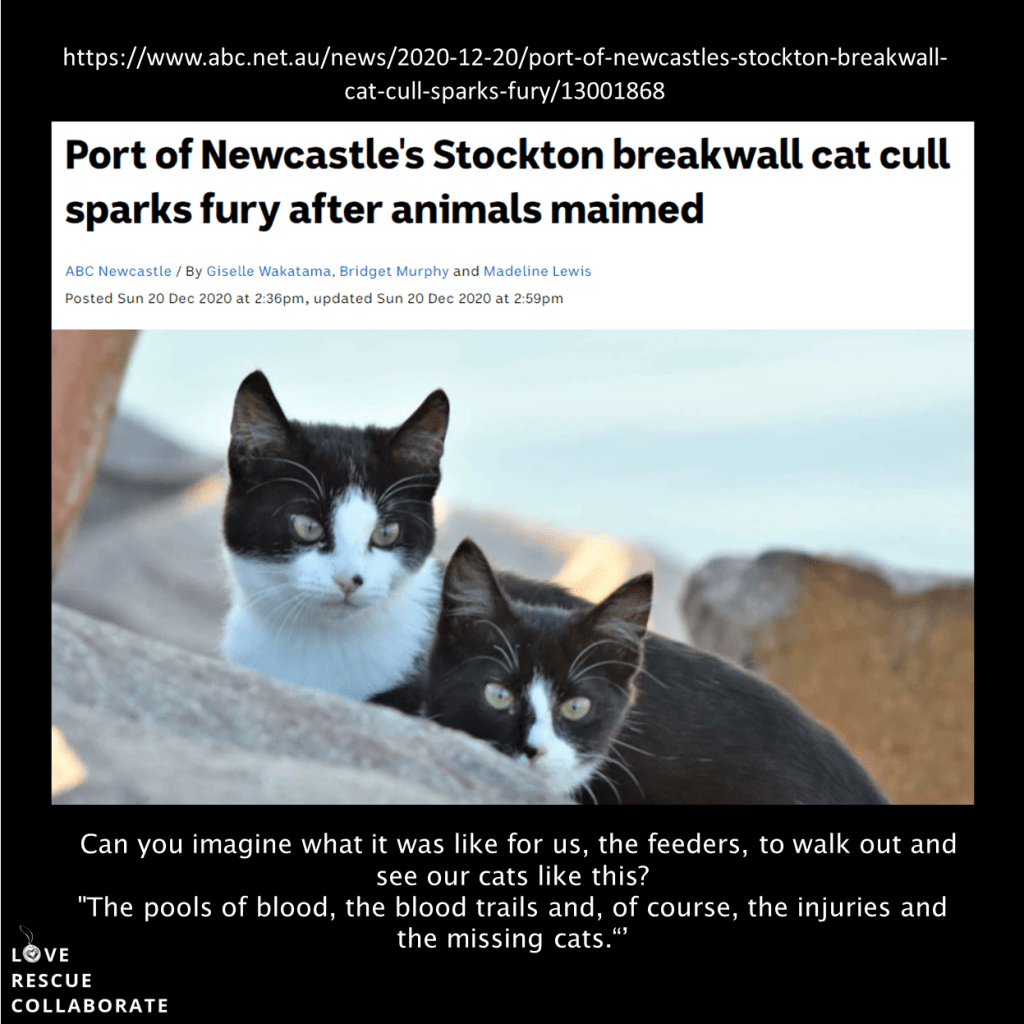
A recent Australian study / research has highlighted the impact to cat carers (eg cat rescue groups) from the Newcastle Port culling/killing of roaming cats, who where in a colony (group) being managed and supported by cat rescuers. This was a shocking incident reported in several media outlets and on social media.
The major finding includes that culling/killing even with humane veterinary techniques will contribute to significant health impacts to the carers, and that this is likely to far outweigh the risks the cats were likely posing to the community and/or wildlife.
More information on this study is summarised below.
Further, this may lead to legal ramifications for the authorities for the cat management approaches based on culling/ killing that may be promoted in the local government area or on a private property.
In our opinion this experience and research is relevant to:
all roaming cats, be they single, a family unit or a colony of cats,
all carers, be they individuals, a group of friends or a cat rescue organisation.
Besides the suffering of cats killed “in the field” or removed/ trapped and taken to a pound or vet for euthanasia, one must recognise the significant negative impacts on the people who were caring for these cats. This becomes more intense the larger the number of roaming cats or colonies of cats, who are targeted for removal and death by authorities being local councils, animal welfare organisations providing enforcement services, or owners of private properties.
DECISION MAKERS NEED TO CONSIDER SUPPORT SERVICES RATHER THAN ENFORCEMENT
Another study from USA 2020 recommends that is it far better practice to offer support services to enable solutions rather than brutally enforcing laws/legislation. [reference link below]
It highlights that over enforcement in low socio economic areas, in terms of “higher confiscation, relinquishment, and euthanasia rates, lower return to owner rates, and extended lengths of stay in animal shelters” results in worse health outcomes for the pets in these areas.
That is, for areas of low socio ecomonics, hard enforcement is not beneficial to the health outcomes for animals and their owners, it is better to provide support services to assist with proactive animal welfare services.
More information from this reserach is summarised below.
A prime example in Australia is Banyule Council AMO who setup and operated free desexing in hot spots for years, rather than siezing and destroying animals, and trying to apply penalties. [reference link to Banyule is provided at the end of this post]
CAT CARERS AFFECTED BY THE CAT CULLING AT THE PORT OF NEWCASTLE
Australian based research and findings publish 12 January 2023 based on the Newcastle Port incident. [reference link is below]
MAJOR RECOMMENDATION
For consideration by all authorities/ decision makers:
“the severity of the adverse psychological impacts, and the morbidity rate amongst the cat caregivers we interviewed, was far greater than would be expected as a risk to the community if the cats had remained at the site. We therefore suggest that potential legal ramifications should be considered before authorities intentionally choose a method of management that is likely to inflict substantial harm on community members.”
BACKGROUND on the research
Several experts in veterinary science from multiple universities completed research on the impacts on the people who were caring for a colony of cats
Published recently 12 January 2023, we feel more similar research will be following, the findings should not be a surprise to any reader or people involved in volunteer rescue / carer roles.
One “aim was to explore caregiver perceptions of the lethal management approach and if psychological impacts were experienced”
“Results demonstrated strong relationships between the caregivers and cats, and negative impacts on caregiver psychological health and quality of life associated with lethal management.”
SEVERE IMPACT on cat carers/ rescuers, included
“The impact on shelter workers of animal euthanasia (killing) is well documented, with participation in this process being associated with negative psychological effects, including depression, traumatic stress, suicide, and substance abuse”
“caregivers described the scene they were met with on the morning after the event using words such as ‘horrific’ and ‘bloodbath’. In response to this event, caregivers described their immediate emotional responses using words such as ‘traumatic’, ‘mortified’, ‘disbelief’, and ‘shock’. Their immediate responses to the cull also included feelings of betrayal”
Long term effects included “The caregivers reported decreased levels of daily functioning and several negative impacts on their wellbeing following the cat culling event. For some, approximately 12 months after the event, these impacts were still felt. Caregivers also spoke about difficulties related to not knowing the fate of some of the cats and being unable to say goodbye”
“As a consequence of feeling betrayed, what was also evident in the caregivers’ discussion was a pervasive distrust of the authorities who organized the event.”
FINDINGS included
“Concern for the welfare of urban stray cats is often centred around a person’s love of animals, sympathy towards cats that may be hungry, injured, or unhealthy, and ethical concerns [69]. Caregivers often provide not only food and water, but also first aid and (self-funded) veterinary attention for cats within their care, including neutering”
“Our study provides further evidence of the positive impacts of human–animal interactions and relationships, but unfortunately also highlights the psychological trauma that can result when the relationship is unexpectedly severed.”
Psychological impacts “the caregivers described the culling event as ‘horrific’ and ‘traumatic’. Since the caregivers were not informed the cull was to occur, they had no opportunity to prepare for the event, so it is perhaps not surprising that the caregivers also described the event as ‘shocking’”… “Killing the cats being cared for after trapping them may on the other hand have similar traumatic impacts if caregivers are not informed or if they disagree with the practice, and/or the fate of the trapped cats remains unknown.”
THE NEED TO ALIGN ANIMAL CONTROL ENFORCEMENT WITH THE HUMAN SOCIAL JUSTICE MOVEMENT
USA based research, publish in 16 October 2020 on proactive people and cultural based approaches for animal welfare initiatives over enforcement approaches. [reference link is below]
MAJOR RECOMMENDATION
“Person-centered and culturally competent policies and programs that focus resources on addressing root causes of pet health and welfare issues as opposed to an emphasis on code enforcement can create more positive, scalable, and sustainable improvements in human, other animal, and environmental health and welfare outcomes. This shift from punishment-oriented approaches to support-based models of animal control aligns the animal welfare field with the modern human social justice movement.”
BACKGROUND
“The current emphasis on enforcement and punishment in animal control policy has disproportionately negative impacts on low-income communities in the United States (US)”
IMPACTS include
“Due to inherent and systemic biases, animal control policies in the US are over-enforced in low-income communities and communities of color, resulting in worse health outcomes for the pets in these communities. These outcomes are exemplified by higher confiscation, relinquishment, and euthanasia rates, lower return to owner rates, and extended lengths of stay in animal shelters.”
“There are substantial barriers to implementing animal control policies that promote One Health and One Welfare, including inherent biases regarding how and why individuals living in poverty may require additional support resources (e.g., they are just “lazy” and need to get a job so they can pay for their pet’s care on their own, rather than relying on government handouts); the animal welfare field’s historic commitment to a specific definition of “responsible pet ownership” that is driven by racism, classism, and the White dominant culture; an absence of strategies for engaging with marginalized populations in a culturally competent manner; over-policing in communities of color; lack of transparency and oversight in data regarding enforcement; lack of a concerted effort to address structural barriers to accessing pet support services; lack of animal control officer training to perform basic animal handling and zoonoses prevention tasks or in de-escalation strategies; and limited funding opportunities for projects aimed at achieving One Health and One Welfare outcomes [4,5,25,26,27,28,29,30]. Without identifying specific strategies for overcoming each of these barriers, the implicit bias that is present in animal control policy will continue, resulting in disproportionately negative impacts on the pet owners of color and their pets that live in low-income communities.”
FINDINGS include
“Policy reform that is informed by the One Health and One Welfare frameworks can provide a more comprehensive approach to maintaining public health and safety that prevents further harm against underserved and socially disadvantaged populations, particularly low-income communities and people of color. Shifting animal control policies from punishment to support is intended to act on the recognition of the physical and emotional benefits of the human–animal bond and incorporating animal control agencies into a more robust system that supports pet ownership [36].”
REFERENCED INFORMATION
The Impact of Lethal, Enforcement-Centred Cat Management on Human Wellbeing: Exploring Lived Experiences of Cat Carers Affected by Cat Culling at the Port of Newcastle
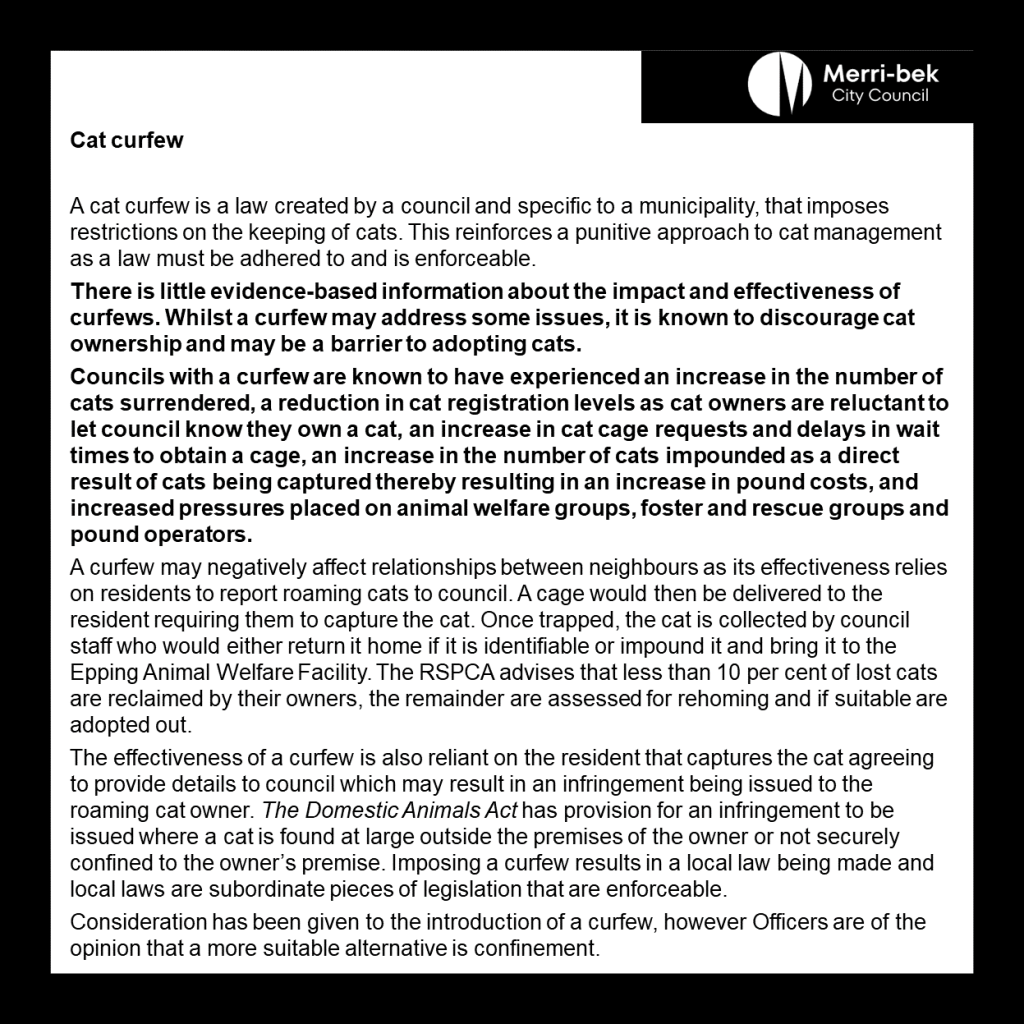
On 7 December 2022 the Merri-bek council in Victoria was the latest to “see the light” that mandatory cat containment and/or mandatory cat curfews are not effective. Instead, the council is supporting alternative successful approaches and recognise that it is the combination of proactive activities which together will provide the best pay-back for investment.
That is, synergy is best achieved by a blend of reducing the number of cats being born, active conversations with communities, and addressing the impact to wildlife in a program of benefits rather than single projects.
MERRI-BEK COUNCIL MEETING 7 DECEMBER 2022
The agenda and meeting video is available on the council webpage. At this time we are waiting on the meeting minutes to be published.
The Meeri-bek council team and councillors appear to have completed a thorough and intelligent set of analysis and assessments prior to the council meeting on the 7th. This information is included in the Agenda document for the meeting, and commences on page 61, item titled “7.8 Cat Containment Strategy”.
It appears (to be confirmed when the minutes are published) that Merri-bek will be proceeding with:
free cat desexing (with nil registration costs) in target hotspots,
education on voluntary cat containment ie encourage and to include “bed time feeding” ie use proactive behaviour changes for cats,
effectively minimising impacts to wildlife through microtargeting cat desexing (ie where endangered & threatened species are most at risk), and microtargeting strategies for general protection for endangered & threatened wildlife are located such as physical boundary barriers, and
other strategies/ steps for the semi owned and unowned cats which are to be analysed further.
The Merri-bek next steps include “Implementation of the recommended decision will start with the development of the communications plan and associated communications material” (Merri-bek Agenda document).
BRIEF OVERVIEW FROM JACQUIE RAND APWF
At the beginning of the meeting (video) at around 46 mins from the start, Jacquie Rand from the Australian Pet Welfare Foundation (APWF) provided a brief explanation of why mandatory cat curfew and containment is not successful.
Her advice is based on their scientific research including research based on several Australian councils, and analysis on “numbers” from Merri-bek.
Jacquie Rand also recommended to support wildlife and:
implement micro targeting cat desexing in the key areas for endangered and threatened animal areas specifically within the council area; and
identify and implement micro target strategies for the specific endangered and threatened animals in the Merri-bek area (eg physical barriers to exclude all introduced species).
BANYULE DESEXING PROGRAM
Banyule council in Victoria and its success with targeted desexing was also considered. LRC included a blog item in 2021.
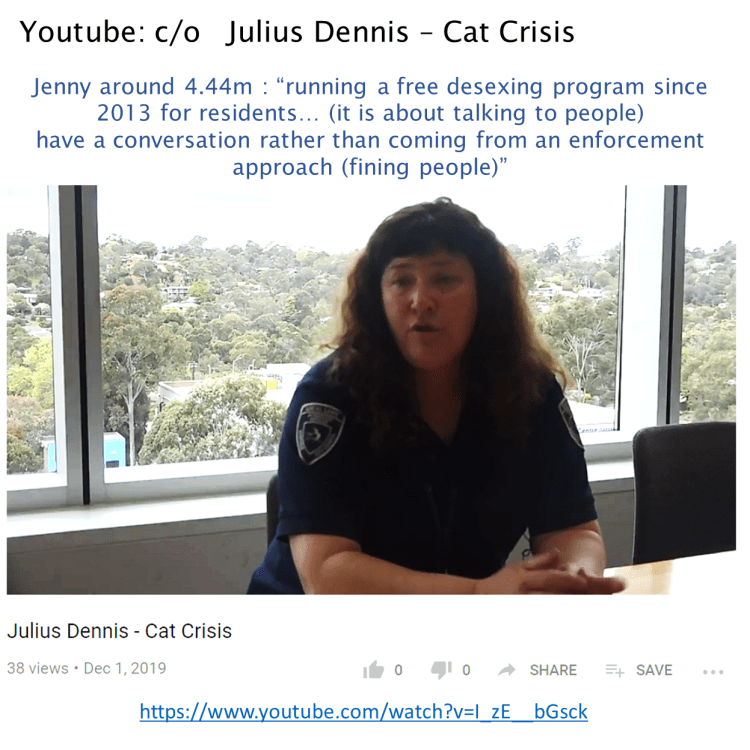
A key factor in the Banyule approach was the Animal Management Officer taking a proactive approach rather than the traditional enforcement role. This included conversations with the community and offers of help rather than judgements, and seizing animals, and/or fines and penalties.
MERRI-BEK COUNCILLOR MOTIONS & DISCUSSIONS
Around 2 hours and 4 minutes into the meeting the item for cat containment is discussed by the councillors for about 15 minutes, and they achieve unanimous support on the approach forward.
HIGHLIGHTS OF MERRI-BEK ANALYSIS & ASSESSMENT
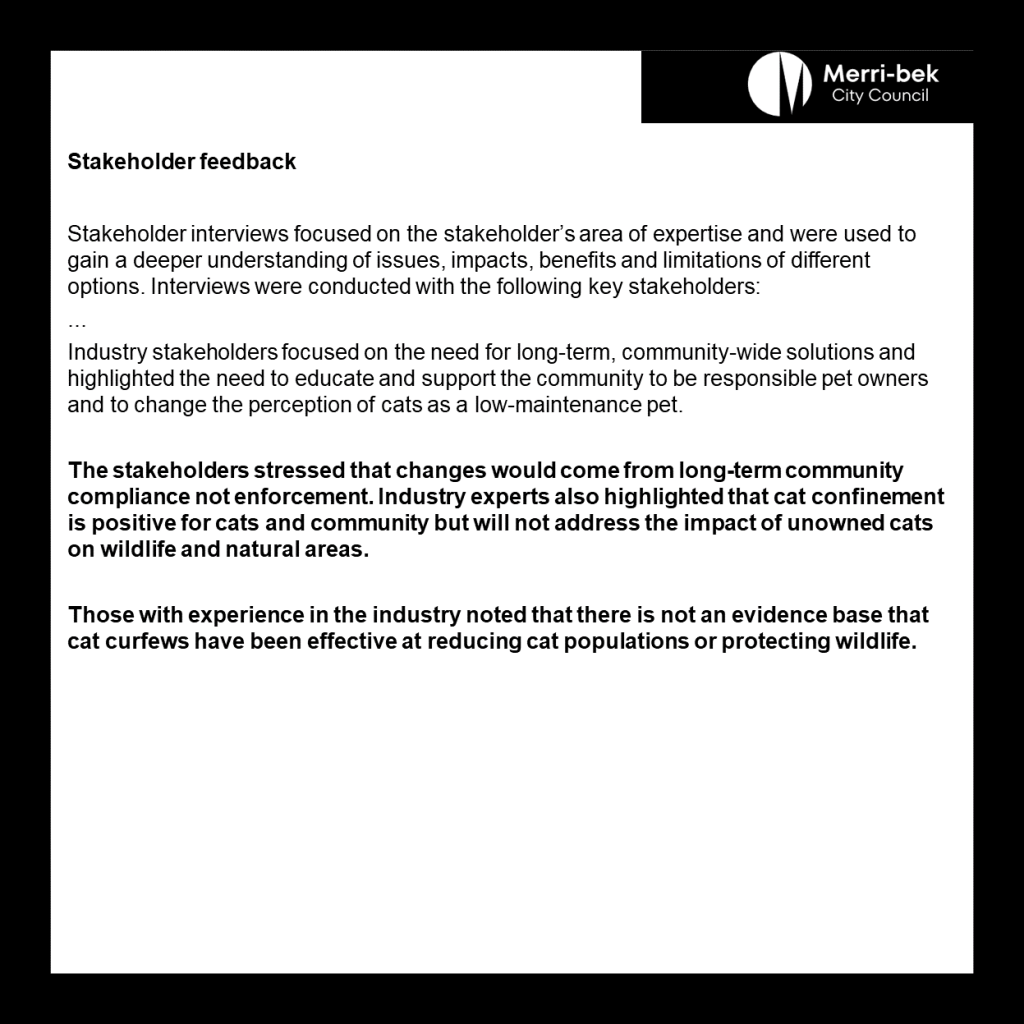
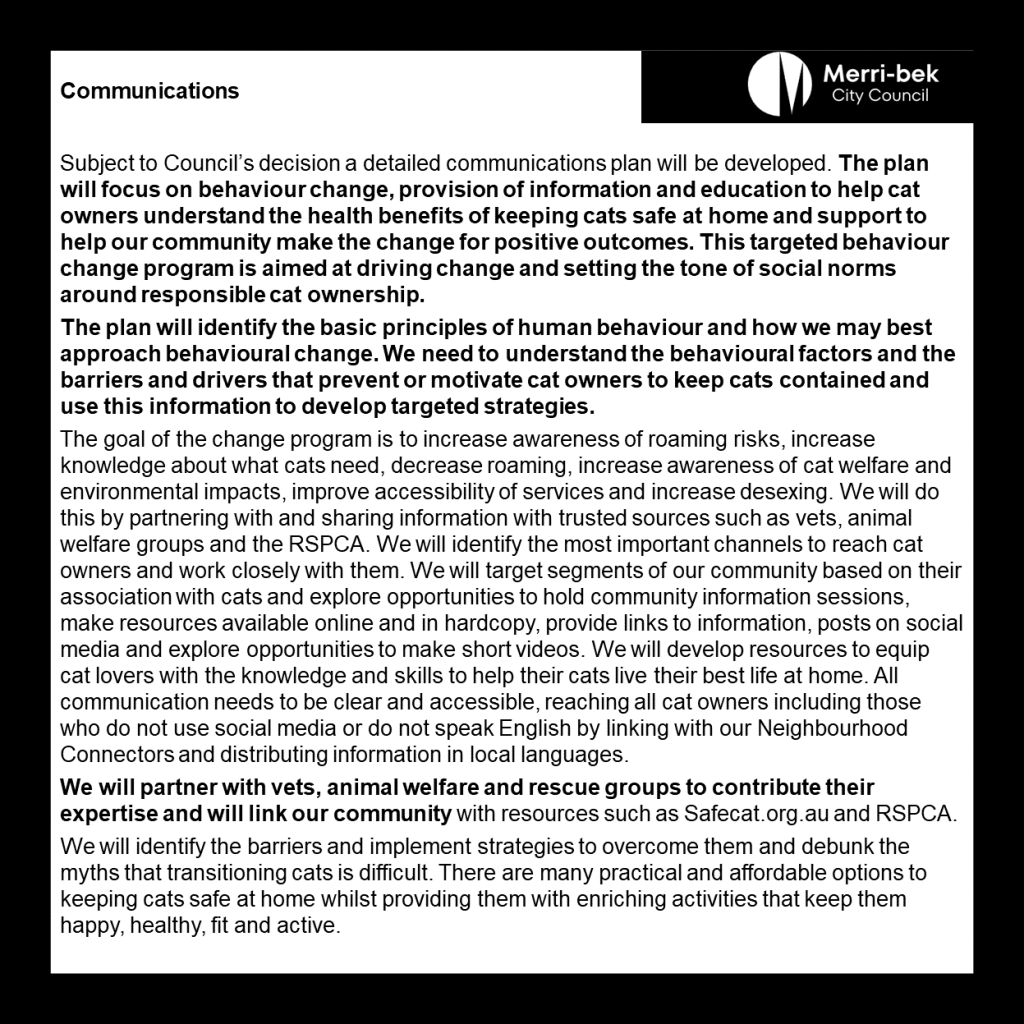
It is interesting to note that the Agenda document (refer the extract on item “7.8 Cat Containment Strategy”) includes:
Stakeholder Feedback
“The stakeholders stressed that changes would come from long-term community compliance not enforcement. Industry experts also highlighted that cat confinement is positive for cats and community but will not address the impact of unowned cats on wildlife and natural areas.
Those with experience in the industry noted that there is not an evidence base that cat curfews have been effective at reducing cat populations or protecting wildlife.”
Communications
“The plan will focus on behaviour change, provision of information and education to help cat owners understand the health benefits of keeping cats safe at home and support to help our community make the change for positive outcomes. This targeted behaviour change program is aimed at driving change and setting the tone of social norms around responsible cat ownership.
The plan will identify the basic principles of human behaviour and how we may best approach behavioural change. We need to understand the behavioural factors and the barriers and drivers that prevent or motivate cat owners to keep cats contained and use this information to develop targeted strategies…
We will partner with vets, animal welfare and rescue groups to contribute their expertise and will link our community…”
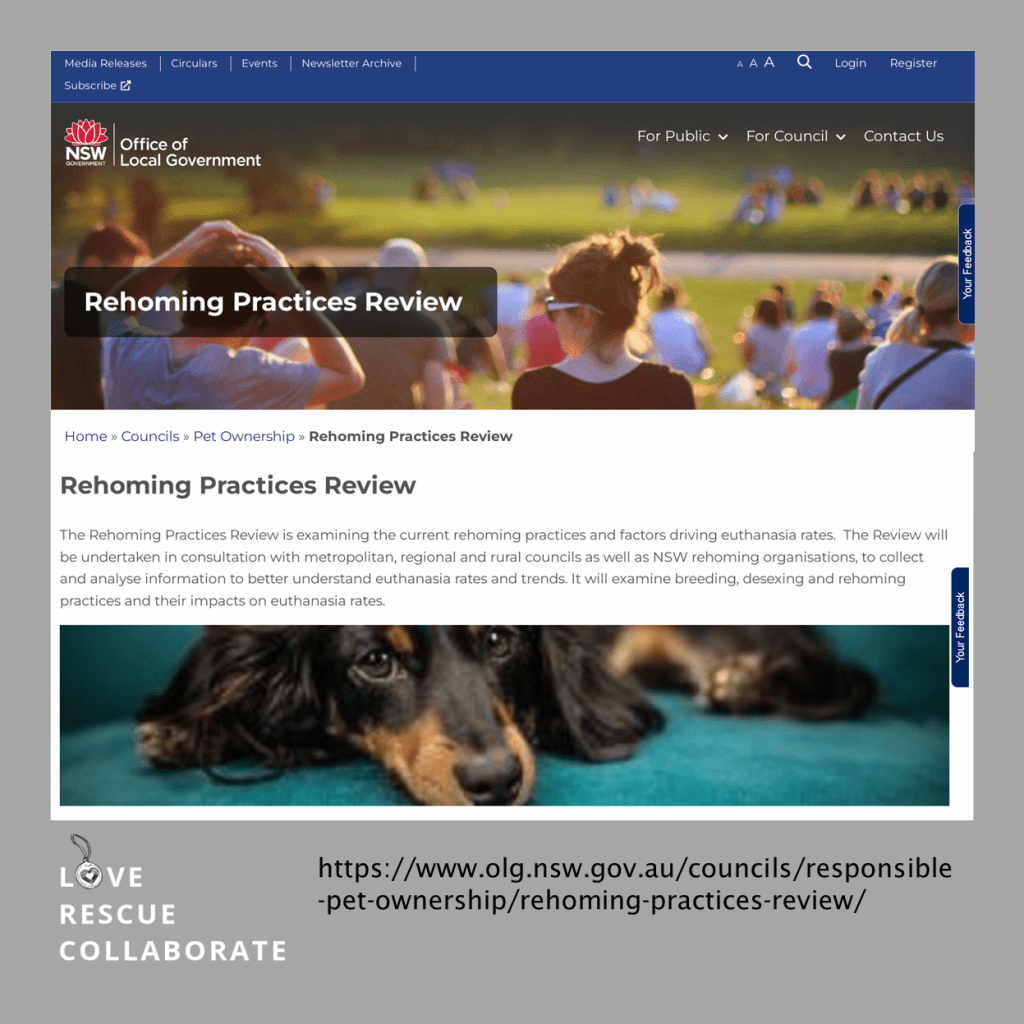
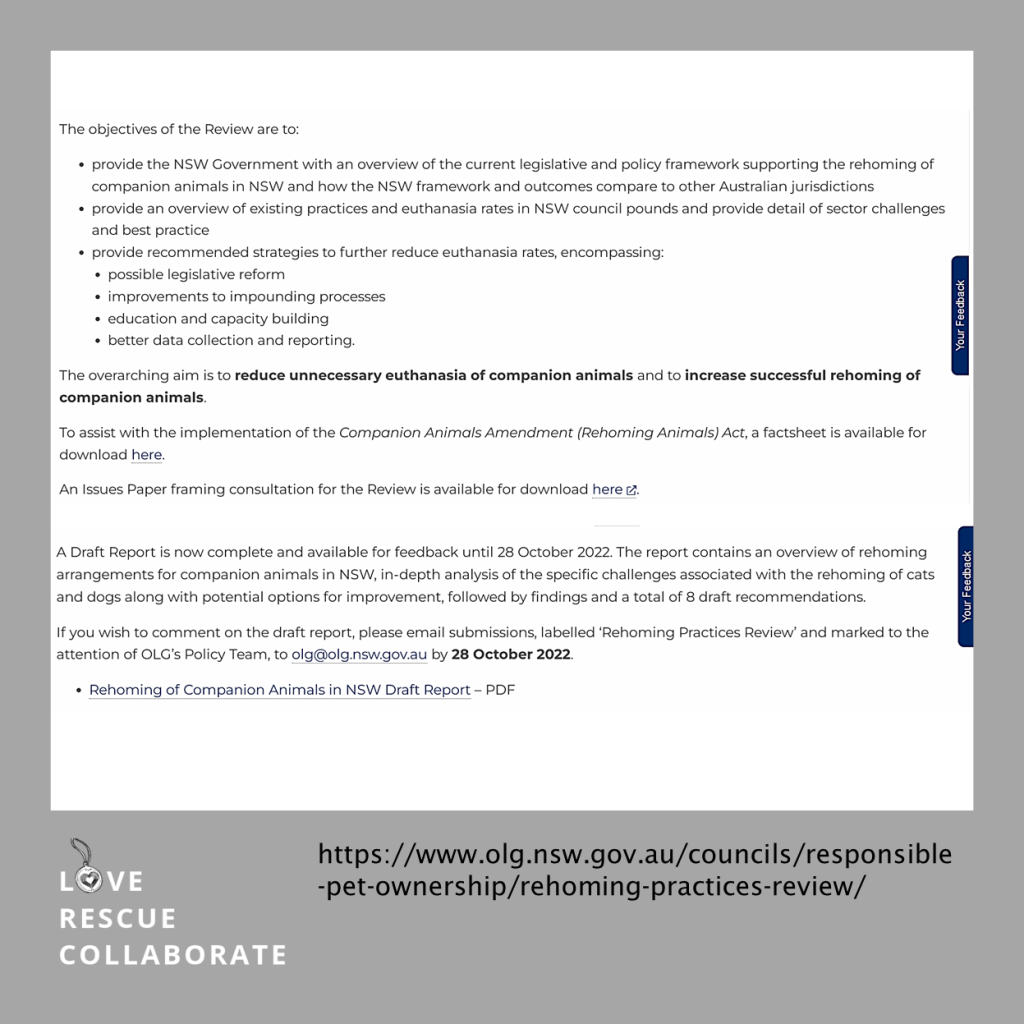
In July 2022 (or perhaps earlier) the NSW state government commenced a review of its practices across councils for rehoming and euthanasia practices for companion animals. This has been a “closed” review for councils, designated rehoming organisations and selected organisations.
Engagement has NOT YET been open to all stakeholders including the public & rescuers and rescue groups who though not designated rehoming organisations, they may include vets, businesses (ABNs), and charities.
This post includes information on:
Background for the draft report on the review of pound practices
Recommendations to include small rescuers in the review of the pound practices
How NSW government charges impact small rescuers
Free high intensity desexing helps communities & relieves the pressure on small rescuers to achieve fewer unwanted pets each year
Reducing pound adoption fees has a negative impact by extending holding periods on small rescuers & their animals
A draft report is available for review only by councils, until 28 October 2022.
We have concerns that a broader engagement & consultation has not yet been completed.
When will it be scheduled? and how open to feedback and change will the NSW government & councils be?
Why are small rescuers not involved?
BACKGROUND FOR THE DRAFT REPORT ON REVIEW OF POUND PRACTICES
Currently 3 documents are available on the NSW OLG webpage:
the draft report/ findings
a background “Factsheet”
an Issues paper
We will provide copies at the end of this post, as these documents may no longer be available after 28 October on the NSW webpage.
RECOMMENDATION TO INCLUDE SMALL RESCUERS IN THE REVIEW OF THE POUND PRACTICES
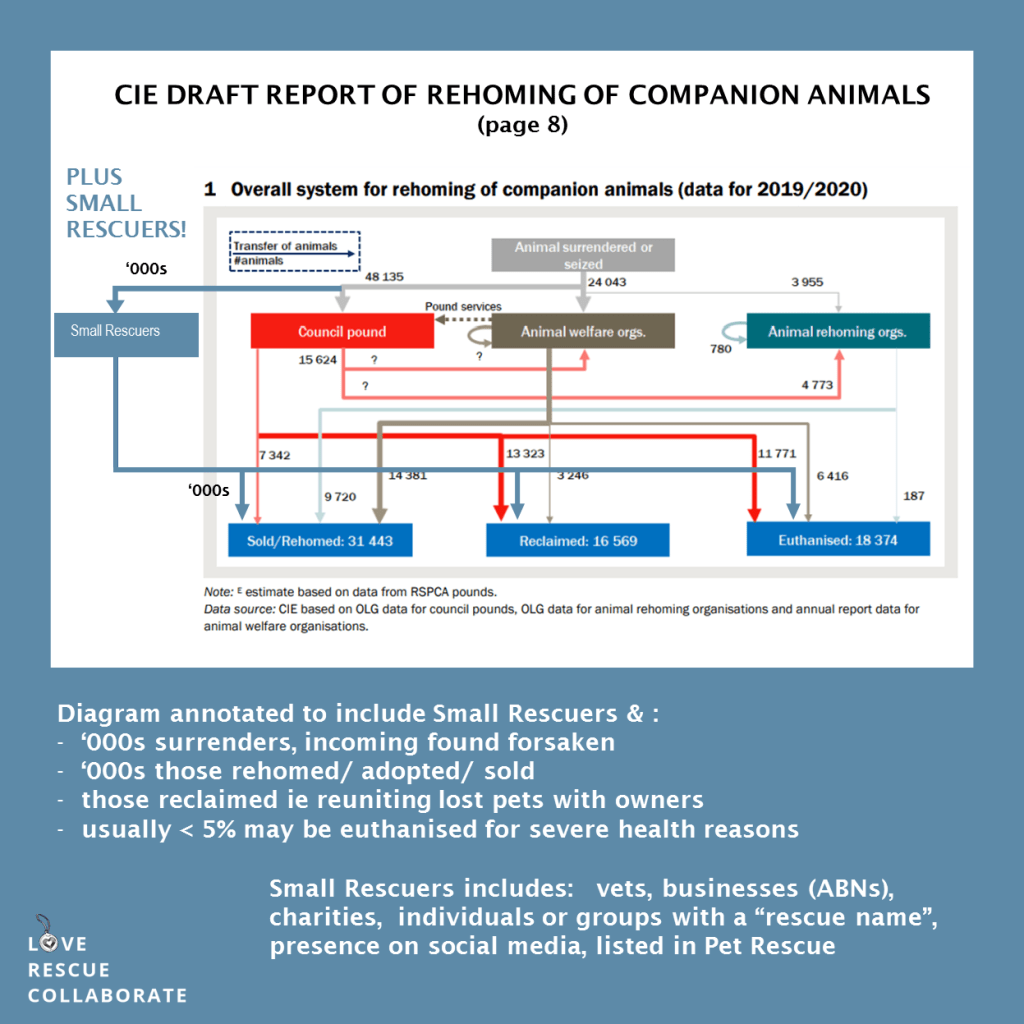
It is recommended that a review of council pounds needs to consider the whole system including: the impact of rescuers minimising animals being taken through the council pound systems&; how changes in the pound practices have an impact on small rescuers.
Small rescuers include: vets, businesses with ABNs, registered charities with the ACNC, rescue individuals or groups, and people from the community who take in a cat or dog from the streets.
Generally, only few councils offer help to small rescuers, who are vets, residents or small rescue groups, who find and attempt to assist forsaken dogs and cats with feeding, desexing etc, and rehoming.
Small rescuers are a factor in minimising council intake numbers, as well as euthanasia numbers, as if more forsaken / “unowned” pets were taken in to council pounds, then with current capacity limits, many more animals will be euthanised, especially on entry.
There are literally hundreds of small cat and dog rescues groups across the state, accumulatively rescuing, desexing and rehoming thousands of animals each year.
It appears that as the NSW state government, nor councils, do not have an explicit line of sight for gathering information and managing the small rescues, then they offer no assistance nor will recognise the effective assistance from volunteer, donation driven people, working to keep animals out of the council pound systems.
These rescue groups/individuals take on the “harder cases”, as the public and the rescuers are very aware of the high euthanasia rates at council pounds and large animal welfare organisations.
Most pounds consider 10% euthanasia rate as “low-kill”. Even 10% euthanasia rates are considered high by small rescue and the public. Small rescues aim for well under 5%.
It is recommended that local government councils increase the designated funding for animal management teams and shelters to enable more animals to be taken in from the public, without increasing euthanasia rates and relieve the pressure on small rescuers and communities.
It is recommended that more detailed information is maintained and reported by council pounds and large animal welfare organisations. For example on the age, breed, physical condition of animals, including incoming, rehomed or euthanased. And a better level of granularity for reasons for euthanasia.
It is also recommended that the NSW state government seeks a method to gather similar information from small rescues in an understanding manner, such as being assessed by the Victorian Government.
HOW NSW GOVERNMENT CHARGES IMPACT SMALL RESCUERS
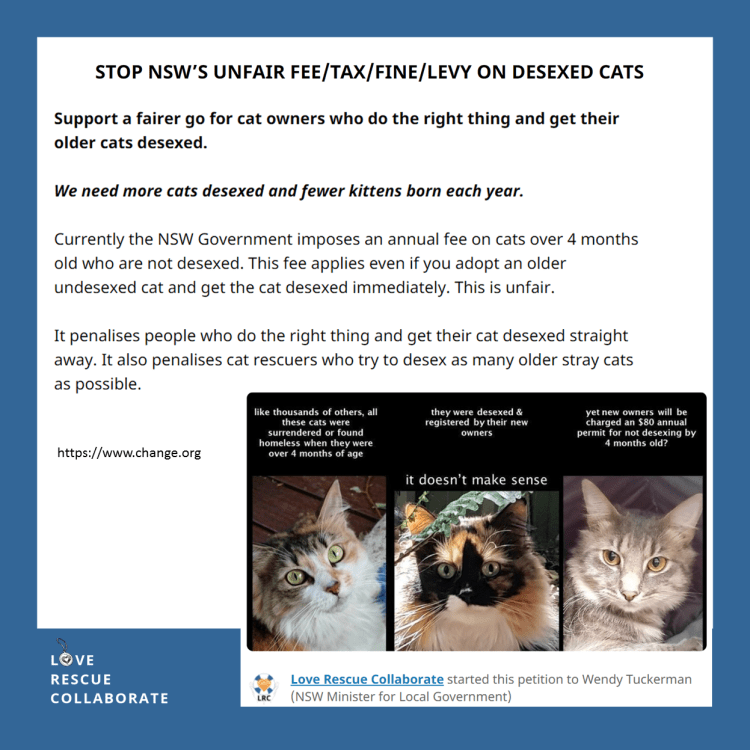
An example of “interactions” is the additional $80 fee introduced in July 2020 by the Office of Local Government for owners of cats not desexed before 4 months of age. This was poorly implemented as it mainly penalised the small rescuers taking in older forsaken cats.
These issues were raised with OLG in 2020 by our team, and others both individuals and organisations. Further a Change.Org petition was raised and sent to the Minister in 2021.
The additional charge & late fees penalise people who adopt/ take in older cats, as they did not own their new cat before the cat reached 4 months of age (ie the government is penalising the wrong people, ie the new owners instead of the owners at the time).
The additional $80 fee also has a related late payment charge of $17 and possible further ramifications for new owners of cats.
It really hits hard the small cat rescue groups who are saving many forsaken cats from the streets or surrendered from owners – the government is raising revenue from hundreds of such cats every year, cats who do not go through the council pound systems and do not cost the NSW government nor councils any funds to desex, register and rehome.
It fails to motivate some people, who will refuse to microchip and register their cats to avoid being penalised by the government for having undesexed cats.
FREE HIGH INTENSITY DESEXING HELPS COMMUNITIES & RELIEVES PRESSURE ON SMALL RESCUERS TO ACHIEVE FEWER UNWANTED PETS EACH YEAR
It is recommended that free high intensity desexing will benefit council animal management & small rescuers, by minimising the number of kittens/puppies being born every year.
It is recommended that each council/ LGA make assessments and estimates of the forsaken animals (especially cats) in the streets, parks, business area etc to be included in future government models and understandings of the scope of work for animal management.
It is recommended that, where enforcement and penalties etc are handed over to councils, that the cost benefit / business cases by the NSW state government are transparent and shared with communities, as it is likely that more proactive steps such as free mass/ high intensity DESEXING may be the very most useful “intervention” to reduce current and future costs for animal management in each LGA.
REDUCING POUND ADOPTION FEES HAS A NEGATIVE IMPACT ON SMALL RESCUERS& THEIR ANIMALS
It is recommended that governments need to consider before reducing adoption charges in council pounds that this negatively impacts the rescuers and ROs who are not able to dramatically cut their charges. It may help the council pounds clear their shelters, but it stalls adoptions for the animals with small rescuers.
There are a number of approaches to reduce the turnaround time (from intake to adoption) for each animal, that is, to reduce the period of staying in the facility. The most popular and simplest approach tends to be to lower the adoption fees or make these nil.
While this tactic is powerful for council pounds, it has a devastating impact on the animals & rescuers who are not able to respond in the same manner.
it is important to note that when council pounds or large animal welfare organisations do this, it means the animals in Rehoming Organisations or small rescue groups are less likely to be chosen by the public, and these mainly volunteer based groups incur animal stay periods extending, and their costs purely from donations increase substantially.
It is recommended that when a council pound or large animal welfare organisation changes their approaches they need to recognise that the “pain” mainly in terms of costs is transferred to others. There is a holistic system that needs to be considered, no part of the system should operate in isolation and just what is best for the pounds in isolation.
Therefore, if the NSW state government and/or the large animal welfare organisations decide to make such changes, how will they actually achieve more adoptions across all rescuers too? Otherwise, isn’t this just “smoke and mirrors” in marketing for the pounds and large animal welfare organisations? ie to communicate how successful they are by increasing adoptions, while they ignore that the adoptions by ROs and small rescuers “stall”.
A collection of views, opinions, facts on what has happened with our governments at federal, state and local levels.
Threatened Species Commissioner
‘Worst it’s ever been’: a threatened species alarm sounds during the election campaign – and is ignored
The Guardian 25 April 2022 Lisa Cox
Gregory Andrews shares he:
“believes the state of the country’s natural wildlife and biodiversity is the “worst it’s ever been” and calls the ongoing destruction of forests and other habitat “crazy”.
…felt restricted due to climate denialism within the Coalition and the refusal to deal with habitat degradation.”
It is also noted:
“In the past term alone, three official reports, two from the Australian National Audit Office plus the independent review of Australia’s environmental laws by the former competition watchdog head Graeme Samuel, highlighted a litany of environmental failures.
A fourth, the five-yearly State of the Environment report, is also expected to highlight the ongoing decline. That report could have been tabled by the Morrison government before the campaign began but has been withheld.”
Management of Threatened Species and Ecological Communities under the Environment Protection and Biodiversity Conservation Act 1999
Australian National Audit Office 17 March 2022
“The department is unable to demonstrate it is efficient. There is limited evidence that desired outcomes are being achieved, due to the department’s lack of monitoring, reporting and support for the implementation of conservation advice, recovery plans and threat abatement plans.”
“…procedural guidance for undertaking listing assessments does not fully capture all relevant requirements of the EPBC Act and is not complete, up to date or consistently implemented”
“Procedural guidance for development needs updating and is not fully followed, and arrangements for review and update are not appropriate”
“Recovery plans, recovery plan reviews, threat abatement plan reviews and changes to the list are not completed within statutory timeframes. The department is unable to demonstrate that its efficiency has improved over time. “
“Measurement, monitoring and reporting arrangements are not sufficient to support the achievement of desired outcomes. The statuses of some threatened species are monitored, but most species are not. The statuses of ecological communities and key threatening processes are not monitored. There is no measurement, monitoring or reporting on progress, or on the contribution of listing assessments, conservation advice, recovery plans and threat abatement plans to their desired outcomes. Available information does not indicate desired outcomes have been achieved.”
The spin and secrecy threatening the Australian environment
The Monthly November 2021 Anthony Ham
“This obsession with secrecy, and with the suppression of potential bad news stories, is especially pronounced when it comes to science and the environment.”
“In 2019, Professor Don Driscoll of Melbourne’s Deakin University and immediate past president of the Ecological Society of Australia, surveyed 220 Australian ecologists, conservation scientists, conservation policymakers and environmental consultants. The results, published this year in the international science journal Conservation Letters, found that one-third of government employees who responded had experienced “undue interference” when it came to public communications about their research.”
“Fifty-two per cent of government respondents had been prevented from publicly sharing scientific information. Of these, 82 per cent had been constrained by senior managers and 63 per cent by a minister’s office. For those respondents who had communicated scientific information in the public domain, 42 per cent reported being harassed or criticised for doing so. Just over half of respondents (56 per cent) believed that the suppression of scientific communications had worsened over recent years.”
Quotes from the above survey include:
“It feels terrible to know the truth about impacts to the environment, but know you’ll never get that truth to the public and that the government doesn’t care at all. They want us to give them politically supportive information, not science.”
“I feel resentment when I am expected to “toe the line” and support decisions I consider wrong and not in the best interest of the environment and not based on sound scientific data.”
“In the absence of informed and objective scientific participation, said one respondent, fake news often fills the evidence void: “I could see that social and media debate was exploiting the lack of information to perpetuate incorrect … interpretations … to further their own agendas.”
Please note, tis is pre 2024 NSW council elections, to be updated! – we have yet to capture every council – a “Work In Progress” [in council name alphabetical order]
To: Mayor & Cr Therese Fedeli, Deputy Mayor & Cr Paul Farrow, Cr Ashleigh Cagney, Cr Peter McLean, Cr Eva Campbell, Cr Russell Zammit, Cr Cindy Cagney, Cr Usha Dommaraju, Cr Lara Symkowiak
To: Mayor – Cr George Greiss, Deputy Mayor – Cr Warren Morrison, Cr George Brticevic, Cr John Chew, Cr Margaret Chivers, Cr Masood Chowdhury, Cr Joshua Cotter, Cr Marian George, Cr Karen Hunt, Cr Masud Khalil, Cr Darcy Lound, Cr Rey Manoto, Cr Riley Munro, Cr Meg Oates, Cr Matt Stellino
Under Administration: “Mr Rik Hart is the Administrator for Central Coast Council”
We suggest emailing the council with Attention to Rik Hart: “The Administrator is here for residents to contact and engage with. The role acts as the Council and undertakes the responsibilities of the Mayor and Councillors representing the interests of residents and our communities. You can contact the Administrator by:
To: Mayor & Councillor Jay Suvaal, Deputy Mayor & Councillor John Moores, Councillor Paul Dunn, Councillor James Hawkins, Councillor Ian Olsen, Councillor Jessica Jurd, Councillor Anthony Burke, Councillor Karen Jackson, Councillor Anne Sander, Councillor Daniel Watton, Councillor Rosa Grine, Councillor Mitchell Hill, Councillor Paul Paynter
To: Cr Paul Amos, Mayor, Cr George Cecato, Cr Jonathan Cassell, Cr Julie Sechi, Cr Rodger Pryce, Cr Sally Townley, Cr Scott Wolgamot, Cr Tegan Swan, Cr Tony Judge
To : Councillor Lisa Lake (Mayor), Councillor Suman Saha (Deputy Mayor), Councillor Steve Christou, Councillor Ola Hamed, Councillor Joseph Rahme, Councillor Diane Colman, Councillor Greg Cummings, Councillor Eddy Sarkis, Councillor Kun Huang, Councillor Sabrin Farooqui, Councillor Helen Hughes, Councillor Glenn Elmore, Councillor Paul Garrard, Councillor Mohamad Hussein, Councillor Michael Zaiter
For attention: Mayor Frank Carbone, Deputy Mayor Dai Le, Councillor George Barcha, Councillor Reni Barkho, Councillor Milovan Karajcic, Councillor Kevin Lam, Councillor Carmen Lazar OAM, Councillor Kien Ly, Councillor Michael Mijatovic, Councillor Hugo Morvillo, Councillor Andrew Rohan, Councillor Charbel Saliba, Councillor Marie Saliba
To: Mayor – Darcy Byrne, Deputy Mayor – Philippa Scott, Kobi Shetty, John Stamolis, Liz Atkins, Pauline Lockie, Chloe Smith, Jessica D’Arienzo, Mark Drury, Dylan Griffiths, Marghanita Da Cruz, Tim Stephens, Mat Howard, Justine Langford, Zoi Tsardoulias
To: Mayor Jeff Pettett, Deputy Mayor Barbara Ward, Cr Greg Taylor, Cr Simon Lennon, Cr Sam Ngai, Cr Alec Taylor, Cr Christine Kay, Cr Martin Smith, Cr Cedric Spencer, Cr Kim Wheatley
Mayor & Cr Kylie Thomas, Deputy Mayor & Cr Tom Cooper, Cr Janet Wilson, Cr Hayden Doolan, Cr John Burley, Cr Robert Cullen, Cr Maggie May, Cr Danielle Mulholland, Cr James Murray
To: Mayor Andrew Zbik, Kathy Bryla, Bridget Kennedy, Katherine Mort, David Brooks-Horn, David Roenfeldt, Merri Southwood, Scott Bennison, Rochelle Flood
To: Liverpool Mayor Ned Mannoun, Deputy Mayor Mazhar Hadid, Councillor Mel Goodman, Councillor Nathan Hagarty, Councillor Peter Harle, Councillor Ali Karnib, Councillor Karress Rhodes, Councillor Richard Ammoun, Councillor Fiona Macnaught, Councillor Charishma Kaliyanda, Councillor Betty Green
To: Lord Mayor – Nuatali Nelmes, Councillor Declan Clausen, Councillor Dr John Mackenzie, Councillor John Church, Councillor Carol Duncan, Councillor Jenny Barrie, Councillor Charlotte McCabe, Councillor Peta Winney-Baartz, Councillor Katrina Wark, Councillor Margaret Wood, Councillor Deahnna Richardson, Councillor Dr Elizabeth Adamczyk, Councillor Callum Pull
To: Cr & Mayor Michael Regan, Cr & Deputy Mayor Sue Heins, Cr Jose Menano-Pires, Cr Stuart Sprott, Cr Candy Bingham, Cr Georgia Ryburn, Cr Sarah Grattan, Cr Bianca Crvelin, Cr Vincent De Luca, Cr Ruth Robins, Cr Kristyn Glanville, Cr David Walton, Cr Michael Gencher, Cr Miranda Korzy, Cr Rory Amon
TO: Lord Mayor Donna Davis, Deputy Lord Mayor Sameer Pandey, Councillor Pierre Esber, Councillor Michelle Garrard, Councillor Kellie Darley, Councillor Lorraine Wearne, Councillor Cameron Maclean, Councillor Ange Humphries, Councillor Georgina Valjak, Councillor Donna Wang, Councillor Henry Green, Councillor Phil Bradley, Councillor Dr Patricia Prociv, Councillor Dan Siviero, Councillor Paul Noack
To: Clr Jordan Lane – Mayor, Clr Sarkis Yedelian OAM – Deputy Mayor, Clr Bernard Purcell, Clr Katie O’Reilly, Clr Shweta Deshpande, Clr Penelope (Penny) Pedersen, Clr Roy Maggio, Clr Sophie Lara-Watson, Clr Charles Song, Clr Daniel Han, Clr Trenton Brown
To: Mayor Amanda Findley, Deputy Mayor Paul Ell, Cr John Wells, Cr Matthew Norris, Cr Serena Copley, Cr Tonia Gray, Cr Evan Christen, Cr Greg Watson, Cr John Kotlash, Cr Liza Butler, Cr Mark Kitchener, Cr Moo D’Ath, Cr Patricia White
To: Lord Mayor – Councillor Clover Moore, Deputy Lord Mayor – Councillor Sylvie Ellsmore, Councillor HY William Chan, Councillor (Waskam) Emelda Davis, Councillor Lyndon Gannon, Councillor Shauna Jarrett, Councillor Robert Kok, Councillor Linda Scott, Councillor Jess Scully, Councillor Yvonne Weldon
To: Chris Cherry Mayor & Councillor, Reece Byrnes Deputy Mayor & Councillor, Rhiannon Brinsmead Councillor, Meredith Dennis Councillor, Nola Firth Councillor, James Owen Councillor, Warren Polglase Councillor
Mayor & Councillor Gordon Bradbery, Councillor Mithra Cox, Councillor Janice Kershaw, Councillor Richard Martin, Councillor Cameron Walters, Councillor Cath Blakey, Councillor David Brown, Councillor Tania Brown (Deputy Lord Mayor), Councillor John Dorahy, Councillor Elisha Aitken, Councillor Linda Campbell, Councillor Dom Figliomeni, Councillor Ann Martin
There are many benefits with cat enclosures, for your cats and for you there is peace of mind.
What’s your favourite reason for keeping your kitty safe?
your cat will not be mixing with other pets (health, diseases, wounds, etc),
you will be keeping wildlife safe,
your cat will be avoiding road or other accidents,
you will be ensuring your pet doesn’t “go missing”, and
it provides a stimulating environment for your kitties: fresh air with sounds & sights stimulate brains which can be just as good as a physical workout.
There’s so many ideas and products available, even DIY options, and then there is reuse / hacking, keep an eye out for freebies such as reusing aviaries and other units often given away for council pickups.
Go to PINTEREST and lose yourself for hours or days on ideas from others.
There are endless solutions.
THINGS TO CONSIDER
your style eg to match your home,
your budget,
your DIY skills and tools,
any RISKS – how strong you may need to make the enclosure (eg metal mesh versus cat netting, lockable gates), consider other animals may try to get in as well as your own cats trying to get out,
you can build in steps or modules – start small, then extend when your budget allows, and you learn what works well for your cat and yourself.
BUNNINGS CAT HACKS
If you need some ideas or advice, then please join the facebook group, it is for everyone in Australia. There’s a huge range of options from members, and suppliers to consider. There’s a Topics option which is helpful.
A few suppliers our team has used include the following (no association with these, other than our team are customers with no discounts).
HARDWARE
Bunnings or other hardware supplier – look for the Rapid Mesh products for animals enclosures, these are metal mesh and can be framed or just panels.
BETTA PET SYSTEMS
They have independent module units, these are versatile and cat be reconfigured to your needs eg placed in a u-shape around doors of windows, are able to be easily installed, dismantled (just nuts & bolts), and relocated to another part of our garden or your next residence.
CAT NETS
Made with special made netting that can cover a frame, be connected from a fence to a roof, or even netting in a whole garden – lightweight and professionally made. They also have several standalone units.
Use one or use a blend of these products, with whatever else you may have. Some folk reuse pre-used flyscreen doors 🙂





 LRC
LRC 