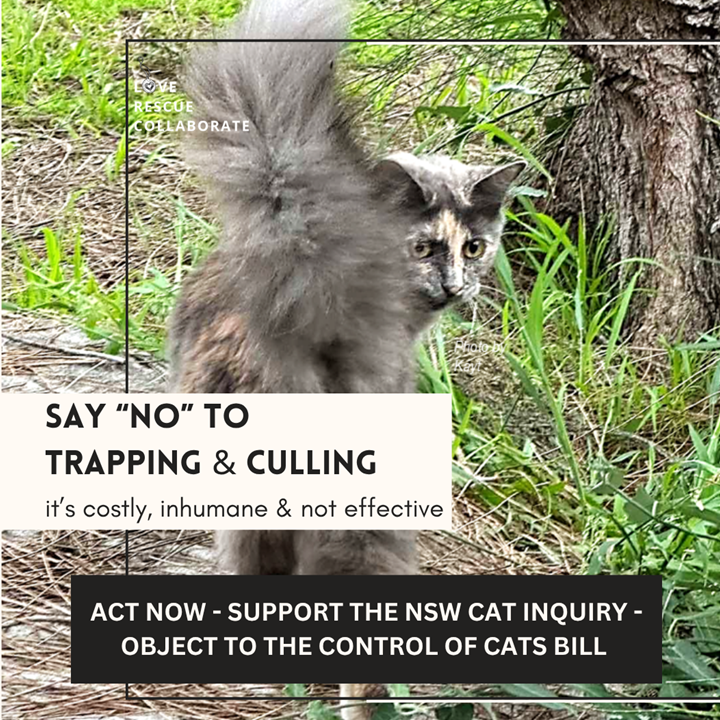
LRC offers a brief summary of the negative consequences and outcomes for the cat trapping and culling approach to reduce cat populations.
This approach is found to be costly, inhumane and ineffective as this approach does not address the root causes, i.e. the “start of the supply chain” with new kittens being born or more cats/ kittens being abandoned. Findings are from domestic cat experts based on Aussie experiences and research.
A wealth of research and information was provided by a number of Australian domestic cat experts at the Inquiry Management of Cat Populations NSW (cat Inquiry) https://www.parliament.nsw.gov.au/committees/inquiries/Pages/inquiry-details.aspx?pk=3011
NSW Cat Rescuers experiences
Trapping and culling in Australia is usually applied where mandatory cat containment legislation is being enforced, and in smaller numbers where cat may be causing a nuisance on private property. Trapping cats in large numbers will be traumatic to the cats as primary and secondary trauma.
From lived experiences of expert trappers, the majority of cats who have been failed to be trapped in one instance will be extremely wary of humans and traps, will be more difficult to trap again, impacts a cat’s behaviour for sociability assessment, and reduces the rehoming opportunities for these cats.
The 2020 culling at Newcastle Stockon breakwater was traumatic to the community cats and the rescuers and carers who were managing and rehoming this group of cats.
For consideration by all authorities/ decision makers: “the severity of the adverse psychological impacts, and the morbidity rate amongst the cat caregivers we interviewed, was far greater than would be expected as a risk to the community if the cats had remained at the site. We therefore suggest that potential legal ramifications should be considered before authorities intentionally choose a method of management that is likely to inflict substantial harm on community members.”
The Impact of Lethal, Enforcement-Centred Cat Management on Human Wellbeing: Exploring Lived Experiences of Cat Carers Affected by Cat Culling at the Port of Newcastle https://www.mdpi.com/2076-2615/13/2/271
Four Paws Australia NSW cat Inquiry
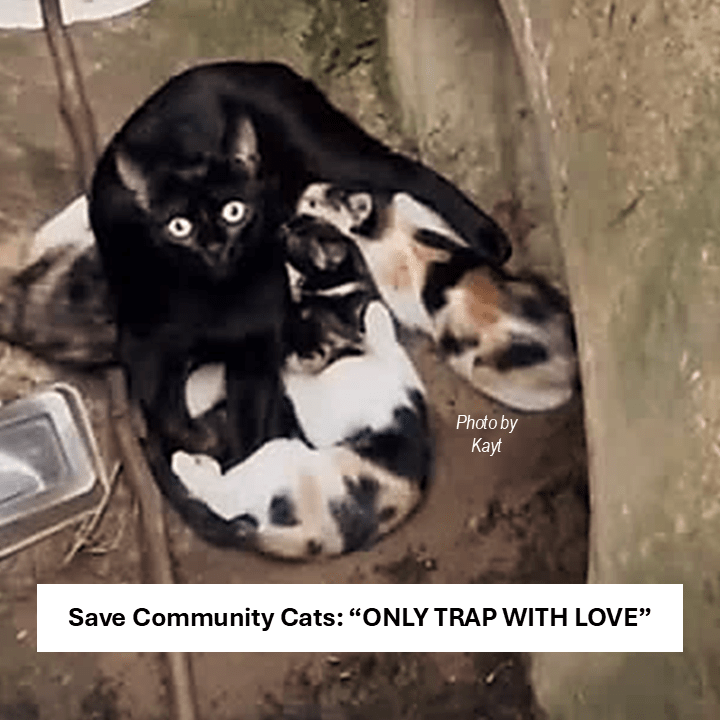
Four Paws Australia provided to the Inquiry for Management of Cat Populations NSW “TNVR [Trap
Neuter-Vaccinate-Return] is widely acknowledged by experts as the most humane and effective strategy for reducing stray cat numbers over time’, particularly in urban and semi urban areas”.
This approach (and other variations e of TNR) is considered the most humane and effective approach for managing cat populations. This view is supported by a number of Australian domestic cat experts, and many from other countries.
Australian Pet Welfare Foundation (APWF) cat Inquiry
“Efforts to reduce the domestic cat population through culling or adoption alone
have proven ineffective …because 30% to 50% of the stray cat population would need to be trapped and killed every 6 months for at least 10 years… which is clearly not economically feasible or acceptable to the community.”
“Mandated containment is proven to be ineffective and is a barrier to solving the issue of cat overpopulation…” accomplished with trapping and culling / euthanasia at council pounds will increase “costs to council and increases killing of healthy and treatable cats, increasing exposure of staff to the subsequent negative mental health impacts.”
“Cats trapped as a result of a complaint about nuisance behaviours are, by definition, domestic cats because a complaint implies the cat is living around where humans live or frequent. Sociability and adoptability cannot be judged in a highly stressful environment, such as in a trap cage; frightened pet cats may display more aggressive behaviours towards humans than truly feral cats… A minimum of 3 to 5 days, and up to 14 days or longer, are required for many pet cats to habituate to a new environment and for accurate assessment of sociability.”
APWF Submission: Inquiry into the Management of Cat Populations in NSW https://petwelfare.org.au/government-submissions/new-south-wales
Urban Cat Management Aussie Research
The outcomes of a legislative compliance-based approach such as mandatory containment, includes “compliance-based approach are that “excessive numbers of cats are impounded nationally, exceeding the capacity to rehome them, resulting in approximately 46% of cats entering local government facilities (pounds) in Australia being euthanized [4]. The worst-performing quartile of local governments impounding more than 50 cats in a year euthanized between 67% and 100%. Because many shelter and pound staff are required to regularly kill healthy and treatable cats and kittens, it negatively impacts their job satisfaction and mental health. This increases their risk of depression, traumatic stress, substance abuse, high blood pressure, sleeplessness, and suicide [29,30,31,32,33,34]. This legislative and enforcement-based approach has not substantially reduced cat-related complaints or impoundments because it does not address the underlying causes [4].”
“An additional issue is that enforcement officers may mistakenly impose fines and penalties intended for pet cat owners on the caregivers of semi-owned and stray cats. The misapplication of domestic animal legislation to semi-owners is ineffective and costly, especially if this is disputed in a magistrate’s court process because, when a responsible owner cannot be definitively linked to the cat, the charge cannot be proven and is dismissed, but the council still incurs the costs.”
The researchers added an acknowledgement “We extend our gratitude to all the semi-owners who have embraced full ownership of community cats and placed their trust in us to support them throughout this journey.”
Rethinking Urban Cat Management—Limitations and Unintended Consequences of Traditional Cat Management https://www.mdpi.com/2076-2615/15/7/1005
RSPCA NSW re NSW cat Inquiry
RSPCA NSW raised under the NSW Inquiry Management of Cat Populations that mandating cat containment may lead to deliberate acts in harming roaming cats, for example:
- “members of the public taking matters into their own hands”
- “cat trapping by individuals… resulting in higher rates of harm, neglect, and cruelty against cats”
RSPCA Australia mandatory containment negative consequences
“Support for the introduction of mandatory 24/7 cat containment would need to be based on evidence that it can achieve the stated objectives for cats, wildlife, and the broader community, and that the potential negative consequences can be eliminated or effectively mitigated. The RSPCA supports and encourages such research.
If mandatory 24/7 cat containment is introduced, effective monitoring is needed that will provide evidence of outcomes (positive and negative) and inform a better understanding of potential negative consequences and strategies to eliminate or effectively mitigate these.” https://kb.rspca.org.au/wp-content/uploads/2024/05/PP-A8-Cat-Containment-2024.pdf


One thought on “Trapping & culling: the negatives”