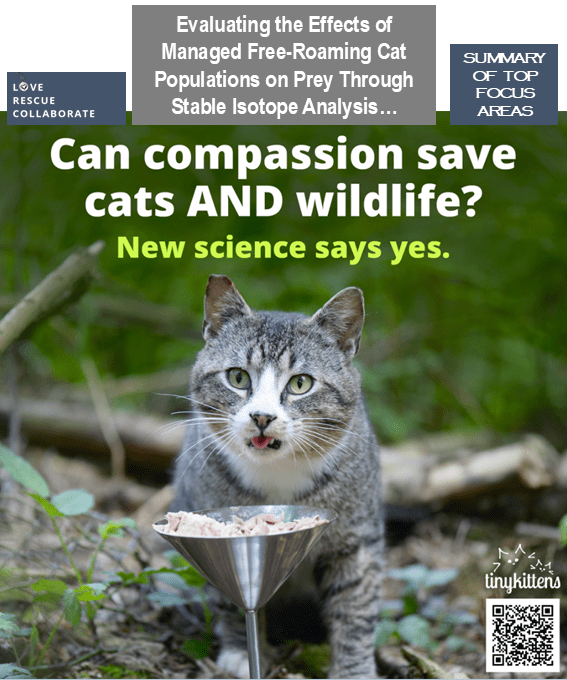
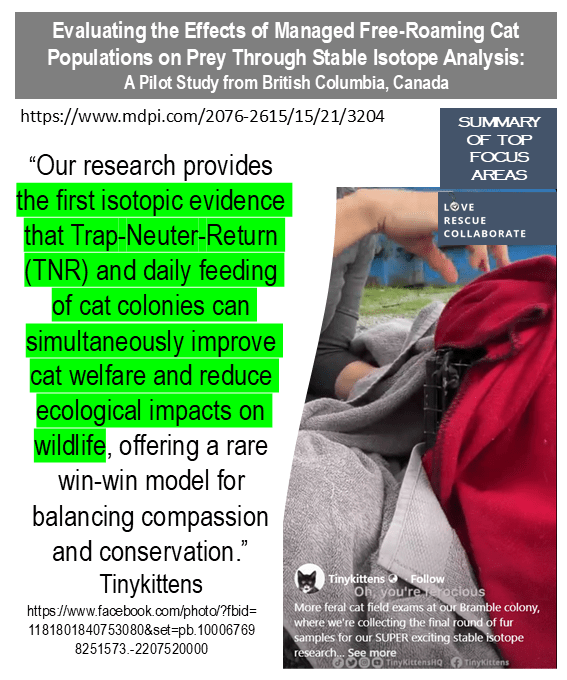
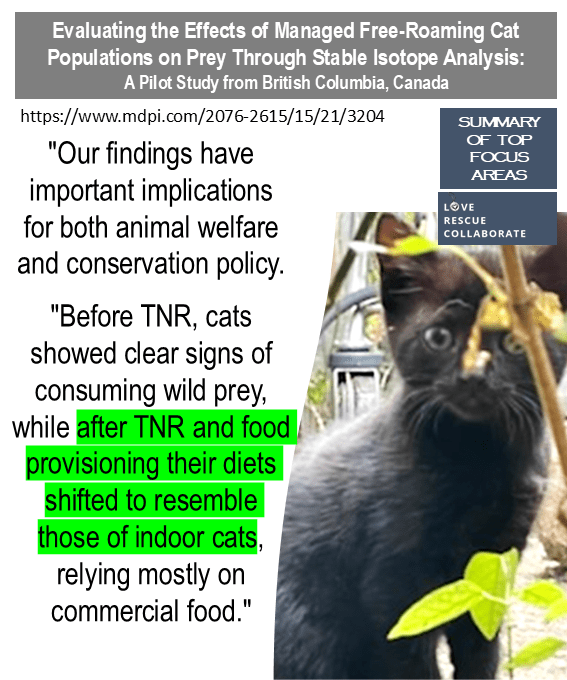
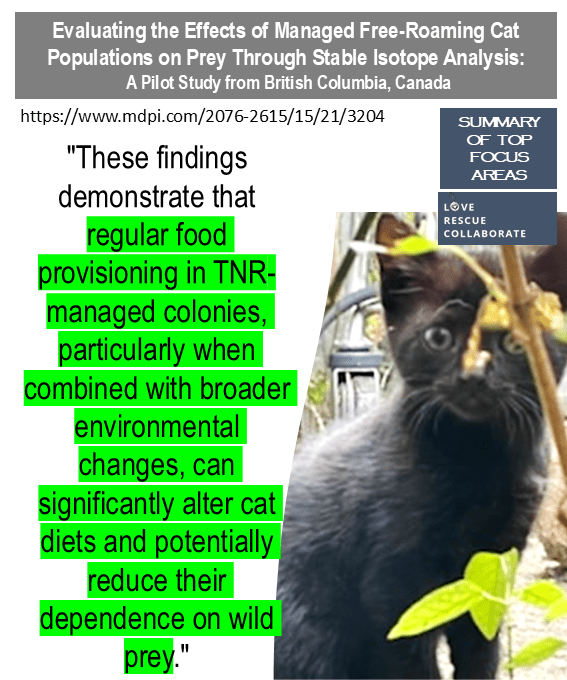
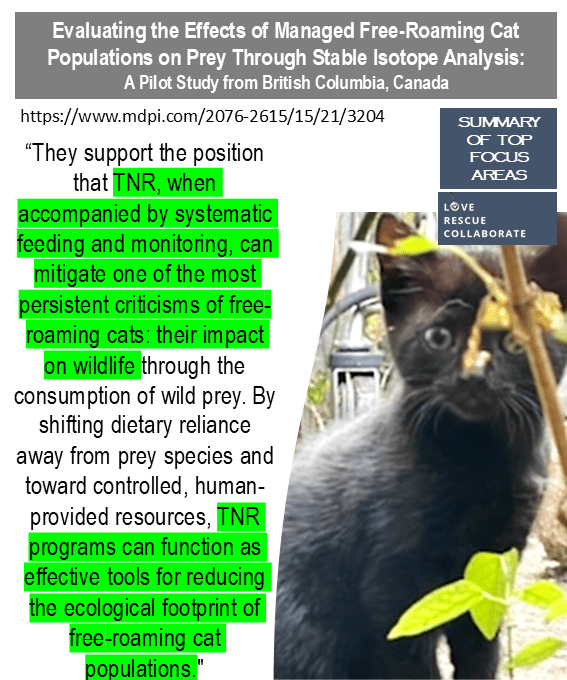
February 2025 Recent new research has evidence that TNR & feeding does assist in reducing impacts to wildlife.
TinyKittens group played an integral part in this leading research.
This was based in a farm and provides the controls to determine the benefits of a colony or group of community cats.
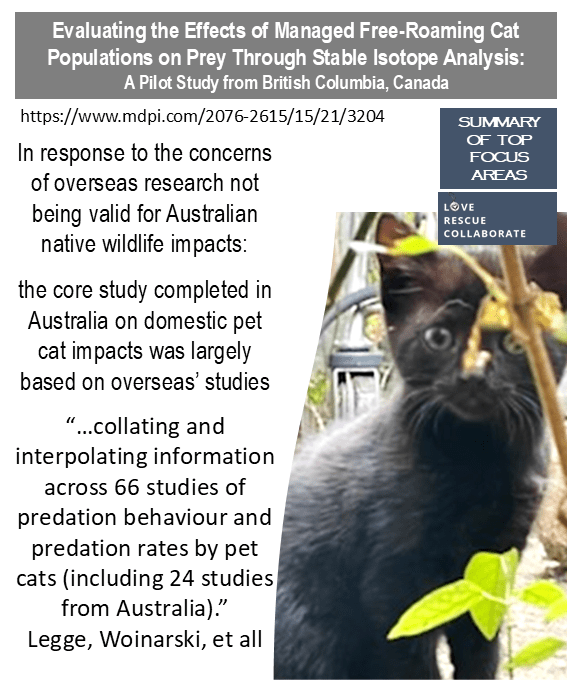
These are domestic cats, commonly known as “strays” or “semi owned” in Australia. See our last image as to why this is relevant to Australia.
TinyKittens group played an integral part in this leading research.
The impacts to wildlife are a significant concern in Australia.
Most stray / semi owned / community cats reside in urban areas.
LRC recommends that instead of broad brushing impacts, each Local Government Area should complete studies of the wildlife which is at risk and the community cats in their areas to provide specific priorities and plans to address the issues.
Stray or semi owned cats are domestic cats, who once being abandoned, have come under the care of other people. This is usually for food, then also desexing and medical care, and rehoming.
It is something that is commonsense that for many (maybe not all) cats, if you feed them well, then they are less likely to hunt for their own food. Remember this are domestic cats who are used to being fed by humans and continue to be reliant on people in urban landscapes.
This research provides evidence that this is the case.
This research provides the proof / evidence that managed colonies including TNR (desexing and returning to a location) and feeding, assist with minimising impacts to wildlife.
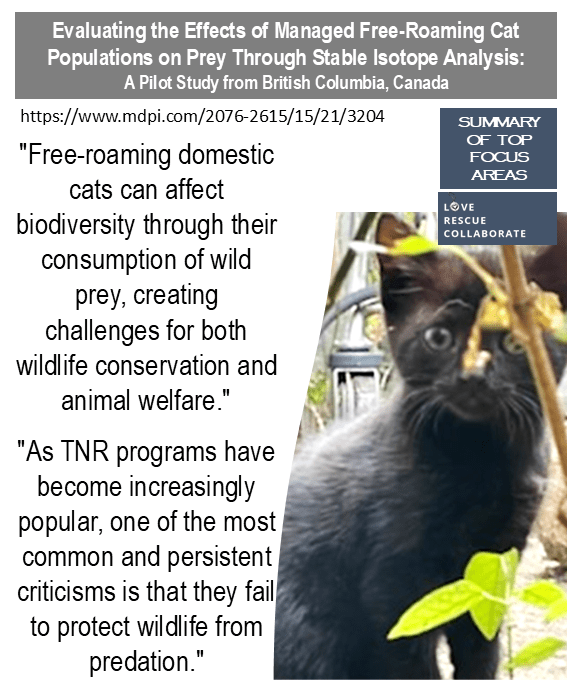
In Australia, one of the main concerns to dismiss TNR for semi owned cats in urban areas is often the view that “all cats hunt”.
This research proves that that is not true for all cats. We do not dispute that some cats may still hunt. LRC supports a number of initiatives for effective and efficient cat management.
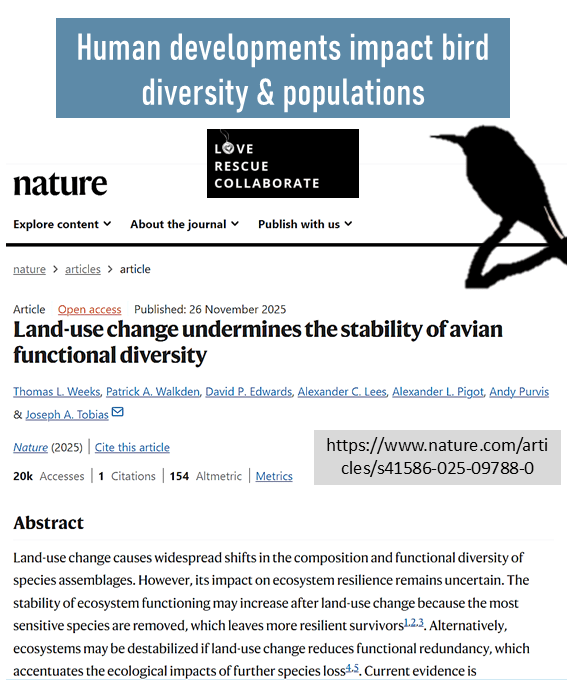
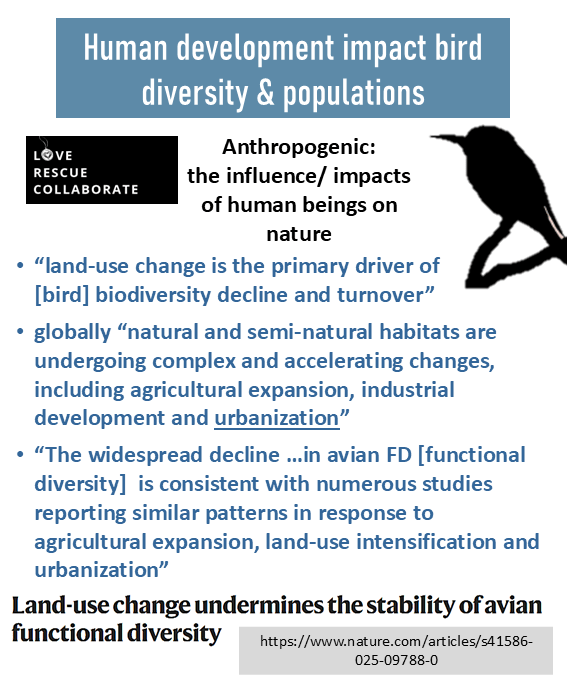
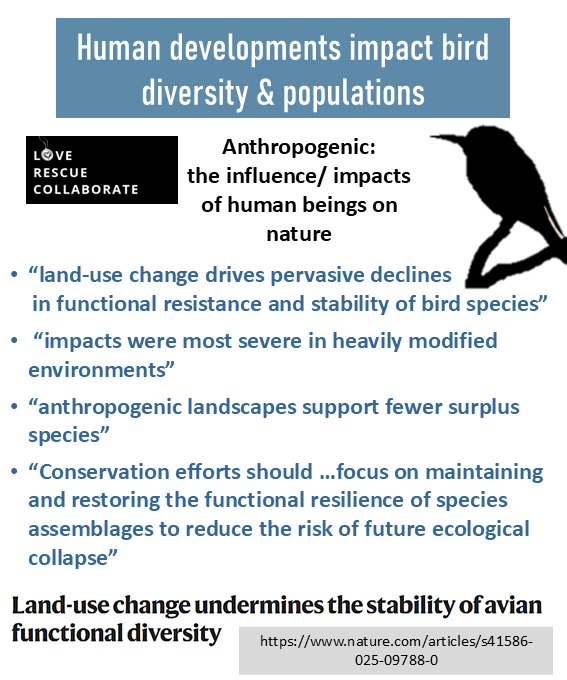
It is rational to recognise that humans changing, replacing or removing native landscapes will impact all native species. A new study confirms that impacting natural native landscapes affects the stability of bird species and communities including in urban areas. The scientists recommend protecting and restoring functional resilience of bird species and assemblages – for example, protecting native habitats and restoring degraded (developed) environments.
This new study brings together a vast set of information to date, including “3,696 bird species in 1,281 focal assemblages worldwide, sampled across land-use gradients from primary vegetation to urban habitats”.
The authors suggest “that the long-term impacts of land-use change may be underestimated” and recommend further research.
Human developments that involve significant change to natural native environments are the primary driver of bird biodiversity decline and turnover.
Though in some places birds may appear to be in adequate numbers, their role in the holistic ecosystems is significantly at risk.
Birds play an important role with dispersing seeds and controlling insect populations. As bird populations decline so do these beneficial influences on ecosystems.
While several species may share these roles, as birds decline so too does the collaborative and cumulative efforts. These are viewed as declines in surplus or buffer species, which places the bird communities at risk.
The authors view that these risks in even small declines may result in major functional changes.
Frequently asked questions, and responses to dispel myths and misunderstandings about the findings, recommendations and outcomes from the Inquiry Management of Cat Populations New South Wales (NSW).
Significant evidence, findings and recommendations were provided by a range of animal welfare experts in their submissions, hearing sessions, and further documents, including: the Australian Pet Welfare Foundation (APWF), the Royal Society for Prevention of Cruelty to Animals (RSPCA) NSW, the Cat Protection Society (CPS) NSW, and Animal Welfare League (AWL) NSW, and many others.
Why was voluntary cat containment supported instead of mandatory containment?
In summary, there was evidence that proved education with a targeted human (owner) change behaviour program provided a rapid uptake on cat containment in studied councils. There was a range of proven negative outcomes with mandating cat containment including excessive costs, lack of effectiveness(cats still roamed, unchipped), likely increase in abandoning due to punitive fines/ charges, likely increase in cruelty to roaming cats.
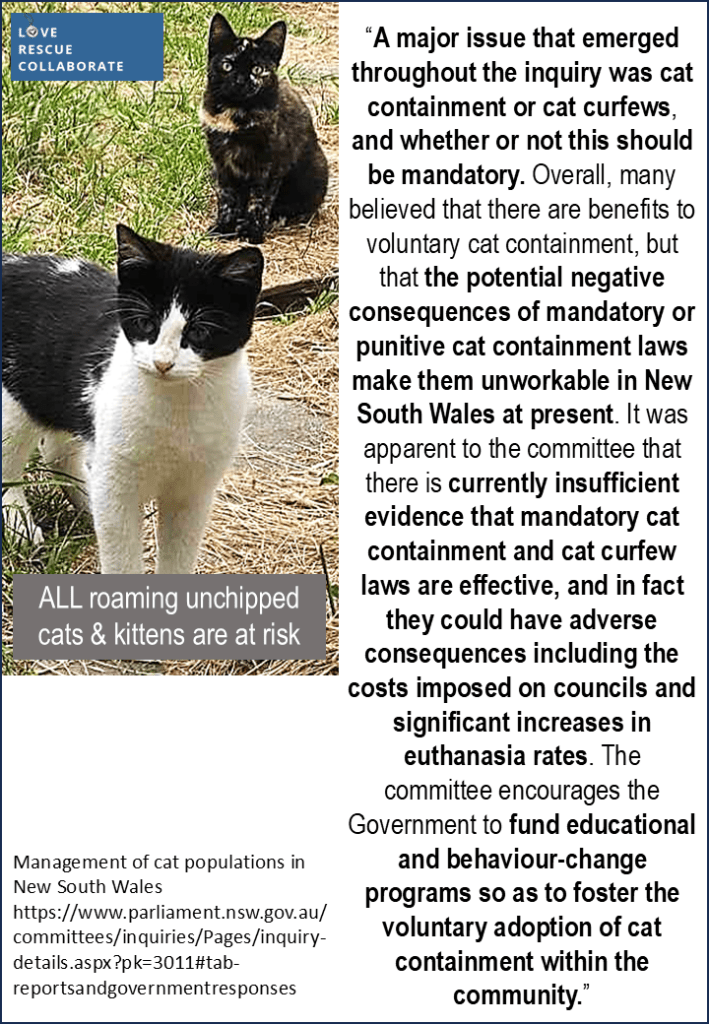
“A major issue that emerged throughout the inquiry was cat containment or cat curfews, and whether or not this should be mandatory. Overall, many believed that there are benefits to voluntary cat containment, but that the potential negative consequences of mandatory or punitive cat containment laws make them unworkable in New South Wales at present. It was apparent to the committee that there is currently insufficient evidence that mandatory cat containment and cat curfew laws are effective, and in fact they could have adverse consequences including the costs imposed on councils and significant increases in euthanasia rates. The committee encourages the Government to fund educational and behaviour-change programs so as to foster the voluntary adoption of cat containment within the community.” https://www.parliament.nsw.gov.au/committees/inquiries/Pages/inquiry-details.aspx?pk=3011#tab-reportsandgovernmentresponses
The RSPCA NSW provided evidence from the Keeping Cats Safe at Home program for the effectiveness in rapidly increasing cat containment across a number of NSW councils through an owner change behaviour program involving a number of initiatives.
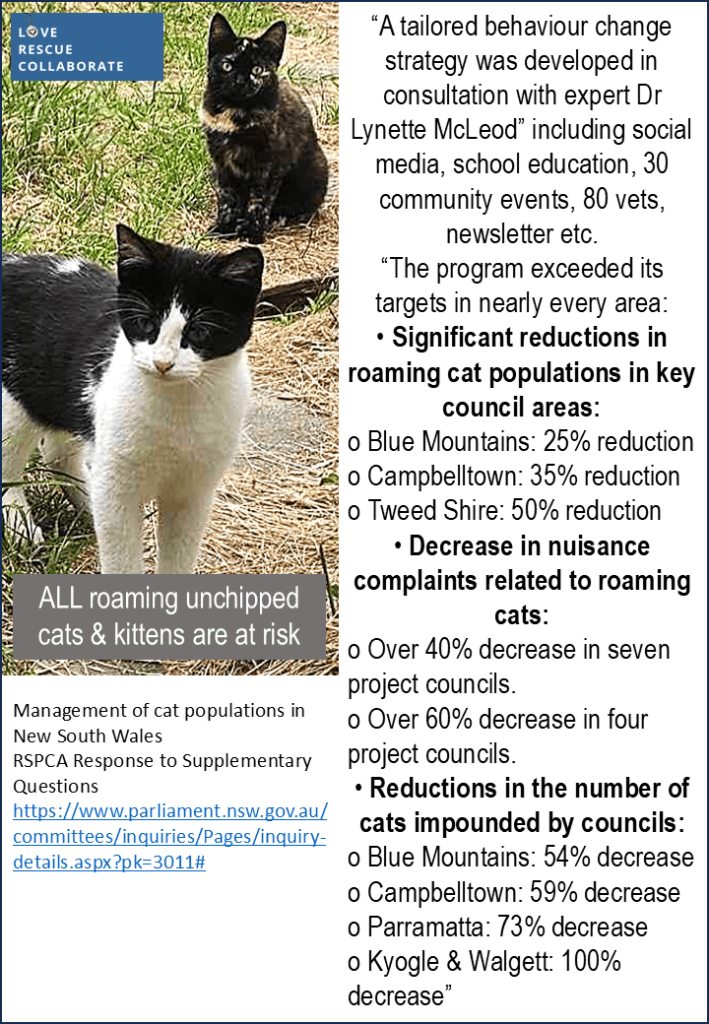
Significant reductions in roaming cat populations in key council areas: o Blue Mountains: 25% reduction o Campbelltown: 35% reduction o Tweed Shire: 50% reduction
Decrease in nuisance complaints related to roaming cats: o Over 40% decrease in seven project councils. o Over 60% decrease in four project councils.
Reductions in the number of cats impounded by councils: o Blue Mountains: 54% decrease o Campbelltown: 59% decrease o Parramatta: 73% decrease o Kyogle & Walgett: 100% decrease”
RSPCA NSW KCSAH beyond desexing, involved holistic human behaviour change program initiatives included:
“A tailored behaviour change strategy was developed in consultation with expert Dr Lynette McLeod.
A dedicated email newsletter (“The Cat-ch Up!”) with over 4,000 subscribers providing ongoing cat care advice and support.
A comprehensive social marketing campaign, including radio, TV, and social media outreach reached more than 3.5 million people.
School-based education programs engaged over 1,400 children and normalised responsible cat ownership from an early age.
More than 30 community events directly engaging over 36,000 people.
Information resources distributed through more than 80 partner veterinary clinics, councils, and rehoming organisations.”
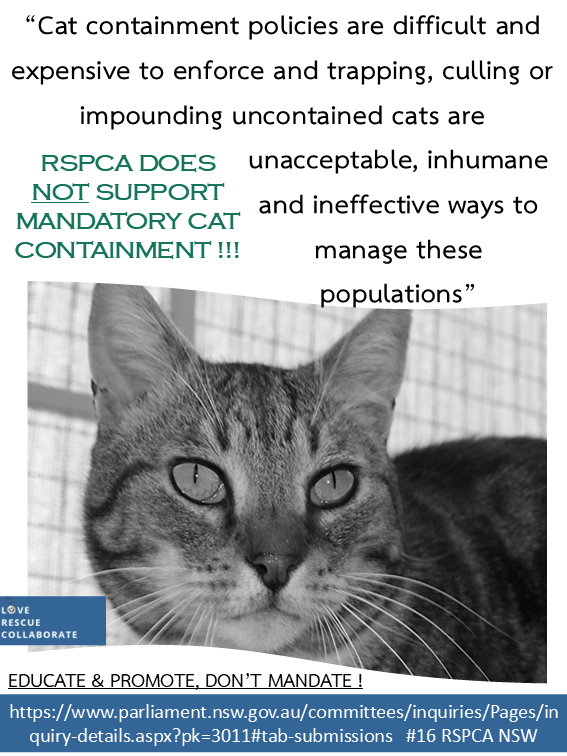
The RSPCA opposes mandatory containment for a number of reasons, including:
“Lack of evidence that containment laws are effective“.
“There is an unacceptable welfare impost on cats. Not all cats can be contained without suffering poor welfare. Some cats struggle with full-time containment due to their behavioural needs.
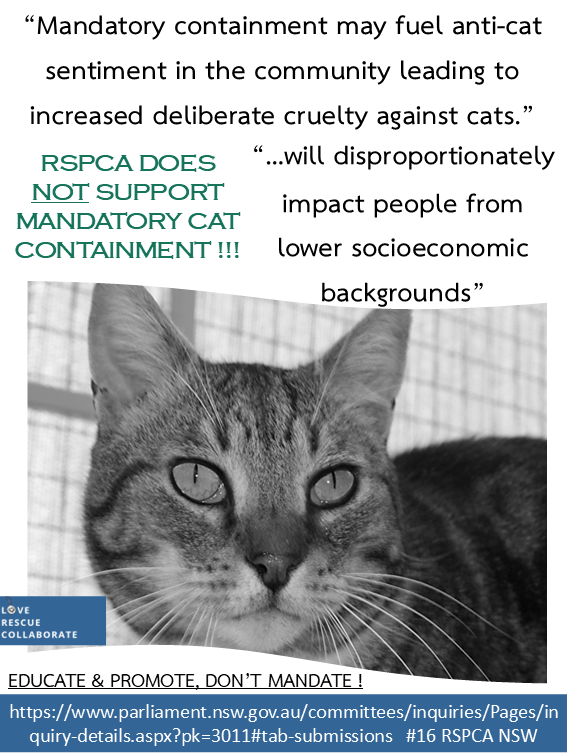
Not all cat caregivers can contain cats where they live. Renters, and people with less disposable income are likely to be disproportionately affected, as many landlords do not allow indoor cats or pet modifications, and containment infrastructure (e.g. catios, secure fencing) can be costly.
Mandatory containment is likely to lead to increased surrenders and abandonment. Pet owners who cannot comply due to financial or housing constraints may be forced to surrender or abandon their cats, placing greater burdens on council pounds and animal welfare organisations that are already struggling with overpopulation.
Mandating cat containment undermines unowned cat management efforts. Many unowned cats (semi-owned cats) rely on informal caregivers who provide food and care but do not consider themselves owners. Adding legal containment requirements will discourage these caregivers from taking on ownership responsibility, undermining interventions designed to manage and reduce unowned cat populations through desexing and support programs.”
AND detailed additional concerns related to the cost of living crisis, including:
“Financial burden on pet owners“
“Disproportionate impact on vulnerable groups“
“Increased pressure on pounds & rescue organisations“
Why were the impacts to wildlife from domestic cats questioned?
Was there a lack of evidence to consider mandatory cat containment?
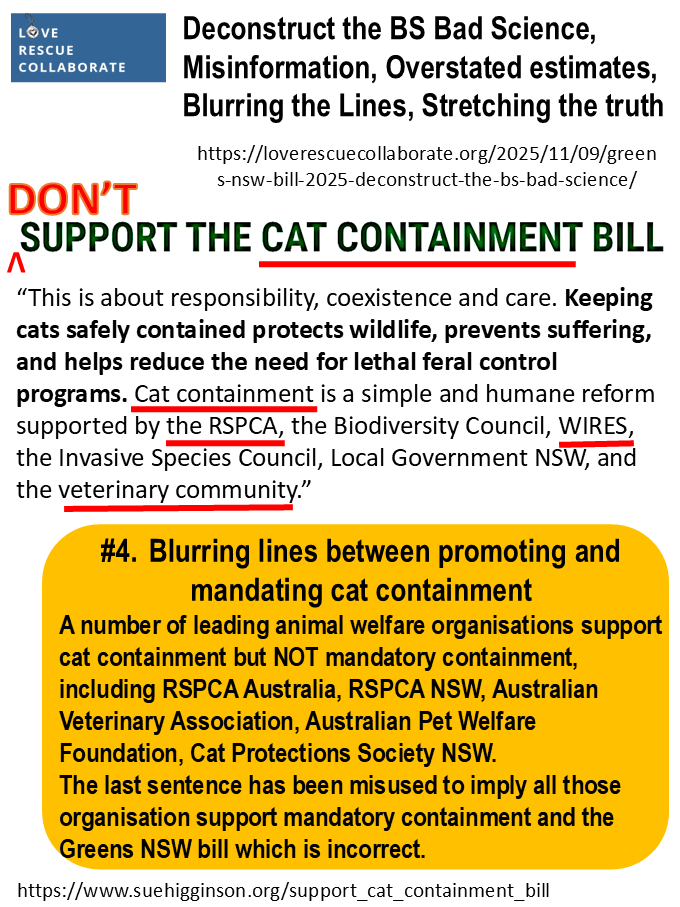
The Royal Society for Prevention of Cruelty to Animals (RSPCA) New South Wales (NSW) clearly indicated support for containing cats, but NOT for mandatory cat containment for many reasons, which was provided in their submission to the recent Inquiry Management of Cat Populations NSW.
This position was based on research including their own with a focus on the recent years of the Keeping Cats Safe At Home (KCSAH) program across over ten NSW councils.
This blog page has been created to assist with clarifying misleading interpretations that the RSPCA does support mandatory containment.
There is a wealth of substantiated information provided in the RSPCA submission for the Inquiry.
The RSPCA has shown increased uptake of cat containment through multiple initiatives in the KCSAH program over years with over ten NSW councils.
This proactive human behaviour change approach aligns with One Welfare approaches aligning human and animal welfare improvements.
RSPCA Representatives at Inquiry Hearings
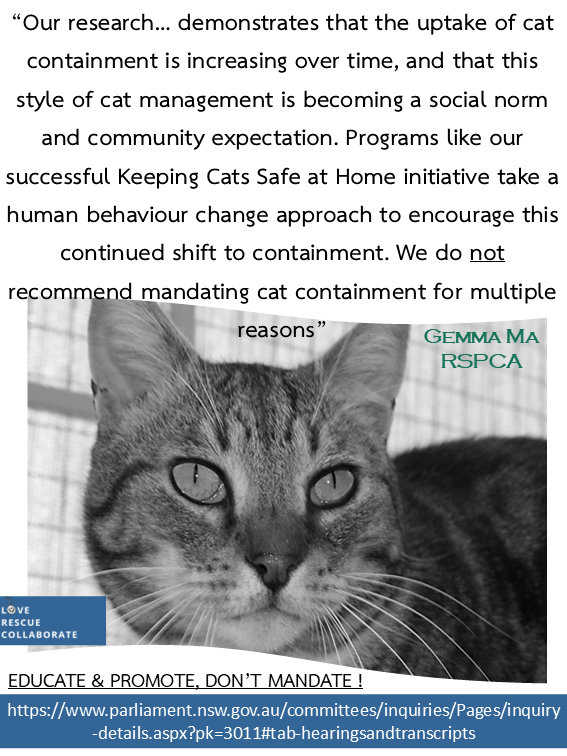
During the 16 December 2024 hearings for the recent Inquiry Management of Cat Populations NSW, Gemma Ma Project Manager for Keeping Cats Safe At Home program, Royal Society for Prevention of Cruelty to Animals, provided the RSPCA position on mandatory cat containment, including:
cat owners using enclosures and containment techniques is increasing
cat containment is becoming a social norm
the RSPCA KCSAH program included a targeted program for human change in relation to encourage the uptake of containment practices.
RSPCA Answers to Supplementary Questions
The RSPCA team were asked for further information on their cat containment change program under the Keeping Cats Safe at Home program funded by the NSW government, and associated findings.
The RSPCA “Answers to Supplementary Questions” response is summarised as it contained a significant amount of information, with justification for their recommendations for not supporting mandatory cat containment.
This is a very information document covering many related subjects,
KCSAH positive outcomes exceeded many targets:
Significant reductions in roaming cat populations in key council areas: o Blue Mountains: 25% reduction o Campbelltown: 35% reduction o Tweed Shire: 50% reduction
Decrease in nuisance complaints related to roaming cats: o Over 40% decrease in seven project councils. o Over 60% decrease in four project councils.
Reductions in the number of cats impounded by councils: o Blue Mountains: 54% decrease o Campbelltown: 59% decrease o Parramatta: 73% decrease o Kyogle & Walgett: 100% decrease”
RSPCA NSW KCSAH beyond desexing, involved holistic human behaviour change program initiatives included:
“A tailored behaviour change strategy was developed in consultation with expert Dr Lynette McLeod.
A dedicated email newsletter (“The Cat-ch Up!”) with over 4,000 subscribers providing ongoing cat care advice and support.
A comprehensive social marketing campaign, including radio, TV, and social media outreach reached more than 3.5 million people.
School-based education programs engaged over 1,400 children and normalised responsible cat ownership from an early age.
More than 30 community events directly engaging over 36,000 people.
Information resources distributed through more than 80 partner veterinary clinics, councils, and rehoming organisations.”
The RSPCA opposes mandatory containment for a number of reasons, including:
“There is an unacceptable welfare impost on cats. Not all cats can be contained without suffering poor welfare. Some cats struggle with full-time containment due to their behavioural needs.
Not all cat caregivers can contain cats where they live. Renters, and people with less disposable income are likely to be disproportionately affected, as many landlords do not allow indoor cats or pet modifications, and containment infrastructure (e.g. catios, secure fencing) can be costly.
Mandatory containment is likely to lead to increased surrenders and abandonment. Pet owners who cannot comply due to financial or housing constraints may be forced to surrender or abandon their cats, placing greater burdens on council pounds and animal welfare organisations that are already struggling with overpopulation.
Mandating cat containment undermines unowned cat management efforts. Many unowned cats (semi-owned cats) rely on informal caregivers who provide food and care but do not consider themselves owners. Adding legal containment requirements will discourage these caregivers from taking on ownership responsibility, undermining interventions designed to manage and reduce unowned cat populations through desexing and support programs.”
AND detailed additional concerns related to the cost of living crisis, including:
“Financial burden on pet owners“
“Disproportionate impact on vulnerable groups“
“Increased pressure on pounds & rescue organisations“
“Lack of evidence that containment laws are effective“.
RSPCA findings include seeing no value in punitive containment laws
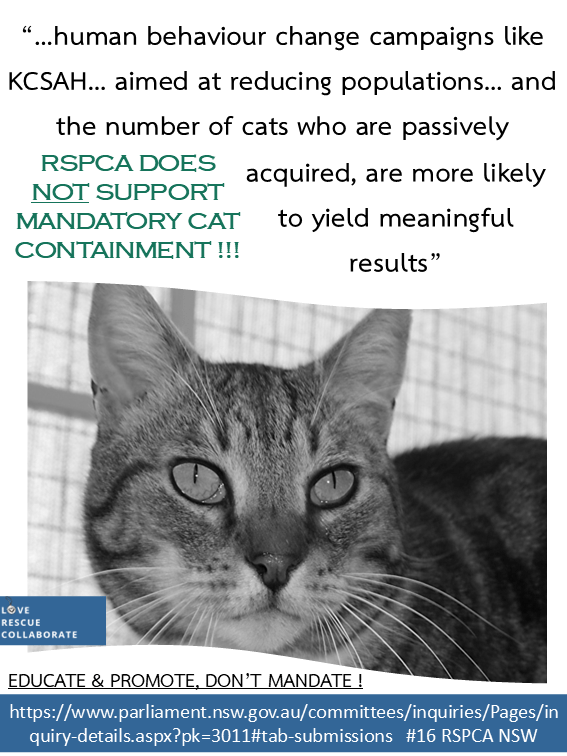
“There is no evidence that education and targeted behaviour change programs are ineffective without containment laws. The results of the KCSAH evaluation (described above and attached herewith) demonstrate the opposite. The important point is that education-based approaches, when coupled with complementary strategies such as subsidised desexing, microchipping, and behaviour change programs, have been shown to be highly effective in increasing voluntary cat containment.”
RSPCA does not support councils being given power to introduce cat containment laws at this time, with concerns including:
“an inherent unfairness in legislating when residents in one LGA will be subject to strict enforcement” while others are not
“legislation to promote behaviour change… cannot be at the risk of significant unintended consequences, including poor animal welfare outcomes”
RSPCA provides that “Mandating cat containment without adequate resourcing and preparation risks a range of negative outcomes” and detailed under the following:
“Increased deliberate harm and cruelty to roaming cats”
“Increased abandonment and surrender of owned cats”
“Increased “stray” cat intake and euthanasia at council pounds”
“Additional barriers to humane management of unowned cat populations”
RSPCA concludes with:
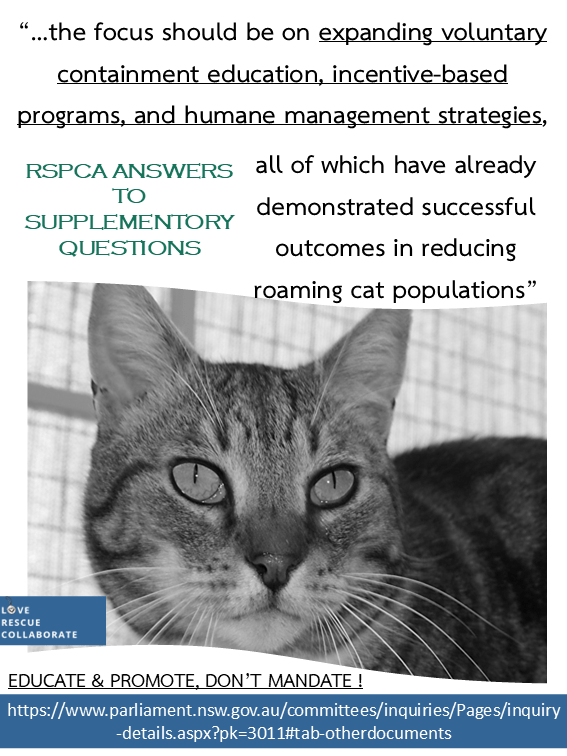
“Rather than rushing to introduce containment laws without proper funding and capacity building in a targeted way across NSW, the focus should be on expanding voluntary containment education, incentive-based programs, and humane management strategies, all of which have already demonstrated successful outcomes in reducing roaming cat populations.”
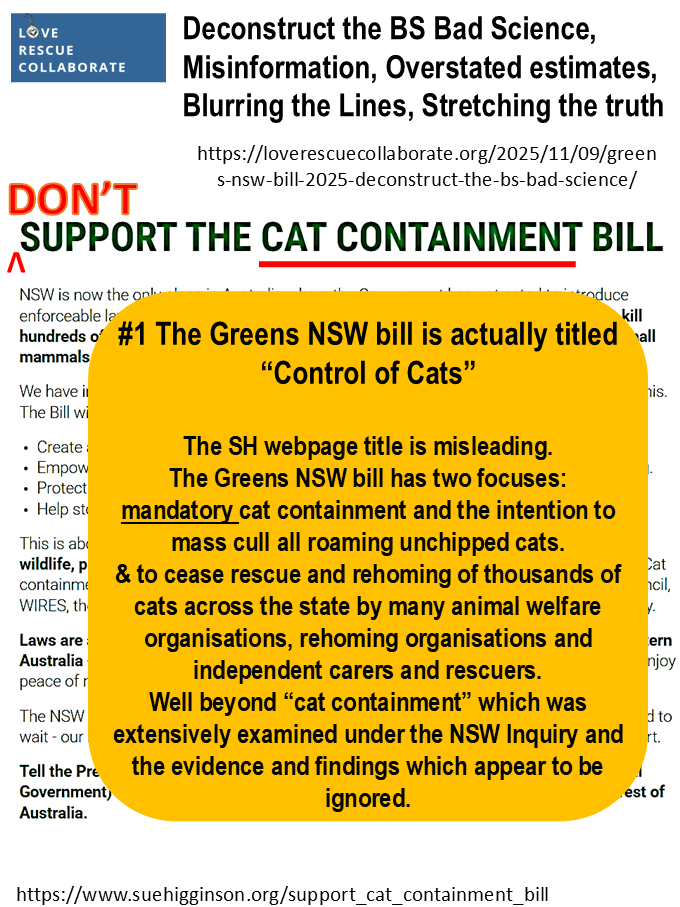
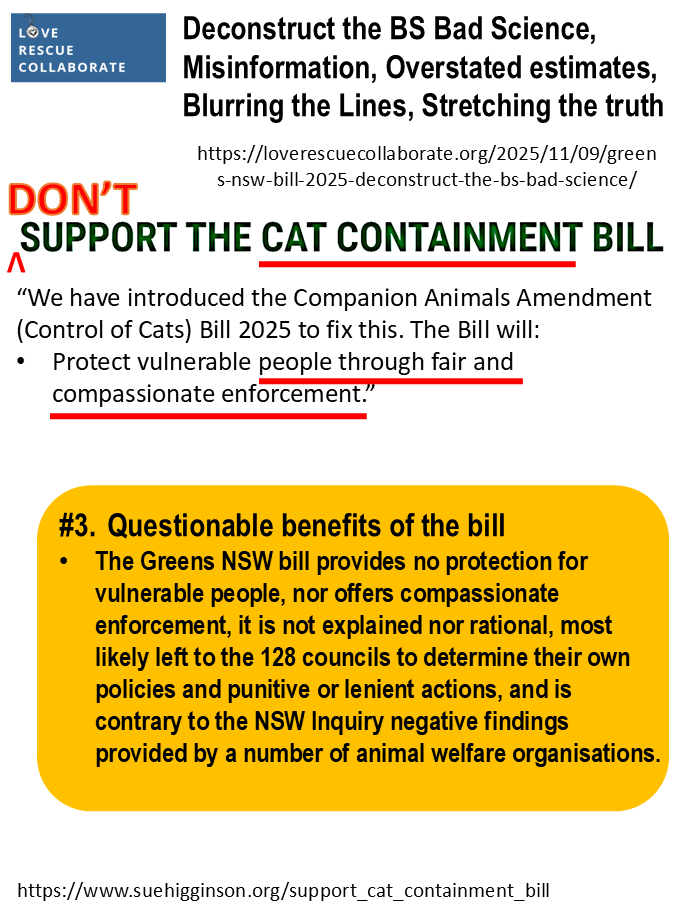
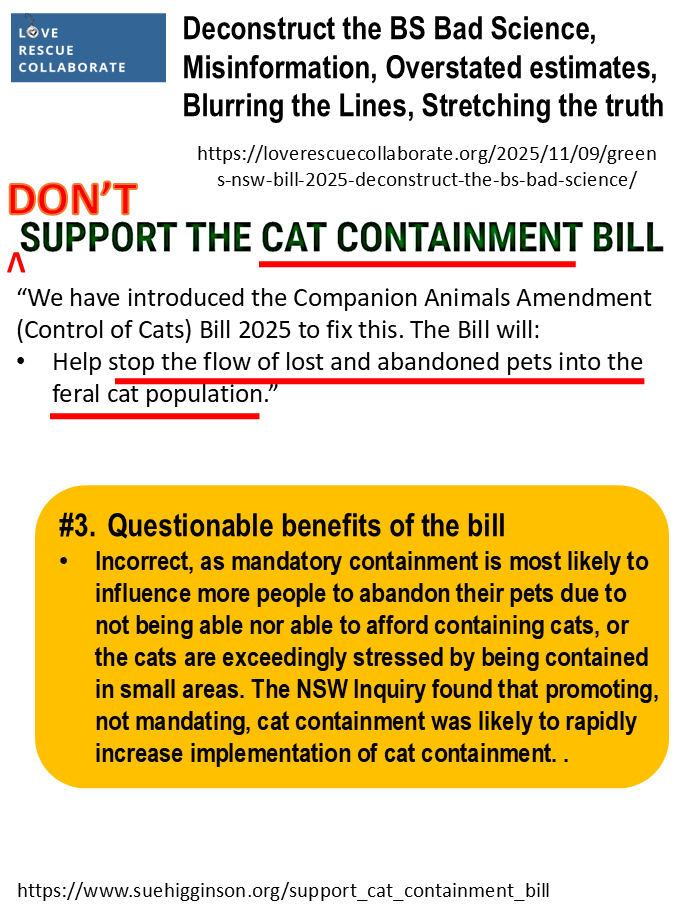
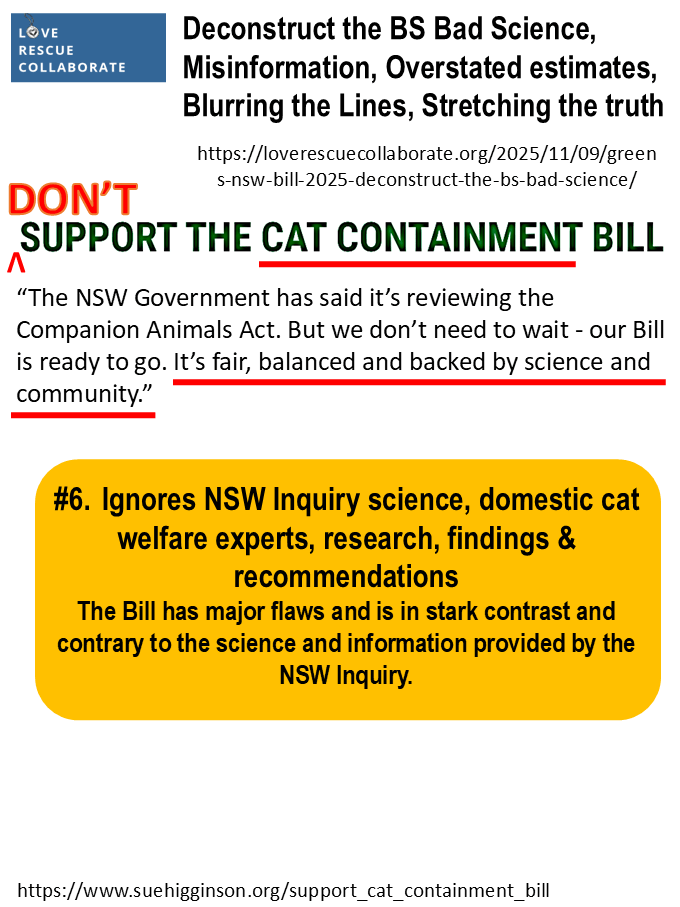
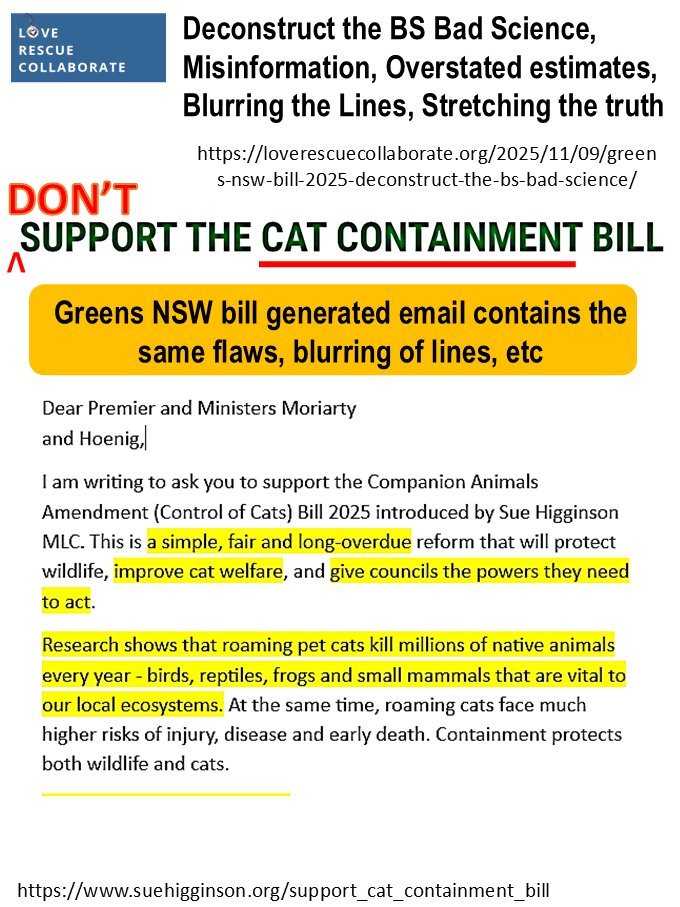
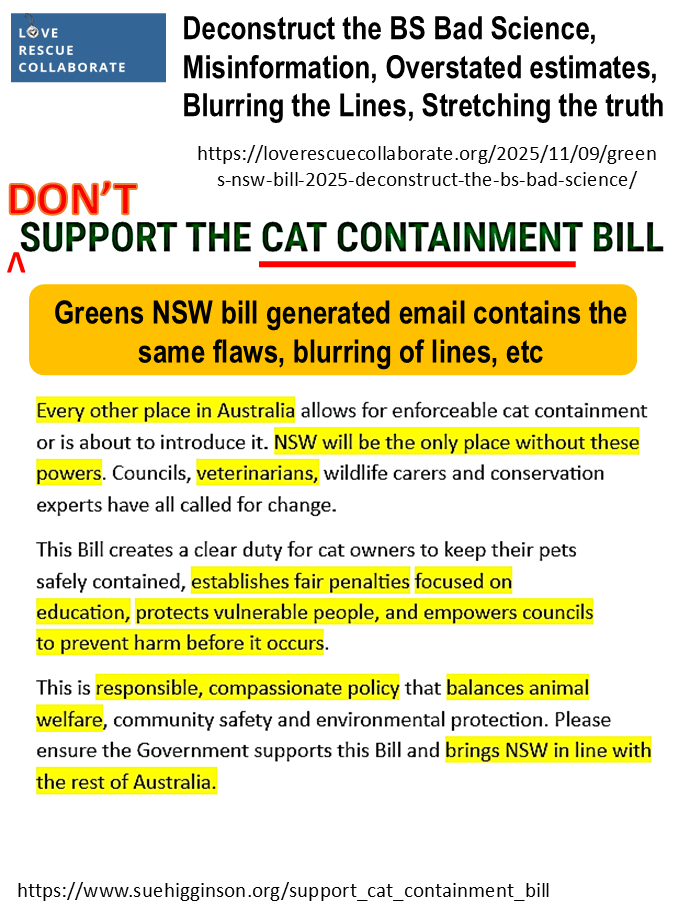
Is Sue Higginson using similar propaganda techniques on domestic cats, as spread by Invasive Species Council, that then further negatively influences impacts and cruelty to animals? As aren’t these similar misleading techniques now appearing in her cat containment webpage and email generator together supporting for the Greens NSW Control of Cats bill?https://www.suehigginson.org/support_cat_containment_bill
During the Inquiry Management of Cat Populations hearing 1 April 2025, Sue Higginson requested a response to a Question on Notice to provide evidence “anything that links the work of the Invasive Species Council to what you’re suggesting is an increase or a prevalence of animal cruelty”. https://www.parliament.nsw.gov.au/committees/inquiries/Pages/inquiry-details.aspx?pk=3011
Sue Higgenson appears to be providing very misleading information to the public on her webpage & email generator to the Premier & Ministers
It is a significant concern that just like the Invasive Species Council, Sue has used overstated cat impacts, misleading information, blurring lines with general benefits of cat containment, misrepresenting a number of animal advocates who oppose mandatory cat containment, lack of understanding of actual number of wildlife in urban areas, and more to promote the Greens NSW bill. https://www.suehigginson.org/support_cat_containment_bill
Similar flaws are included in the template email that is addressed to yourself, available on Sue’s webpage for the public’s use.
Both the webpage and email webpage:
fail to be transparent that the intent of the Greens NSW bill is for mass culling of stray cats, regardless of these cats being recently unchipped lost or abandoned domestic cats, and the cats likely being assisted by carers and rescuers, and
significantly ignore the NSW Inquiry scientific evidence from experts, the findings and recommendations, including the positive and rapid outcomes form the RSPAC NSW holistic human behaviour change program increasing cat containment.
It appears that Sue’s claims that the bill is compassionate and balanced is fairly outrageous.
The Greens NSW Companion Animals Amendment (Control of Cats) Bill 2025 is in stark contrast and contrary with the recent Parliament Inquiry Management of cat populations in New South Wales with its proven rapid approach to increase cat containment and other proactive One Welfare solutionsunder its scope.
The NSW Government is taking the issue of cat management very seriously with a number of related Inquiries and reviews, including the shortage of vets, improving the performance of council pounds, cat management and review of the overly complex yet open to interpretation Companion Animals Act etc.
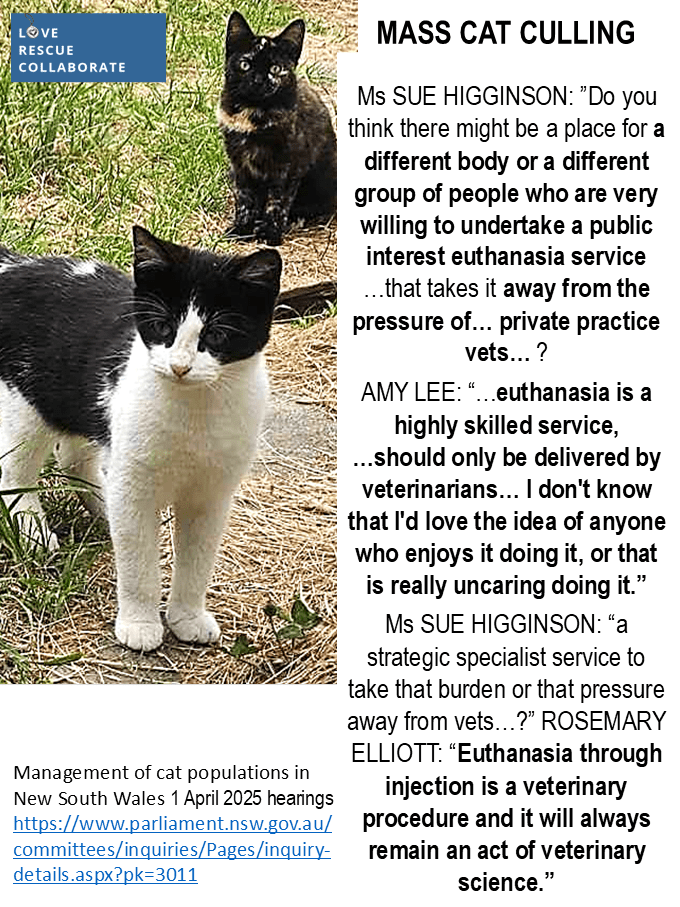
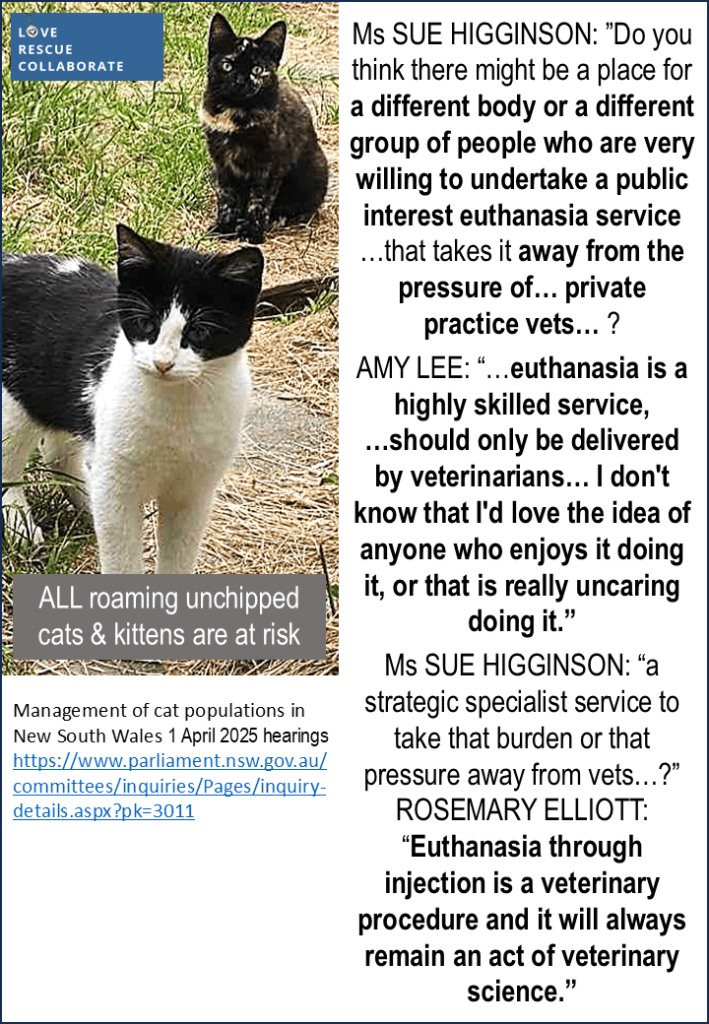
The recent formal Inquiry Management of Cat Populations, which included Greens NSW and other representatives, involved extensive engagement with leading domestic cat welfare experts, with their substantial scientifically proven evidence and outcomes, peer-reviewed formal research and cost/benefit analysis. During the hearings it was incredibly disturbing that Sue Higginson proposed “a different body or different people” to complete massive culling instead of professional vets under council pounds. Policy should follow animal welfare standards, evidence, effectiveness, ethics, and the Inquiry provided these, where the Greens NSW bill contains major flaws in all of these obligations.
The Inquiry findings and recommendations are fully supported as it provided the most recent appropriate, effective, humane and proven improvements for cat management, and specifically the proven holistic humane behaviour change program for cat containment, which integrated assist with reducing impacts for wildlife.https://www.parliament.nsw.gov.au/committees/inquiries/Pages/inquiry-details.aspx?pk=3011
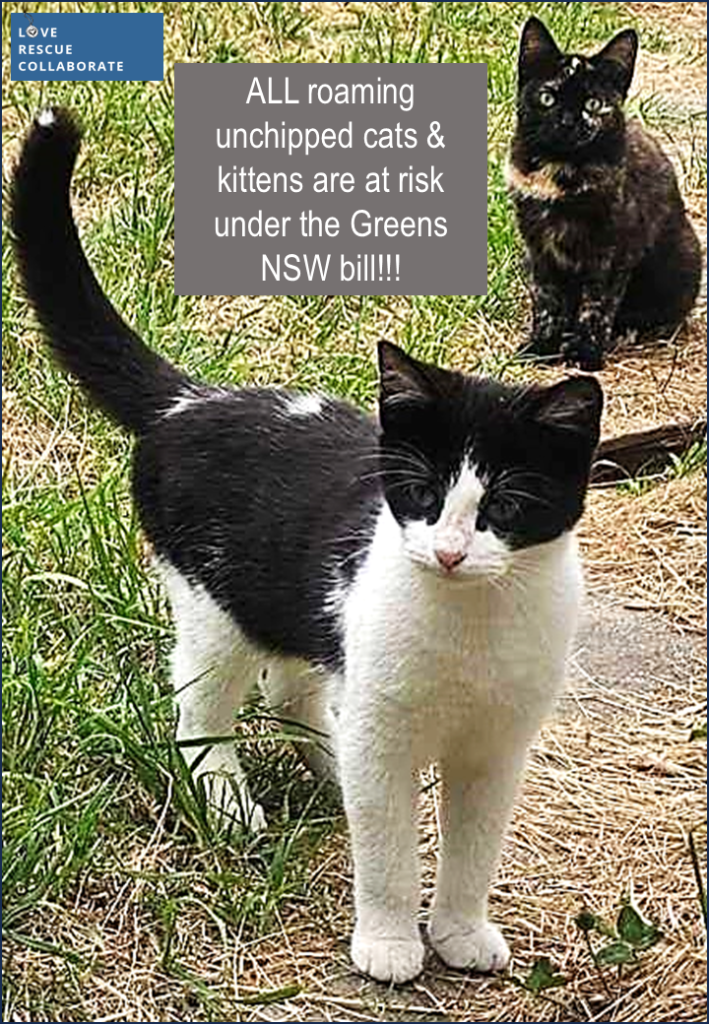
The Greens NSW bill is NOT supported as it will take our animal welfare approaches back decades with researched and proven failed techniques and outcomes. It does not represent a “a clear but simple legal duty on cat owners”. It represents a deadly intention for ALL roaming unchipped/registered cats, likely ceases most efforts to rescue and rehome semi owned and unowned cats (strays), and likely increases cruelty to all roaming cats.https://www.parliament.nsw.gov.au/bills/Pages/bill-details.aspx?pk=18825
NSW deserves evidence-based, compassionate, and effective cat management. The Greens NSW bill fails that test and will divert resources away from proven solutions, and punish vulnerable cat owners.
It appears the Greens NSW bill is NOT just to “prevent cats from escaping from places or from leaving places”. During the hearings Sue Higginson, Scott Barrett and Susan Carter raised mass cullings. There are further harsh flow-on implications as if all unchipped roaming cats are deemed illegal then so too for the efforts of many thousands of individuals and organisations who currently assist and rehome abandoned cats and kittens across NSW. may also be deemed illegal. Directly assisting roaming unchipped cats may cease for the Animal Welfare League NSW, Cat Protection Society NSW, over 100 rehoming organisations, and many thousands of independent community cat rescuers. Further, with pounds and rehoming organisations already at capacity, the Greens NSW bill effectively removes the community safety net that currently saves countless cats from euthanasia every year.
Under the Inquiry, cat management and containment to reduce impacts to wildlife was significantly considered with the most recent extensive evidence by a number of trusted organisations in the field, proven to reduce roaming and population size by treating root causes, and included in the Inquiry final report. These approaches were both humane and community supported, and cost-effective compared with enforcement and euthanasia-based systems.
It is understood our government is committed to assessing the policy implications to owners and communities, and provide better outcomes for both endangered native species and companion animals. In summary in relation to the Greens NSW bill, the Inquiry key findings were based on substantial evidence from relevant domestic cat experts and their organisations, including:
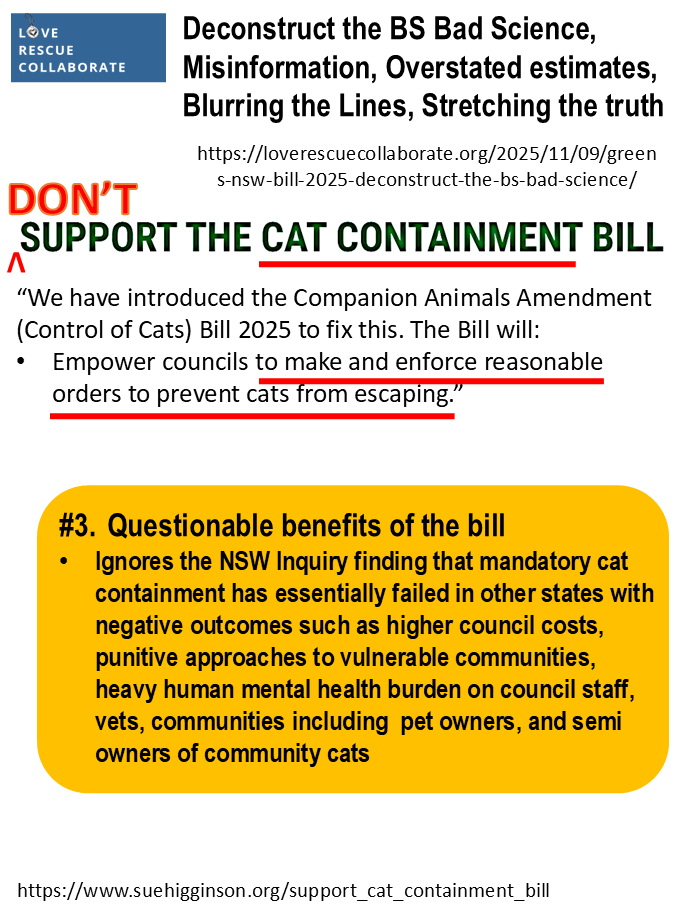
traditional and current punitive practices were found to be ineffective, and mandated containment was researched and found as ineffective across many Australian councils, as it is punitive and costly, with higher euthanasia rates putting further burdens on vets, their staff and the community. These issues have been explained in detail by the Australian Pet Welfare Foundation submission, and for which Jacquie Rand and other animal welfare experts provided further advice during and after the hearings https://www.parliament.nsw.gov.au/lcdocs/submissions/88514/0068%20Australian%20Pet%20Welfare%20Foundation.pdf
the leading effective humane One Welfare solutions to minimise the number of cats, rapidly increase cat containment, and therefore minimise impacts to wildlife included:
high intensity desexing, which has been substantiated by many animal welfare organisations across many councils in NSW, Queensland, and Victoria including APWF community cat programs, RSPCA NSW Keeping Cats Safe at Home desexing programs, Cat Protection Society NSW desexing services, Animal Welfare League NSW, etc and included as evidence in submissions etc under the Inquiry https://www.parliament.nsw.gov.au/committees/inquiries/Pages/inquiry-details.aspx?pk=3011#tab-submissions and
Greens NSW & cohorts appeared to have preset aims for culling cats / mass euthanasia
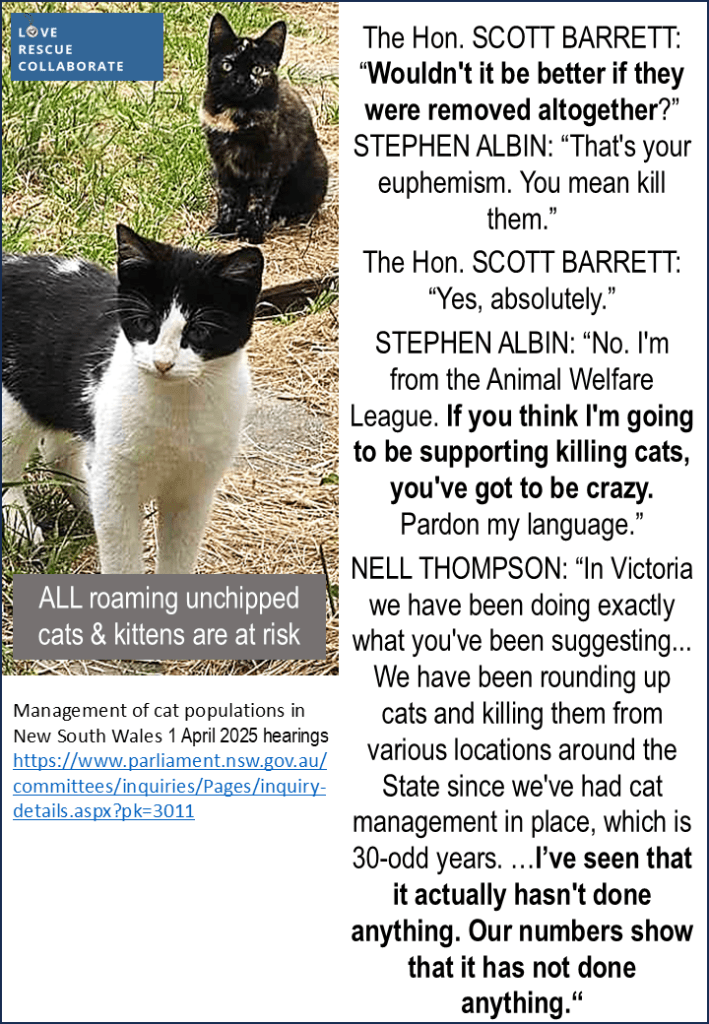
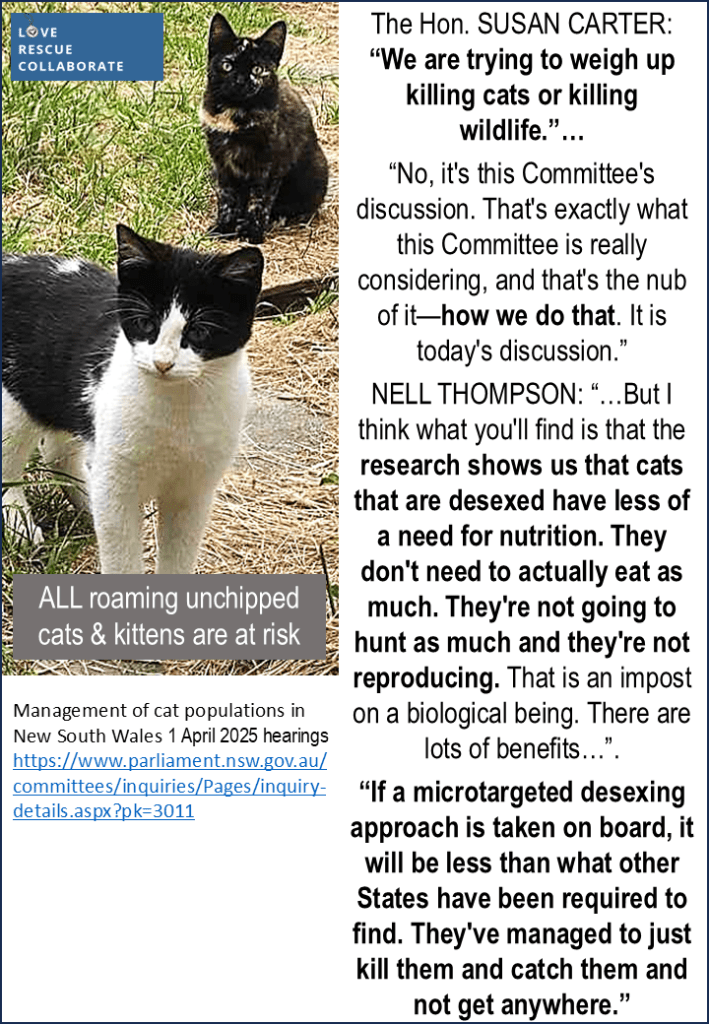
Disturbingly, during the Inquiry hearings, it became evident that a few committee representatives clearly had the intent for archaic mass culling, potentially with alternatives to the current animal welfare standards for humane euthanasia by council pound vets. Specific example comments from committee members Sue Higginson, Scott Barrett and Susan Carter are included below, which also include animal welfare experts strongly rejecting these ineffective and inhumane approaches.
From Sue Higginson’s comments during the Inquiry hearings, it appears there is a Greens NSW aim to target all roaming unchipped cats for mass euthanasia, in a manner potentially different to current humane standards by professional vets under our councils.
A traditional mass euthanasia approach by council pounds takes our animal welfare system back decades.
The Inquiry included evidence that these traditional culling methods are not effective.
The focus on mass culling cats appears strongly supported by Scott Barrett committee representative at the Inquiry hearings.
Animal welfare representatives at the hearing did not agree with culling roaming cats and were concerned about this focus. The approach of mass culling has not been effective including when triggered by mandatory cat containment under a cat management approach in urban and peri urban areas.
It appears the focus on mass culling cats was also supported by Sue Cater committee representative at the Inquiry hearings, and clearly not open to seeking a balanced approach and outcomes.
At the Inquiry, a number of animal welfare experts provided proven examples of the success of targeted domestic cat desexing programs which minimise cat populations and impacts to wildlife.
Funding for desexing programs is justified on a cost/benefit assessment, and if considered less cost than other negative approaches.
Greens NSW bill motivated by questionable generic wildlife impacts, while Inquiry evidence indicates more research is required for domestic cat impacts in specific conditions and target areas
Policy should be formed from science and not politics, nor fear.
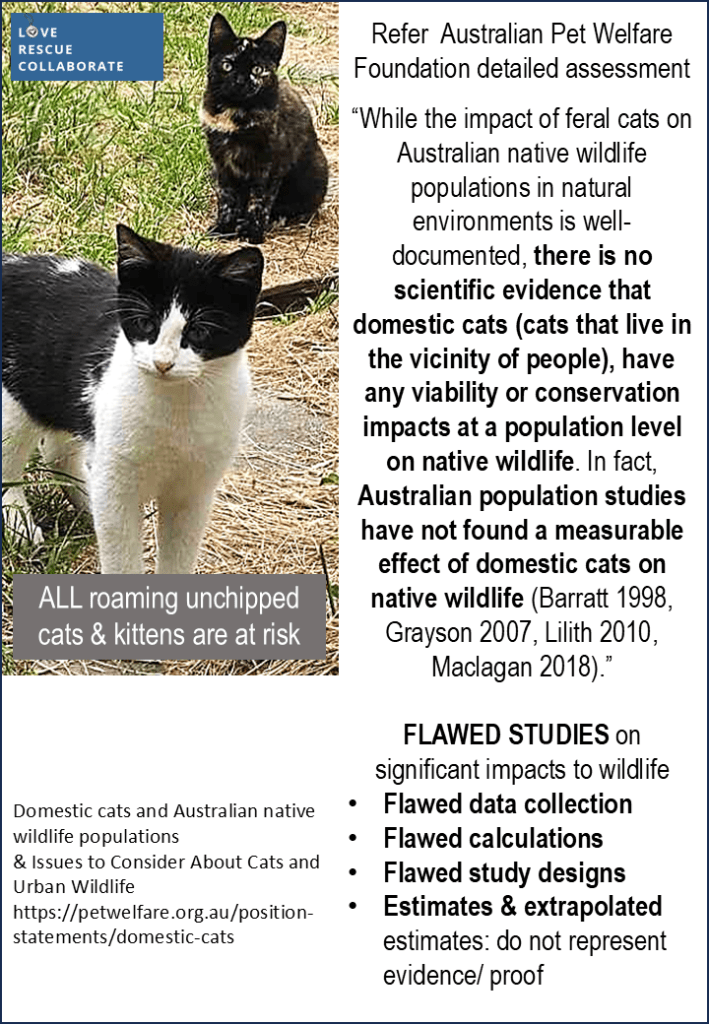
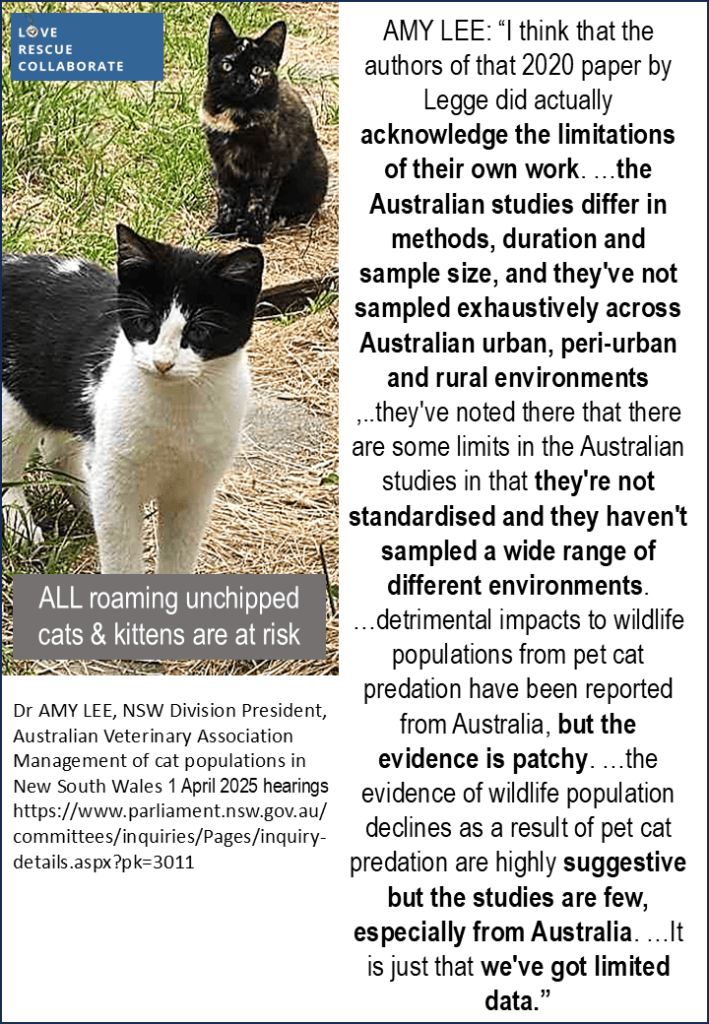
The often quoted, dramatic wildlife impacts of domestic cats are derived from studies which have been analysed which identified a number of flaws and issues.
The most significant concern is that there have been few Australian based scientific studies on domestic cats, which has been augmented by many questionable assumptions based on feral cat research and selected studies from other countries.
The range of flaws and issues highlight the limitations of the to-date studies with domestic cats in urban and peri urban areas.
A number of animal welfare representatives are aware of the questionable cat impacts to wildlife.
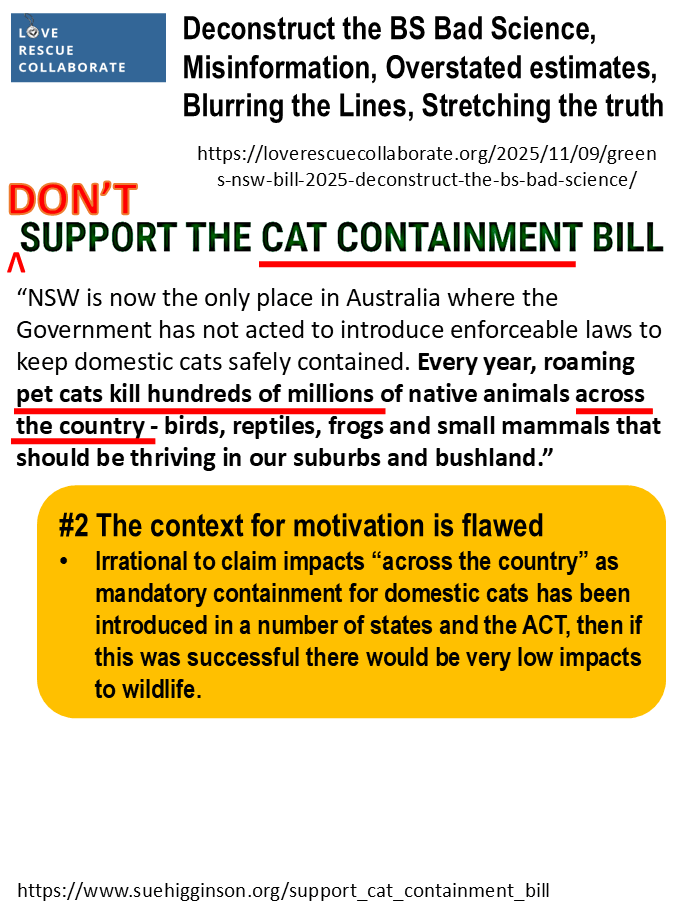
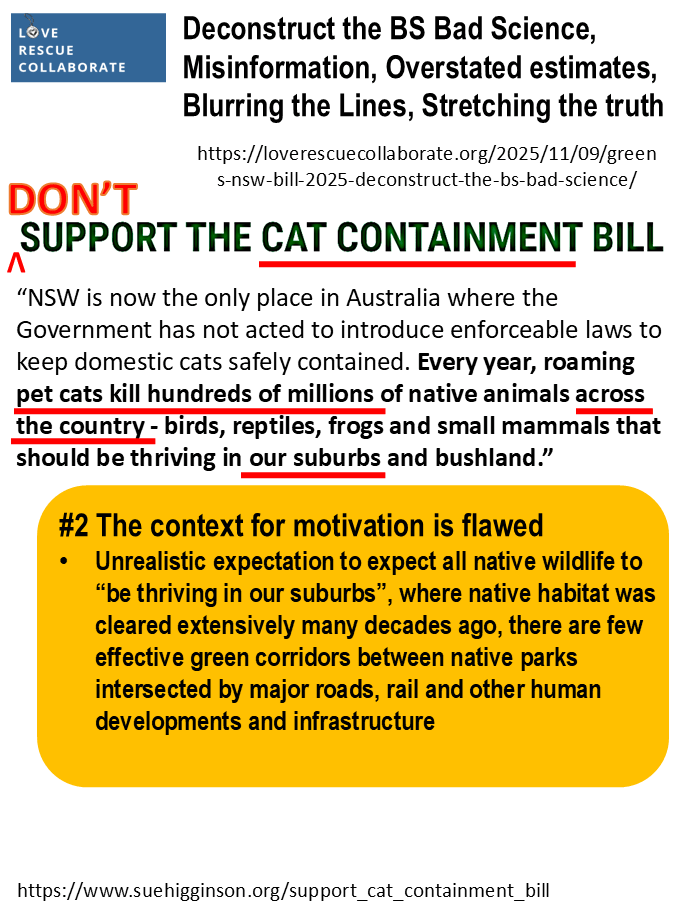
Currently the flawed estimated impacts are applied uniformly across our nation and not tailored for the lack of native habitat conditions or wildlife densities in different cities, towns or Local Government Areas (LGAs).
It is not unusual for the national overstated estimates to be quoted at state/ territory level or even separate LGAs to incentivise the need for harsh treatment of all cats.
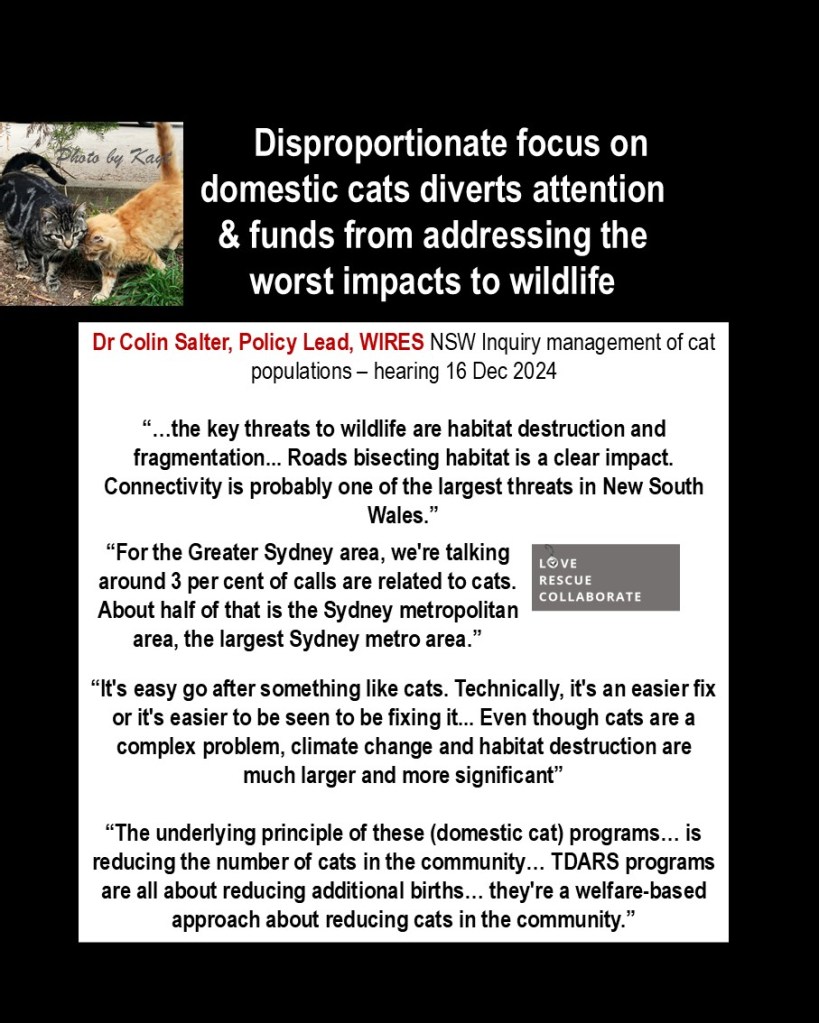
WIRES provided their view that other factors such as habitat loss have a worse impact to wildlife than cats. This aligns with Australia’s State of the Environment Report 2021) https://soe.dcceew.gov.au/biodiversity/key-findings.
The Greens NSW bill directly aimed at cats is being justified by dramatic impacts to wildlife which have not been justified in urban and peri urban areas of significantly compromised native habitat and native species.
During the Inquiry:
commitment to wildlife was shared by animal welfare organisations and advocates; and
a number of animal welfare advocates raised the need for more targeted Australian based domestic cat research to provide specific impacts to prioritise the areas of concern and to tailor and design appropriate and effective responses at a local level.
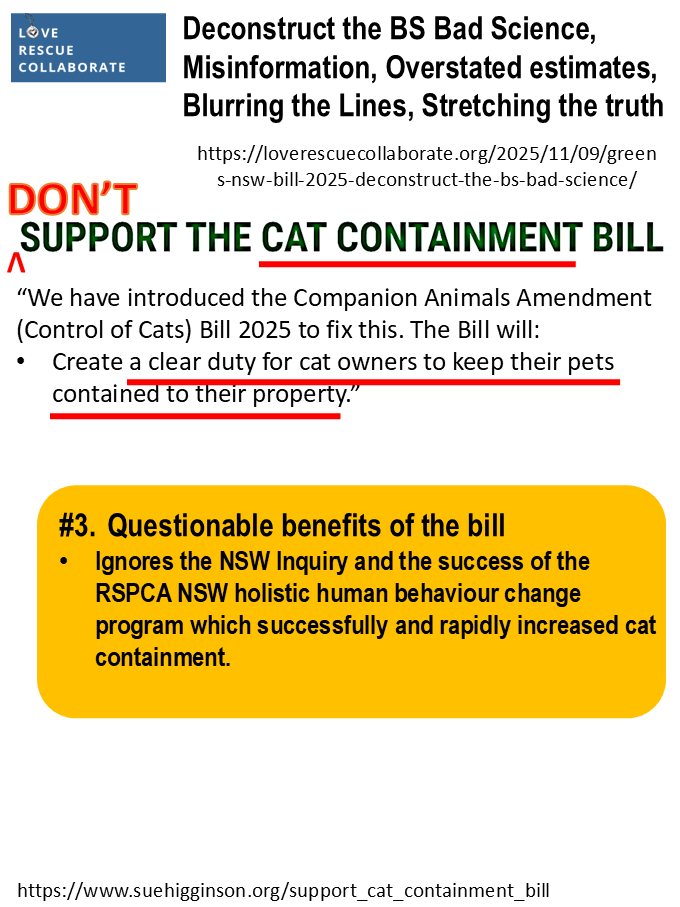
Greens NSW bill dismisses Inquiry evidence for voluntary cat containment rapidly increasing with education & change programs, and evidence for mandatory containment not being effective
During the Inquiry, containment was supported by many, research was provided on the effectiveness of human change approaches to rapidly increase uptake of cat containment, and evidence was provided where mandatory containment was not being effective and was costly.
Cost of living pressures mean more cats are being abandoned and adoption rates have dropped significantly. The council pounds and animal welfare shelters are limited in capacity and resources. There is a significant burden on volunteer community cat rescuers and carers.
These and other factors were included in the NSW Inquiry which advised against supporting mandatory containmentat this time due to negative consequences and costs, andincluded evidence on the success of increasing voluntary containment with positive and proactive education initiatives.
RSPCA NSW provided evidence from their Keeping Cats Safe at Home program across a number of NSW councils for its effective improvements with desexing, resulting in reducing cat nuisance complaints, impound numbers, and in increasing cat containment across NSW.
These desexing programs were accompanied with a range of human behaviour change program initiatives.
The Greens bill is contrary to the proven proactive human change program approach that rapidly increased cat containment across NSW, which was comprised of a range of proactive engagement activities developed with science
The RSPCA NSW achieved these results without punitive legislation, fines and penalties to cat owners.
RSPCA NSW provided information to the Inquiry in their submission, at the hearings, and further documents in relation to the Questions on Notice and Supplementary Questions. The latter was requested in response to a specific criticism by another hearing attendee, which the RSPCA NSW considered to “grossly misrepresents the program’s scope, activities, and outcomes”.
Greens NSW bill ignores that negative propaganda & mandatory containment influences increasing cruelty to cats
The significant concern for increasing cruelty towards cats was raised during the Inquiry, which is predominantly delivered from wildlife lobby groups demonising all cats, and then in response, community members expressing anger about roaming cats as they are certain the cats should already be contained.
The Sue Higginson requested evidence about the work of Invasive Species to the increase or prevalence of animal cruelty to cats as a Question on Notice following the hearing 1 April 2025.
The Greens NSW representatives, and presumably all committee members, received a documented set of examples indicating the trail similar to a waterfall of repetition of overstated misleading information from Invasive Species webpages and social media, that was negatively enhanced by other parties.
This trail of traditional and social media items, results with the internet being flooded with adverse views on all cats, which then affects search engines and Artificial Intelligence (AI) interpretations that are not able to discern quality versus flawed (shaky science) information.
Many cases of animal cruelty include justification of pet cats not staying on their own properties, e.g. Coffs Harbour. Recently in Sydney and Goulburn, there are repeated incidents of cats taken from their own properties to be harmed, and likely tortured, and killed. Current NSW Prevention of Cruelty to Animals legislation and funding is not adequate to address many of these cases where just boasted on social media with minimal evidence or where children are involved.
The Greens bill shows inadequacies and a lack of social licensing for the impacts of mandatory containment influencing cat haters to take actions into their own hands which has been seen in cat haters own social media posts on destroying cats in inhumane ways, and the inadequacies in POCTA responses to address these.
Greens NSW bill ignores and stops high intensity desexing solutions for semi owned cats, instead condemning these cats to die with trauma to semi owners
The Inquiry recommendations are underpinned by evidence of a number of successful Australian desexing programs, including those involving semi owned cats were provided to the Inquiry in submissions, and discussed in the hearings which were attended by Greens NSW committee members.
If mandatory containment is implemented for all cats then stray or semi owned and unowned cats will be deemed “illegal”, trapped and impounded and likely euthanased ASAP.
The Greens NSW bill ignores the Inquiry findings and recommendations that were based on “sound, peer-reviewed scientific evidence etc” and is aimed at culling all roaming unchipped cats in urban and peri urban areas. This is regardless of most of these cats being under the care of a community member and/or rescuer, and the bond that will be destroyed and the trauma caused to these people.
Currently we are waiting for the New South Wales government Ministers to declare the future intentions for managing cat populations amid the cat crisis.
While we see the potential for high intensity desexing in the “hardest” areas with significant numbers of undesexed cats, it is unknown how many councils will receive funding assistance, and the number who will not or what alternatives will be put in place.
We provide a brief guide to information that may assist residents of councils in approaching councils to self-fund and plan for their own initiatives.
Kickoff a conversation with your Mayor & Councillors
We strongly suggest you start at the top: your Mayor and Councillors. You will find their email contact information on your council webpage.
We suggest you get to know and follow your Mayor and local ward Councillors with events and on their social media and leverage any of their posts in relation to responsible pet ownership.
We also suggest you attach the LRC document on the compelling evidence on desexing programs in other Australia councils., and consider being prepared to discuss related topics.
Does your council already have a cat management plan / strategy? It may be embedded in a companion animal management plan or a dog and cat management plan. What is also available on your council website re pets? What does it currently explain? Are there off leash dog parks? Has the council designated any cat parks? Search your council website for this information.
What have been the reported statistics on the cats impounded and rehomed? All NSW councils’ pound data can be found under Animal Seizures – Pound Data from this webpage. Reported per year, a bit if a cumbersome document to access and read your council pound information, each year in a separate spreadsheet.
The LRC team have provided a subset of the most recent four years (draft a WIP) – refer subsection in this post.
Are you aware of your council’s reports/findings on biodiversity, including
which native animals that are most at risk and any specific council actions such as conservation fencing?
are you aware of the NSW Native Parks and Wild Life Protection Areas (WLPAs) where cats are not allowed to roam? WLPAs are usually council parks which are predominantly for people recreation that may contain native vegetation that is designated important for local native wildlife.
Are you aware of the following NSW government assessments, and did you and/or your council make submissions? ie are you aware of your council’s views on managing cats?
LRC Compelling Evidence of Australian Desexing Initiatives
The following summary of a number and range if Australian desexing initiatives is provided to be downloaded and attached to communications with Australian councils. We believe this provides:
We will appreciate if this document is sent as an attachment to your communications with your own council, and please highlight in your communication the councils and programs which will align with the characteristics / aspects of your council.
compelling evidence of the success of desexing programs
the underlying research of these programs indicates that the desexing programs are cost effective (achieving greater savings over costs), and
desexing programs are significantly less cost than traditional and ineffective culling approaches.
LRC Combined Councils’ Pound Cat Stats Reporting
The LRC team provide this combined spreadsheet for the most recent four years. This is a WIP and currently incorporating formatting from the original spreadsheets. Further tailoring and analysis is intended. The first file an Excel spreadsheet, the second is a PDF view.
NSW report from inquiry management of cat populations
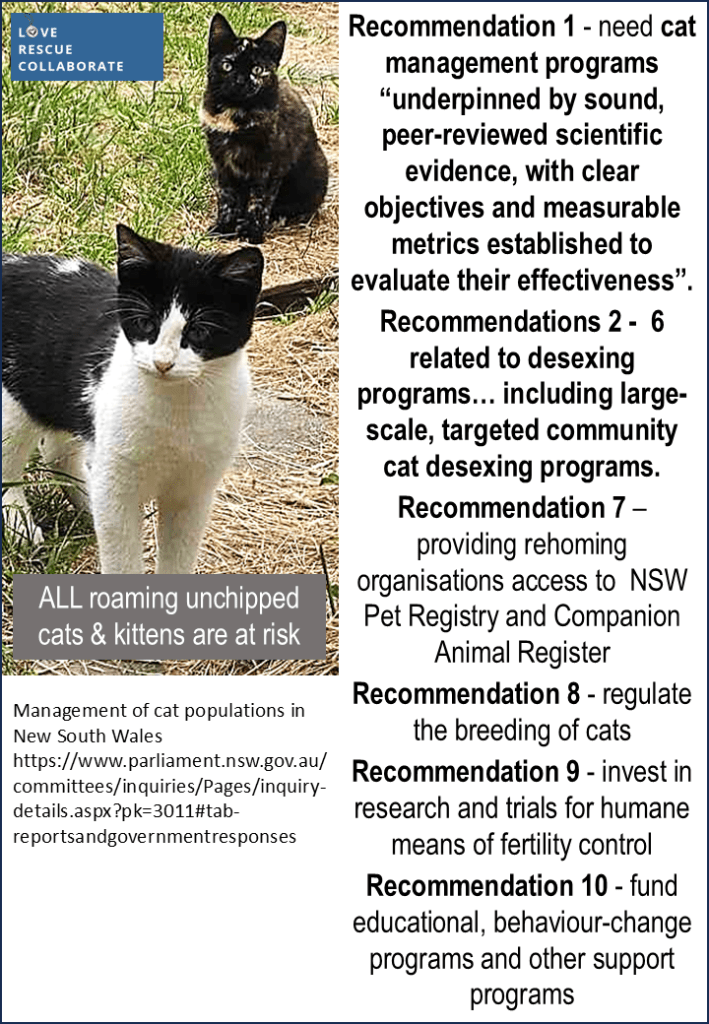
The committee report was published 18 August 2025 and contains Findings and Recommendations. The recommendations in relation to desexing programs include the following. It is not yet known if the NSW state government is supporting and funding these recommendations. However, this will be of interest to local government/ councils and their cat management initiatives.
Recommendation 2 page 53 That the Government provide grants to councils and rescue and rehoming organisations to carry out free and subsidised desexing programs throughout the state, including desexing of ‘owned’ cats for those on lower incomes, and large-scale, targeted community cat desexing programs.
Recommendation 3 page 53 That the Government expand the capacity for high-volume desexing in New South Wales through animal welfare agencies, veterinary schools, and private veterinary practices.
Recommendation 4 page 53 To assist rural and regional councils with desexing programs, the NSW Government should investigate ways to provide additional support including but not limited to encouraging metropolitan veterinarians and mobile desexing programs to regularly visit rural and regional areas, providing this does not have a negative impact on local service providers.
Recommendation 5 page 53 That the Government, as part of its review of the Companion Animals Act 1998, consider legislative, regulatory and policy changes necessary to support the effectiveness and operation of community cat desexing programs.
Recommendation 6 page 54 That the Government provide funding to cat rescue and rehoming organisations to support desexing, care and rehoming costs.
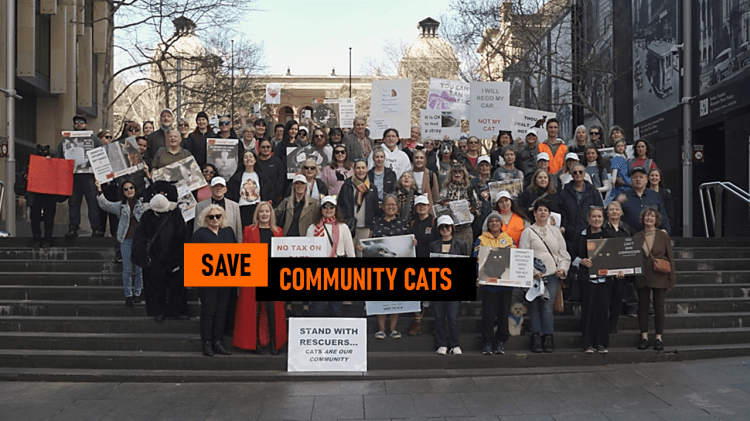
On a cool windy Saturday morning in Martin Place near Parliament House, a group of like-minded cat rescuers and carers attended a rally to raise recognition of community cats, the burden that is currently carried by these volunteers across the state, and to seek to be integrated with state and local government initiatives, all for better outcomes for domestic cats
If you are communicating with your local councils, then please feel welcome to reference this rally event which has been raised with Minister Ron Hoenig.
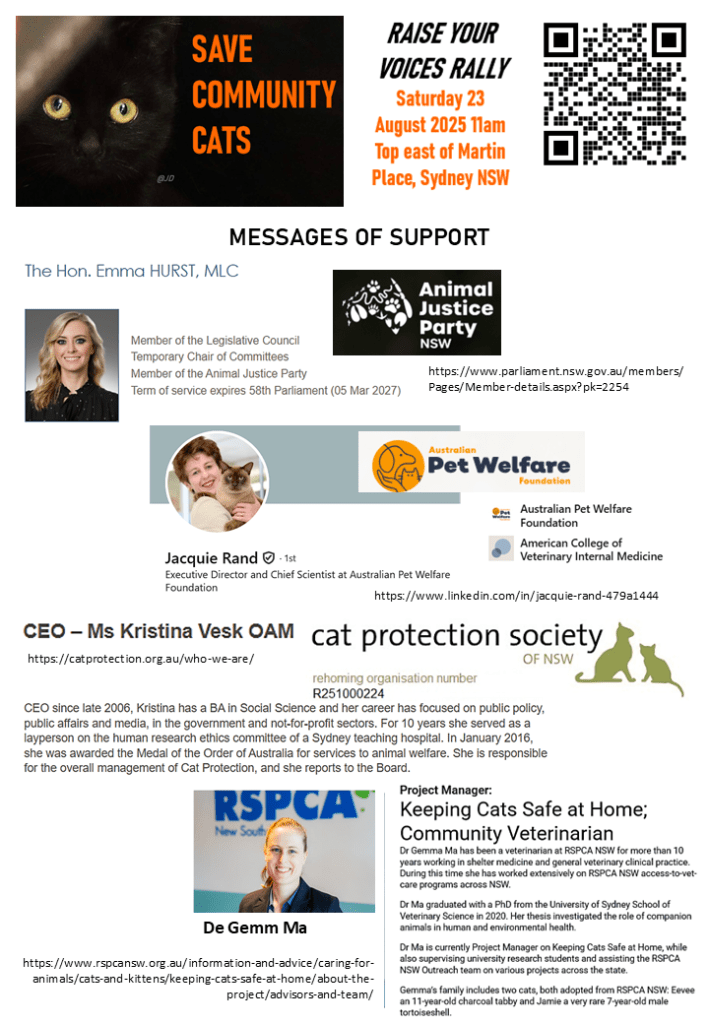
The rally included messages of support from Emma Hurst AJP NSW, Jacquie Rand APWF, Kristina Vesk CPS NSW and Gemma Ma RSPCA NSW. Phots and videos are available, and more.
This is a summary of one view that was presented to the NSW Inquiry Management of Cat Populations. During the hearing 1 April 2025, Stephanie Bates Westie Cat Support Services raised her concerns including the impact of groups, such as Invasive Species and the Threatened Species Commissioner that provide overstated estimates and significant negative consequences of cats which are published in a trail of repeated misinformation, leading to cruelty to cats.
We provide summaries and links to the full documents.
Summary of WCSS concerns raised at the hearing 1 April 2025
Stephanie Bates’ Westie Cat Support Services opening statement, included the following highlighted views (refer to a copy of the hearing transcript in this blog).
“I think there need to be some amendments to do with community members taking it upon themselves to trap cats—whether owned or unowned—and the investigation of this practice, the penalties for this practice and who is responsible for monitoring this practice. Is it the RSPCA cruelty inspectors? Is it a council animal ranger? Who is it? Is it an AWL inspector? The role and powers of the council need to be clearly defined and ascertained. My approach generally to this inquiry is coming from an animal welfare perspective, not necessarily threatened species protection in urban areas—or indeed other species protection in other areas. I also think that there’s a paucity of research on domestic and urban cats—owned, unowned and community—in urban areas. Even in the threat abatement plan, it’s stated that they’re talking about non-urban cats, yet they’re trying to extrapolate the data for urban cats and talk about urban cats in the same sentence, pretty much.
It’s quite ridiculous. We do need more solid, substantive and well-done research on urban cats. At the moment, it’s not really there. There’s a lot of crazy statistics put out there. The ANU, in 2023, stated that roaming pet cats kill 66 million native animals each year in Sydney. I would question that. There’s also not very much talk about what species are actually killing and exactly how many. A lot of their information is based on anecdotal reports from wildlife organisations. However, the anecdotal evidence given by people who actually rescue and TNR cats, for some bizarre reason, is never taken into account. That’s probably because they don’t even talk to us, so it’s great to have this investigation and this Committee.”
WCSS views, concerns and recommendations during the hearing session included the following.
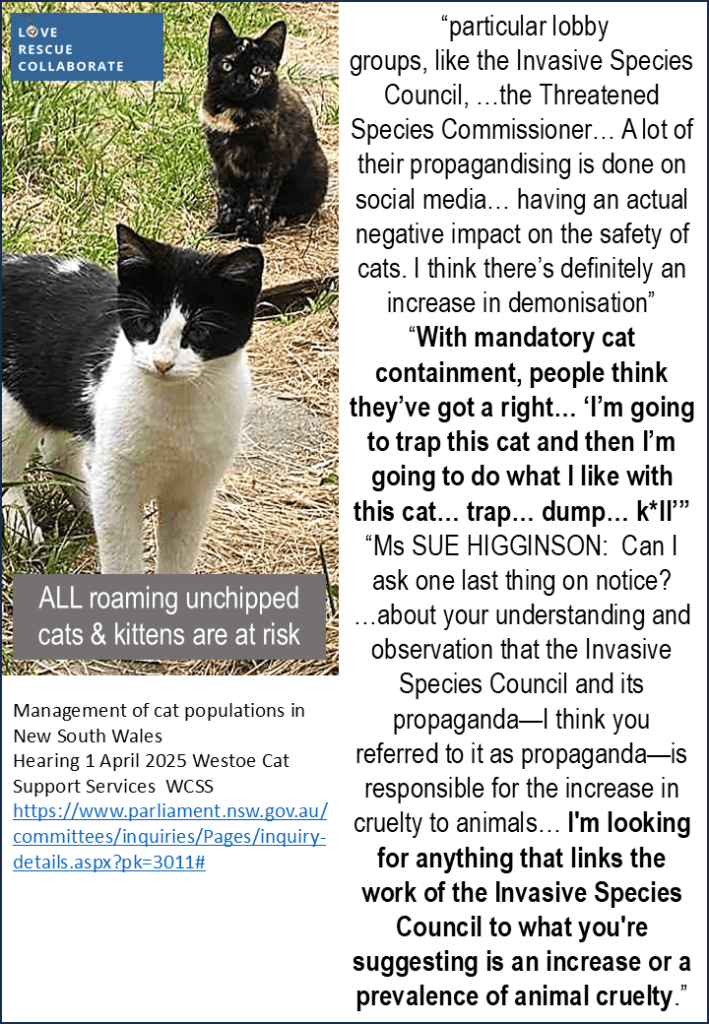
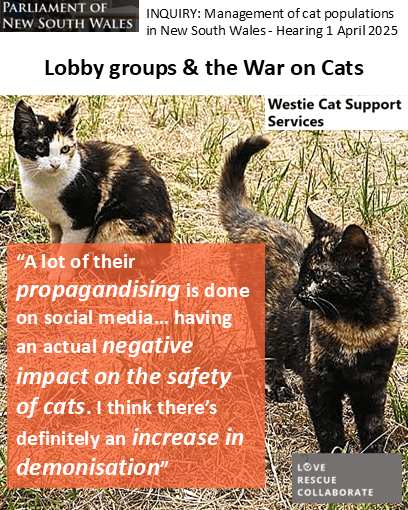
“Certainly, particular lobby groups, like the Invasive Species Council, are very official, such as the Threatened Species Commissioner, have been heavily involved in lobbying, propagandising and, especially the Invasive Special Council, seeking funding. A lot of their propagandising is done on social media and a lot of it, I think, is having an actual negative impact on the safety of cats. I think there’s definitely an increase in demonisation.”
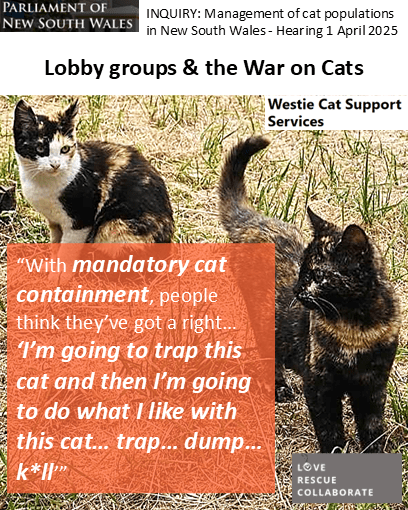
“With the mandatory containment, people think they’ve got a right, “Oh, this cat’s not on their property. They’re not contained. Good. I’m going to trap this cat and then I’m going to do what I like with this cat. I’m going to dump them in a suburb that’s 10 suburbs away. I’m going to kill them, or I’m going to take them to the pound, or I’m going to ring the ranger and they’re going to be taken to the pound”—in some sort of utopic nirvana of what needs to be done.”
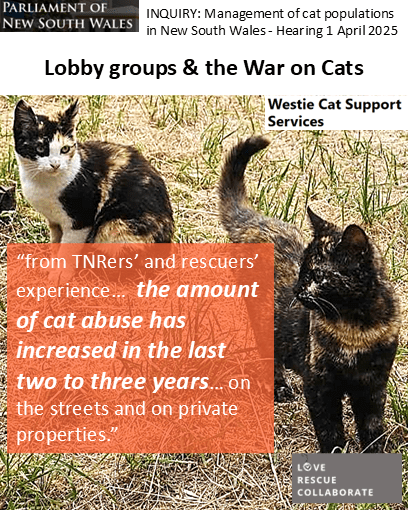
“The problem with that is most of them don’t even contact the council rangers or the pounds about these cats. It would be interesting to correlate statistics of cat cruelty with what was going on in those councils—for example, the Yarra council. Having said that, there is a lot of animal cruelty that the RSPCA or the AWL inspectorate will not investigate, whether it’s about resource allocation or the probability of being able to prosecute. I’m not sure, but I’d be very interested to see. Certainly anecdotally, and from TNRers’ and rescuers’ experiences on the ground, the amount of cat abuse has increased in the last two to three years in what we’re seeing on the streets and on private properties.”
Towards the end of the hearing session, WCSS provided the following.
“My vision is that colonies will always exist. I think it’s incredibly unrealistic to suggest that they won’t, or that they shouldn’t exist, because you’re always going to have people in society that do not desex their cats, do not microchip their cats, dump their cats, people that are cruel to cats and dump owned or otherwise cats. Like I said in my submission, TNR is but one management strategy to deal with a public and private animal issue. You’ve got two options. You either kill the lot of them, which is what Professor Sarah Legge and others suggest, or you start doing TNR and you have responsible colonies as a way to humanely manage. Cats on the streets are always going to exist, particularly in certain suburbs, and to suggest otherwise is ridiculous. You can try to mass cull them, but you’re still going to have more cats emerging, because people will still do irresponsible things. I also think the education of the public is limited. You can educate till the cows come home with focused education about responsible pet ownership, but you will still have people being irresponsible.”
Summary of WCSS Answers to Questions On Notice
At the end of the hearing session, the following was raised with WCSS.
“Ms SUE HIGGINSON: Can I ask one last thing on notice? Ms Bates, you made a number of statements about your understanding and observation that the Invasive Species Council and its propaganda—I think you referred to it as propaganda—is responsible for the increase in cruelty to animals. If you could provide the Committee any evidence or anything to suggest that’s the case, that would be of assistance.”
The following is included in the answer to question on notice. The document provided may be downloaded at the end of this article.
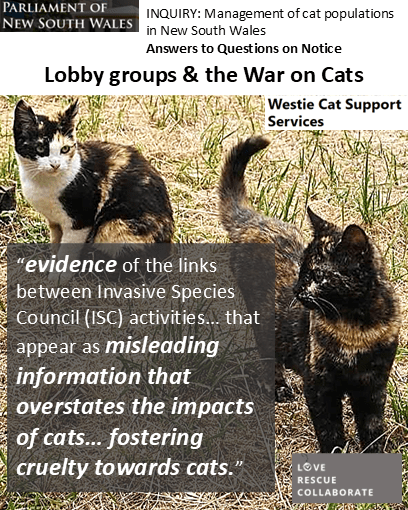
“I provide the following facts and factors, and examples as evidence of the links between Invasive Species Council (ISC) activities, specifically social media posts and website information, that appear as misleading information that overstates the impacts of cats. As a cat rescuer I believe this is fostering cruelty towards cats.”
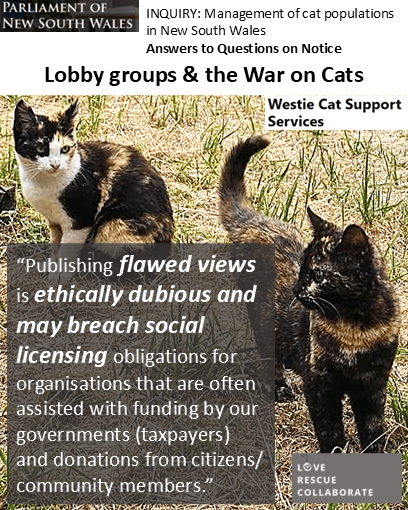
“Publishing flawed views is ethically dubious and may breach social licensing obligations for organisations that are often assisted with funding by our governments (taxpayers) and donations from citizens/ community members. The impacts of flaws in overstated impacts and significant negative terms become highlighted in the unmoderated comments against cats which include forms of violence towards cats.
“Assessed examples as evidence [examples are located in the detailed document]
A small range of the examples from traditional and social media is provided where includes:
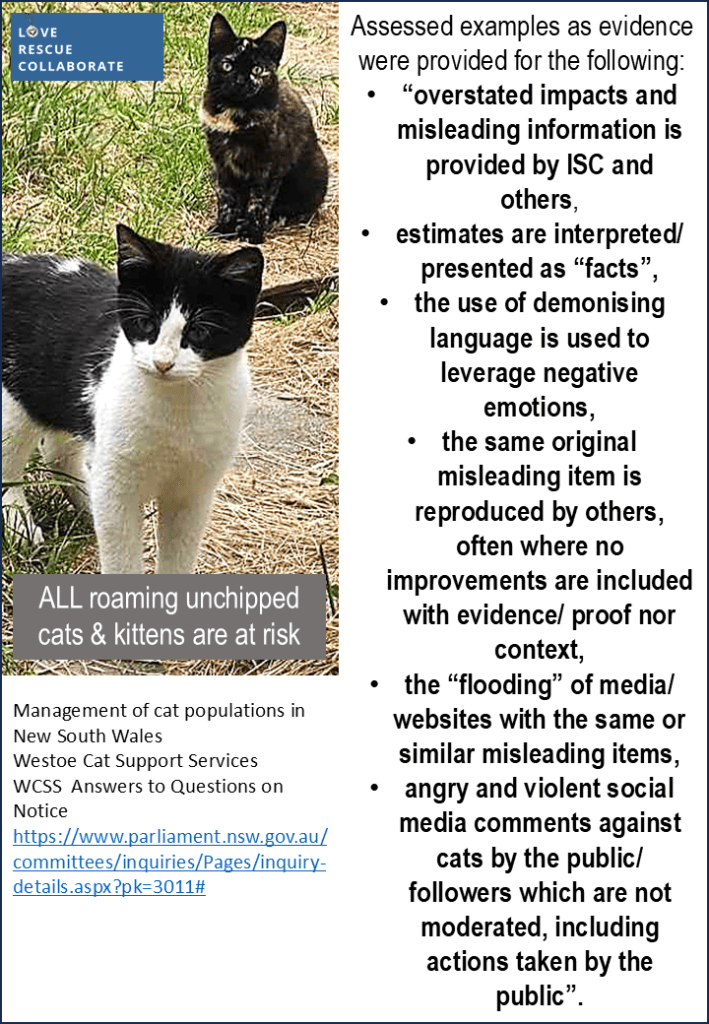
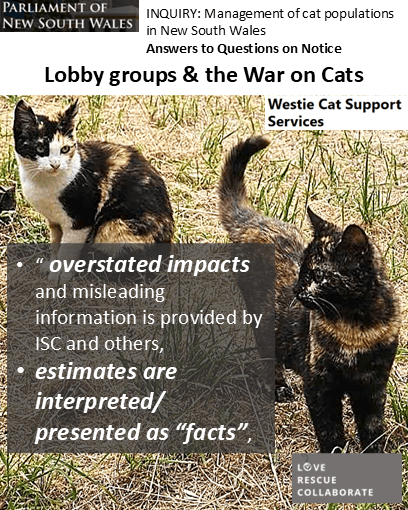
overstated impacts and misleading information is provided by ISC and others,
estimates are interpreted/ presented as “facts”,
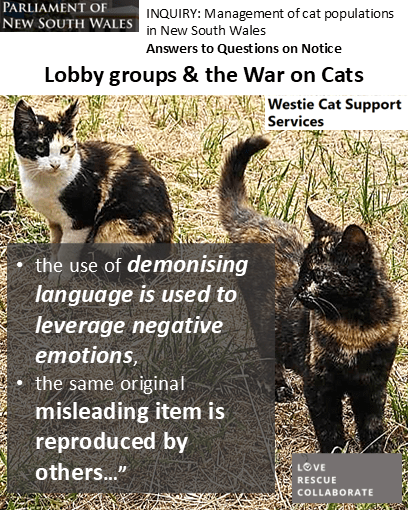
the use of demonising language is used to leverage negative emotions,
the same original misleading item is reproduced by others, often where no improvements are included with evidence/ proof nor context,
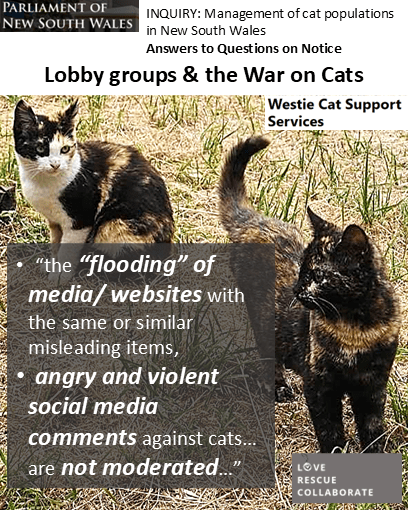
the “flooding” of media/ websites with the same or similar misleading items,
angry and violent social media comments against cats by the public/ followers which are not moderated, including actions taken by the public.”
“The ISC and cohort cat impact articles are seldom in context of other significant factors. It appears national generalisations are preferred to present a dramatic view that does not match evidence in separate locations across our nation. These items do not include: land clearing (habitat loss), climate change impacts (bushfires, floods, droughts), and impacts from other invasive species.”
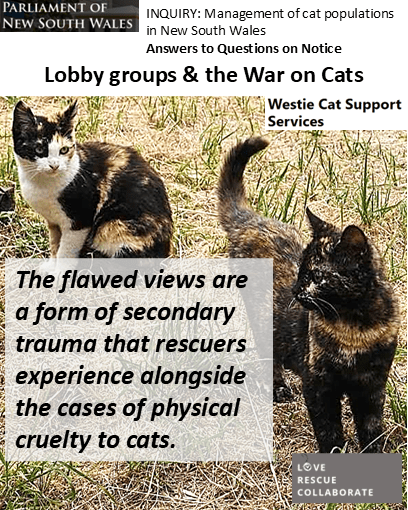
“Community cat rescuers and carers are volunteers from a range of career backgrounds. The flawed views are a form of secondary trauma that rescuers experience alongside the cases of physical cruelty to cats. I strongly recommended that a relationship is established between the NSW state government, councils and community cat rescuers/ carers, with One Welfare solutions to proactively minimise the impacts of cats, and reduce the impacts to wildlife.”
It is noted that in the examples of evidence provided, the Inquiry committee has heavily redacted the specific words in the following item:
The Guardian Nov 2023 re cats from Australian Wildlife Conservancy Trevor Bauer & Biodiversity Council ANU Sarah Legge media item: “From beloved pet to biodiversity villain: what now for Australia’s cats?” In the lead up to the end of consultation of the draft Threat Abatement Plan, there were several articles in media, published it appears to promote all cats as “villains” and which proposed just two categories being pet (owned) and feral cats.
The rally was successfully held. As an inaugural event it attracted 150 attendees on a Saturday when many rescuers are busy with adoption interviews and events.
This short video is an interim update.
Audio and text support messages from domestic cat experts will be uploaded soon,
OVERVIEW
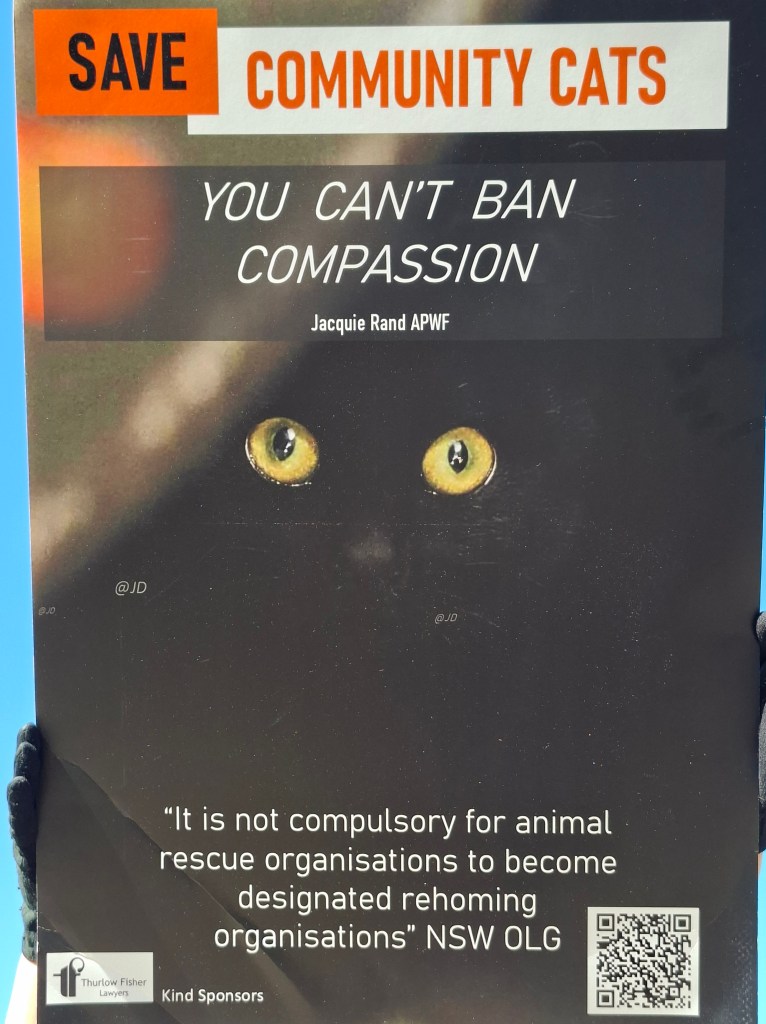
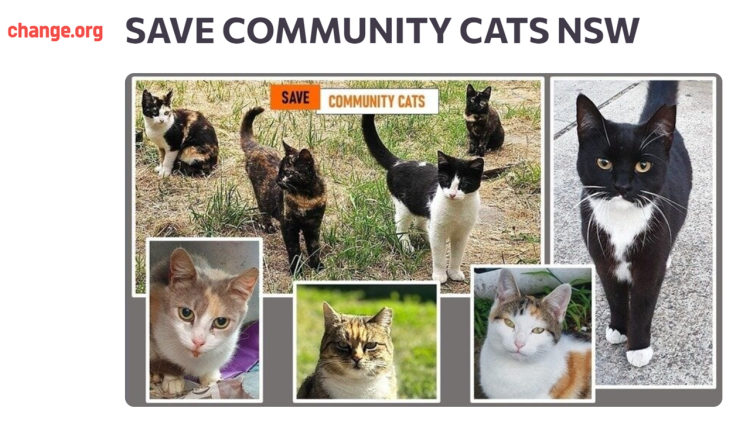
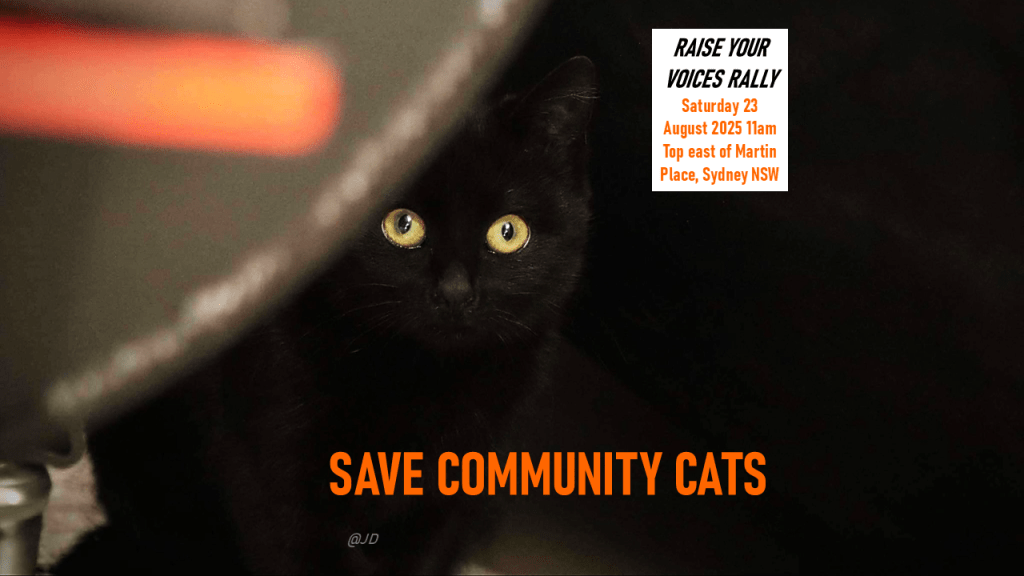
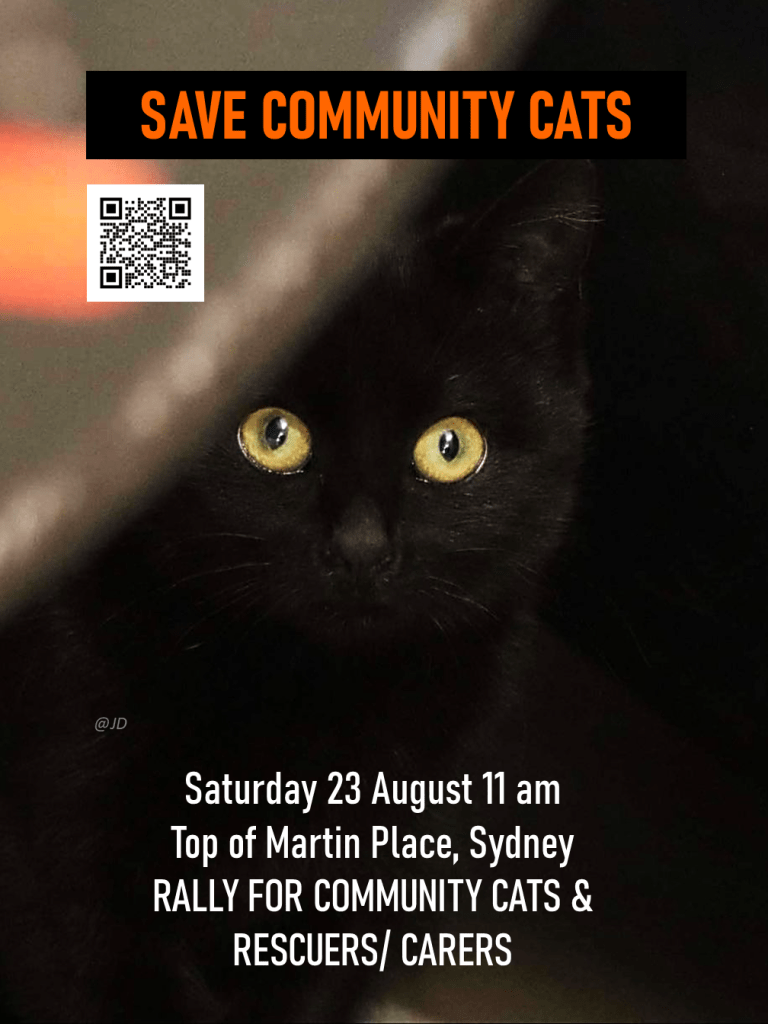
SAVE COMMUNITY CATS is a peaceful public assembly 11am Saturday 23 August Sydney to raise our voices for community cats and their rescuers and carers.
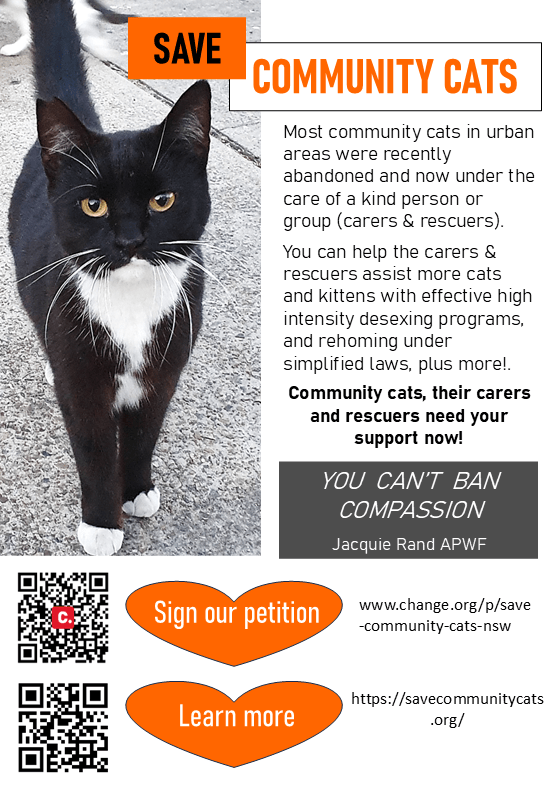
COMMUNITY CATS is a widely accepted term for STRAY cats. Most stray cats are domestic semi owned, meaning a person or people are involved in providing food and care.
The volunteers represent an “army” across NSW seeking to work with the state and council governments to improve outcomes for community cats.
We seek One Welfare solutions for better outcomes for community cats, & for rescuers and carers to be integrated with NSW state and local government cat management strategies, plans, delivery of desexing programs, research, and critical education programs with communities.
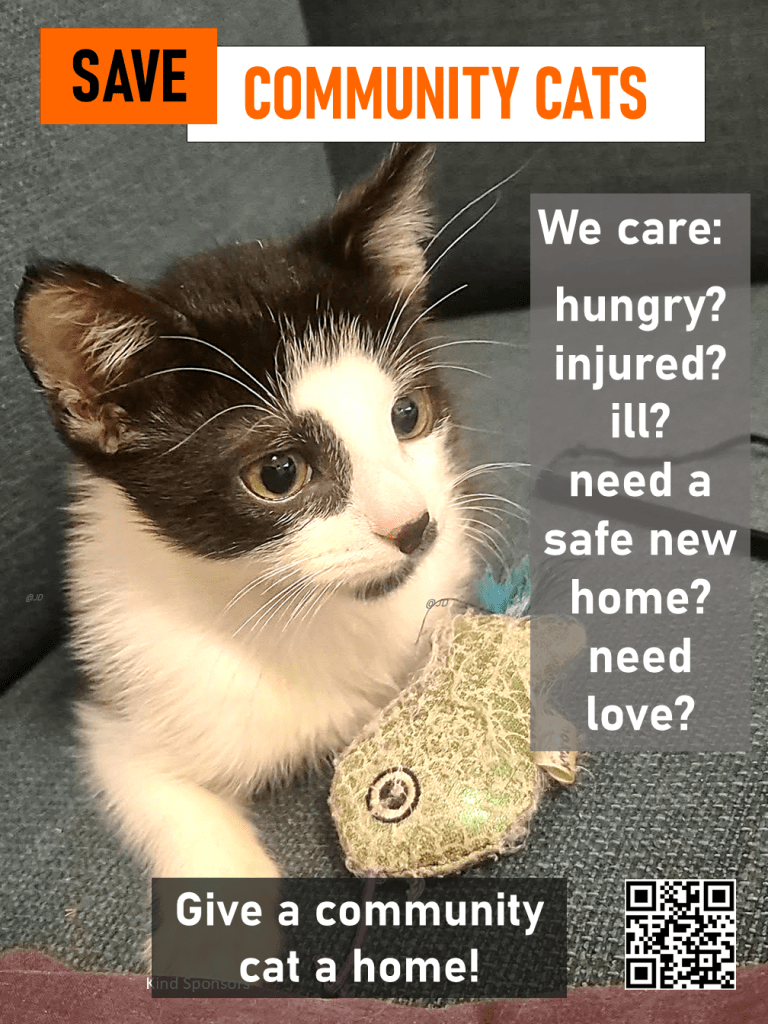
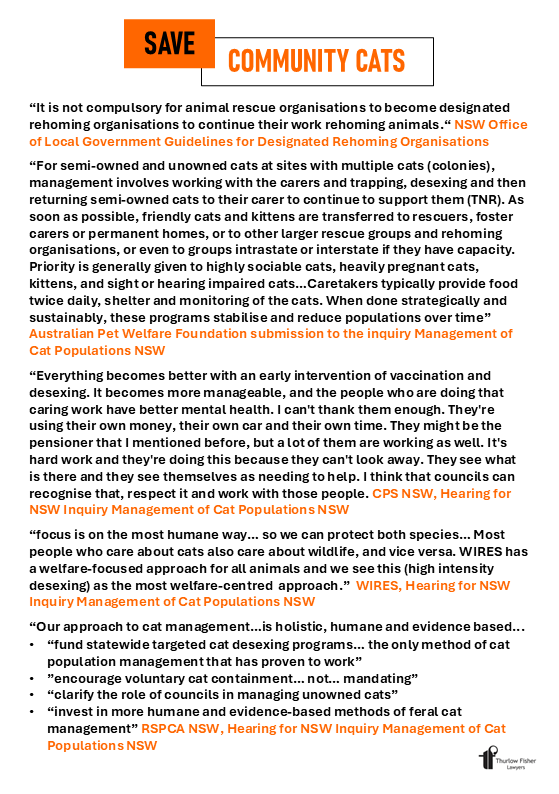
distribute our online posts and physical flyers (see next section to download)
Save Community Cats Movement – Background & Press Release
SAVE COMMUNITY CATS is a peaceful public assembly 11am Saturday 23 August Sydney to raise our voices for community cats and their rescuers and carers.
We seek One Welfare solutions for better outcomes for community cats, and for rescuers and carers to be integrated with NSW state and local government cat management strategies, plans, delivery of desexing programs, research, and critical education programs with communities.
Our top priorities include high intensity desexing for community cats, promoting not mandating cat containment, a moratorium on pet registrations, and enabling other legal obligations to support rather than hinder the rescue and rehoming of community cats.
BACKGROUND
Are you aware there is a “cat crisis” across Sydney and other major urban areas? Cats are being abandoned at a higher rate than before, mainly driven by cost-of-living concerns with owners struggling to afford increases in vet costs.
While some councils assist owners on welfare with desexing and pet registration, many owners are not aware of this, or it is a subsidy or the owners may not have transport, or commitments to much needed jobs. This becomes a bigger burden when one owns multiple cats, or when their young cat becomes pregnant and within two months there are now several kittens.
The burden of abandoned cats and kittens most often falls on community cat rescuers and carers – kind people, volunteering their time and effort, and resources and finances. These Good Samaritans help feed, care, desex, cover vet bills for treatments for illnesses too, and they rehome cats and kittens to new caring families.
Council pounds are often at their limited capacity and there has been a challenge to the councils’ understanding of taking in and caring for “stray” cats. For years, many councils have claimed they are not able to take in stray cats as cats are allowed to roam under the Companion Animal Act in NSW.
The burden on community cat rescuers and carers has recently increased further with RSPCA NSW also recently indicating their shelters will not be taking in stray animals.
Under Labor, over the last few years the NSW government has been operating a number of reviews and inquires for animal welfare and management, with a specific focus on cat management to better understand the concerns and recommended steps forward for improvements. Just this week, the report including findings and recommendations was published for the Management of Cat Populations.
One area that is of great concern is the lack of recognition of community cat rescuers and carers, and the integral role played as part of the holistic animal welfare system. Without recognising the efforts of thousands across the state, how will adequate planning and funding be achieved for improvements?
SAVE COMMUNITY CATS RALLY FORMATION
Rescuers and carers have provided submissions and emails to our NSW government. However, we felt that a collaborative rally was the most appropriate way to raise awareness of both the efforts and the burden carried by volunteers. Many independent and groups of rescuers and carers are taking part in this event.
We have support from a number of domestic cat experts. This includes:
Emma Hurst Animal Justice Party NSW, and Chairperson for the Inquiry Management of Cat Populations NSW
Jacquie Rand Australian Pet Welfare Foundation, Community Cat Programs and relevant Research
Kristina Vesk Cat Protection Society NSW, Subsidised Desexing and DIVA programs
Gemma Ma RSPCA NSW Keeping Cats Safe at Home and the Stray Care programs
We are receiving their messages of support that we will share at the rally. Their experiences, scientific knowledge and recommendations is greatly appreciated.
The rally will also include key messages from a small number of experienced rescuers with hands on experience over many years. They have been helping to rehome many hundreds of cats and kittens alongside the rally attendees.
COMMUNITY CATS is a widely accepted term for stray cats. Most stray cats are domestic semi owned, meaning a person or people are involved in providing food and care.
The volunteers represent an “army” across NSW seeking to work with the state and council governments to improve outcomes for community cats.
Rally Overview
Location
East top of Martin Place (near Macquarie Street & Parliament House) Sydney NSW
Purpose
To raise to NSW Minister for Companion Animals and Councils the need for recognition, respect and support for community cats and their rescuers / carers, and appreciation of all those who have adopted a once abandoned kitty.
We seek One Welfare solutions for better outcomes for community cats, & for rescuers and carers to be integrated with NSW state and local government cat management strategies, plans, delivery of desexing programs, research, and critical education programs with communities.
Objectives
Establish a respectful working relationship between the NSW state and local governments with grassroots community cat rescuers/carers, to leverage their valuable lived experiences, resources and community contacts with formulating cat management strategies and plans, at state and local levels.
FACTS: Across NSW hundreds of rescuers/ carers collectively assist thousands of community cats, delivering care, desexing & rehoming for the once abandoned cats, with contacts with the public in local areas to deliver education & welfare improvements for cats.
Encourage and promote funding and support for the highest priority One Welfare initiatives to effectively manage cat populations where rescuers/ carers are already involved. Critical proven successful initiatives include to promote cat containment (don’t make it mandatory), community cat programs, high intensity desexing programs, vaccinations, resolving registration processes, assistance for rehoming programs, community engagement, education & cultural change programs.
FACTS: Refer proven examples from RSPCA NSW stray cats programs, APWF Community Cat Programs, CPS NSW DIVA & desexing programs, Banyule Council research where 4 times the financial savings were achieved for the costs with funded desexing, and Rosewood Council NSW research.
Ensure rescuer/ carers will assist and be integrated with new localised programs and research for managing cat populations, to enrich the knowledge base and clarify financial justifications with local evidence. This includes local research on cat impacts including on wildlife and council resources. Further, to actively decrease the significant risks of cruelty associated with demonising roaming and abandoned cats, and those who care for them.
FACTS: The lived experiences of rescuers/ carers will provide insights to local communities, and they are able to effectively work with council Animal Management Officers, vets and local communities, providing an “army” of volunteers and experiences. Refer APWF, AIAM, RSPCA.
Aligned with APWF, RSPCA Aust, RSPCA NSW, CPS NSW, AIAM
We strongly support the research, findings & recommendations from domestic cat experts including Australian Pet Welfare Foundation, RSPCA Australia and NSW, Cat Protection Society NSW, Australian Institute of Animal Management & more.
After preliminaries, the rally will kick off with messages of support, first from domestic cat experts, and then local representatives of community cat rescuers & carers.
Domestic cat experts include:
Emma Hurst, NSW Legislative Council & Animal Justice Party NSW
Jacquie Rand, Australian Pet Welfare Foundation
Kristina Vesk, Cat Protection Society NSW
Gemma Ma, Project Manager, RSPCA NSW Keeping Cats Safe at Home
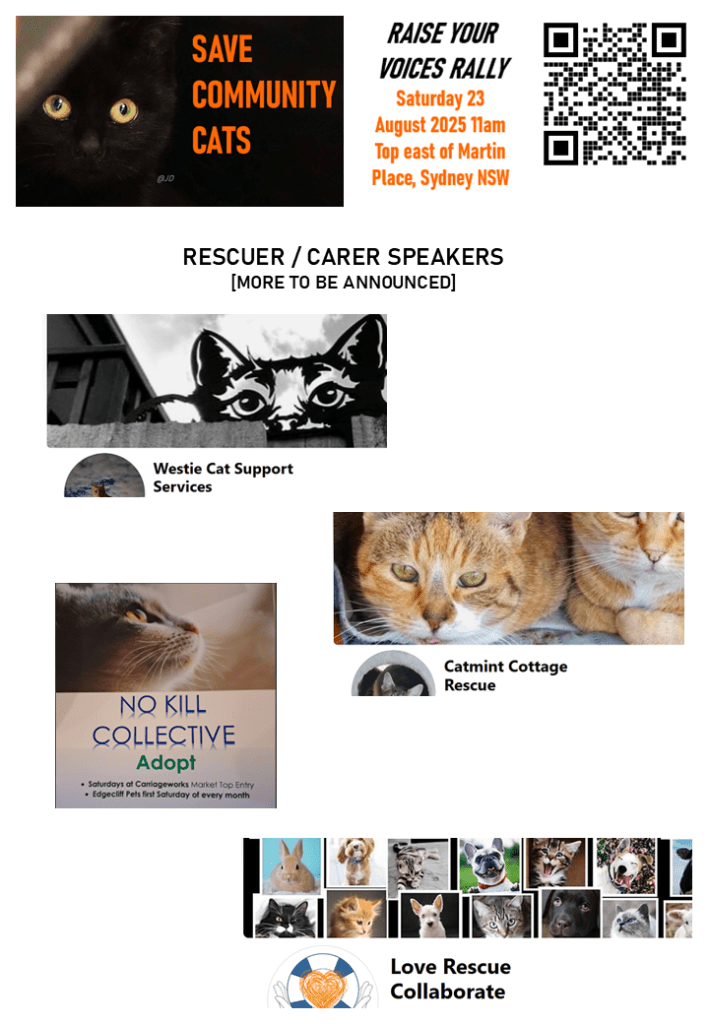
A number of rescuers and carers will also speak at the rally, bringing their lived experiences that will be relevant to all community cat rescuers and carers. These include:
Steph Bates Westie Cat Support Services
Margaret Dalziel, Catmint Cottage and Street Cat Rescue
Compelling evidence on desexing programs for owned and community cats
The following summary may be downloaded and shared with interested councils and organisations. It focuses on Australian based desexing programs by a number of organisations and inclusion of community cats and their rescuers/ carers.
Read just one of the related Australian research items on successful strategies here: Urban Cat Management in Australia—Evidence-Based Strategies for Success https://www.mdpi.com/2076-2615/15/8/1083
Issues with poorly defined categories of cats – especially “stray” cats
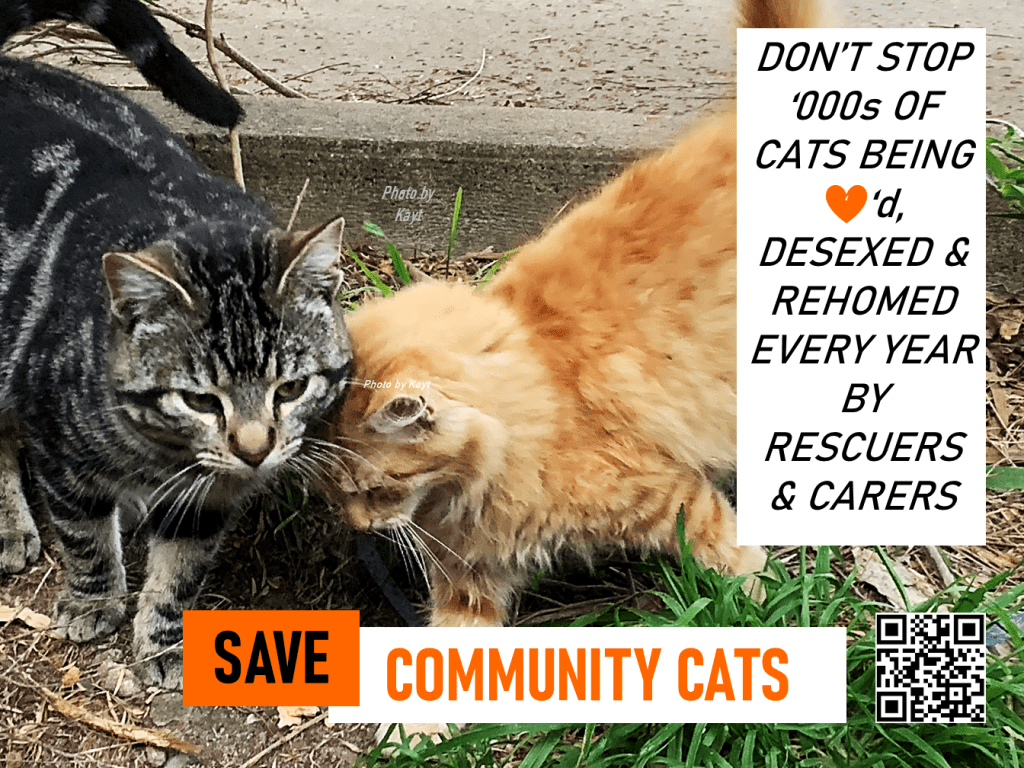
Don’t stop rescuing, desexing, rehoming of thousands of cats every year
There is a risk that stray cats may be deemed “illegal” under mandatory cat containment rules, and/ or as a subset of feral cats (refer national Threat Abatement Plan for predation by feral cats). Don’t allow either of these to occur when thousands of cats are being loved and rehomed every year.
Community Cat rescuers and carers have valid lived experiences. APWF has included a view on these in their submission to the inquiry into the Management of Cat Populations NSW, including
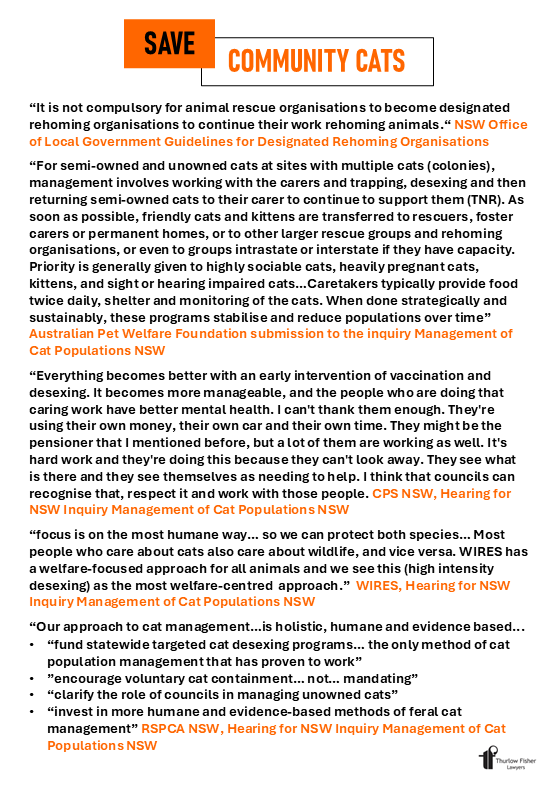
“Multi-cat sites (colonies)
For semi-owned and unowned cats at sites with multiple cats (colonies), management involves working with the carers and trapping, desexing and then returning semi-owned cats to their carer to continue to support them (TNR). As soon as possible, friendly cats and kittens are transferred to rescuers, foster carers or permanent homes, or to other larger rescue groups and rehoming organisations, or even to groups intrastate or interstate if they have capacity. Priority is generally given to highly sociable cats, heavily pregnant cats, kittens, and sight or hearing impaired cats. Cats with significant injuries or other health issues affecting their welfare such as severe dental disease should be a priority for veterinary care. Caretakers typically provide food twice daily, shelter and monitoring of the cats. When done strategically and sustainably, these programs stabilise and reduce populations over time (Swarbrick 2018; Tan 2017; Levy 2014; Boone 2019, Rand 2024b).”
“In NSW, with 76.21% of the 8,186,000 residents over 18 years of age (and using 5% of adults being semi-owners feeding an average of 1.5 cats each) means that more than 311,900 adults are feeding over 467,800 semi-owned cats each day in NSW.”
“trapping, desexing… As soon as possible, friendly cats and kittens are transferred to rescuers, foster carers or permanent homes, or to other larger rescue groups and rehoming organisations, or even to groups intrastate or interstate”
APWF Submission
Stray cats are at risk of being a subclass of feral cats. Feral cats are to be destroyed and there exists a risk that rescue & rehoming for stray cats may be deemed illegal.
A3 landscape
Stray (Community) cats are not Feral cats and should not be treated in the same way
Our stray / community cats deserve the opportunity to be rescued and rehomed, stray cats should NOT be treated as a subclass of feral cats to be destroyed.
We need our Companion Animal Act NSW to be updated with terms and definitions for the different classes / categories of cats. It is critical for cats to be recognised and treated in ways that are appropriate to their category.
“Cats should be categorized based on how and where they live This will enable the implementation of effective domestic cat management strategies, supported by the community. Research shows that pet cats can react with more aggressive behaviours to humans than feral cats when highly stressed.” https://petwelfare.org.au/position-statements/cat-definitions
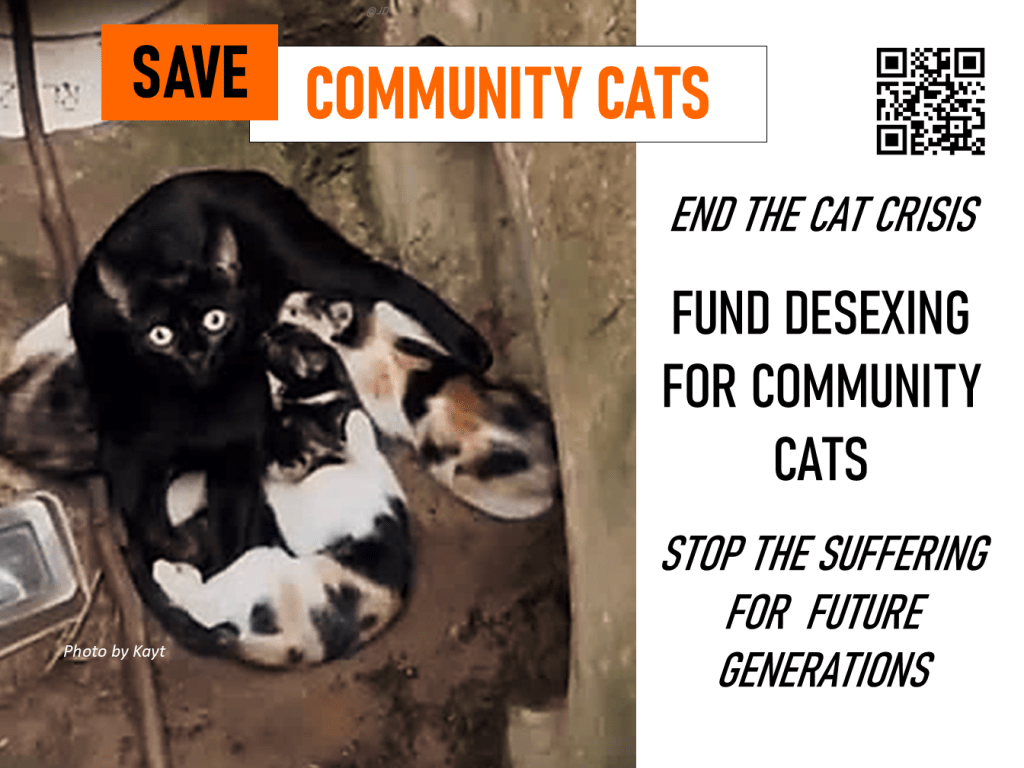
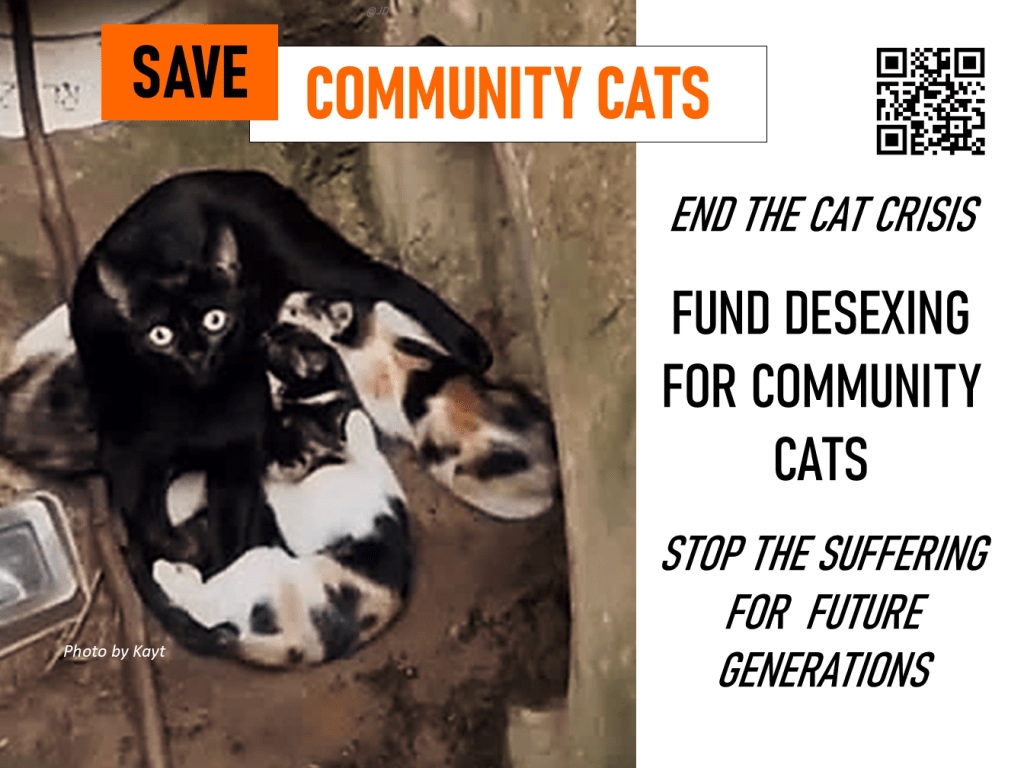
Funded desexing for community cats is needed and to relieve the burden on rescuers / carers
In the past the traditional methods for fining, trapping & euthanasing meant cat death rates at council pounds of 70% to 90% with devasting impacts on all people involved without solving the cat crisis.
Read more recent research: Rethinking Urban Cat Management—Limitations and Unintended Consequences of Traditional Cat Management
“…enforcement-driven policies face significant challenges. They are costly for local governments, resource-intensive, and fail to address the root causes of free-roaming cat populations, such as financial barriers and the prevalence of semi-owned or stray cats, particularly in disadvantaged areas. Animal management officers are central to enforcing these measures, often issuing fines and trapping cats identified as causing a nuisance. Despite these efforts, compliance remains low, and issues like high shelter intakes, cat-related complaints, and euthanasia persist. Moreover, the punitive nature of these policies can place additional financial strain on vulnerable communities and negatively impact the mental health of animal management officers and shelter staff. This approach, focused on penalties, addresses symptoms rather than systemic issues. A shift toward addressing the root causes—through financial support, including support for cat sterilization, resource accessibility, and community engagement—presents a more effective and compassionate solution. Such strategies benefit both the cats and their caregivers while reducing the burden on local governments, promoting sustainable and humane outcomes for communities while better protecting wildlife.”
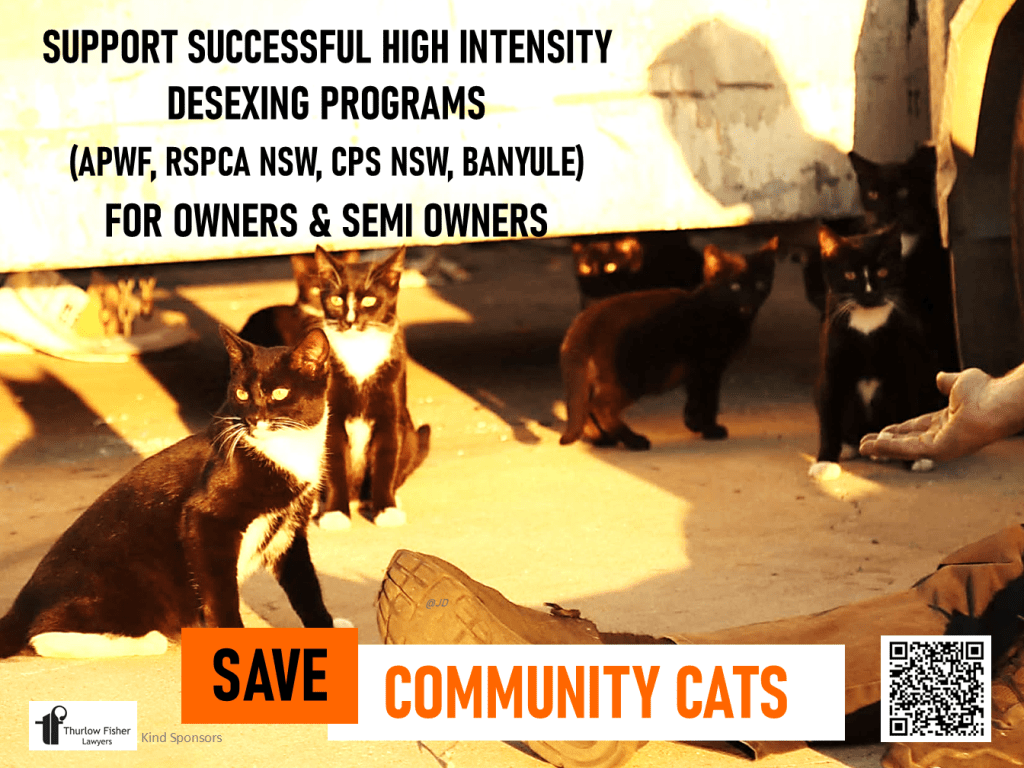
Urgent need for high intensity desexing for owned & semi owned cats
Community cat rescuers / carers struggle under the burden of undesexed cats being abandoned by owners and multiplying rapidly. The costs are high and unfairly reliant on good Samaritans to donate their personal resources.
The APWF views include: “High intensity desexing initiatives This is critically important to address the number of free-roaming domestic cats, because more than 50% of cats entering shelters and pounds in Australia were born in the last 6 months (Albertson 2016; Kerr 2018), and recent modelling from the UK found that owned cats are the substantial contributor to domestic cat populations (McDonald 2023). Australian research suggests that in areas of high cat impoundments and cat-related calls to councils, owned cats and semi-owned cats contribute similarly to number of kittens being born (Rand 2024a). Programs for free and highly subsidized cat registration, microchipping and desexing for owned cats, especially in areas of socioeconomic disadvantage are essential. However, stopping litters from semi-owned and unowned cats is also essential.” APWF submission to Inquiry Management of Cat Populations NSW. https://petwelfare.org.au/publications
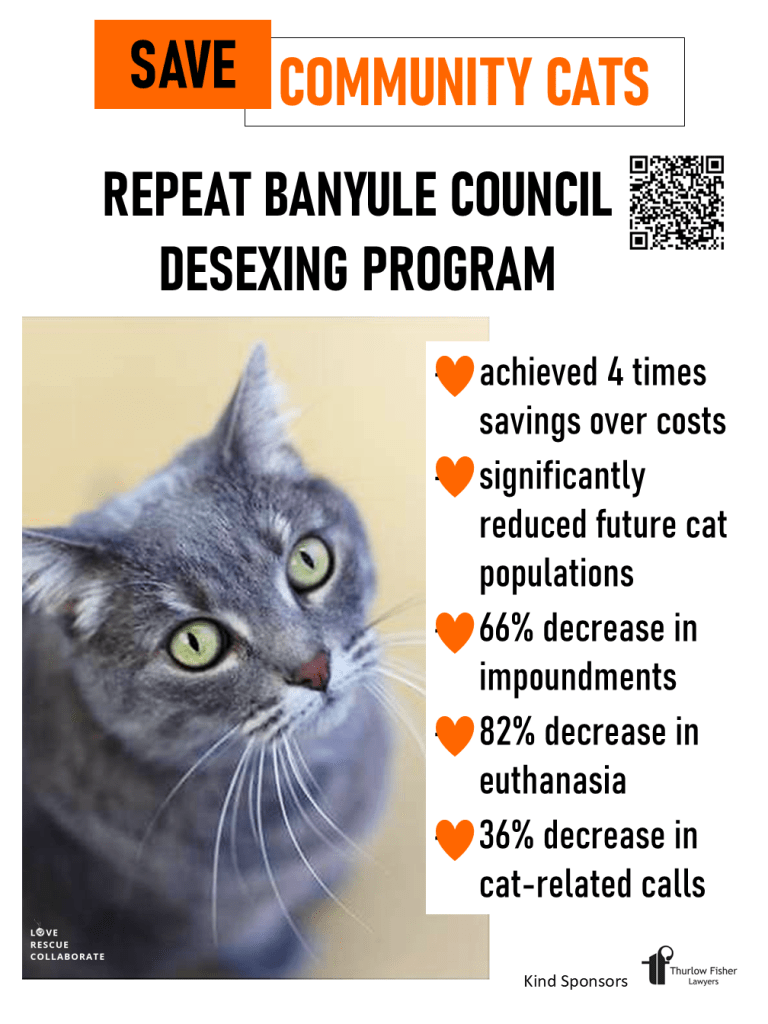
Banyule Council highly successful desexing program
Are you aware of the highly successful & researched Banyule Council desexing program that ran for several years? We ask: why aren’t more councils following this program?
The Banyule Council in Victoria operated their own self-funded desexing program over several years, where the investment was returned 4 times in terms of savings over costs. For owned and semi-owned cats this included several benefits “decreases in impoundments by 66%, euthanasia by 82%, and cat-related calls by 36% over 8 years, with savings to council of AU $440,660 for an outlay of AU $77,490”.
The research also concluded:
“the traditional methods of trapping wandering and nuisance cats have not resulted in long-term reductions in cat-related calls to councils. However, following the implementation of a microtargeted free sterilization program for owned and semi-owned cats, marked reductions in cat-related calls, impoundments, euthanasia, and costs were realized, similar to that reported in US programs. It is recommended that urban cat management policies and programs are revised and, instead of being focused on a traditional compliance-based approach, are focused on being assistive, helping owners and semi-owners have their cats sterilized and identified with a microchip. Legislative changes need to be implemented to facilitate this approach to assist people caring for multiple stray cats, instead of the current approach to trap and euthanize most of these cats which are poorly socialized, which is documented to damage the mental health of shelter and pound staff and cat caregivers”
The value of rescuers & carers saving & rehoming thousands of abandoned cats every year
Rescuers & carers are a force for community cats & desexing programs
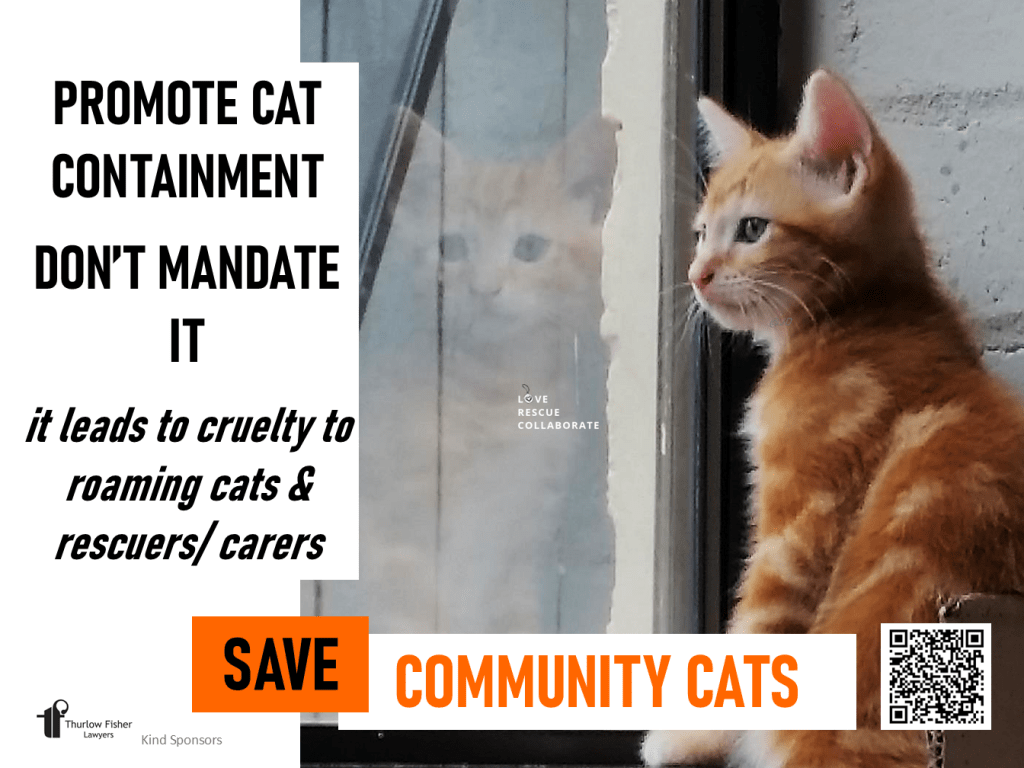
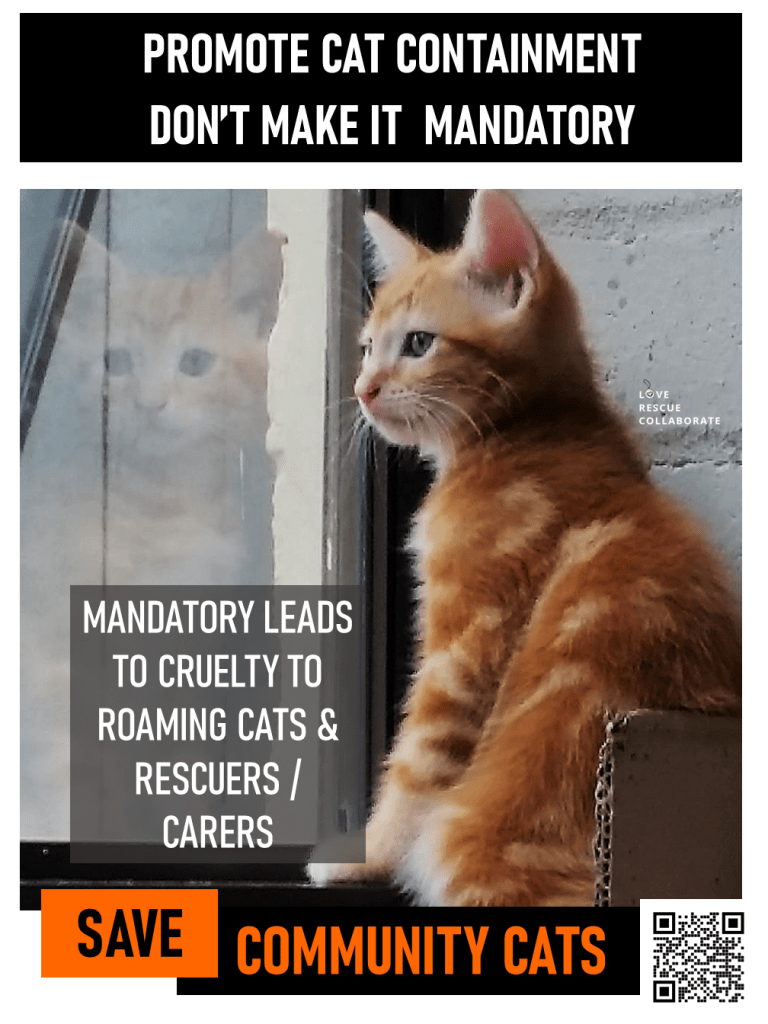
Promote Cat Containment don’t make it mandatory
The increase in cruelty if roaming cats are seen as illegal
Love Rescue Collaborate: The Darkside of Mandatory Cat Containment, includes
“We promote cat enclosures to keep cats and wildlife safe.” “Cat enclosures may involve significant costs for cat owners, difficult to erect due to other resident complaints, and difficult and costly for a council to enforce. We also see the dark side, which may include to incite or encourage violence to cats.” https://loverescuecollaborate.org/2022/09/27/the-dark-side-of-mandatory-cat-confinement/
APWF Position Statement on Cat Containment: APWF encourages cat containment, but not making it mandatory. “Mandated cat containment has been proven to be an ineffective strategy; a failure at reducing wandering cats in the short and long term, both in Australia and internationally.” “Criminalises cat ownership for low-income households and people with ‘door dasher’ cats” “Places semi owned stray cats being fed by people who have an emotional attachment to the cat at significant risk of being impounded and killed.” “Increases risks of cruelty towards cats, increasing animal pain and suffering.” https://petwelfare.org.au/position-statements/cat-containment
A3 Landscape
A3 portrait
The issues with NSW registration system & why it deters owners
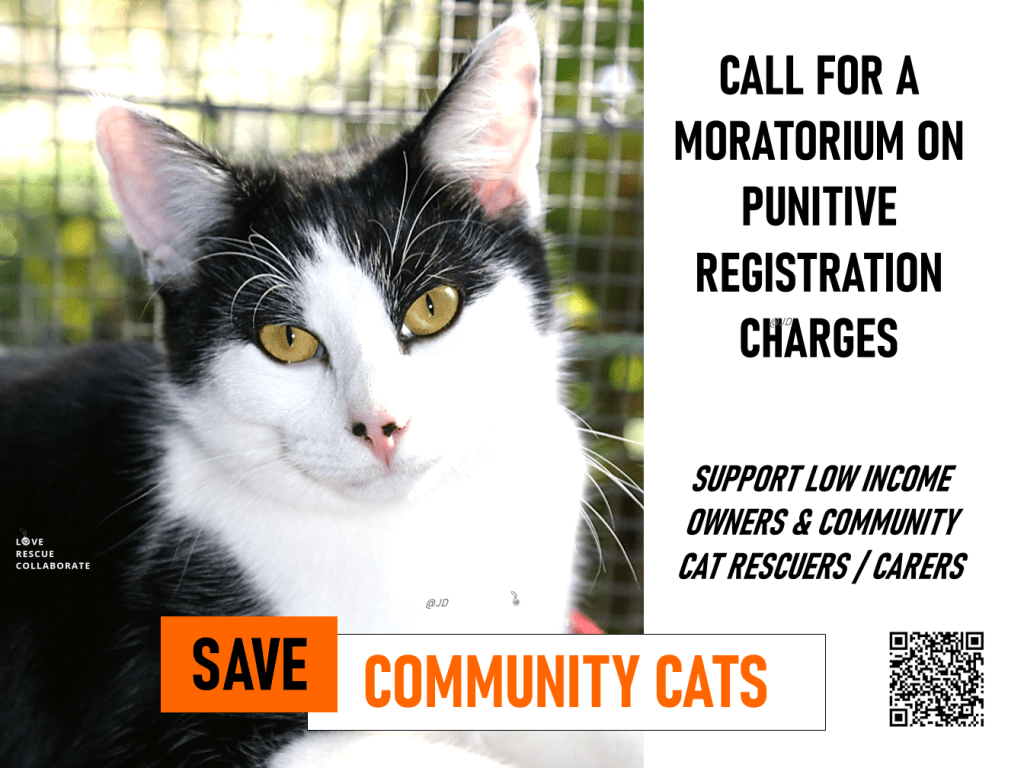
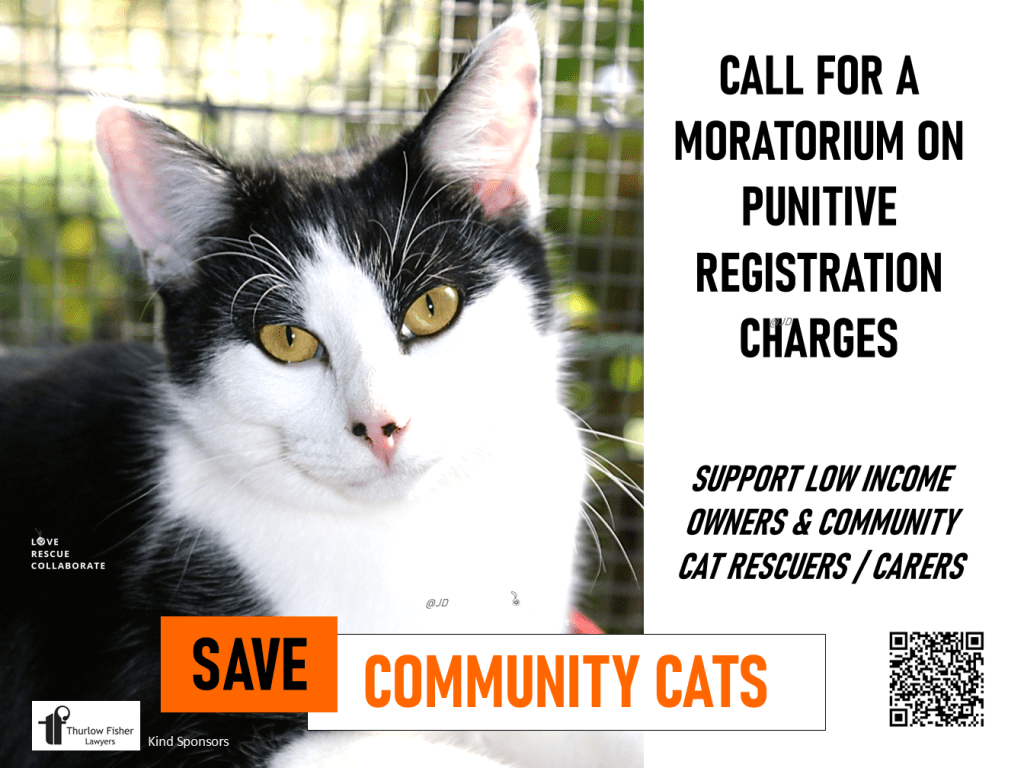
Moratorium on Punitive Registration Charges
Rescuers & carers are carrying a burden for desexing and registering cats older than 4 months of age, anecdotally older cats are more often abandoned in urban areas due to costs to owners.
APWF raised concerns their submission to the NSW government for Management of Cat Populations:
“To reduce free-roaming domestic cats, legislation and policy need to reflect an understanding of the true causes of the problem and must pursue solutions that are shown scientifically to be effective.”
“In NSW, the registration and breeder-permit fees are cost barriers to taking ownership. If a domestic cat is acquired that is older than 4 months and is not desexed, there is an annual permit fee payable ($96) as well as life-time registration ($69) These fees apply even if the cat was desexed, microchipped, and registered immediately at, or soon after, acquisition (NSW Government 2024 a, b.)
In NSW, return to owner rates are almost half those in Victoria and Queensland (3% versus 7%) (Chua 2023). This might reflect that the state microchip register can be used to identify cat owners who have not paid for registration, creating a financial disincentive to microchipping.
In NSW, costs to local governments for managing cats, not including administration costs for registration, are approximately 7 to 10 times the income to the state government from registration fees (NSW Gov. Pet Registration Fees 2024). Therefore, it makes little fiscal sense to create cost barriers which discourage cat owners from microchipping and thereby reduce return to owner rates. It is recommended instead that mandatory registration be abolished and microchipping made affordable and included with free or affordable desexing. The effectiveness of microchips for facilitating reuniting cats with their owners can be increased by sending regular SMS messages or email messages reminding owners to update contact details if they have changed (CIE 2022).”
A3 landscape
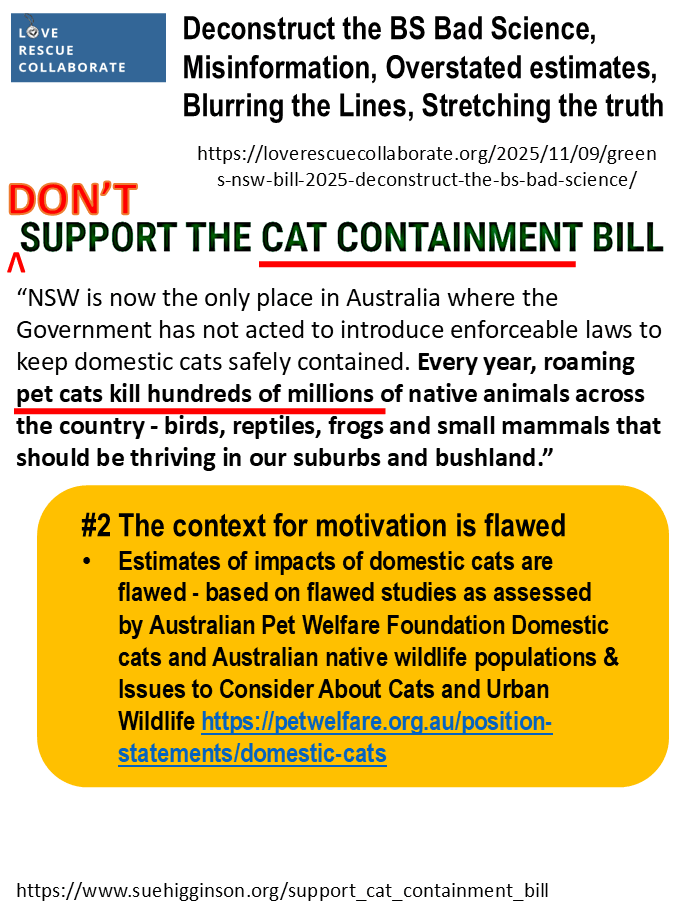
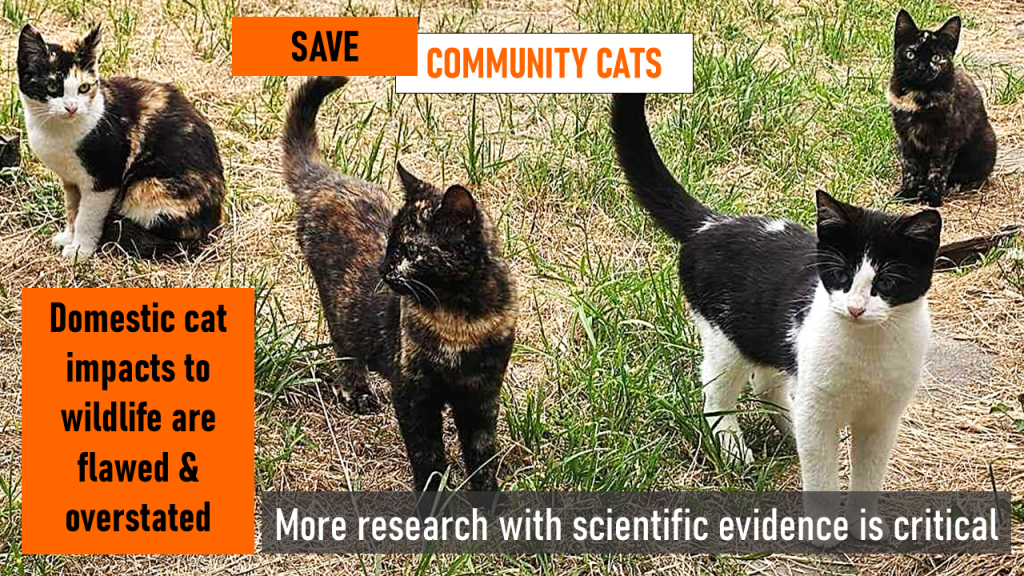
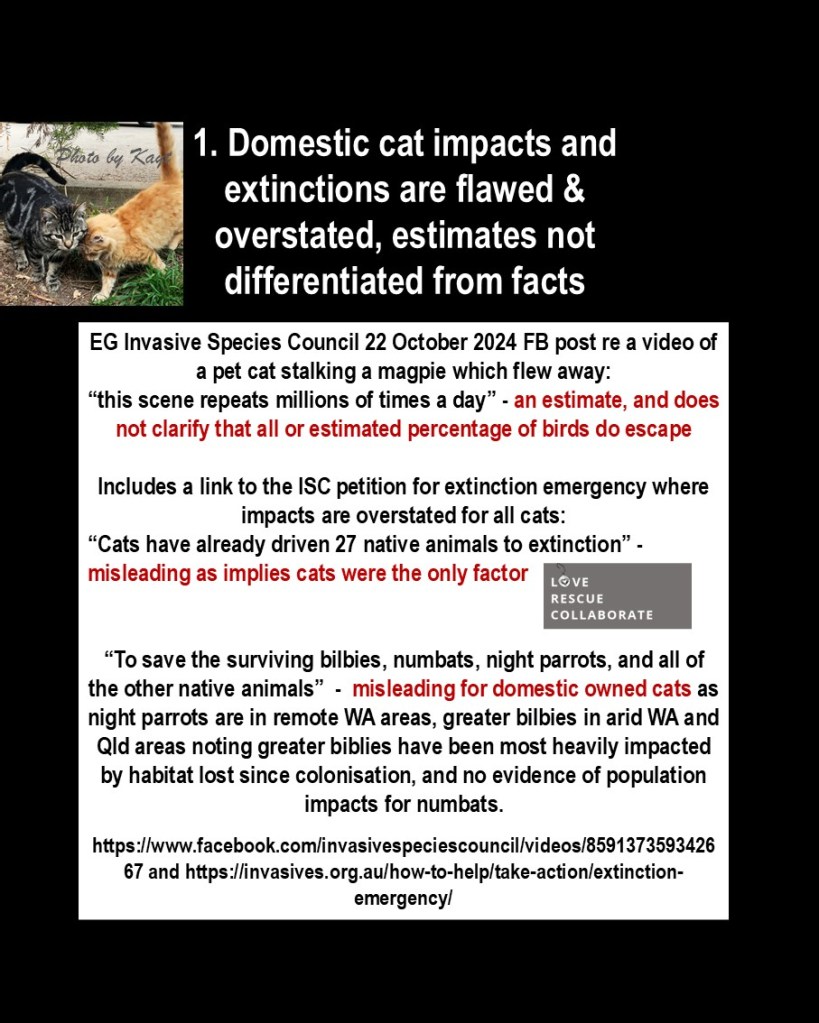
Wildlife impacts by domestic cats are flawed estimates & overstated
This summary is based on our view of the misleading information on the impacts of Aussie domestic cats and how this influences cat hate.
Cats do hunt, but not all cats, and cat containment should be promoted rather than legislated for more successful outcomes.
This assessment is based on contents and features of traditional and social media artefacts. The assessment is summarised in five steps to show the trail that contributes to increased cat hate, animal cruelty to roaming cats, and abuse to the volunteer community members who care & rehome abandoned cats.
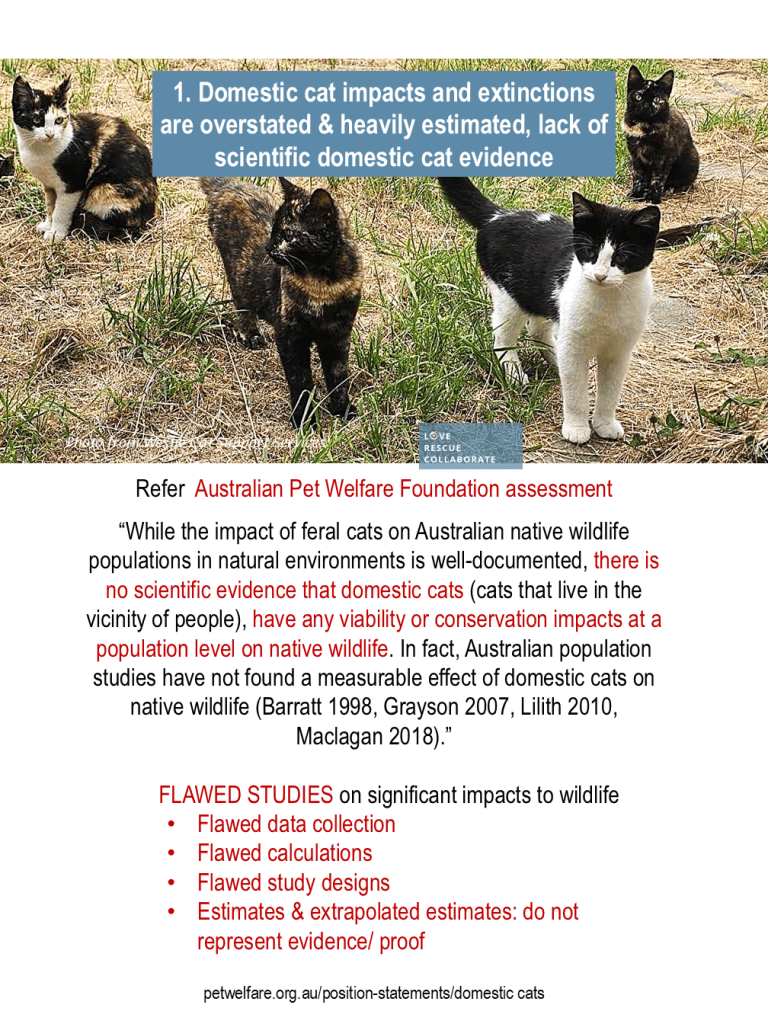
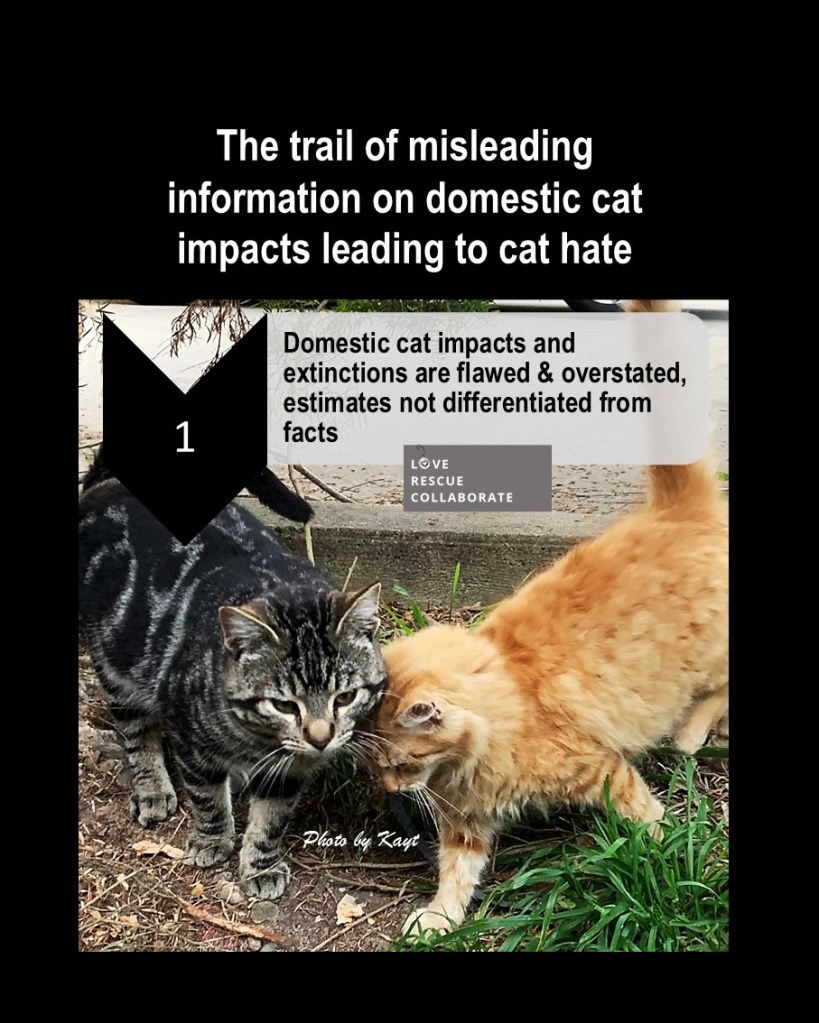
The trail starts with studies on the impacts of domestic cats which contain flaws and are heavily estimate based.
There are also flawed statements on the number of native animal extinctions attributed to cats, usually phrased in a misleading manner.
Often the differentiation between domestic cats owned (pets), semi owned and unowned (strays) and feral cats is blurred and challenging for the public to ascertain.
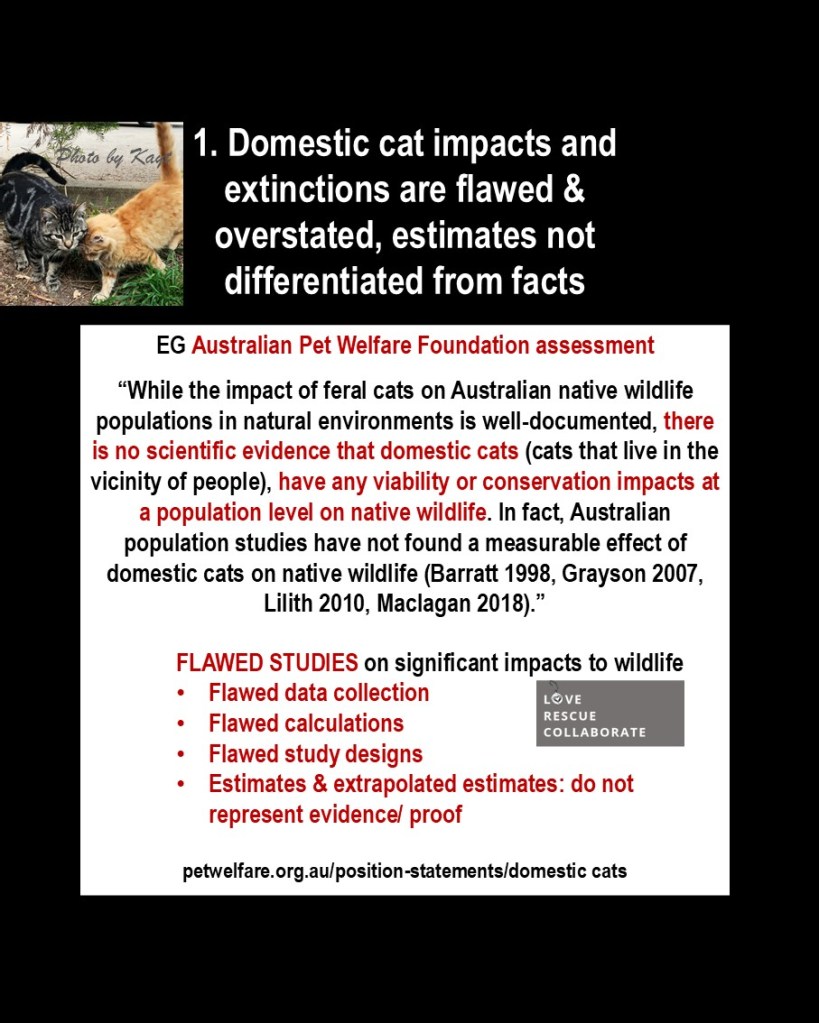
More studies are required for domestic cat impacts. The current studies are flawed in several ways. These studies are reliant on feral cat studies and heavily assumption based.
“While the impact of feral cats on Australian native wildlife populations in natural environments is well-documented, there is no scientific evidence that domestic cats (cats that live in the vicinity of people), have any viability or conservation impacts at a population level on native wildlife. In fact, Australian population studies have not found a measurable effect of domestic cats on native wildlife (Barratt 1998, Grayson 2007, Lilith 2010, Maclagan 2018).”
Be wary of social media posts, traditional media, and webpages where lines are blurred between domestic owned (pet cats), domestic semi owned and unowned (strays), versus feral cats who are truly wild and avoid humans.
We provide just a few examples to illustrate how estimates, impacts, and the native animals most at risk are not clearly articulated.
Wildlife and domestic cat experts are concerned that these approaches divert attention and funding from the most appropriate actions and funding for wildlife.
Several organisations call out the disproportionate focus on domestic cats where it is obvious in large urban areas and peri urban areas that land clearing of native habitat has caused the worst impacts to native wildlife.
Rewilding native animals in urban areas needs to carefully consider conservation fencing to protect wildlife and natural habitat from all threats, including human developments, road accidents, dog attacks etc not just domestic cats.

















 LRC
LRC