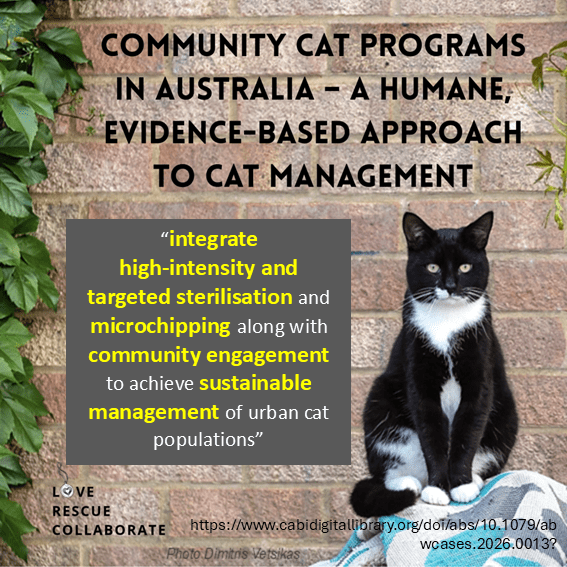
“Community Cat Programs humanely manage urban cats through sterilisation of owned and semi-owned cats, microchipping, owner and carer support, adoption, nuisance resolution, and return to field or working cat options for healthy nonadoptable cats. These evidence-based initiatives reduce shelter intake, increase reunification, minimise euthanasia, and improve animal and human wellbeing.”
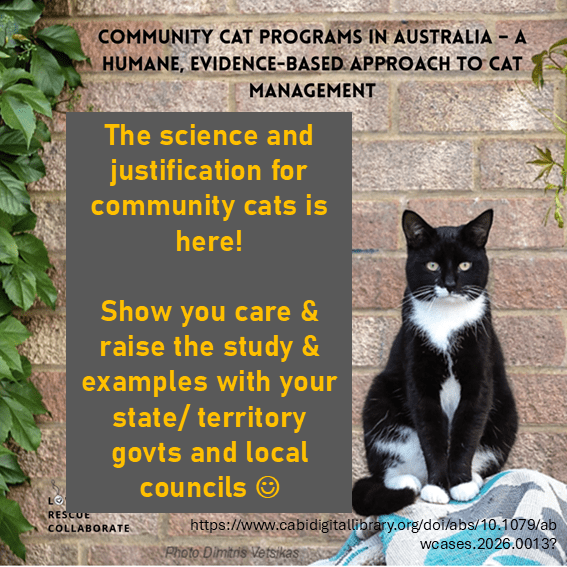
The latest science and justification for community cat programs is here! Based on specific council examples in Victoria, Queensland and New South Wales.
Community Cat Programs in Australia – A Humane, Evidence-Based Approach
to Cat Management https://www.cabidigitallibrary.org/doi/abs/10.1079/abwcases.2026.0013?
Please note this is a subscription study, and a summary has been included in this post with minimal quotes.
- Critical factors to consider
- Cats’ lives and welfare are improved under community cat programs
- Effectively addressing the “Cat Crisis”
- Next Steps
- Sample email for your local government contacts
- Related information in LRC posts
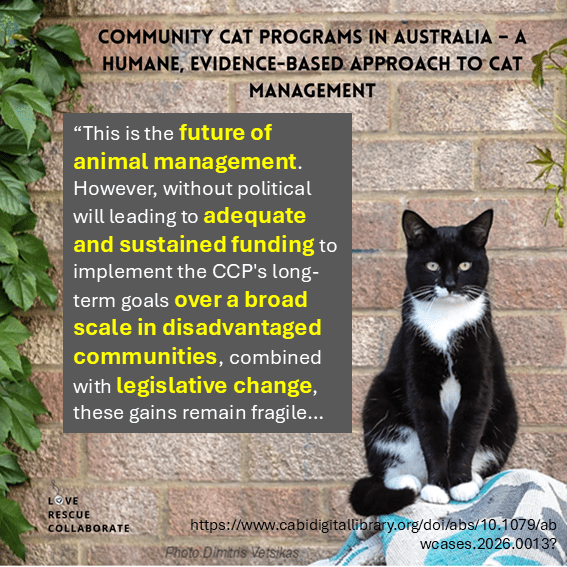
The study does leave open the question of expanding community cat programs extending or overlapping with owned and semi owned cats in low-income areas, as this is where usually the financial barriers and sometimes lack of awareness of responsible ownership may have impacts to the populations of free roaming cats with unclear ownership.
This question of scope should be considered by local authorities to achieve the best value for money and optimise benefits for cats and humans.
This study provides the significant relevance of Australian structured community cat programs to critically assist in management of cat populations in urban areas. This proven approach includes high-intensity and targeted desexing, microchipping and most importantly community engagement bringing the wealth of local experience, effort and commitment to the care of cats.
“Community Cat Programs (CCPs) use a holistic, non-lethal approach to managing free-roaming cat populations, grounded in the One Welfare framework. These programs integrate targeted sterilisation and identification (microchipping), support for owners and semi-owners to care for their cats, and for unowned cats to be sterilised, microchipped, and converted to semi-owned cats with a carer. Where indicated, this includes assistance with the provision of cat food and veterinary care. CCPs also include processes that maximise live outcomes for healthy cats unlikely to be adopted, such as return-to-field and working cat programs. However, legal reform is required to achieve sustainable outcomes for cats, communities, and wildlife.”
Critical factors to consider
This study is about domestic urban cats: owned, semi owned and unowned. This study excludes feral cats.
To distinguish a domestic cat from a feral cat should be based on the location. Domestic cats will be comfortable or at least have some reliance on humans. Feral cats are wild and avoid humans. Misjudging or applying responses based on flawed assessments between domestic and feral cats will restrict options and damage efforts for humane management techniques.
Unowned cats may easily become semi owned under carers and rescuers. In the field this is very common where newly abandoned cats are even placed with existing known colonies/ groups or locations. Unowned cats are also quickly helped by well meaning community members, even near food businesses where scraps may be purposely left outdoors for roaming cats.
The One Welfare framework in integrated through collaboration between community members and rescuers/carers, and with supporting legislation improvements then the programs and their benefits become a sustainable and humane outcome for animals, people and the environment.
The community members, and rescuers/ carers are an essential key success factor. Community cat programs consist of core components which are critically dependent on carers and rescuers:
- desexing and chipping,
- addressing treatments & health,
- on-going monitoring and management (before, during and after the former), and
- rehoming opportunities.
Medical assistance may be provided in a range of services:
- Desexing, chipping and vaccination (sometimes the latter may be referenced as TNVR),
- Ongoing treatments to prevent parasites and minor illnesses
- Triage for very ill or injured cats where all these including surgery are completed by veterinary professionals.
There are well known and proven benefits of community cat programs including:
- minimising costs for councils (and therefore ratepayers),
- reducing the burden and associated stress (primary and secondary trauma also considered compassion fatigue) on staff, vets and community.
- aligning support and welfare of cats, people and wildlife.
If a cat or cats are in a working environment then it is likely their role for vermin control or even as a support animal for workers or visitors/ clients.
Working cat programs or finding a new home/owner for less social cats in businesses should be acceptable and legal if the cat is chipped and owned and it is not a food production facility.
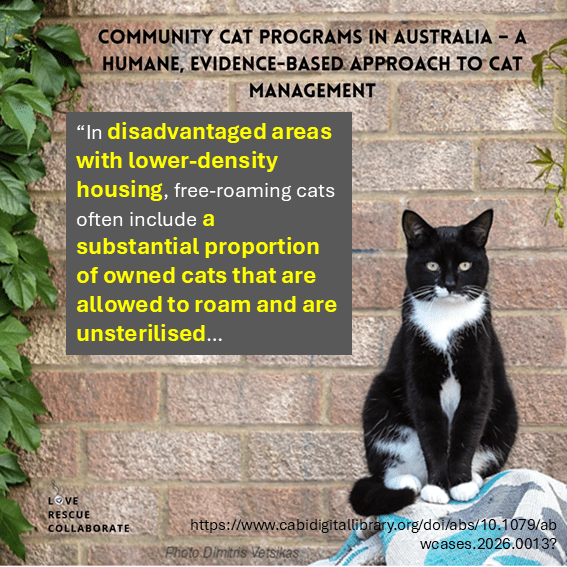
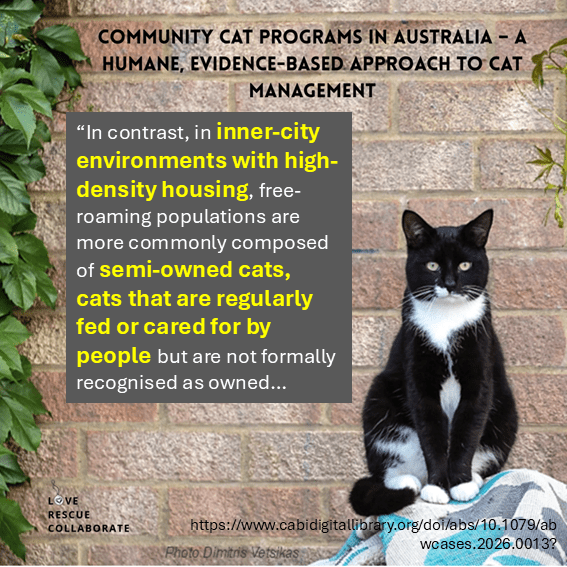
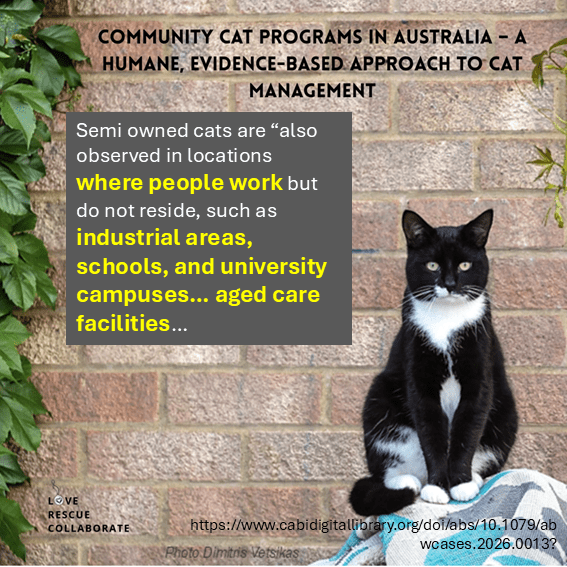
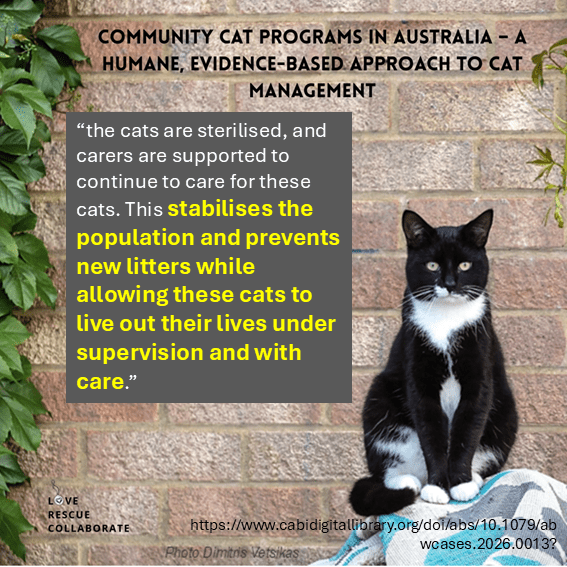
“In disadvantaged areas with lower-density housing, free-roaming cats often include a substantial proportion of owned cats that are allowed to roam and are unsterilised. In contrast, in inner-city environments with high-density housing, free-roaming populations are more commonly composed of semi-owned cats, cats that are regularly fed or cared for by people but are not formally recognised as owned. This pattern is also observed in locations where people work but do not reside, such as industrial areas, schools, and university campuses, as well as in settings where cat ownership is restricted or prohibited, including aged care facilities. Where cat carers are caring for a small number of cats, it is recommended that these semi-owners be helped to take ownership of the cats (McDonald and Clements, 2019). At multi-cat sites where caregivers cannot or are unwilling to take ownership, the cats are sterilised, and carers are supported to continue to care for these cats. This stabilises the population and prevents new litters while allowing these cats to live out their lives under supervision and with care. More rapid decreases in free-roaming cat numbers occur where adoptable kittens are rehomed after sterilisation through shelters, rescue groups, or by the carer. Similarly, if supported by the cat carer, after sterilisation, sociable adults can also be rehomed, and less socialised cats can be placed in working-cat homes to decrease cat numbers at the site.”
Cats’ lives and welfare are improved under community cat programs
- through low stress handling by caring people and involving trapped humanely in traps which are covered and kept in quiet locations
- cats may be chipped to their carers and rescuers or a group or organisation and as cats and kittens are identified as being social for rehoming, more rapidly reducing the cat population in the colony / group / location
- desexing improves ongoing health for the cats and reduces a potential rapid growing cat population,
- cats who are impounded but not claimed by owners, however not immediately adjusting to a shelter/ pound environment should be returned to their original location under a carer – interestingly it may be that the cats will return to their owners as studies has shown by Lord et al.,
Effectively addressing the “Cat Crisis”
The scientific research data from a range of Australian community cat programs is available from Queensland, Victoria and NSW which all show measurable outcomes with fewer roaming cats, fewer entering pounds costing effort and ratepayers, fewer complaints from the public, reducing council costs and ratepayer funding.
These prove that this One Welfare humane approach breaks the cycle of a rapidly increasing cat population, and largely replaces traditional methods of trapping, impounding and intensely high rates of euthanasia.
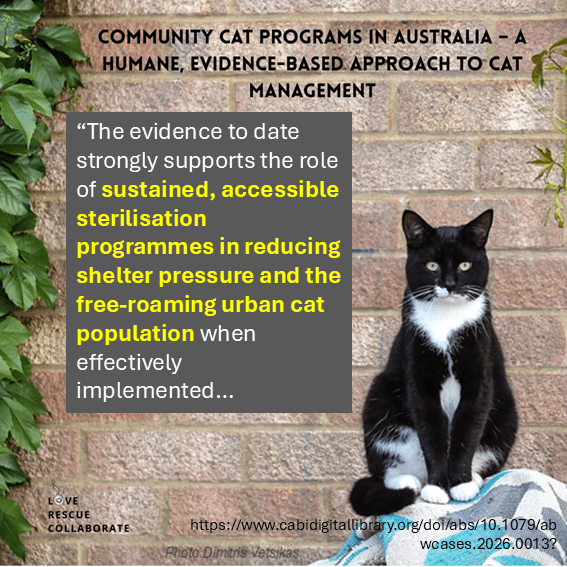
The study and related researched works provide more than adequate scientific evidence on sustained, accessible sterilisation programs providing worthwhile benefits in reducing the burden on shelters and minimising the free-roaming urban cat population.
Secure, sustained funding based on cost benefit assessments enable these programs to increase their impact through continued community engagement, targeted sterilisation, and microchipping.
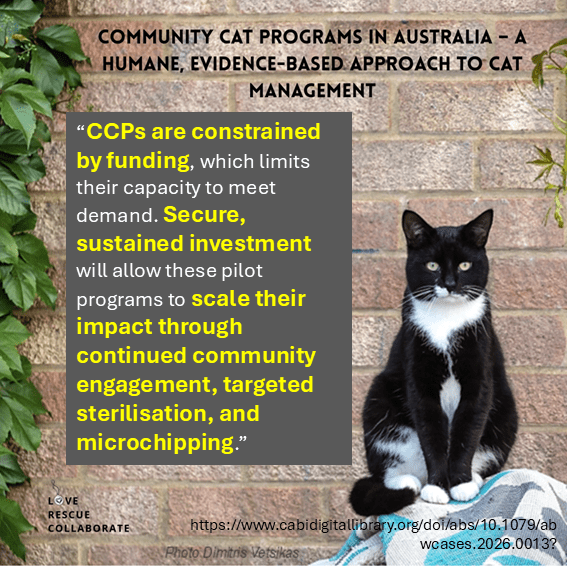
The next steps are to sharing information on the effectiveness with state and local government authorities, welfare agencies, and rescue groups to facilitate increasing implementations and momentum across Australia. Savings achieved can be applied in related companion animal support services.
Cases to justify community cat programs need to be developed working with local and state governments. The benefits will provide savings in ongoing effort and facilities.
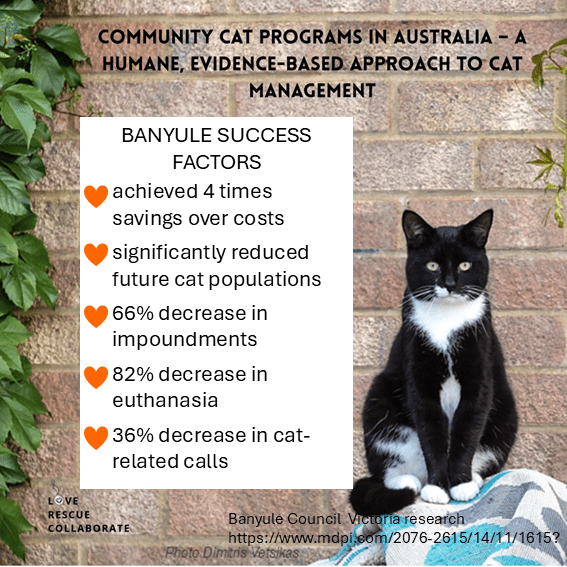
The Banyule Council desexing program has been formally researched. It provides a very sound case for consideration by other councils.
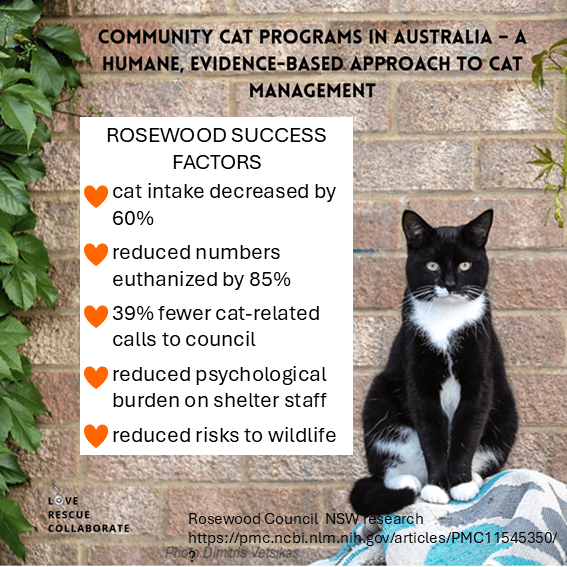
The Rosewood Council example is of interest as it is in a regional area of NSW and also formally researched.
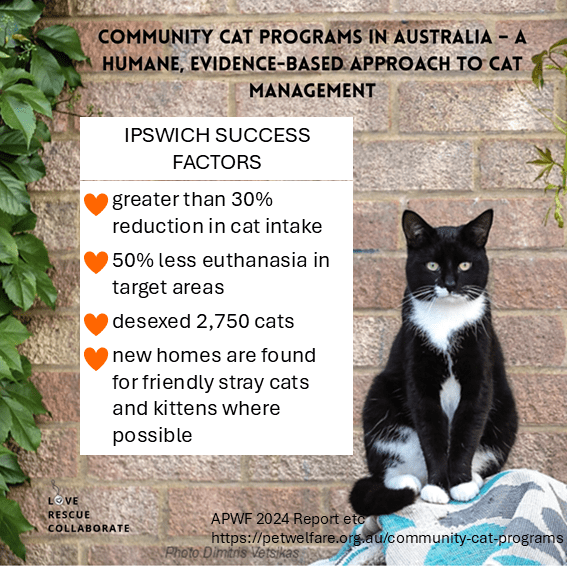
The community cat programs in Ipswich have been formally managed and operated in Queensland, and well documented.
Next Steps
If you have not yet, then start contacting your Mayor and councilors to kick off discussions on the issues and the proven success of managed community cat programs.
Seek funding under a trial program, seek advice from the Australian Pet Welfare Foundation.
Sample email for your local government contacts
[Please tailor for your concerns and recommendations]
There is proven value for our council to invest in improved management of community cats currently under the care of a community member, or cat rescuer / carer individual or group. These programs have been proven to be cost-justified, and provide savings over time in reduced burden on council staff and facilities. These community cat programs are a humane approach for cats, council staff, vets and community members. I will appreciate having the opportunity to discuss a similar program in our local government area.
I provide the most recent Australian study and the related research items for your consideration.
“Community Cat Programs humanely manage urban cats through sterilisation of owned and semi-owned cats, microchipping, owner and carer support, adoption, nuisance resolution, and return to field or working cat options for healthy nonadoptable cats. These evidence-based initiatives reduce shelter intake, increase reunification, minimise euthanasia, and improve animal and human wellbeing.”
Community Cat Programs in Australia – A Humane, Evidence-Based Approach
to Cat Management https://www.cabidigitallibrary.org/doi/abs/10.1079/abwcases.2026.0013?
Banyule Council research https://www.mdpi.com/2076-2615/14/11/1615
Rosewood Council research https://pmc.ncbi.nlm.nih.gov/articles/PMC11545350/?
Ipswich APWF Community Cat Program research https://petwelfare.org.au/community-cat-programs

