We are kicking off a section on some key issues regarding fire ants in Australia. This is not intended as a holistic “encyclopedia”, just a few hot topics for consideration by communities.
“Wildly toxic’ poison used on fire ants is killing native Australian animals, experts warn Senate inquiry”
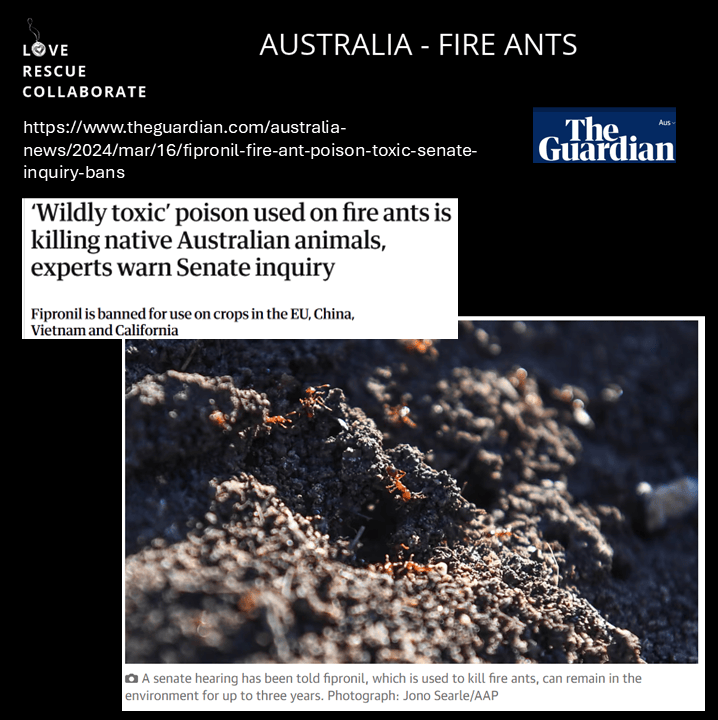
We are now aware of other much safer techniques validated in other countries to combat the varroa mite & fire ants – why aren’t these techniques being considered and used by Australian authorities?
This article appeared following contentious facts provided by experts on the toxic poisons being used in the senate inquiry.
The Guardian, Katie Cunningham, 12 Nov 2023
Useful quotes & information
Fipronil is described as “wildly toxic” is “used to combat fire ants and the varroa mite in Australia is banned in Europe and harmful to humans – and it is poisoning waterways and killing native fauna” – it is banned in the EU, China, Vietnam and California for use on crops as fipronil acts as an insect nerve agent it impacts pollinators, primarily bees.
“scientists are ringing alarm bells over its dangers” including “its deadly impacts on bees and other species” indicating “a lack of oversight by Australia’s chemical regulatory body” – by 2023 across New South Wales, fipronil has been used in sugar baits “in the now abandoned fight against the invasive varroa mite, and in south east Queensland and in northern NSW it had been injected into 35,539 fire ant nests as part of the national red imported fire ant eradication program.
“One bee can carry enough fipronil to kill an entire hive and native bees and other insects, reptiles, birds and mammals may die from fipronil poisoning” – in 2022 we were warned that fipronil can remain active in the environment for up to three years by the Australian Native Bee Association.
“Fipronil is very, very long lived so will keep poisoning the ecosystem… It can blow on the wind, and move in water” – the University of Queensland professor and director of the Future Fisheries Veterinary Service. Mat Landos, an aquatic veterinarian has extensively researched the effects of fipronil on aquatic animals and water systems and raised that fipronil will enters land and water environments from fire ant nest injection site.
“It is highly toxic to birds and there is a lack of data regarding its effects on amphibians, mammals, arthropods, reptiles – and humans” – in 2017, Queensland’s Logan River was found to contain fipronil from farm run-off at high enough levels to kill prawn populations (CSIRO data).
“fipronil transferred into foetuses and caused “infantile adverse health outcomes” – 2019 study reference not included
fipronil “can negatively affect male fertility leading to infertility” – 2020 research reference not included
“It is time for Australia to catch up to the rest of the world and ban fipronil” – NSW MP Emma Hurst of the Animal Justice Party.
Reference Information

