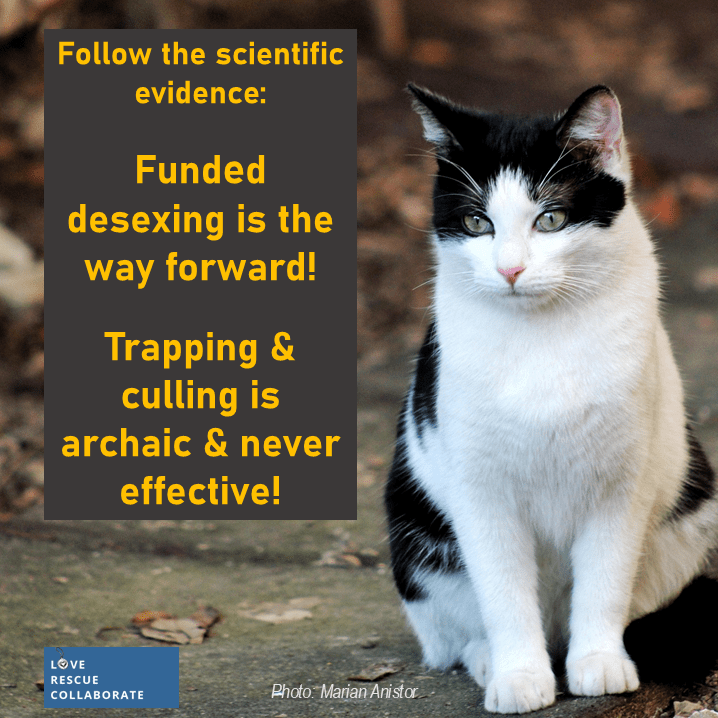
Based on scientific evidence from a number of domestic cat experts – references to research & experts follows.
Urban Cat Management in Australia—Evidence-Based Strategies for Success: “Urban free-roaming cats present challenges like noise, urination, defecation, property damage, public health risks, and wildlife predation. Traditional enforcement methods, such as containment laws and impounding, are ineffective, especially in low-income areas, where many free-roaming cats live. These cats are often cared for by “semi-owners”, who feed them without formal ownership. Financial barriers to sterilization for owned and semi-owned cats in these areas result in unplanned litters, sustaining the free-roaming population and burdening local authorities and animal welfare organizations. Cats causing complaints are frequently impounded and euthanized, affecting the mental health of veterinary, shelter, and council staff. This paper critiques punitive, compliance-driven strategies and highlights the success of assistive Community Cat Programs offering free sterilization, microchipping, and registration. In Banyule, Victoria, such a program reduced cat impoundments by 66%, euthanasia by 82%, and complaints by 36% between 2013 and 2021. Two other programs in large cities and rural towns in NSW and a rural town in Queensland have now reported similar results. Based on the One Welfare framework, these programs address the interconnectedness of animal welfare, human well-being, and environmental health. By removing financial barriers, they build trust between authorities and caregivers, improving compliance and welfare for cats, communities, and wildlife. However, following the loss of key program staff and the reintroduction of financial barriers in Banyule, cat intake rose by 140% between 2022 and 2024, demonstrating the detrimental impact of financial barriers and punitive approaches. This underscores the importance of sustained, community-based solutions and legislative reforms that prioritize humane, barrier-free strategies. Understanding the critical success factors for Community Cat Programs is essential for effective cat management.”
Most effective management of cat populations
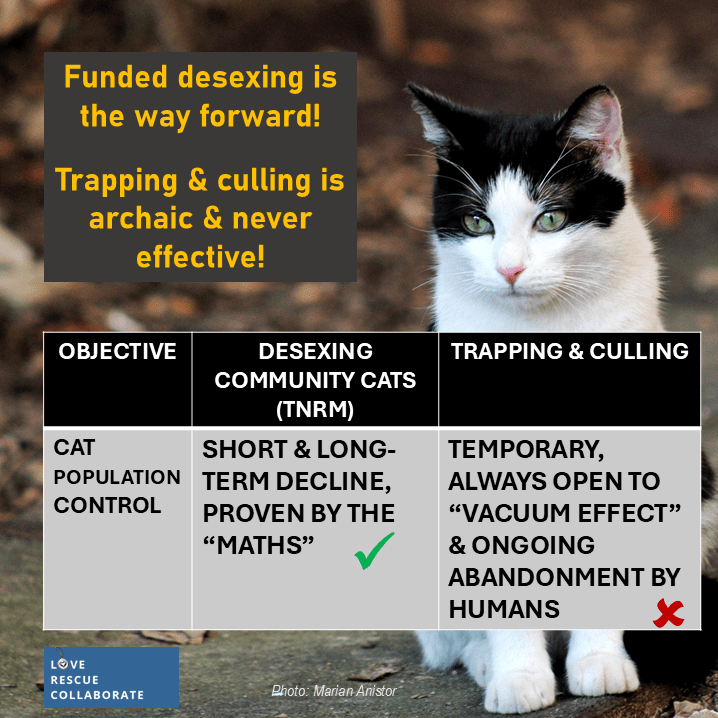
Funded desexing or sterilisation programs have been proven effective in Australia and other countries.
Trapping and culling is considered inhuman, costly and is not a long-term solutions due to the vacuum effect.
Ally Cats: “What is the Vacuum Effect and What Does It Have To Do with Cats?
The Vacuum Effect occurs when a portion of an animal population is permanently removed from their home range. These animals may have been killed or removed by people, a natural disaster, or any other means. The result is a temporary dip in population levels.
To be clear, any such population dip will only be temporary. The initial population lived in that location because there were resources such as shelter, food, and water. Once emptied, this still resource-rich habitat, the vacuum, inevitably attracts other members of the same species from neighboring areas. They move in to use the same resources that sustained the first group.”
Reference Information
NSW Inquiry Management of Cat Populations https://www.parliament.nsw.gov.au/committees/inquiries/Pages/inquiry-details.aspx?pk=3011
Urban Cat Management in Australia—Evidence-Based Strategies for Success https://www.mdpi.com/2076-2615/15/8/1083
Community Cat Programs in Australia – A Humane, Evidence-Based Approach to Cat Management https://www.cabidigitallibrary.org/doi/abs/10.1079/abwcases.2026.0013
ASPCA Position Statement Community Cats https://www.aspca.org/about-us/aspca-policy-and-position-statements/position-statement-on-community-cats
Guidance for management of free-roaming community cats: a bioeconomic analysis https://journals.sagepub.com/doi/10.1177/1098612X211055685
New Paradigms for Shelters and Community Cats, Shelter Medicine School of Veterinary Medicine, University of Wisconsin–Madison https://sheltermedicine.wisc.edu/library/resources/new-paradigms-for-shelters-and-community-cats
APWF Submission NSW Inquiry Management of Cat Populations https://petwelfare.org.au/government-submissions/new-south-wales
Urban Cat Management in Australia—Evidence-Based Strategies for Success https://www.mdpi.com/2076-2615/15/8/1083
Catch and Kill vs TNR: A Look at Sustainability – APA Adoption Center https://apamo.org/catch-and-kill-vs-tnr-a-look-at-sustainability/
Australian Pet Welfare Foundation Position Paper on Cat Containment https://petwelfare.org.au/position-statements/cat-containment
Bella and Charlie Are Not the Problem – It’s Us: The Real Drivers of Wildlife Decline in NSW https://www.mdpi.com/2076-2615/16/14/2174
Evaluating the Effects of Managed Free-Roaming Cat Populations on Prey Through Stable Isotope Analysis: A Pilot Study from British Columbia, Canada https://www.mdpi.com/2076-2615/15/21/3204?
Alley Cat Allies (2026) The Vacuum Effect: Why Catch-and-Kill Doesn’t Work. [online]. Available at: https://www.alleycat.org/resources/the-vacuum-effect-why-catch-and-kill-doesnt-work/
ABC Melbourne Facebook post 19 May 2026 Melbourne’s Lost Dogs Home animal shelter
& MORE just do an internet search!

