During June 2026, information on the tactics used by Invasive Species Council was provided across social media in relation to the inhumane treatment of brumbies in New South Wales Parks. We believe the information to be substantially true and relevant to the public to understand how misleading information is used by a specific lobby group, as we believe this is ethically questionable. We have evidence of these tactics as applied to domestic cats.
- How the Invasive Species Council lobby group persuades Aussies to support the cruel shooting of brumbies
- Simple example of Jack Gough spreading misinformation on Bengal cats to ban importing
- Jack Gough incorrectly blames pet cats for impact to greater bilbies
- Australian Pet Welfare Foundation Studies and Research
- APWF Expert Advice for NSW Inquiry Management of Cat Populations
- Recent Australian Research on Domestic Cat Impacts to Wildlife
- Unraveling the Invasive Species Council overstated estimates for cat Impacts
- RSPCA NSW Expert Advice for NSW Inquiry Management of Cat Populations
- Invasive Species Council Propaganda contributing to cruelty to cats as discussed & documented under the NSW cat Inquiry
- More examples to come – stay tuned!
How the Invasive Species Council lobby group persuades Aussies to support the cruel shooting of brumbies
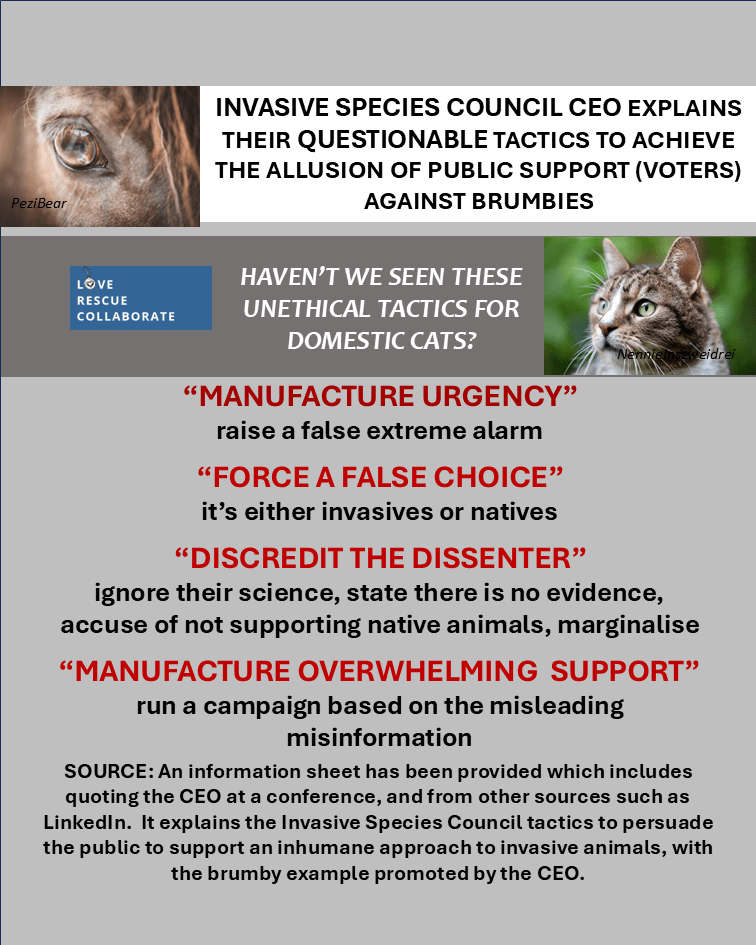
We have yet to verify the original author and the contents of the information on the lobby group manipulating information for brumbies. However, it appears the tactics appear SUBSTANTIALLY TRUE. Noting this generally means that:
- the statements need not be exact in every detail
- but show an essence of the truth, and
- this is important information for the public given the significant relevance and seriousness for brumbies, domestic cats, and other animals which is more important than precise accuracy.
“So the lobby [organisation] does the job for them [the governments] – not on merits, and not by putting the whole picture to people – but by selecting the science that persuades [or possibly ignoring relevant contrary science?] sidelining the people offering alternatives and running a campaign method”. (View of author)
Our assessment of there being substantial truth is based on:
✅1. An AI search as it produced a similar set of tactics from a number of media sources including SBS, and there is the brumby page from the Animal Defenders Office which provides related information.
✅2. Under the NSW cat Inquiry the ISC cat propaganda issue was raised by a rescuer and a supplementary document was provided with evidence and an assessment of the tactics/ methods that contributed to cat hate and harm to cats.
✅3. The LRC team and others have analysed the misinformation and manipulation of ISC webpages and posts on cats, which then is further manipulated through paid media adding emotive opinions and blurring facts, and through social media pages not being moderated for comments on cat hate and cruel acts. Refer our previous web blogs and posts.
In other sections of this blog, we will provide examples of evidence for cats where the same tactics have been applied:
- Manufactured urgency
- Force between just two extreme solutions
- Discredit the dissenter (eg animal welfare experts being labeled activists)
- Manufacture overwhelming support (eg we see inaccurate portrayal of RSPCA NSW aggressively supporting mandatory cat containment)
In our examples, these tactics and misinformation appear to be used by ISC and their followers in media, social media posts and comments.
Simple example of Jack Gough spreading misinformation on Bengal cats to ban importing
“Contrary to the misguided beliefs of the Invasive Species Council, the Bengals’ temperament, genetic makeup, and behaviour are domestic. With responsible ownership and containment, the impact on wildlife is zero – which applies to all cat breeds.” Animal Care Australia
Jack Gough tactics and misinformation prior to the total ban

This is a summary of just some of the comments Jack Gough made to News Com in September 2025.
From March 2026 a complete ban for importing Bengal cats was implemented – no Bengal cats will be permitted to enter Australia.
This replaces a 12-year exemption period that previously made it possible with specific conditions. This was one of many alternatives available.
MANUFACTURE URGENCY
Jack Gough “This is sheer lunacy, there’s no other way to describe it,”
“It’s something that needs to be stopped.”
News Com on Jack Gough ISC views: “has sparked outrage over fears it would “turbocharge” the nation’s cat crisis… the group warned the move – which would reverse a ban implemented earlier this year – would mean ‘deliberately unleashing more genetic monsters’ on the country’s native wildlife”.
Where in reality Bengal cats are domestic cats and given their high value are usually contained as pets, not free roaming and extremely rarely abandoned as easily adopted by a new family. Further, Bengal cats usually reside in urban areas where wildlife has already been decimated by human developments.
Recent research confirms earlier advice from wildlife rescuers that wildlife in urban areas is more likely to be significantly harmed by humans, road accidents and dogs than cats.
Bella and Charlie Are Not the Problem – It’s Us: The Real Drivers of Wildlife Decline in NSW https://www.preprints.org/manuscript/202604.1191
FORCE A FALSE CHOICE
News Com: “A proposal to import a controversial pet cat into Australia has been slammed by a major environment group, who has branded the breed a ‘hybrid killing machine’.”
The previous controls were a reasonable and proven workable option, the ban replaced a 12-year exemption period that previously made it possible with specific conditions.
Jack Gough “cats are ‘“’one of the greatest drivers of extinction’”’ for native animals, with roaming pet cats killing over 300 million native animals every year in Australia, including lizards, frogs, bilbies and small wallabies” – land clearing of native vegetation has been proven the worst impact for native animals “Habitat loss and clearing has caused the extinction of 62 Australian terrestrial species since European colonisation” https://www.dcceew.gov.au/sites/default/files/documents/6.%20DCCEEW-SOE_factsheet_Habitat%20and%20Natural%20Capital.pdf
Jack Gough “Collectively, feral and roaming cats have driven at least 25 species to extinction, including the pig-footed bandicoot, broad-faced potoroo and desert rat-kangaroo” Note – this is not proven by any scientific evidence based research.
It is just feral cats NOT roaming domestic cats who have CONTRIBUTED with many other factors (e.g. land clearing, climate change and other invasive species) to the “extinction of more than 20 Australian mammal species, including the pig-footed bandicoots, lesser bilby and broad-faced potoroo” https://www.dcceew.gov.au/environment/invasive-species/feral-animals-australia/feral-cats
Jack Gough called out those who “think that their desire for a trophy pet is more important than protecting our native wildlife” – just two choices allowing your cat or supporting wildlife. This accusation of caring for one or the other is experienced often.
DISCREDIT THE DISSENTER
News Com “The Invasive Species Council has blasted what it has called a “ridiculous” new application to the federal government to include Bengal cats – designer hybrids of a domestic cats and Asian leopard cats – on the Live Import List as household pets… which would reverse a ban implemented earlier this year – would mean “deliberately unleashing more genetic monsters” on the country’s native wildlife.”
Jack Gough “Bengal cats would ‘inevitably’ escape or breed with feral cats, which would “turbocharge feral cat populations” and kill wildlife already devastated by roaming and feral cats… we’re bringing in genes that will make them more effective and more impactful on our native wildlife”.
Bengal cats are domestic, no more aggressive than other breeds and mainly reside in urban areas and extremely unlikely to be in areas with feral cats.
Jack Gough included the application against the ban was “irresponsible and selfish”.
MANUFACTURING OVERWHELMING SUPPORT
Published in media EG News.com, possibly elsewhere too https://www.news.com.au/technology/science/animals/hybrid-killing-machines-outrage-over-proposal-to-import-pet-cat-into-australia/news-story/e5c9cf41b07ec7a68f23ea997af6930f
Veterinary Advice on the Bengal cat breed
While a vets advise “…these cats have strict breed standards to limit aggression and favor good temperaments”.
“Bengal cats may look like wild jungle cats but they’re fully domesticated like any other breed of cat. These cats aren’t particularly aggressive or dangerous as a breed”
https://articles.hepper.com/are-bengal-cats-aggressive-dangerous
Animal Care Australia raising issues with the interpretations and ban
“Contrary to the misguided beliefs of the Invasive Species Council, the Bengals’ temperament, genetic makeup, and behaviour are domestic. With responsible ownership and containment, the impact on wildlife is zero – which applies to all cat breeds.”
The ban made in December 2024 and was reviewed in late 2025, was “reported to have been made on the basis that some cats imported into Australia were less than five (F5) generations removed from their wild ancestors which caused concern about potential risks to Australia’s ecosystem and wildlife.
There is no information accessible that supports that claim.
The DCCEEW announced there was a detailed policy review, however, neither they nor the Australian Department of Agriculture, Fisheries and Forestry (DAFF) provided a reference for the Review title documentation.
Further “the DCCEEW has not provided statistics showing how many Bengal cats actually entered into Australia who were less than five generations removed, or over what period of time or how DCCEEW identified that this had occurred”.
“It is a misleading statement to classify the current day Bengal cat as a hybrid… these days are at least 5 generations away from the original matings which began in the 1940’s and are considered worldwide to be a domestic cat”.
From the year 2000, “Bengal cats have been classified at domestic cats on a global scale… their heritage lies in a cross mating with the Asian Leopard Cat is so far from the cats bred today”
https://www.animalcareaustralia.org.au/2026/02/07/import-of-domestic-bengal-cat/
Jack Gough incorrectly blames pet cats for impact to greater bilbies
Jack Gough Invasive Species Council CEO unleashes on pet cats impacting greater bilbies on ABC morning news national program May 2024 following urban myth of panther based on a large black cat in Vic.
It appears that Gough managed to appear based on his experience with “the impact of feral cats an invasive species on native wildlife. However, not far into the segment, Gough turns to pet cats who reside predominantly in urban areas with human owners, and their impacts on greater bilbies who predominantly reside in remote areas mainly deserts.
As at June the video is still available https://www.facebook.com/watch/?v=1776107772878901

Bilbies reside in the NT Tanami Desert, the WA Gibson, Little and Great Sandy Deserts, Pilbara and Kimberley regions, and the southwest QLD Mitchell Grasslands. Their greatest threats identified include: competition for food from livestock and introduced species such as rabbits, predation by foxes and feral cats & changing fire patterns. (refer Bush Heritage)
Jack Gough tactics and misinformation on pet cats and bilbies
A common flaw by Invasive Species Council is to blur the lines between feral cats, stray cats and pet cats. ISC do not recognise stray cats as a separate category being domestic and predominantly occurring in urban and peri urban areas. Invasive Species Council and cohorts promote that stray cats are a subclass of feral cats, but this is misleading and not accepted by domestic cat experts (refer 2018 Royal Society for Protection of Animals Australia).
However, stating “the greater bilby is directly under threat from pet cats” is misinformation, misinformation that was broadcast nationally, then repeated in radio programs during the rest of the day by Jack Gough, and the link to the ABC program has been shared by several organisations and Gough’s ISC linked in page.
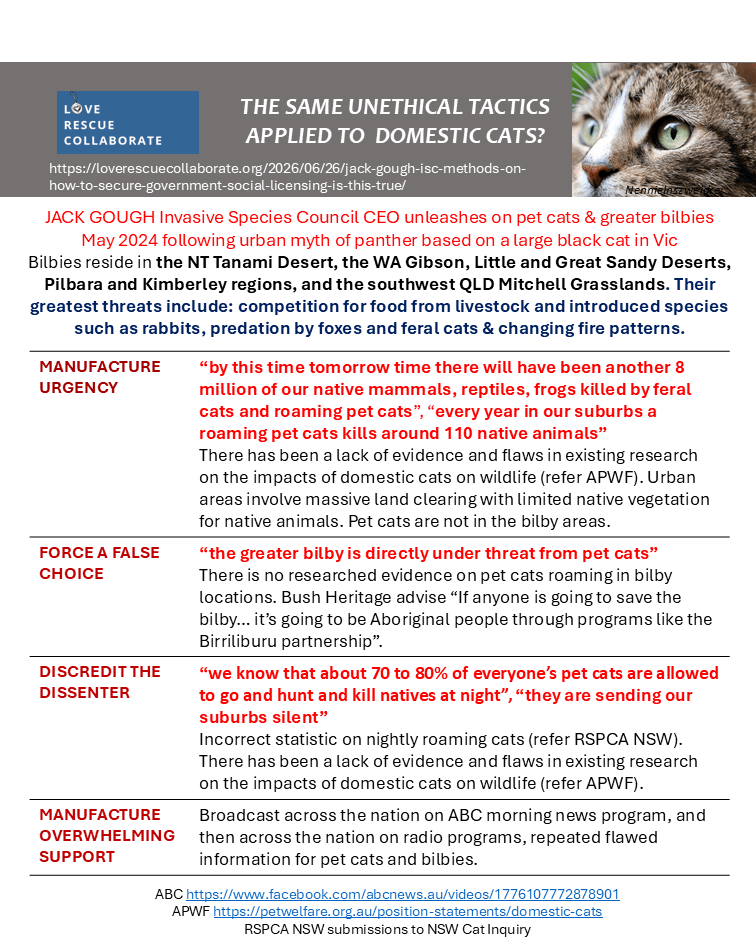
There is no proven impact of pet cats to bilbies residing mainly in remote areas in Western Australia (WA), Northern Territory (NT), nor Queensland (QLD).
There is an impact from feral cats which is being addressed.
The idea that pet cats will roam and breed with feral cats in this area is not rational based on near impossible probability.
Bilbies have been most impacted by land clearing and other human developments since colonisation.
MANUFACTURE URGENCY
Gough uses a number of variations of the impact of feral and domestic cats on wildlife to create urgency. With extreme wildlife numbers every year, to in each 24 hour period and by every / each roaming cats.
It appears Gough used the opportunity to raise support for funding from the federal government – in the video he concludes with “we had a really good plan put together by the federal Environments Minister Tanya last year… but unfortunately no money was associated with that plan… we are really looking forward to the budget coming up…”.
We note Threat Abatement Plan was based on a Background Document which was developed with ISC cohorts Professor Sarah Legge and Professor John Woinarski, who have also been involved with a number of studies on feral cats to produce questionable numbers for domestic cats. https://www.dcceew.gov.au/sites/default/files/documents/background-document-for-tap-predation-feral-cats-2024.pdf
The Australian Pet Welfare Foundation has been questioning overstated numbers for domestic cat impacts to wildlife for a number of years and in a number of studies. https://petwelfare.org.au/position-statements/domestic-cats
FORCE A FALSE CHOICE
Gough used false information indicating pet cats were the major threat to bilbies to most likely gain support for the ISC organisation and funding for treatment programs, and to likely support mandatory actions for pet cats such as containment and desexing that ISC promotes.
No other choices were provided which suggest the other choice was totally accepting the false major threat to bilbies, a much-loved native animal now replacing the Easter Bunny with chocolate bilbies in the lead up to Easter Sunday.
The Threat Abatement Plan for predation by feral cats includes the inhumane 1080 based poison as well as programs to shoot feral cats. It also included a questionable overlap for domestic cats, including stray cats (domestic semi owned and unowned cats) under the feral cat class for “organisational” purposes – this was objected by many domestic welfare organisations and experts. This document confuses many across Australia, and causes conflict in real-life and on social media.
DISCREDIT THE DISSENTER
The estimate for roaming pet cats is regarded as an overstated estimate. Pet owners who allow their cats to roam were clearly, incorrectly, assigned blame for threats to bilbies in remote areas.
ISC relies on studies on feral cat experts to determine domestic cat impacts. This has been shown to have several flaws and results in overstated estimates.
The TAP and its Background Document contain a controversial and strongly disagreed definition “A subset of feral cats is found in and around cities, towns and rural properties; these cats may rely on resources that are indirectly (e.g. rubbish tips or abundant rodent populations), or deliberately and periodically, provided by people (e.g. placing food out for cats). These cats are sometimes called ‘stray cats’.”
“For the purposes of this threat abatement plan, a categorisation of ‘feral’ cats and ‘pet’ cats has been used. This corresponds with the differences in the management focus required to address the impacts of cats on native wildlife, and the actions most likely to be in-scope having regard to the management context and location. This is not a prescribed categorisation, rather an organising framework for the information in this plan; it does not override the legal categorisations that apply in jurisdictions across Australia.” https://www.dcceew.gov.au/sites/default/files/documents/tap-for-predation-feral-cats-2024.pdf
MANUFACTURING OVERWHELMING SUPPORT
Gough appeared on national ABC Morning News and then spoke on radio programs across the nation during the day. He was seeking support for funding from the federal government department for treatments for invasive species, and the ISC promoted steps for mandatory cat containment and desexing.
This was based on a Victorian video of a black cat in a rural area. This cat may have been owned by a farm or business, or be semi owned, rather than a feral cat – this was never investigated.
Bush Heritage clarifies locations for greater bilby & feral cats not pet cats
“Bilbies are generalist animals and were once found across 70% of Australia. Today they’re restricted to around 15% – the Tanami Desert of the Northern Territory, the Gibson, Little and Great Sandy Deserts, the Pilbara and Kimberley regions of Western Australia, and the Mitchell Grasslands of southwest Queensland.”
“The two main threats are competition for food from livestock and introduced species such as rabbits, and predation by foxes and feral cats.”
https://www.bushheritage.org.au/species/bilby
QLD recognises feral cats not pet cats
WA recognises feral cats not pet cats
“Greater Bilbies once ranged over three‑quarters of Australia, but declined coincident with the spread of European foxes, along with habitat changes from introduced herbivores (especially rabbits),
changed fire regimes and predation by feral cats. Recovery actions have focused on maintaining or restoring traditional Indigenous patchwork fire regimes and controlling introduced predators.
Translocations into predator-free exclosures (sic) and a predator-free island have allowed for further increases in population and re establishment into the species’ former range.”
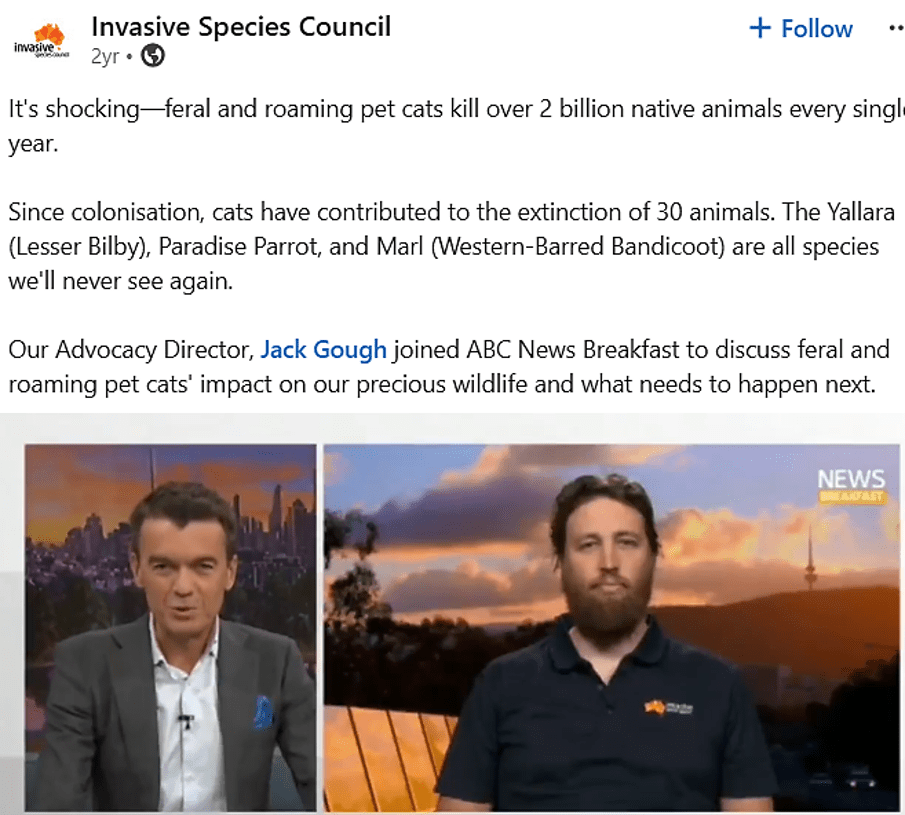
Gough’s Linked in post
Jack Gough’s messages were refined.
Australian Pet Welfare Foundation Studies and Research
The Australian Pet Welfare Foundation has been questioning overstated numbers for domestic cat impacts to wildlife for a number of years and in a number of studies. https://petwelfare.org.au/position-statements/domestic-cats
APWF Expert Advice for NSW Inquiry Management of Cat Populations
“Based on data from councils, 24/7 cat containment regulations would not provide any measurable benefit in reducing complaints, cat impoundments, potential wildlife predation or cat-related costs and would instead increase costs to local governments.”
City of Yarra Ranges Vic: increases in complaints 143%, Impoundments 68%, Euthanasia 18%, City of Casey Vic: after 20 years “the number of cats impounded was still 296% higher than baseline”, and City of Hobsons Bay Vic: “mandated 24/7 cat containment is not an effective strategy for reducing the number of wandering cats or associated issues and has rejected cat curfews”
APWF Submission NSW Inquiry Management of Cat Populations
https://petwelfare.org.au/government-submissions/new-south-wales
Recent Australian Research on Domestic Cat Impacts to Wildlife
This research is based on a wildlife rescuer database and the scope is on ii\njured wildlife in or very near urban landscapes. Bella and Charlie Are Not the Problem – It’s Us: The Real Drivers of Wildlife Decline in NSW https://www.mdpi.com/2076-2615/16/14/2174
Unraveling the Invasive Species Council overstated estimates for cat Impacts
Please refer our summary of the number of assessments (primarily by APWF) of various parts of the data and methods used by ISC cohorts to develop the extreme impacts of domestic cats in urban areas, environments that have been largely decimated of natural habitat vegetation and native animals due to human developments (e.g. medium and high density urban landscapes). https://loverescuecollaborate.org/2026/07/01/questionable-flaws-in-invasive-species-council-cat-impacts-to-wildlife/
RSPCA NSW Expert Advice for NSW Inquiry Management of Cat Populations
“…research from Queensland published in 2024 indicated that 51% of cat owners contained their cat 24/7 whilst a further 18% contained their cat at night (Rand et al., 2024). In NSW, Ma et al (2023) identified that “65% of NSW residents indicated they currently kept their cat(s) fully contained, with a further 24% containing their cats overnight.”
“Cat containment policies are difficult and expensive to enforce and trapping, culling or impounding uncontained cats are unacceptable, inhumane and ineffective ways to manage these populations”
“Mandatory containment may fuel anti-cat sentiment in the community leading to increased deliberate cruelty against cats.”
https://www.parliament.nsw.gov.au/committees/inquiries/Pages/inquiry-details.aspx?pk=3011#tab-submissions #16 RSPCA NSW
RSPCA NSW @ Hearings:
“Our research through Keeping Cats Safe at Home demonstrates that the uptake of cat containment is increasing over time, and that this style of cat management is becoming a social norm and community expectation. Programs like our successful Keeping Cats Safe at Home initiative take a human behaviour change approach to encourage this continued shift to containment. We do not recommend mandating cat containment for multiple reasons” Gemma Ma RSPCA NSW
Invasive Species Council Propaganda contributing to cruelty to cats as discussed & documented under the NSW cat Inquiry
During the NSW cat Inquiry an experienced Sydney based community cat rescuer and rehomer, raised the issue of propaganda from Invasive Species Council was influencing the cat hating community members in harming roaming cats, community cats, and their rescuers and carers. This was questioned by Sue Higginson and a document was requested to explain this concern, which was provided https://www.parliament.nsw.gov.au/lcdocs/other/22106/AQON%20-%20Westie%20Cat%20Support%20Services%20-%20received%202%20May%202025.pdf
In summary the document provided the chain of misinformation including:
- Starts with the cat impacts that include generalised extreme cat impacts – numbers of cat predation on wildlife rolling in overstated estimates for domestic cats from the ISC and related organisations (cohorts), most often using national generalisations that present a dramatic view that does not match evidence in separate locations across our nation.
- Omit meaningful context other significant factors, such as “land clearing (habitat loss), climate change impacts (bushfires, floods, droughts), and impacts from other invasive species”. [LRC notes that native predators are also not included which can be major causes when native vegetation has been decimated.]
- Use of negative demonising emotive language “terms, adverbs and adjectives) to describe all cats for example “alien”, “villains” and “invasive”, and “cat catastrophe”, has been found to contribute to fear and moral disengagement, leading to support for lethal control methods and reduced concern for animal welfare for feral and domestic cats“
- These posts and traditional media forms on social media posts for ISC and cohorts do not have administrators / moderators allowing a wide range of comments from community members / followers, “inflammatory comments and arguments equal engagement on social media – often seen as “click bait”” and owners/ authors are rewarded by the social media platforms in various ways. .”However, biased misinformation may result in forms of animal cruelty being promoted and shown that normally violates community standards, regulations and our laws/ legislation.”
- The traditional media articles and social media posts by ISC and cohorts are proliferated across many similar organisations, which “floods the internet and influences the AI/search algorithms to prioritise listing these inaccurate misleading items to be listed before other items” for example the researched quality information on cat impacts.
- It was noted that “cruelty to animals is on the rise, reported by RSPCA NSW and RSPCA United Kingdom” which matches anecdotal experiences from cat rescuers and carers.
The discussion and parts of the transcripts was raised as another LRC blog post:

