November 2025
The Greens NSW Companion Animals Amendment (Control of Cats) Bill 2025 is in stark contrast and contrary with the recent Parliament Inquiry Management of cat populations in New South Wales with its proven rapid approach to increase cat containment and other proactive One Welfare solutions under its scope.
The NSW Government is taking the issue of cat management very seriously with a number of related Inquiries and reviews, including the shortage of vets, improving the performance of council pounds, cat management and review of the overly complex yet open to interpretation Companion Animals Act etc.
The recent formal Inquiry Management of Cat Populations, which included Greens NSW and other representatives, involved extensive engagement with leading domestic cat welfare experts, with their substantial scientifically proven evidence and outcomes, peer-reviewed formal research and cost/benefit analysis. During the hearings it was incredibly disturbing that Sue Higginson proposed “a different body or different people” to complete massive culling instead of professional vets under council pounds. Policy should follow animal welfare standards, evidence, effectiveness, ethics, and the Inquiry provided these, where the Greens NSW bill contains major flaws in all of these obligations.
The Inquiry findings and recommendations are fully supported as it provided the most recent appropriate, effective, humane and proven improvements for cat management, and specifically the proven holistic humane behaviour change program for cat containment, which integrated assist with reducing impacts for wildlife. https://www.parliament.nsw.gov.au/committees/inquiries/Pages/inquiry-details.aspx?pk=3011
The Greens NSW bill is NOT supported as it will take our animal welfare approaches back decades with researched and proven failed techniques and outcomes. It does not represent a “a clear but simple legal duty on cat owners”. It represents a deadly intention for ALL roaming unchipped/registered cats, likely ceases most efforts to rescue and rehome semi owned and unowned cats (strays), and likely increases cruelty to all roaming cats. https://www.parliament.nsw.gov.au/bills/Pages/bill-details.aspx?pk=18825
NSW deserves evidence-based, compassionate, and effective cat management. The Greens NSW bill fails that test and will divert resources away from proven solutions, and punish vulnerable cat owners.
It appears the Greens NSW bill is NOT just to “prevent cats from escaping from places or from leaving places”. During the hearings Sue Higginson, Scott Barrett and Susan Carter raised mass cullings. There are further harsh flow-on implications as if all unchipped roaming cats are deemed illegal then so too for the efforts of many thousands of individuals and organisations who currently assist and rehome abandoned cats and kittens across NSW. may also be deemed illegal. Directly assisting roaming unchipped cats may cease for the Animal Welfare League NSW, Cat Protection Society NSW, over 100 rehoming organisations, and many thousands of independent community cat rescuers. Further, with pounds and rehoming organisations already at capacity, the Greens NSW bill effectively removes the community safety net that currently saves countless cats from euthanasia every year.
The criticism from Sue Higginson is considered intrinsically flawed: “The Minns Labor Government has intentionally avoided this politically tricky problem, and have prevented evidence based recommendations from being included in Parliamentary reports”. https://greens.org.au/nsw/news/media-release/greens-introduce-cat-containment-laws-nsw#
Under the Inquiry, cat management and containment to reduce impacts to wildlife was significantly considered with the most recent extensive evidence by a number of trusted organisations in the field, proven to reduce roaming and population size by treating root causes, and included in the Inquiry final report. These approaches were both humane and community supported, and cost-effective compared with enforcement and euthanasia-based systems.
It is understood our government is committed to assessing the policy implications to owners and communities, and provide better outcomes for both endangered native species and companion animals. In summary in relation to the Greens NSW bill, the Inquiry key findings were based on substantial evidence from relevant domestic cat experts and their organisations, including:
- traditional and current punitive practices were found to be ineffective, and mandated containment was researched and found as ineffective across many Australian councils, as it is punitive and costly, with higher euthanasia rates putting further burdens on vets, their staff and the community. These issues have been explained in detail by the Australian Pet Welfare Foundation submission, and for which Jacquie Rand and other animal welfare experts provided further advice during and after the hearings https://www.parliament.nsw.gov.au/lcdocs/submissions/88514/0068%20Australian%20Pet%20Welfare%20Foundation.pdf
- the leading effective humane One Welfare solutions to minimise the number of cats, rapidly increase cat containment, and therefore minimise impacts to wildlife included:
- high intensity desexing, which has been substantiated by many animal welfare organisations across many councils in NSW, Queensland, and Victoria including APWF community cat programs, RSPCA NSW Keeping Cats Safe at Home desexing programs, Cat Protection Society NSW desexing services, Animal Welfare League NSW, etc and included as evidence in submissions etc under the Inquiry https://www.parliament.nsw.gov.au/committees/inquiries/Pages/inquiry-details.aspx?pk=3011#tab-submissions and
- proactive education offering practical advice on cat containment from APWF, CPS, etc and RSPCA NSW providing the successful findings of the holistic human behaviour change program based on a long list of engagement initiatives under the KCSAH program https://www.parliament.nsw.gov.au/lcdocs/other/20914/Answers%20to%20supplementary%20questions%20-%20RSPCA,%20received%2031%20January%202025.pdf
Please note, that the Inquiry included significant evidence over the few reference links included above and in the following key points. The Inquiry final report is a summary of all the evidence that substantiated the findings and recommendations. https://www.parliament.nsw.gov.au/lcdocs/inquiries/3011/Animal%20Welfare%20Committee%20-%20Report%20no.%202%20-%20Management%20of%20cat%20populations%20in%20New%20South%20Wales.pdf
KEY POINTS WITH FURTHER INFORMATION
- Greens NSW & cohorts appeared to have preset aims for culling cats / mass euthanasia
- Greens NSW bill motivated by questionable generic wildlife impacts, while Inquiry evidence indicates more research is required for domestic cat impacts in specific conditions and target areas
- Greens NSW bill dismisses Inquiry evidence for voluntary cat containment rapidly increasing with education & change programs, and evidence for mandatory containment not being effective
- Greens NSW bill ignores that negative propaganda & mandatory containment influences increasing cruelty to cats
- Greens NSW bill ignores and stops high intensity desexing solutions for semi owned cats, instead condemning these cats to die with trauma to semi owners
Greens NSW & cohorts appeared to have preset aims for culling cats / mass euthanasia
Disturbingly, during the Inquiry hearings, it became evident that a few committee representatives clearly had the intent for archaic mass culling, potentially with alternatives to the current animal welfare standards for humane euthanasia by council pound vets. Specific example comments from committee members Sue Higginson, Scott Barrett and Susan Carter are included below, which also include animal welfare experts strongly rejecting these ineffective and inhumane approaches.
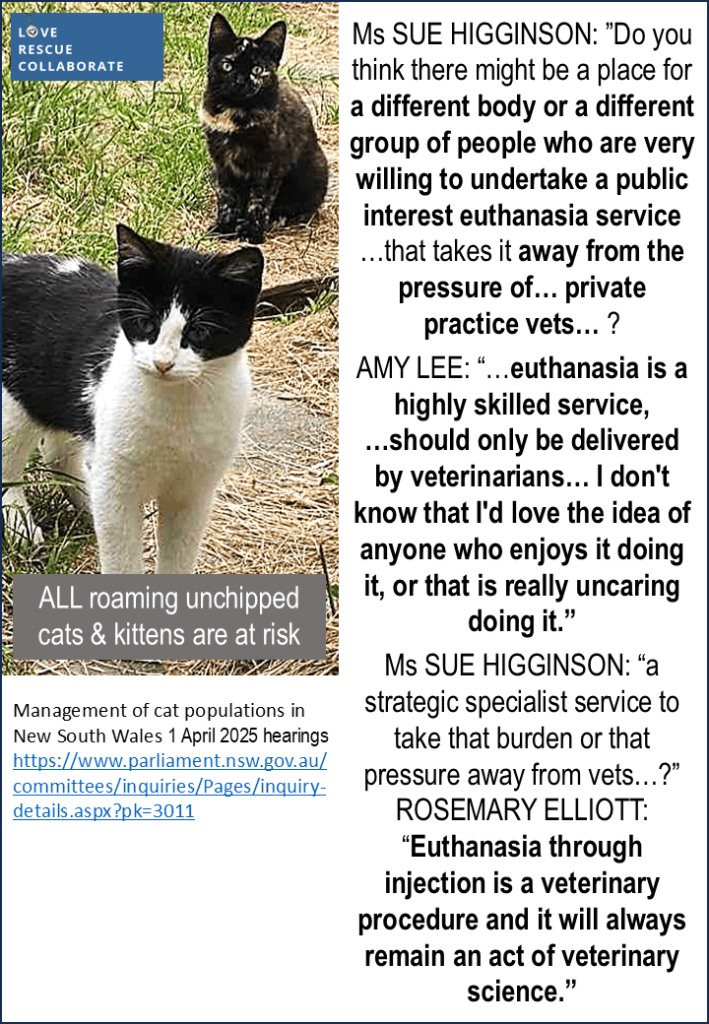
From Sue Higginson’s comments during the Inquiry hearings, it appears there is a Greens NSW aim to target all roaming unchipped cats for mass euthanasia, in a manner potentially different to current humane standards by professional vets under our councils.
A traditional mass euthanasia approach by council pounds takes our animal welfare system back decades.
The Inquiry included evidence that these traditional culling methods are not effective.
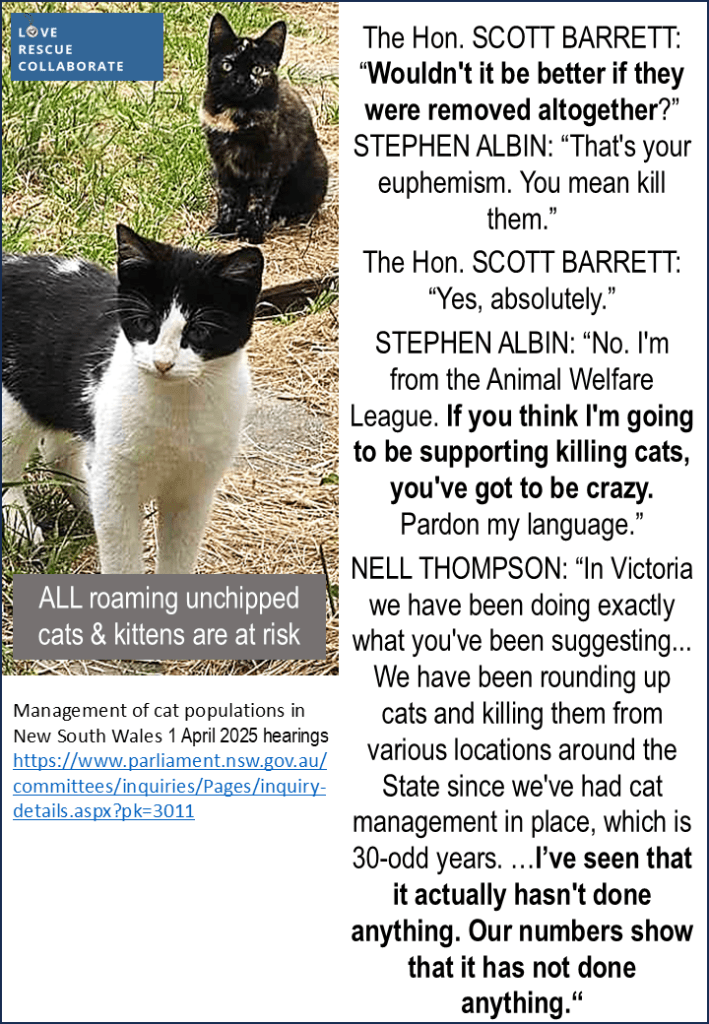
The focus on mass culling cats appears strongly supported by Scott Barrett committee representative at the Inquiry hearings.
Animal welfare representatives at the hearing did not agree with culling roaming cats and were concerned about this focus. The approach of mass culling has not been effective including when triggered by mandatory cat containment under a cat management approach in urban and peri urban areas.
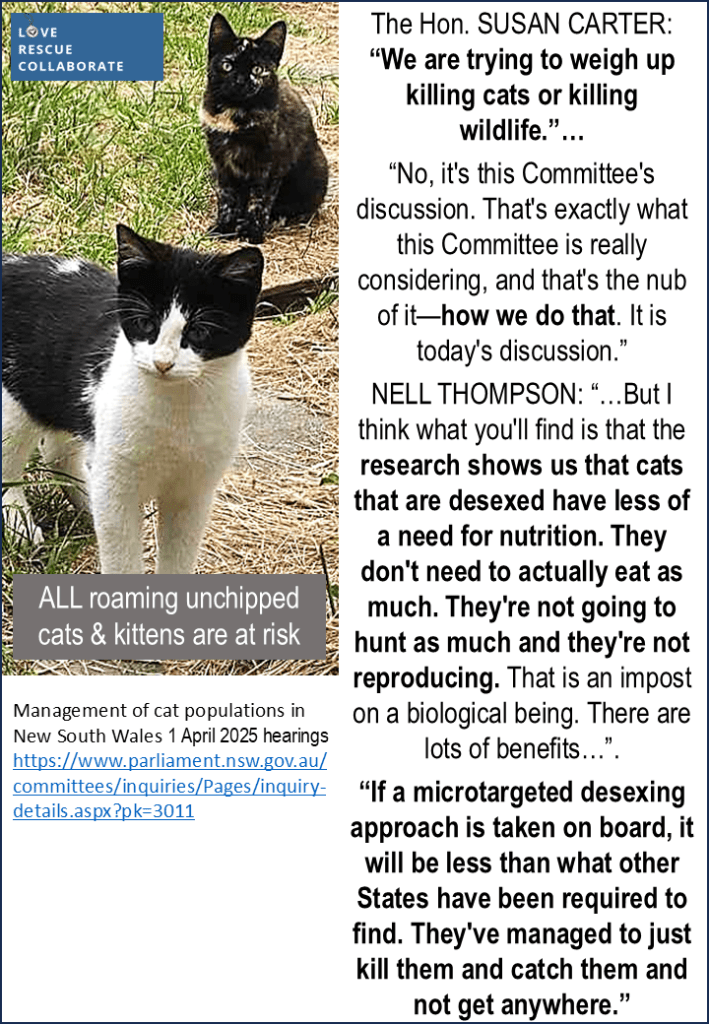
It appears the focus on mass culling cats was also supported by Sue Cater committee representative at the Inquiry hearings, and clearly not open to seeking a balanced approach and outcomes.
At the Inquiry, a number of animal welfare experts provided proven examples of the success of targeted domestic cat desexing programs which minimise cat populations and impacts to wildlife.
Funding for desexing programs is justified on a cost/benefit assessment, and if considered less cost than other negative approaches.
Greens NSW bill motivated by questionable generic wildlife impacts, while Inquiry evidence indicates more research is required for domestic cat impacts in specific conditions and target areas
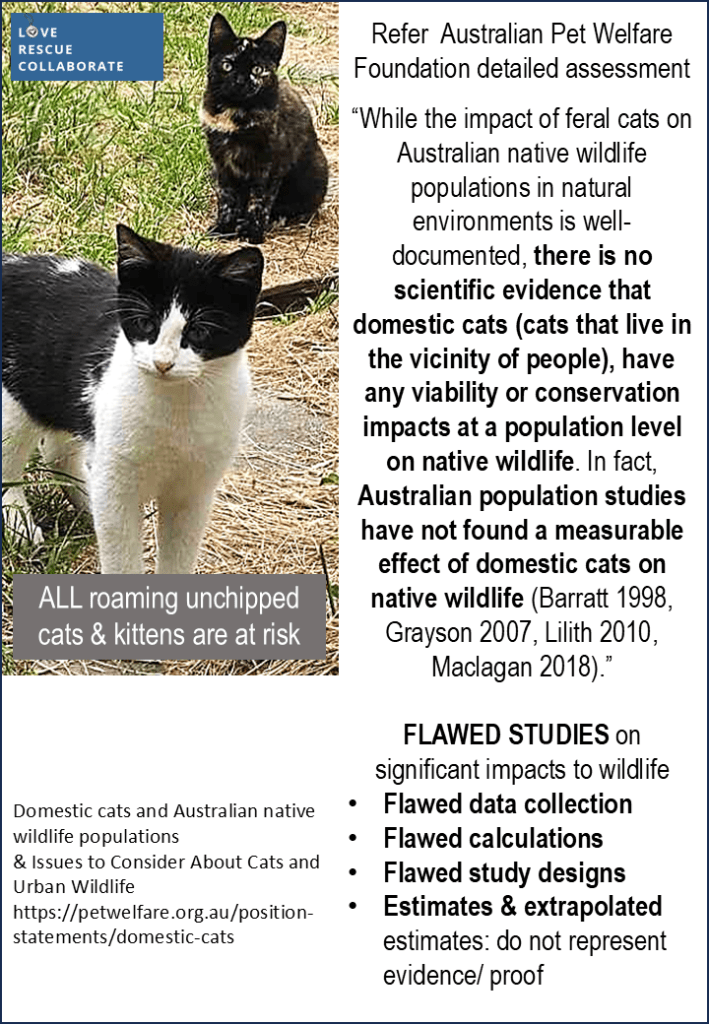
Policy should be formed from science and not politics, nor fear.
The often quoted, dramatic wildlife impacts of domestic cats are derived from studies which have been analysed which identified a number of flaws and issues.
The most significant concern is that there have been few Australian based scientific studies on domestic cats, which has been augmented by many questionable assumptions based on feral cat research and selected studies from other countries.
The range of flaws and issues highlight the limitations of the to-date studies with domestic cats in urban and peri urban areas.
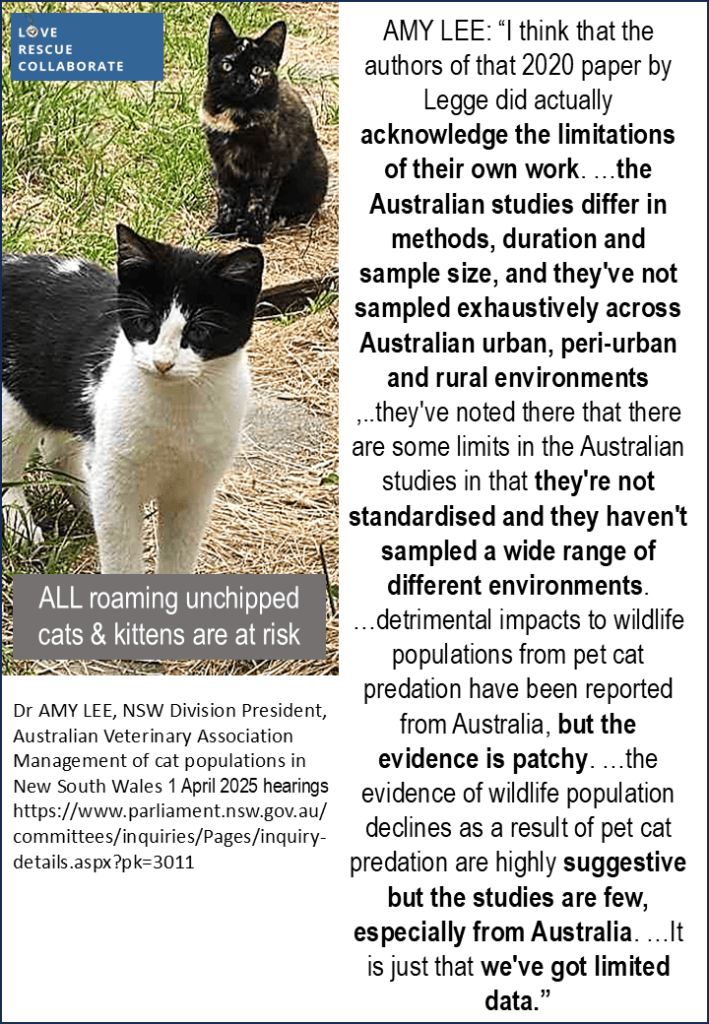
A number of animal welfare representatives are aware of the questionable cat impacts to wildlife.
Currently the flawed estimated impacts are applied uniformly across our nation and not tailored for the lack of native habitat conditions or wildlife densities in different cities, towns or Local Government Areas (LGAs).
It is not unusual for the national overstated estimates to be quoted at state/ territory level or even separate LGAs to incentivise the need for harsh treatment of all cats.

WIRES provided their view that other factors such as habitat loss have a worse impact to wildlife than cats. This aligns with Australia’s State of the Environment Report 2021) https://soe.dcceew.gov.au/biodiversity/key-findings.
“Habitat loss and clearing has caused the extinction of 62 Australian terrestrial species since European colonisation” https://www.dcceew.gov.au/sites/default/files/documents/6.%20DCCEEW-SOE_factsheet_Habitat%20and%20Natural%20Capital.pdf
The Greens NSW bill directly aimed at cats is being justified by dramatic impacts to wildlife which have not been justified in urban and peri urban areas of significantly compromised native habitat and native species.
During the Inquiry:
- commitment to wildlife was shared by animal welfare organisations and advocates; and
- a number of animal welfare advocates raised the need for more targeted Australian based domestic cat research to provide specific impacts to prioritise the areas of concern and to tailor and design appropriate and effective responses at a local level.
Greens NSW bill dismisses Inquiry evidence for voluntary cat containment rapidly increasing with education & change programs, and evidence for mandatory containment not being effective
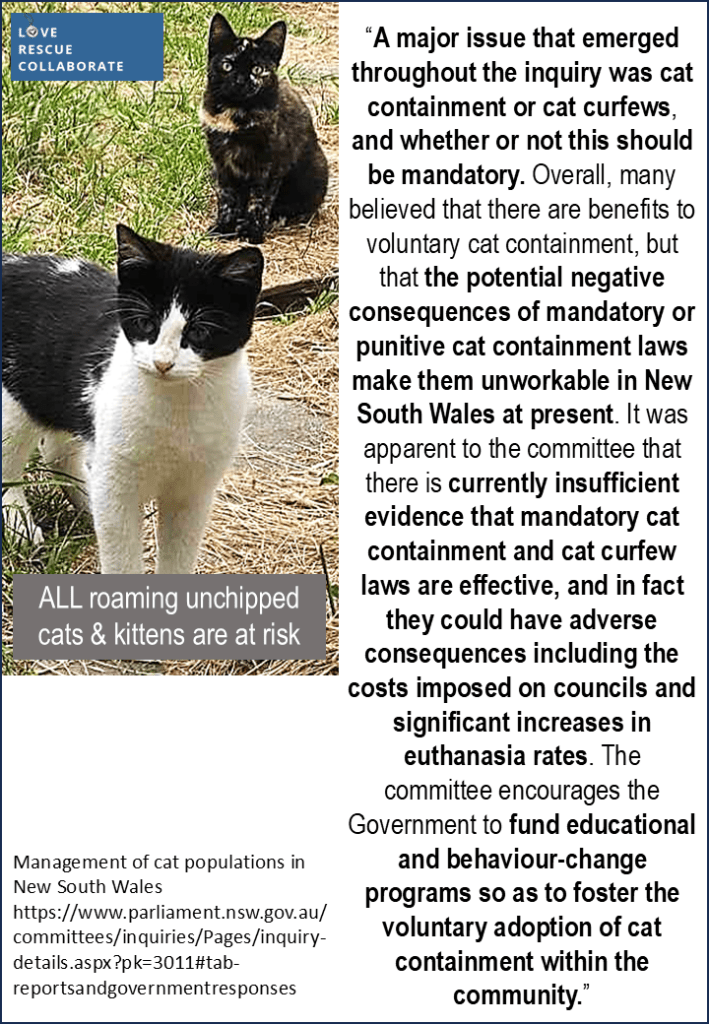
During the Inquiry, containment was supported by many, research was provided on the effectiveness of human change approaches to rapidly increase uptake of cat containment, and evidence was provided where mandatory containment was not being effective and was costly.
Cost of living pressures mean more cats are being abandoned and adoption rates have dropped significantly. The council pounds and animal welfare shelters are limited in capacity and resources. There is a significant burden on volunteer community cat rescuers and carers.
These and other factors were included in the NSW Inquiry which advised against supporting mandatory containment at this time due to negative consequences and costs, and included evidence on the success of increasing voluntary containment with positive and proactive education initiatives.

RSPCA NSW provided evidence from their Keeping Cats Safe at Home program across a number of NSW councils for its effective improvements with desexing, resulting in reducing cat nuisance complaints, impound numbers, and in increasing cat containment across NSW.
These desexing programs were accompanied with a range of human behaviour change program initiatives.
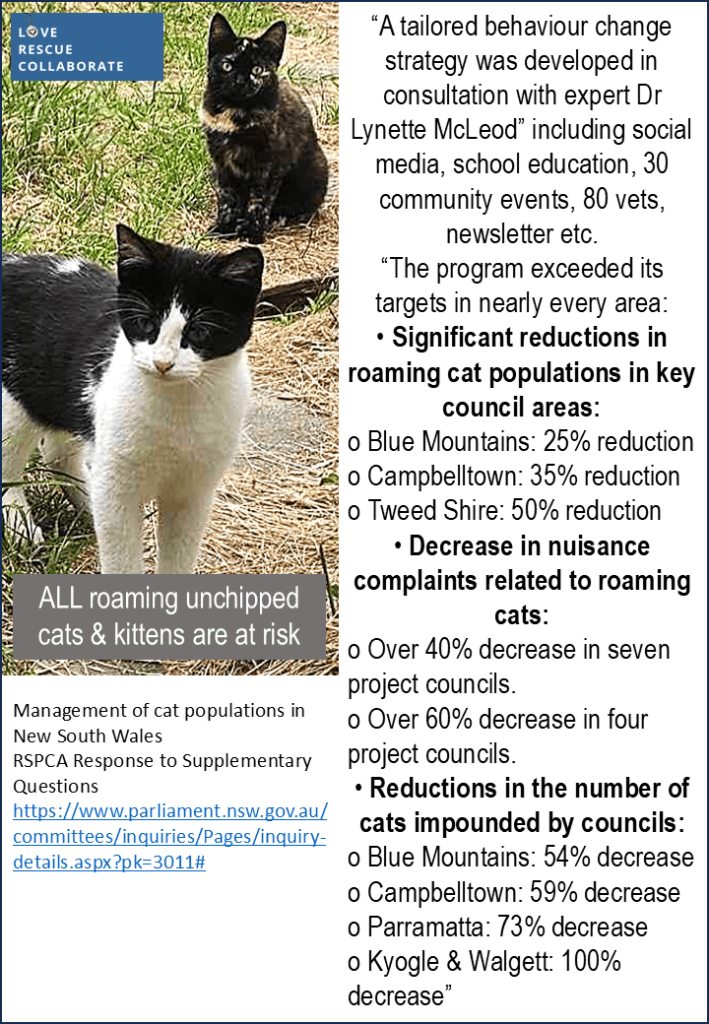
The Greens bill is contrary to the proven proactive human change program approach that rapidly increased cat containment across NSW, which was comprised of a range of proactive engagement activities developed with science
The RSPCA NSW achieved these results without punitive legislation, fines and penalties to cat owners.
RSPCA NSW provided information to the Inquiry in their submission, at the hearings, and further documents in relation to the Questions on Notice and Supplementary Questions. The latter was requested in response to a specific criticism by another hearing attendee, which the RSPCA NSW considered to “grossly misrepresents the program’s scope, activities, and outcomes”.
Greens NSW bill ignores that negative propaganda & mandatory containment influences increasing cruelty to cats
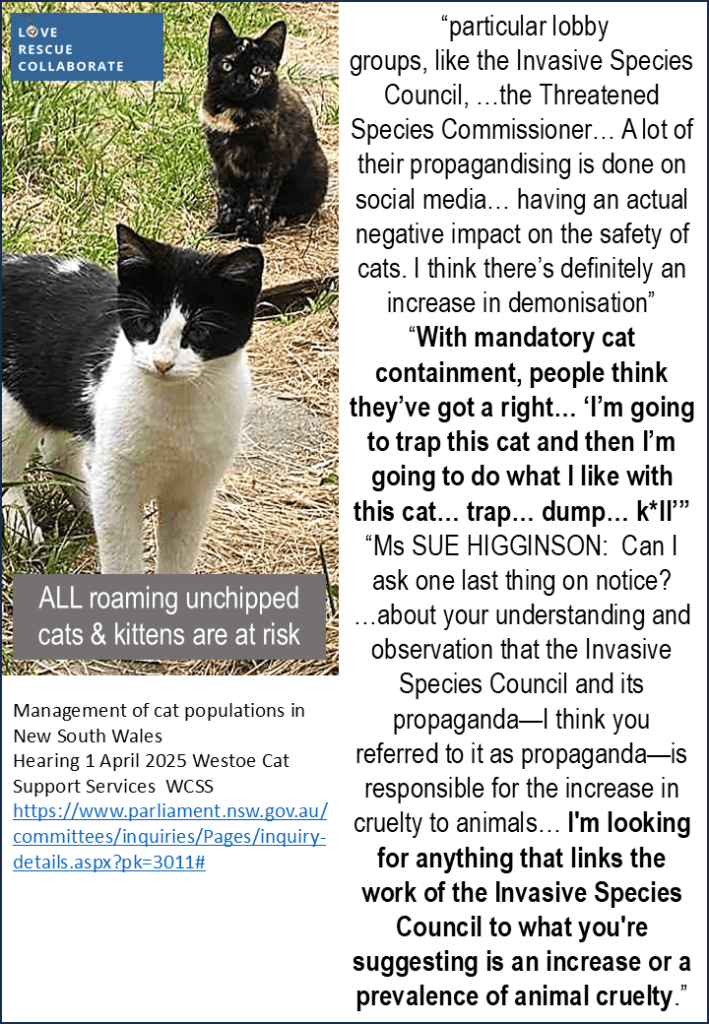
The significant concern for increasing cruelty towards cats was raised during the Inquiry, which is predominantly delivered from wildlife lobby groups demonising all cats, and then in response, community members expressing anger about roaming cats as they are certain the cats should already be contained.
The Sue Higginson requested evidence about the work of Invasive Species to the increase or prevalence of animal cruelty to cats as a Question on Notice following the hearing 1 April 2025.
The Greens NSW representatives, and presumably all committee members, received a documented set of examples indicating the trail similar to a waterfall of repetition of overstated misleading information from Invasive Species webpages and social media, that was negatively enhanced by other parties.
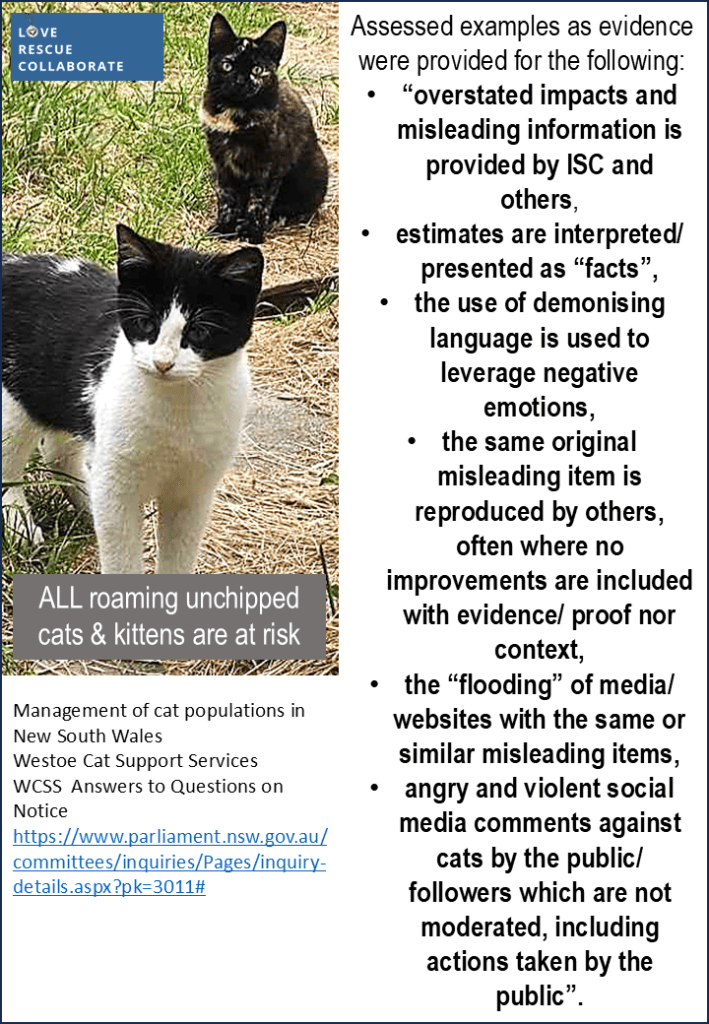
This trail of traditional and social media items, results with the internet being flooded with adverse views on all cats, which then affects search engines and Artificial Intelligence (AI) interpretations that are not able to discern quality versus flawed (shaky science) information.
Many cases of animal cruelty include justification of pet cats not staying on their own properties, e.g. Coffs Harbour. Recently in Sydney and Goulburn, there are repeated incidents of cats taken from their own properties to be harmed, and likely tortured, and killed. Current NSW Prevention of Cruelty to Animals legislation and funding is not adequate to address many of these cases where just boasted on social media with minimal evidence or where children are involved.
The Greens bill shows inadequacies and a lack of social licensing for the impacts of mandatory containment influencing cat haters to take actions into their own hands which has been seen in cat haters own social media posts on destroying cats in inhumane ways, and the inadequacies in POCTA responses to address these.
Greens NSW bill ignores and stops high intensity desexing solutions for semi owned cats, instead condemning these cats to die with trauma to semi owners
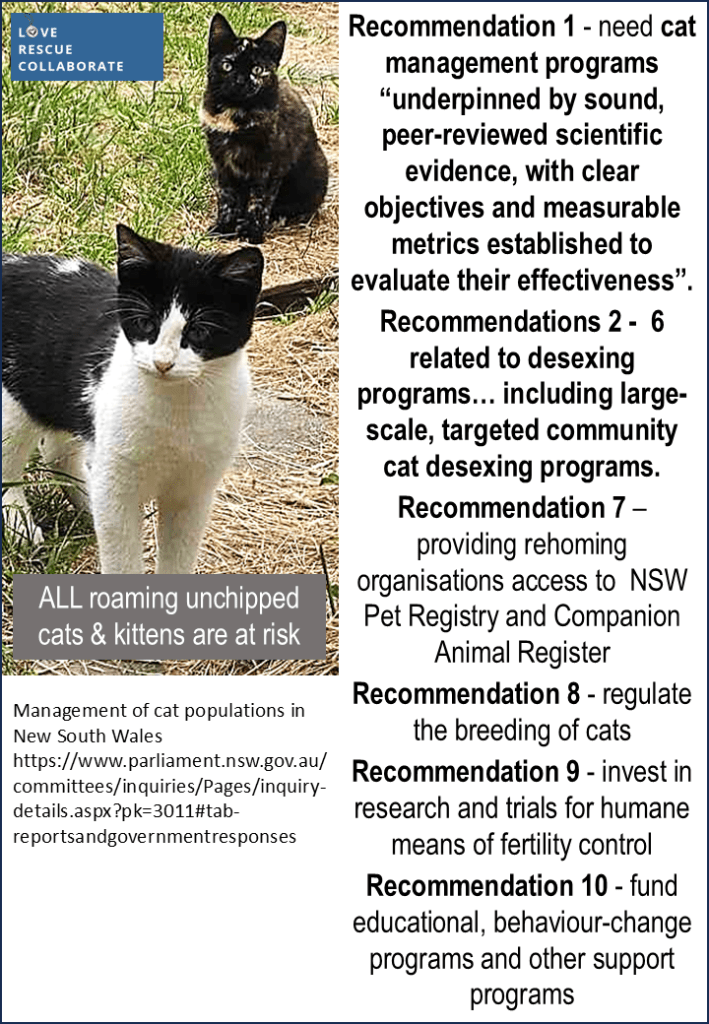
The Inquiry recommendations are underpinned by evidence of a number of successful Australian desexing programs, including those involving semi owned cats were provided to the Inquiry in submissions, and discussed in the hearings which were attended by Greens NSW committee members.
If mandatory containment is implemented for all cats then stray or semi owned and unowned cats will be deemed “illegal”, trapped and impounded and likely euthanased ASAP.
The Greens NSW bill ignores the Inquiry findings and recommendations that were based on “sound, peer-reviewed scientific evidence etc” and is aimed at culling all roaming unchipped cats in urban and peri urban areas. This is regardless of most of these cats being under the care of a community member and/or rescuer, and the bond that will be destroyed and the trauma caused to these people.
 LRC
LRC 