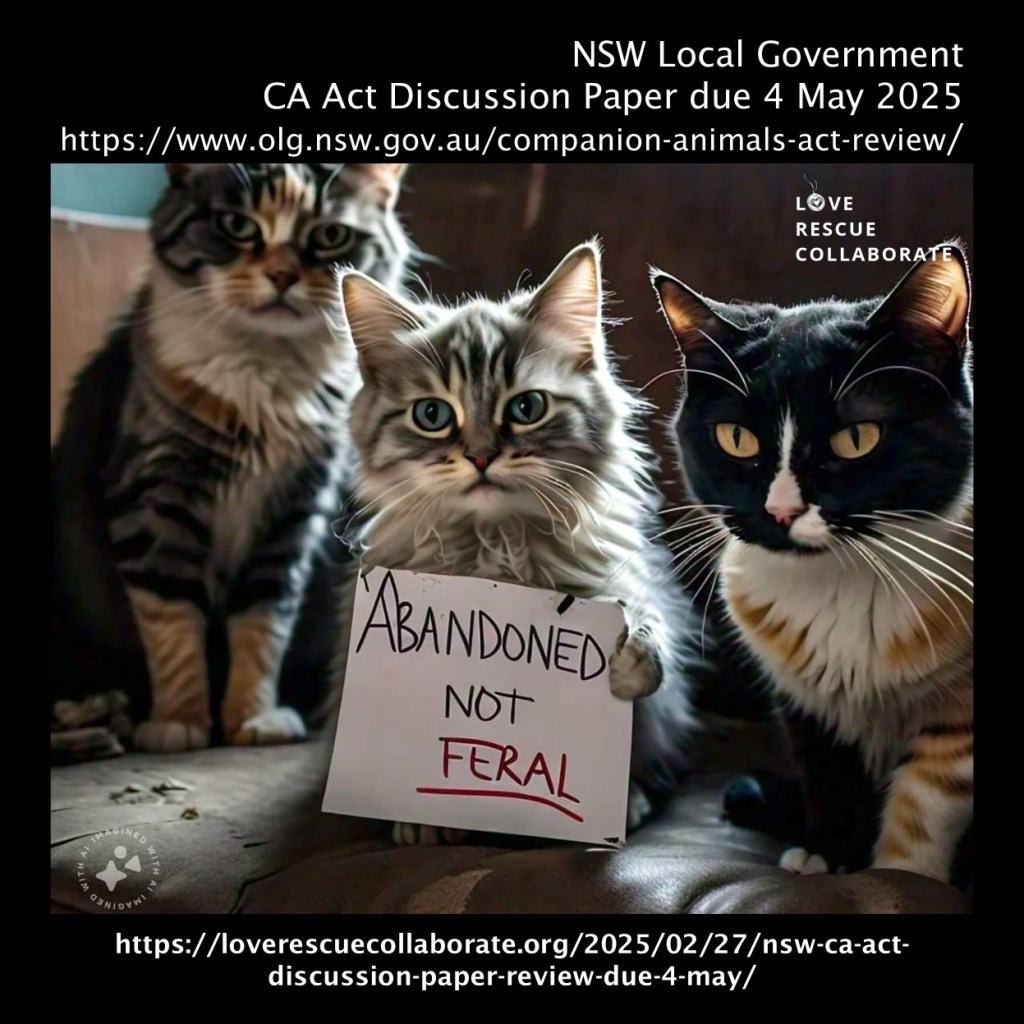
Submissions are due Sunday 4 May by 11.59pm.
“The aim is for the Act to strengthen
the social licence for keeping companion animals, while also holding pet owners accountable for the care and management of their pets. The Act must also address the urgent need to prevent companion animals from needlessly entering the council pound and rehoming system.” Discussion paper
Please note, that this blog is a WIP, adding information as developed.
Table of Contents
- NSW Companion Animal Act Discussion Paper [Copy]
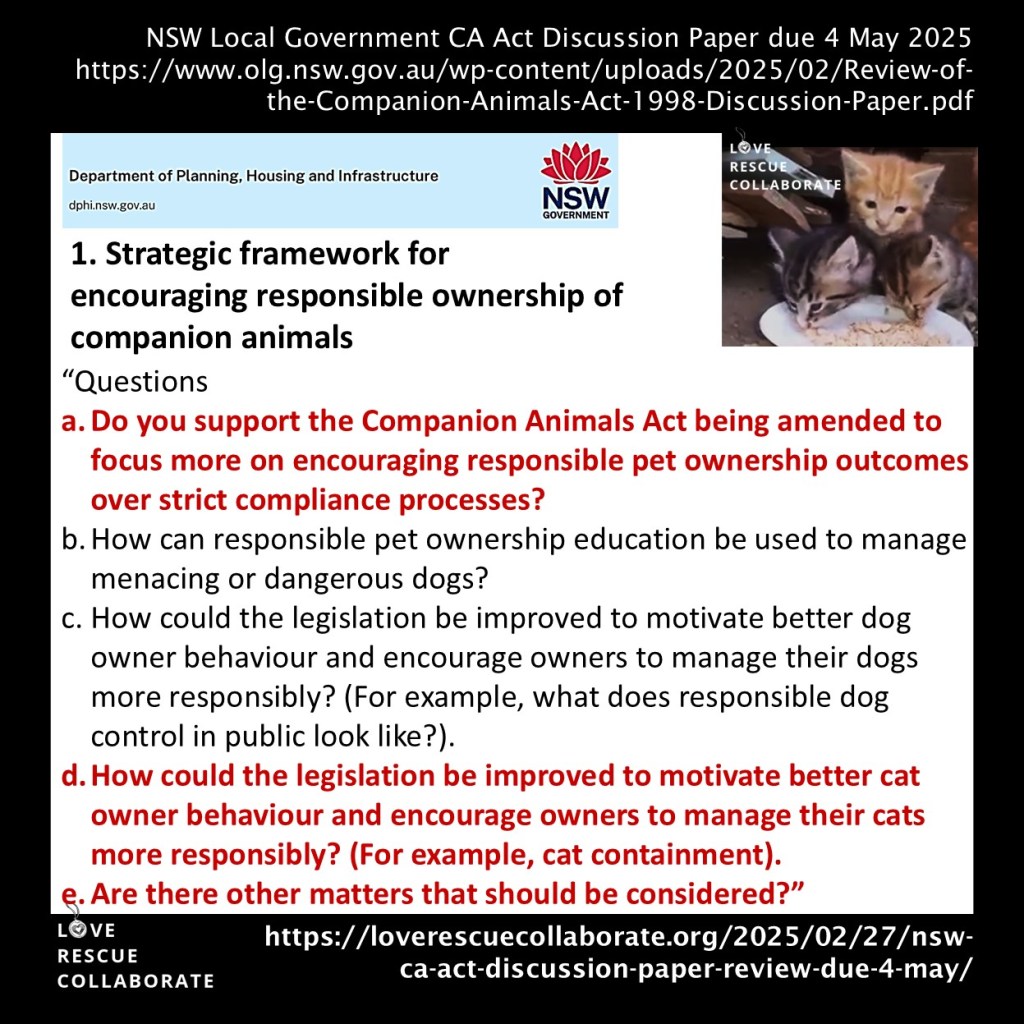
- Review questions requiring responses for cat rescuers & carers
- How to provide a submission
- Guides to concerns & recommendations to be tailored
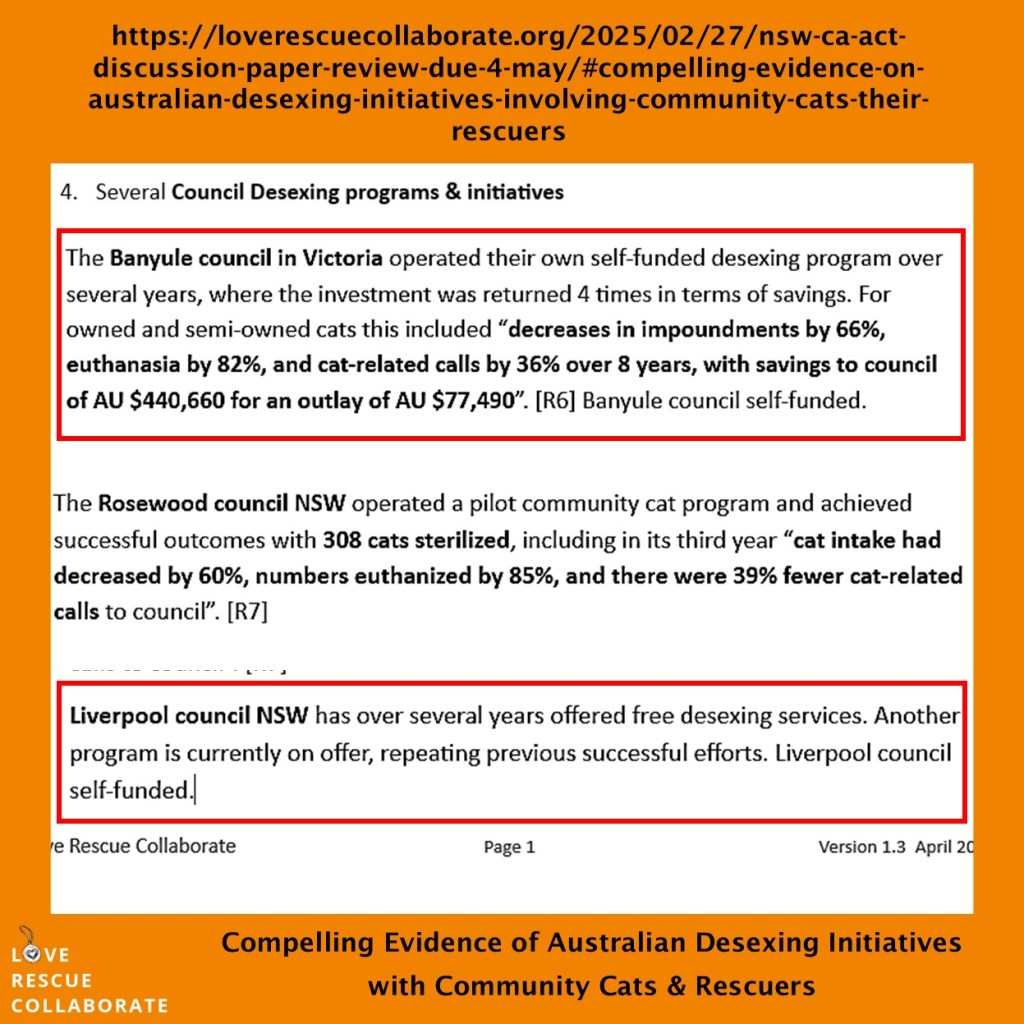
- Compelling evidence on Australian desexing initiatives involving community cats & their rescuers
- Cats and Wildlife Impacts: a reality check
- Latest research on sterilizing abandoned cats: Rethinking Urban Cat Management—Limitations and Unintended Consequences of Traditional Cat Management
- Brief bullet points for key questions [WIP]
- Q group 1: Strategic framework for encouraging responsible ownership of companion animals
- Q 1.a Do you support the Companion Animals Act being amended to focus more on encouraging responsible pet ownership outcomes over strict compliance processes?
- Q 1.b How can responsible pet ownership education be used to manage menacing or dangerous dogs?
- Q 1.c How could the legislation be improved to motivate better dog owner behaviour and encourage owners to manage their dogs more responsibly? (For example, what does responsible dog control in public look like?)
- Q 1.d How could the legislation be improved to motivate better cat owner behaviour and encourage owners to manage their cats more responsibly? (For example, cat containment).
- Q 1.e Are there other matters that should be considered?
- Q group 2: Compliance and enforcement role of councils
- Q group 3. Companion animal population and rehoming
- Q group 1: Strategic framework for encouraging responsible ownership of companion animals
NSW Companion Animal Act Discussion Paper [Copy]
This review follows three inquiries.
Veterinary workforce shortage in New South Wales https://www.parliament.nsw.gov.au/committees/inquiries/Pages/inquiry-details.aspx?pk=2964
Pounds in New South Wales https://www.parliament.nsw.gov.au/committees/inquiries/Pages/inquiry-details.aspx?pk=2970
Management of cat populations in New South Wales https://www.parliament.nsw.gov.au/committees/inquiries/Pages/inquiry-details.aspx?pk=3011#
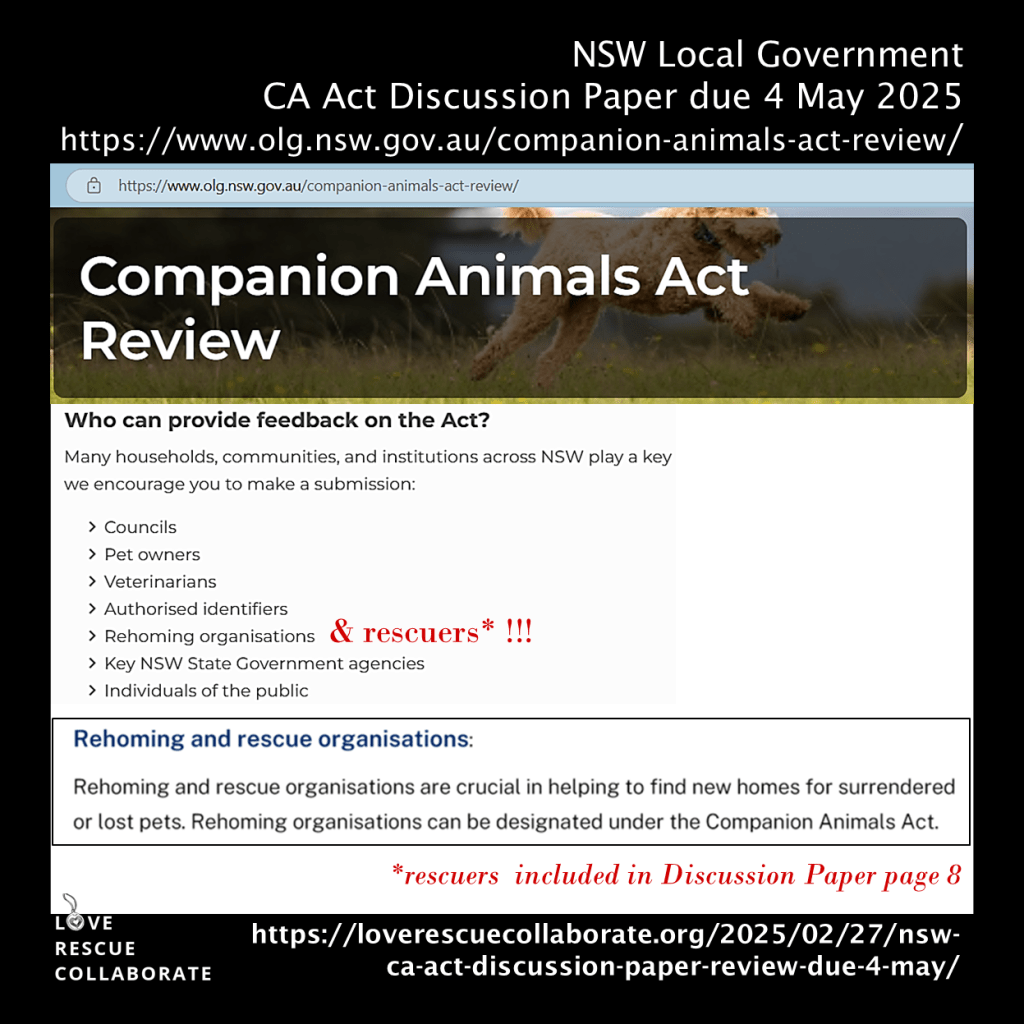
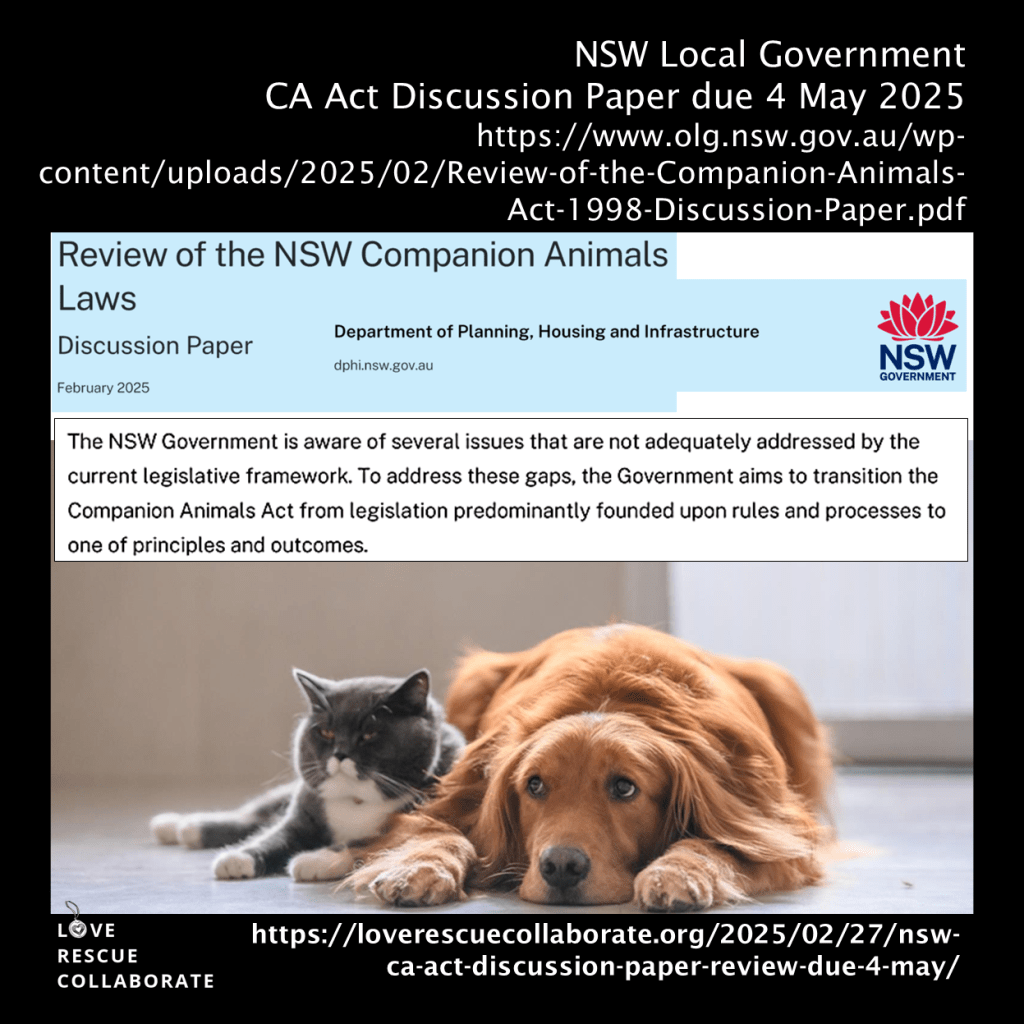
Original source: https://www.olg.nsw.gov.au/wp-content/uploads/2025/02/Review-of-the-Companion-Animals-Act-1998-Discussion-Paper.pdf
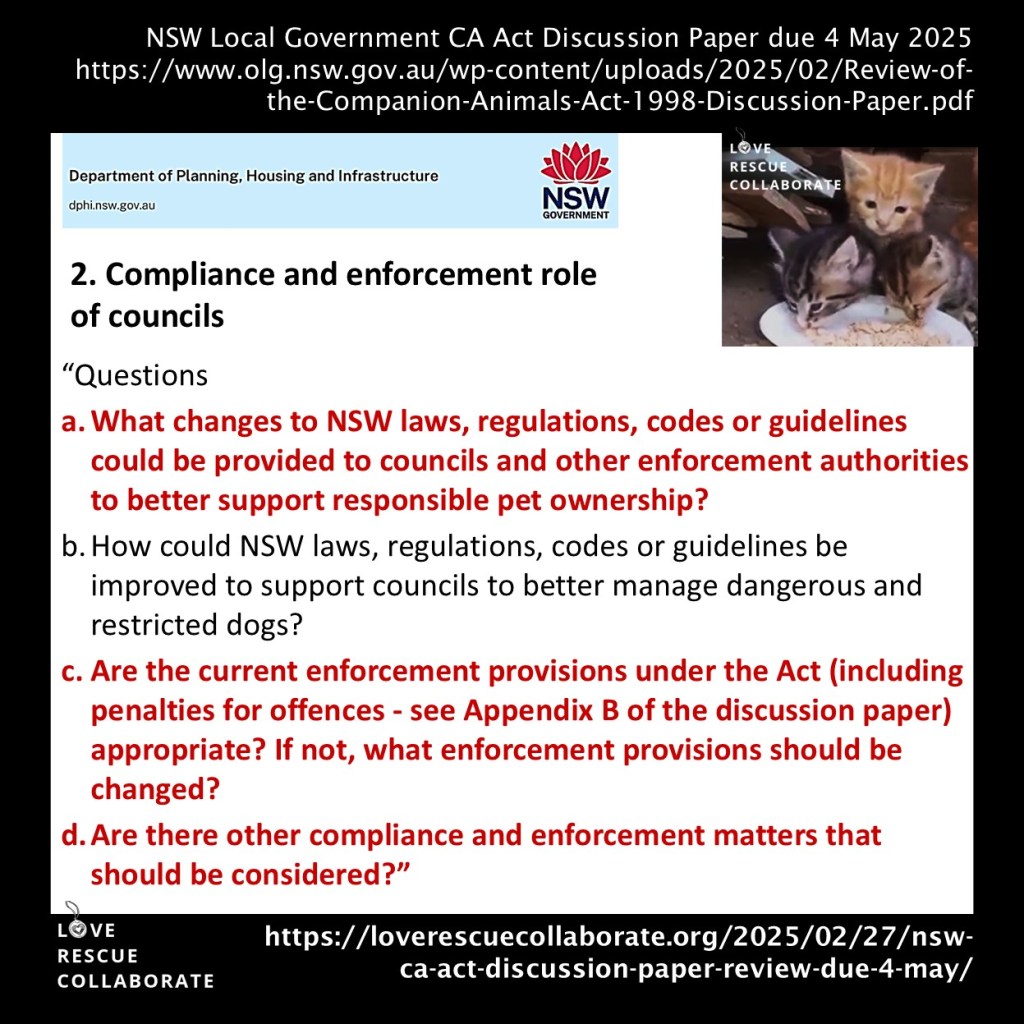
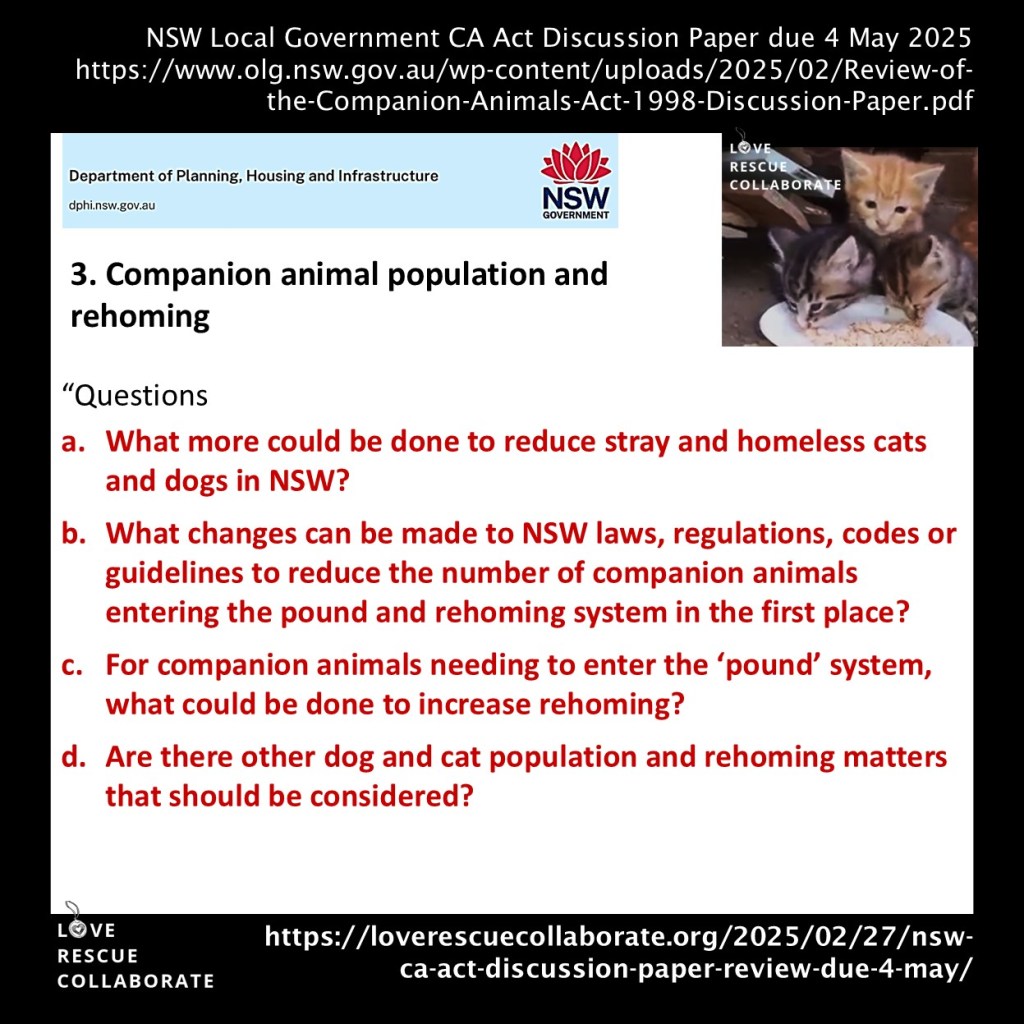
Review questions requiring responses for cat rescuers & carers
How to provide a submission
Provide a submission online
An online form is provided on the webpage, scroll down: https://www.olg.nsw.gov.au/companion-animals-act-review/
Email an edited Submission MS Word template
OR you may edit a version of the submission form and email it to ca.review@olg.nsw.gov.au
This form (MS Word doc) has been provided by the NSW government on their webpage. A copy is provided here for ease of access.
The form may be downloaded from this webpage, scroll down: https://www.olg.nsw.gov.au/companion-animals-act-review/
Guides to concerns & recommendations to be tailored
Very brief guide
Guide with reference information
APWF Draft Submission
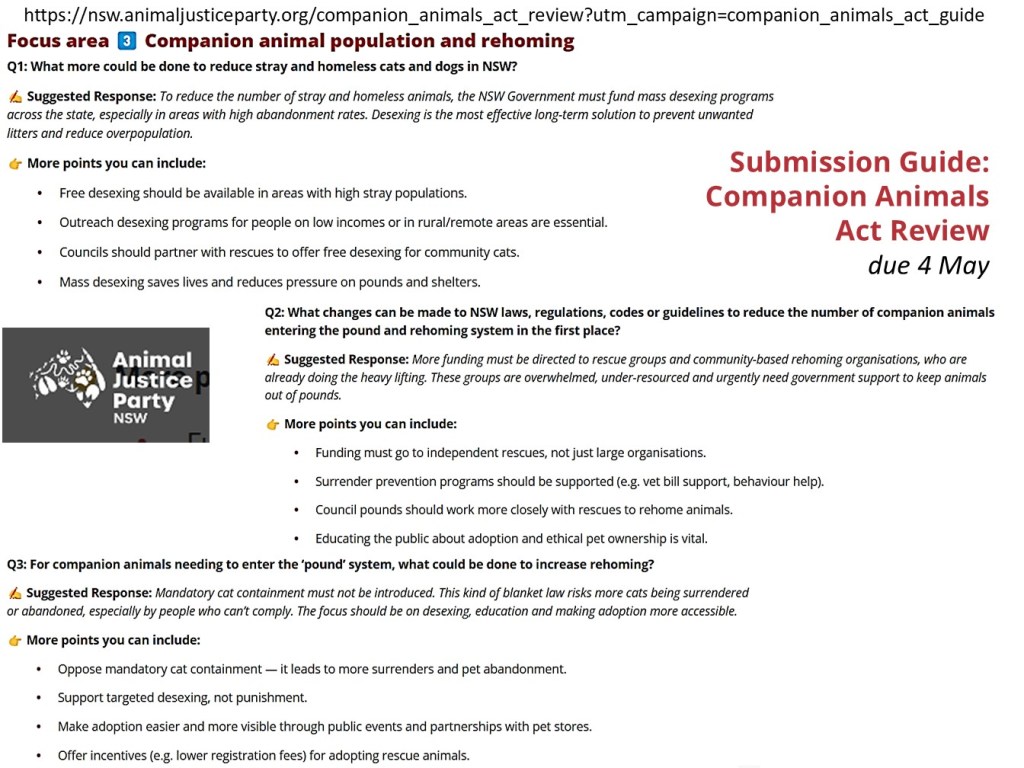
AJP Guide
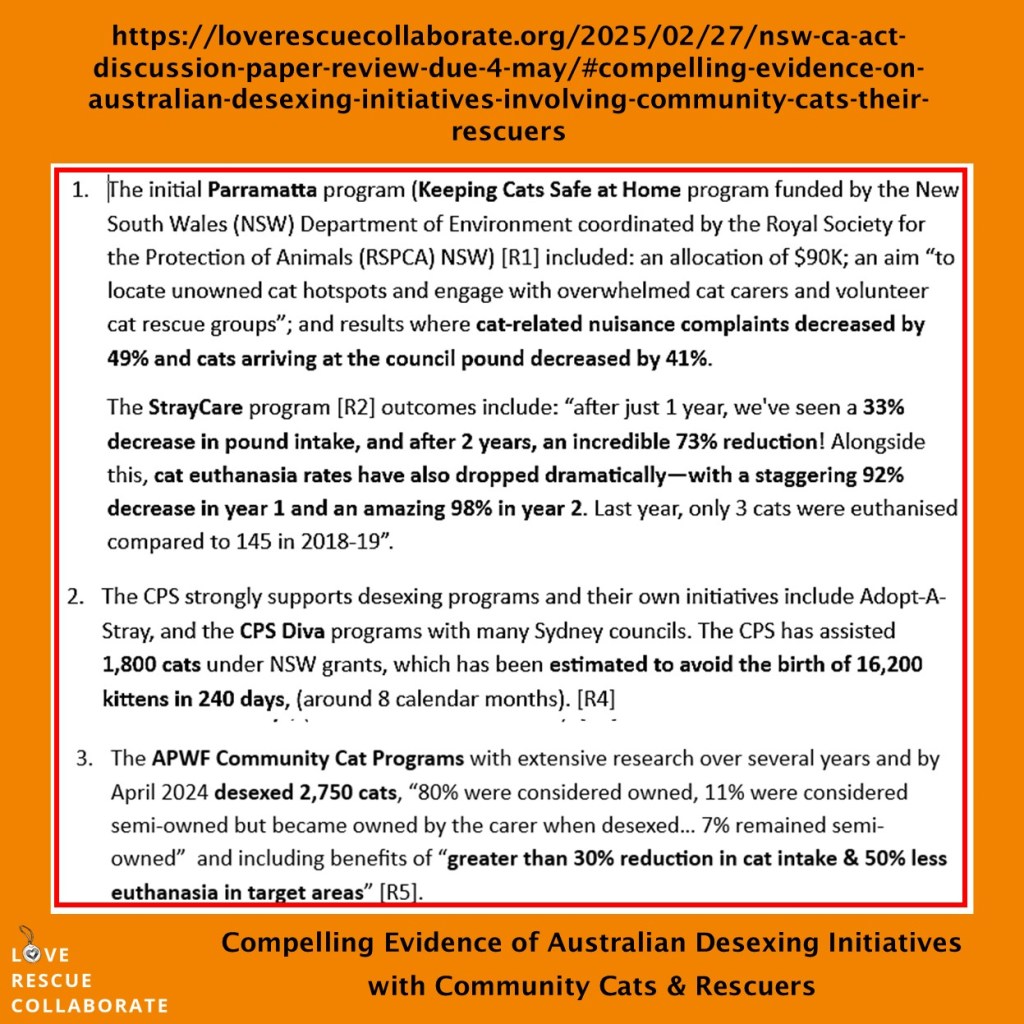
Compelling evidence on Australian desexing initiatives involving community cats & their rescuers
We provide a summary of initiatives from RSPCA NSW, CPS NSW, APWF, Banyule Council Vic, plus others and vet programs. This has been produced as a flyer which may be downloaded in PDF format.
Cats and Wildlife Impacts: a reality check
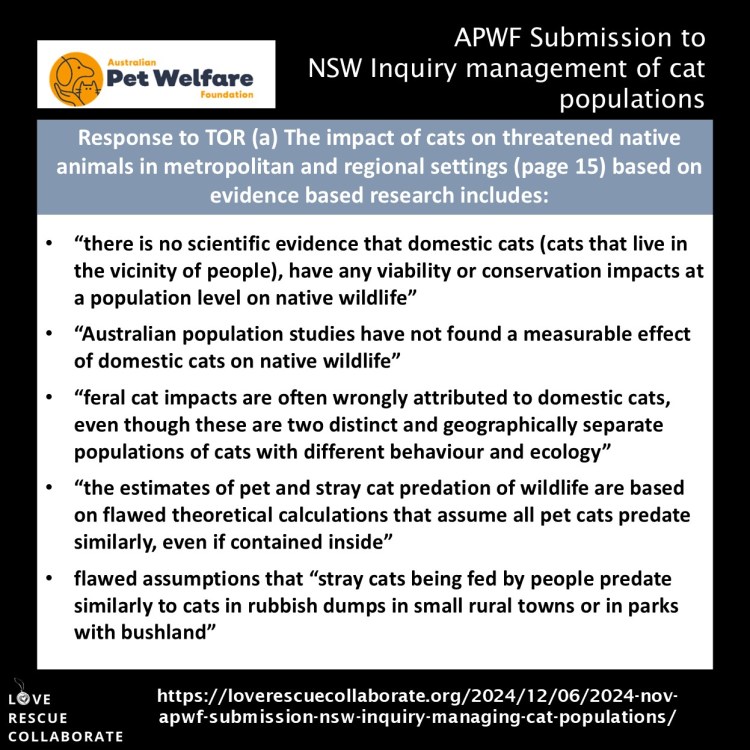
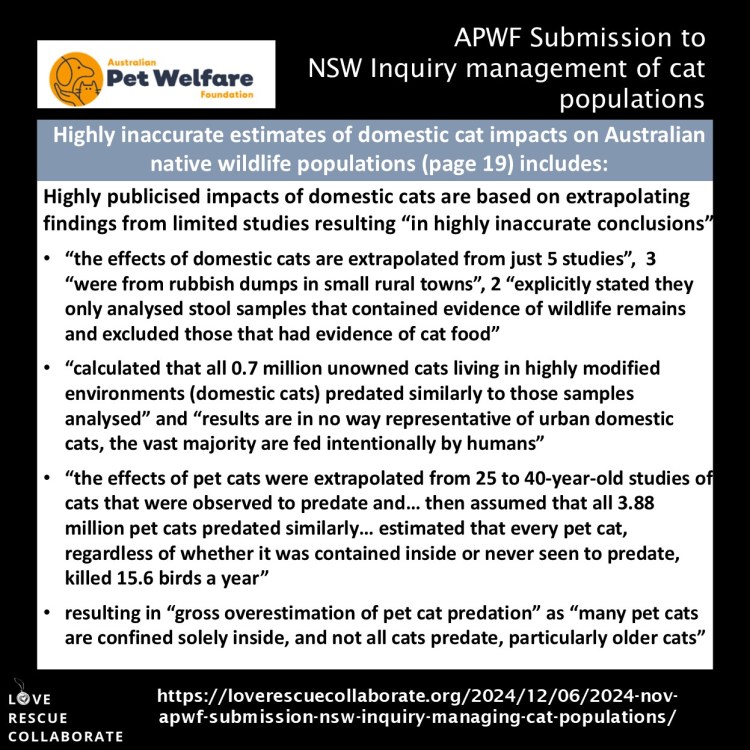
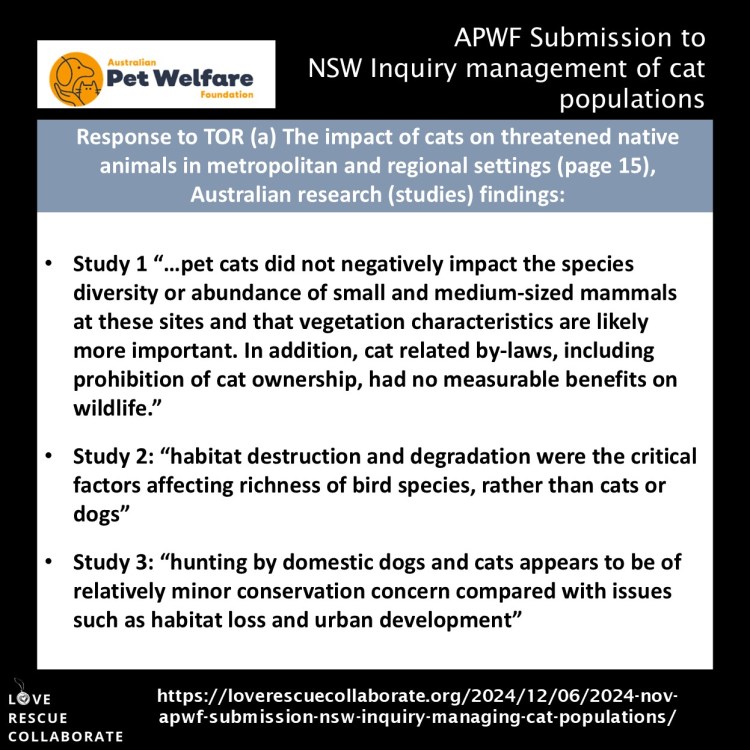
APWF Analysis & Questions re common misconceptions of numbers etc
Note, the leading explanation:
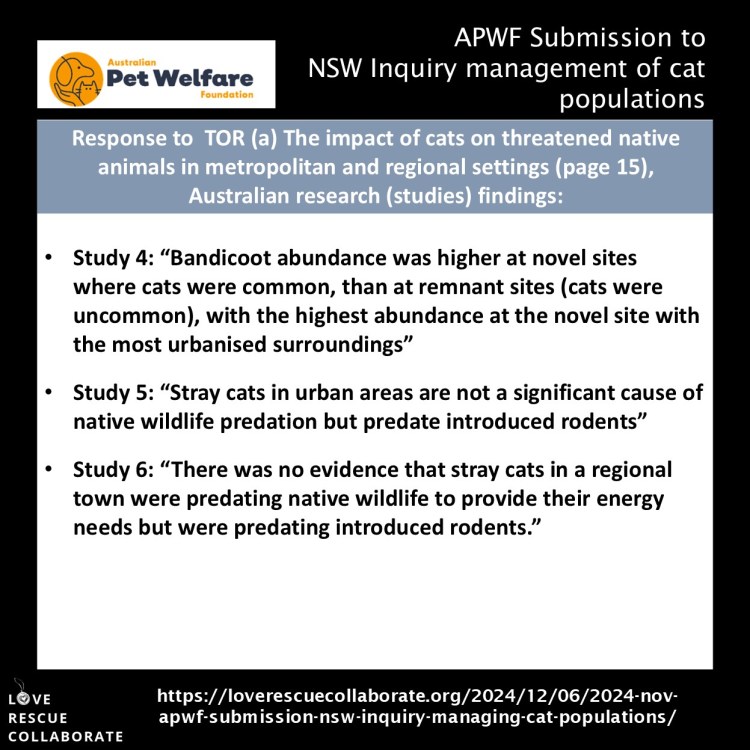
“An ongoing issue is that feral cat impacts are often wrongly attributed to domestic cats, even though these are two distinct and geographically separate populations of cats with different behaviour and ecology. In addition, the estimates of pet and stray cat predation of wildlife are based on flawed theoretical calculations that assume all pet cats predate similarly, even if contained inside, and that stray cats being fed by people predate similarly to cats in rubbish dumps in small rural towns or in parks with bushland (Woinarski 2017, Coman 1972).” APWF Inquiry into the Management of Cat Populations in NSW https://petwelfare.org.au/government-submissions
Extract from the full APWF submission:
APWF Presentation on Cats and Wildlife
LRC Summary of APWF points for questioning XXL estimates
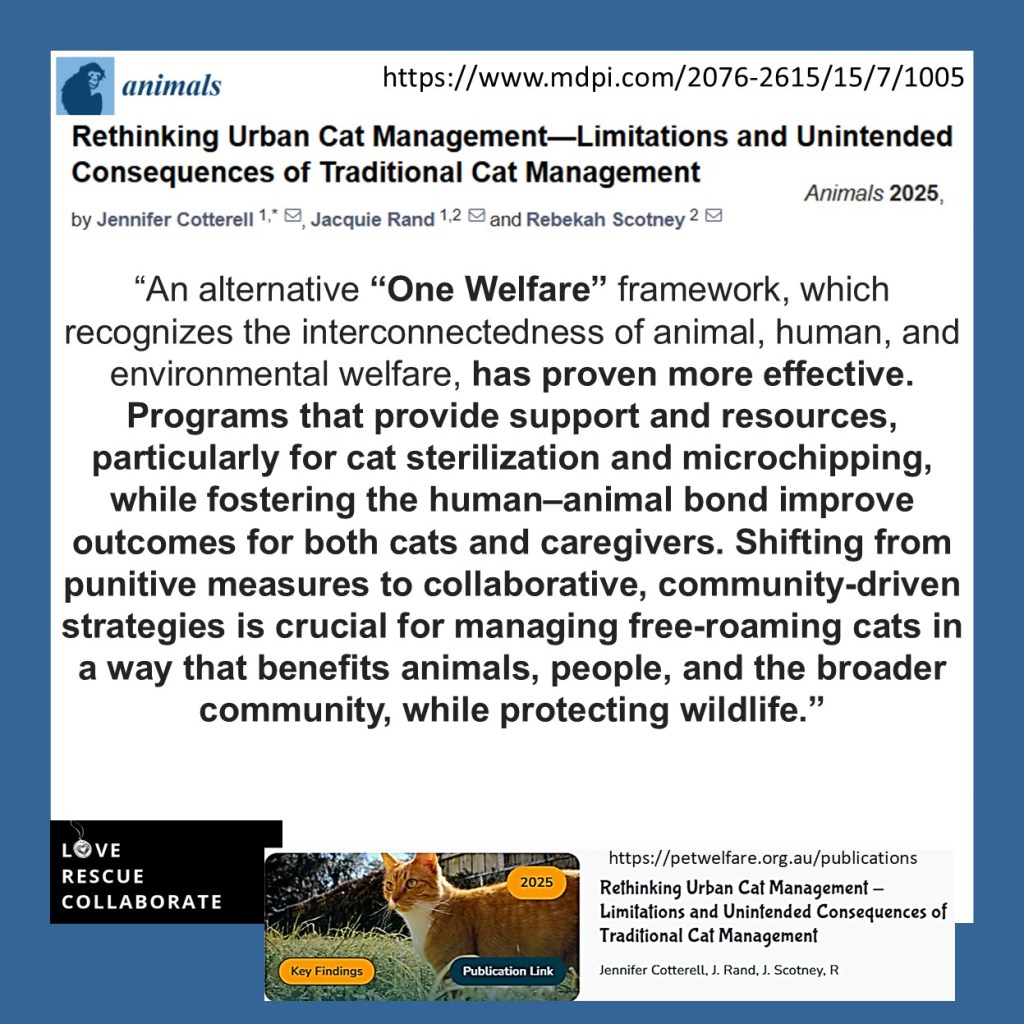
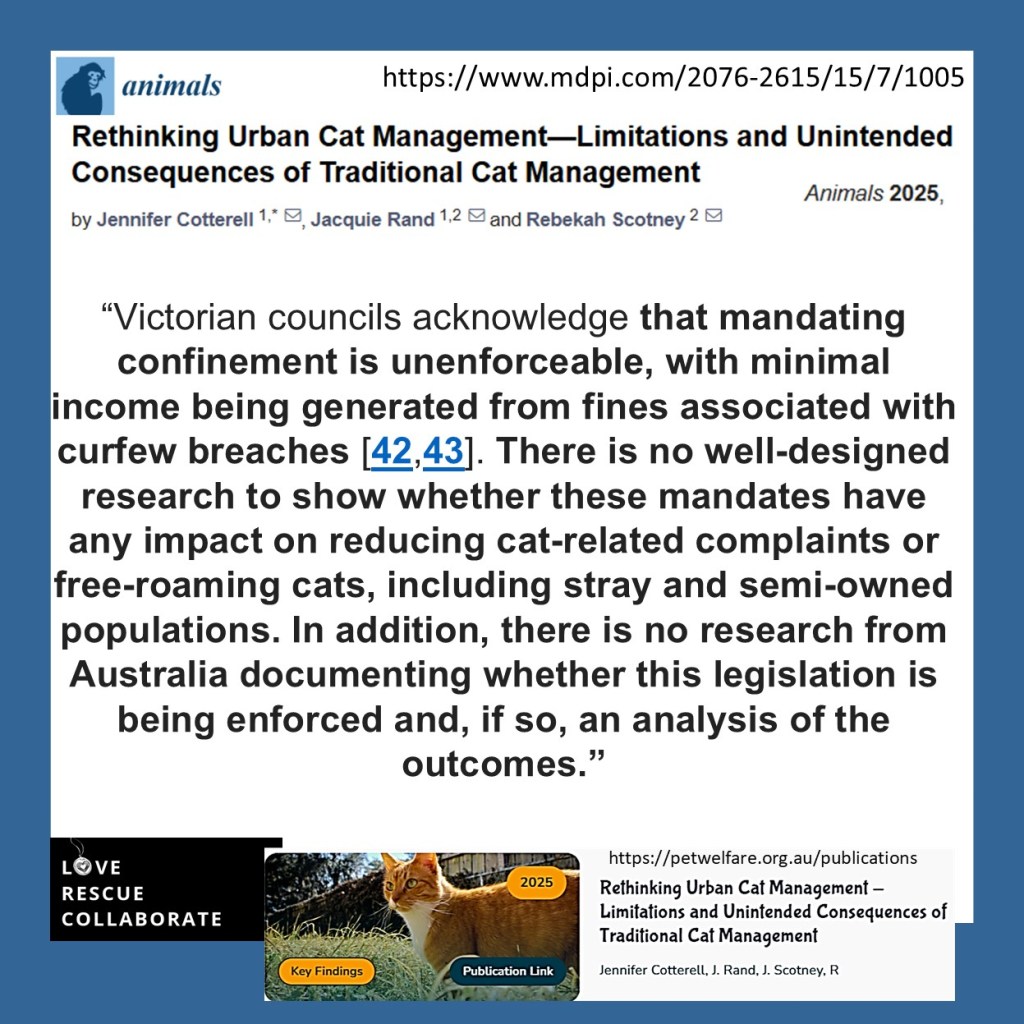
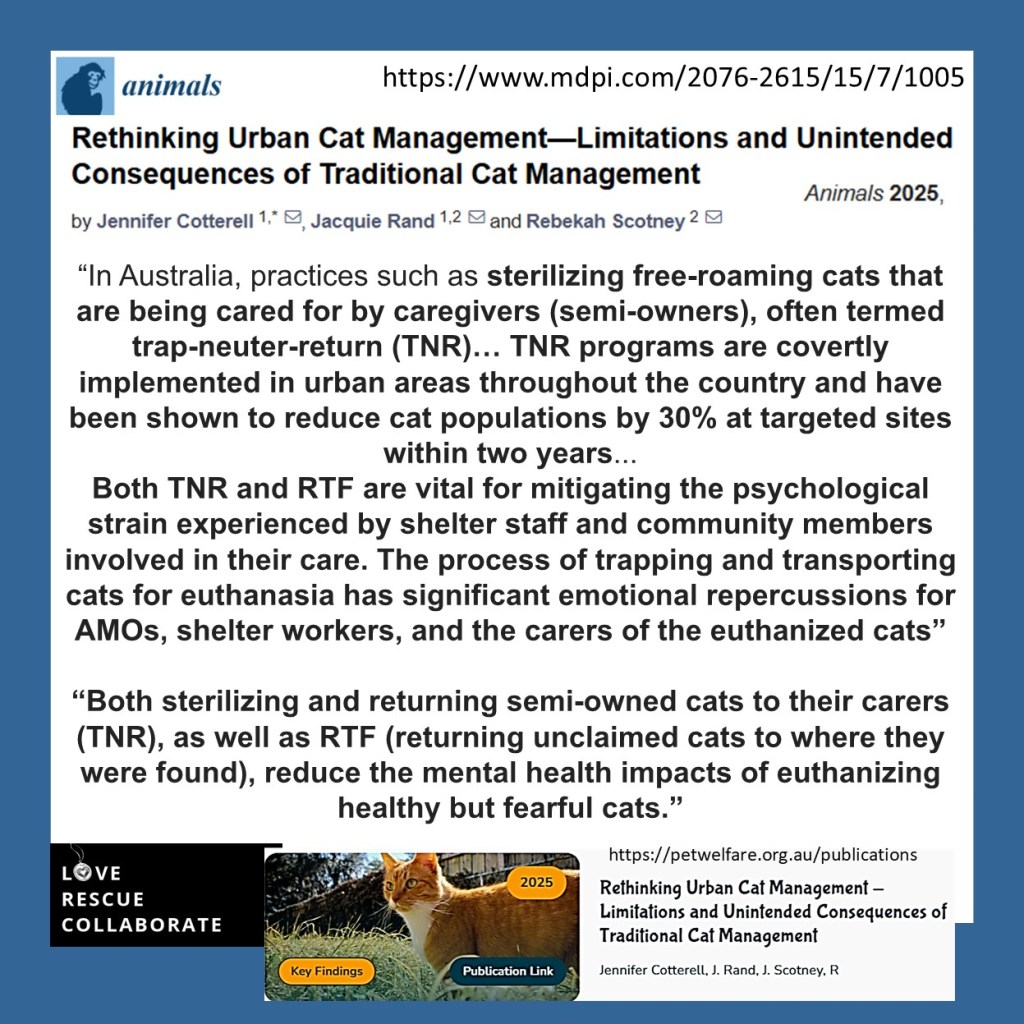
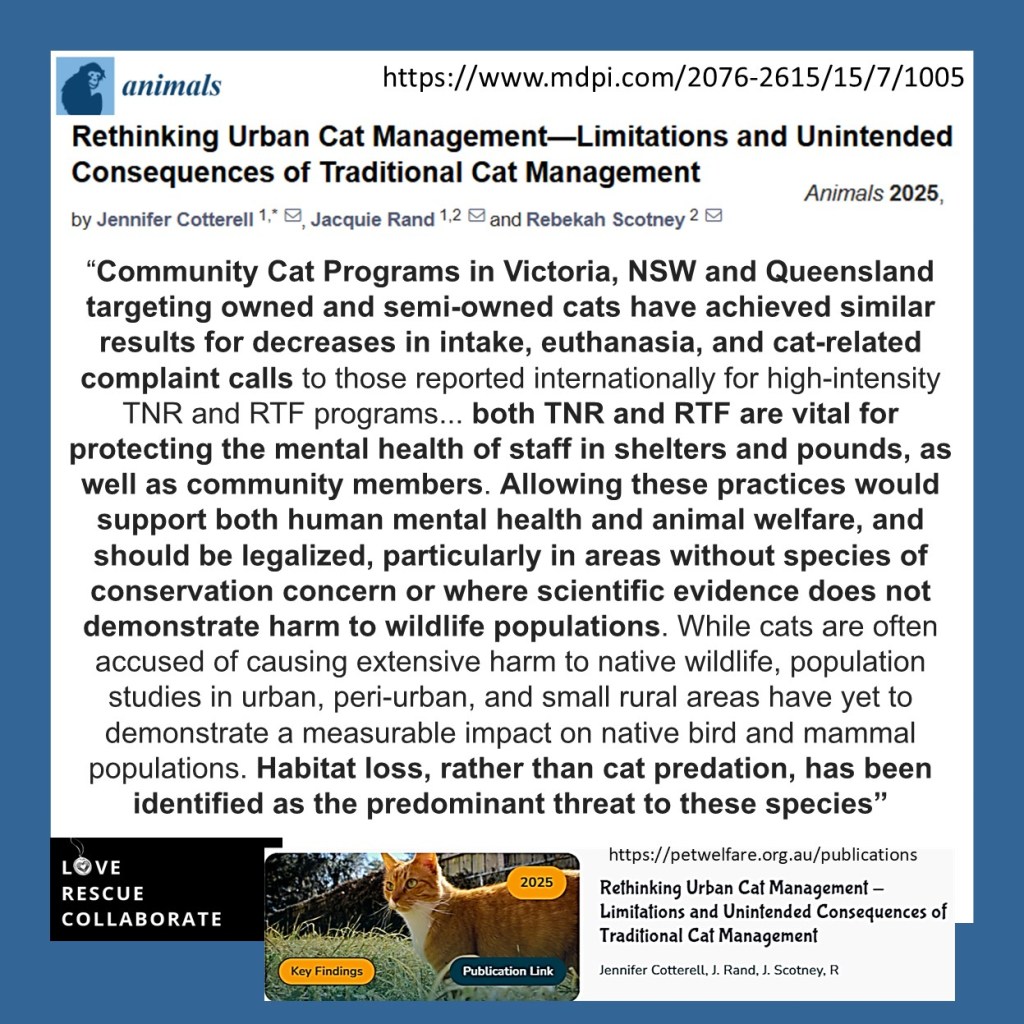
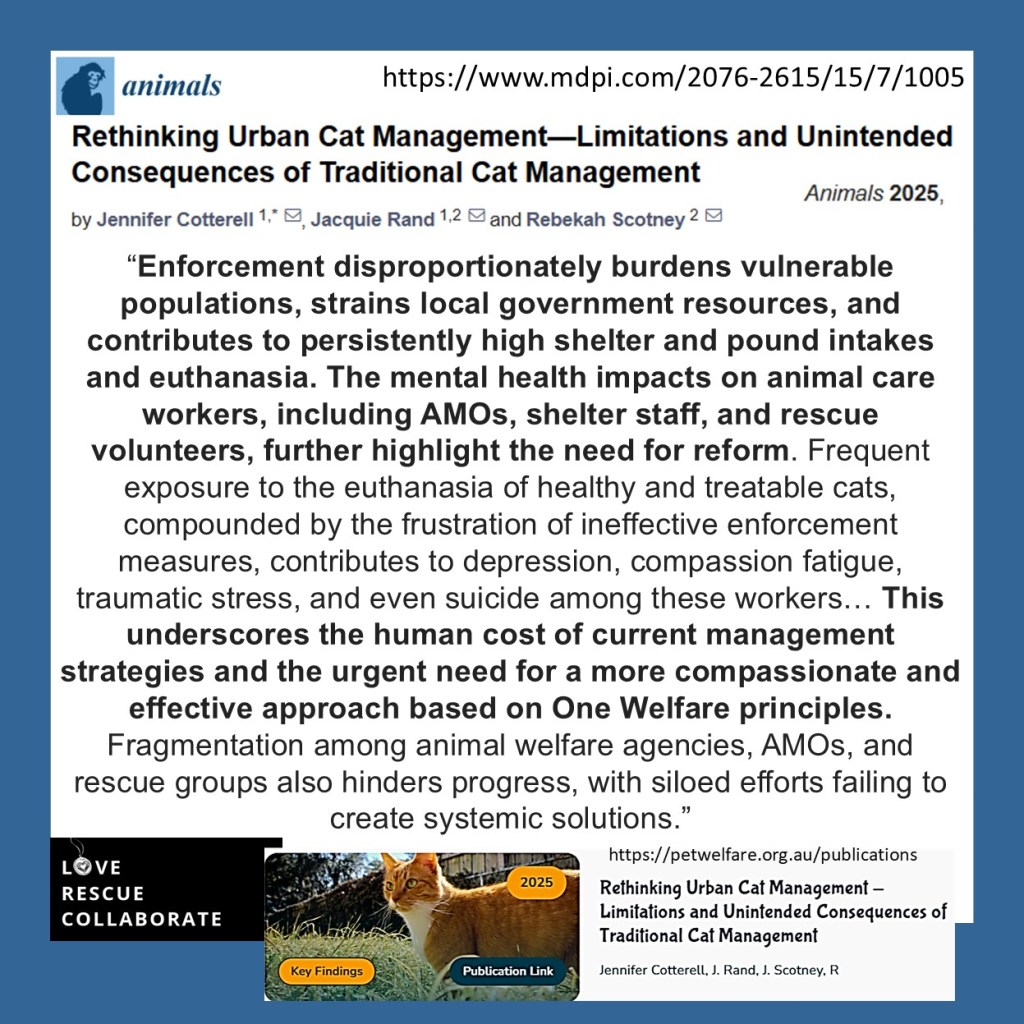
Latest research on sterilizing abandoned cats: Rethinking Urban Cat Management—Limitations and Unintended Consequences of Traditional Cat Management
This latest research brings together many key topics, such as the failures of mandatory containment and desexing, and the benefits of desexing under community cat programs including TNR and RTF. The research also recognises the impacts to all of those involved including the community and cat rescuers/carers with mental and emotional impacts, not just the council and etc staff.
https://www.mdpi.com/2076-2615/15/7/1005


Brief bullet points for key questions [WIP]
Q group 1: Strategic framework for encouraging responsible ownership of companion animals
Q 1.a Do you support the Companion Animals Act being amended to focus more on encouraging responsible pet ownership outcomes over strict compliance processes?
A proactive approach over punitive legislation is supported, However, there are significant concerns to ensure that every NSW council adheres to humane treatments for domestic cats in urban environments. Domestic cat experts should be respected and their advice incorporated. It is essential the roles of community cat rescuers and carers are included in thie framework (not just Rehoming Organisations).
[WIP]
Q 1.b How can responsible pet ownership education be used to manage menacing or dangerous dogs?
Once a dog has been declared menacing or dangerous, then training and reconditioning, and the owner’s behaviour need to be addressed under the council AMO and Police roles.
Q 1.c How could the legislation be improved to motivate better dog owner behaviour and encourage owners to manage their dogs more responsibly? (For example, what does responsible dog control in public look like?)
Similar for cats, the roles of AMO need to “grow” into proactive roles engaging with the communities face to face / on the ground. [refer APWF]
Stop Back Yard Breeding – refer Oscar’s Laws already implemented in Victoria… [tbc]
Breeders for dogs and cats need to be regulated – not self-regulated.
Dog trainers, especially for “security purposes” need to be regulated, not a self-regulated industry.
Allocate funding and more resources to dog and puppy training, which should be a mandatory activity / responsibility for dog owners.
Allocate funding and more resources to NSW Police to break illegal dog fighting rings.
Allocate funding and more resources to NSW Police to break illegal live animal baiting in the greyhound racing industry.
Q 1.d How could the legislation be improved to motivate better cat owner behaviour and encourage owners to manage their cats more responsibly? (For example, cat containment).
Mandatory containment is ineffective, and this has been proven across Victorian councils who have backed out or not taken up this policy. The costs in council staff labour (addressing complaints, intakes to pounds, high euthanasia rates) outweigh the benefits.
Better outcomes may be achieved by proactive One Welfare solutions, including funding desexing programs offered free to residents (owners and semi owners), and promoting, offering assistance with acquiring (e.g. subsidies in Bunbury and Bayside councils WA) and installing cat enclosures with advice and support from council AMOs.
Refer APWF research in this topic which is supported: Rethinking Urban Cat Management—Limitations and Unintended Consequences of Traditional Cat Management https://www.mdpi.com/2076-2615/15/7/1005
Q 1.e Are there other matters that should be considered?
Cat definitions and terms
The NSW framework needs to follow and incorporate the 2018 RSPCA definitions for feral versus domestic cats, the latter being owned, semi owned and unowned.
The NSW framework should incorporate further details definitions from APWF for…
Abandoned domestic cats are not to be treated as feral cats who are truly wild.
[APWF plus other links]
The advise of domestic cat experts needs to be followed, domestic cat knowledge and experiences are not to be defined by NSW government departments whose primary purposes ate to support primary industries or native environments.
[links]
Establish a NSW independent animal welfare officer & office
[links etc]
CA Act clause 32.1 seizing a cat
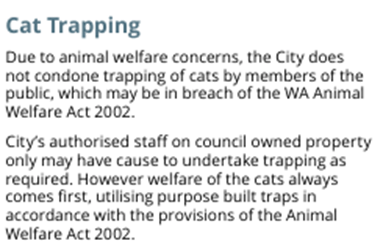
The CA Act needs to be improved to clarify the situations when and where community members may seize a cat – the current clause 32.1 is misinterpreted/misused, not controlled nor monitored, and the welfare of the cats is then not assured and at risk. Very few NSW council clarify that Rangers should be involved for nuisance calls.
“Any person may lawfully seize a cat if that action is reasonable and necessary for the protection of any person or animal (other than vermin) from injury or death” https://legislation.nsw.gov.au/view/whole/html/inforce/current/act-1998-087
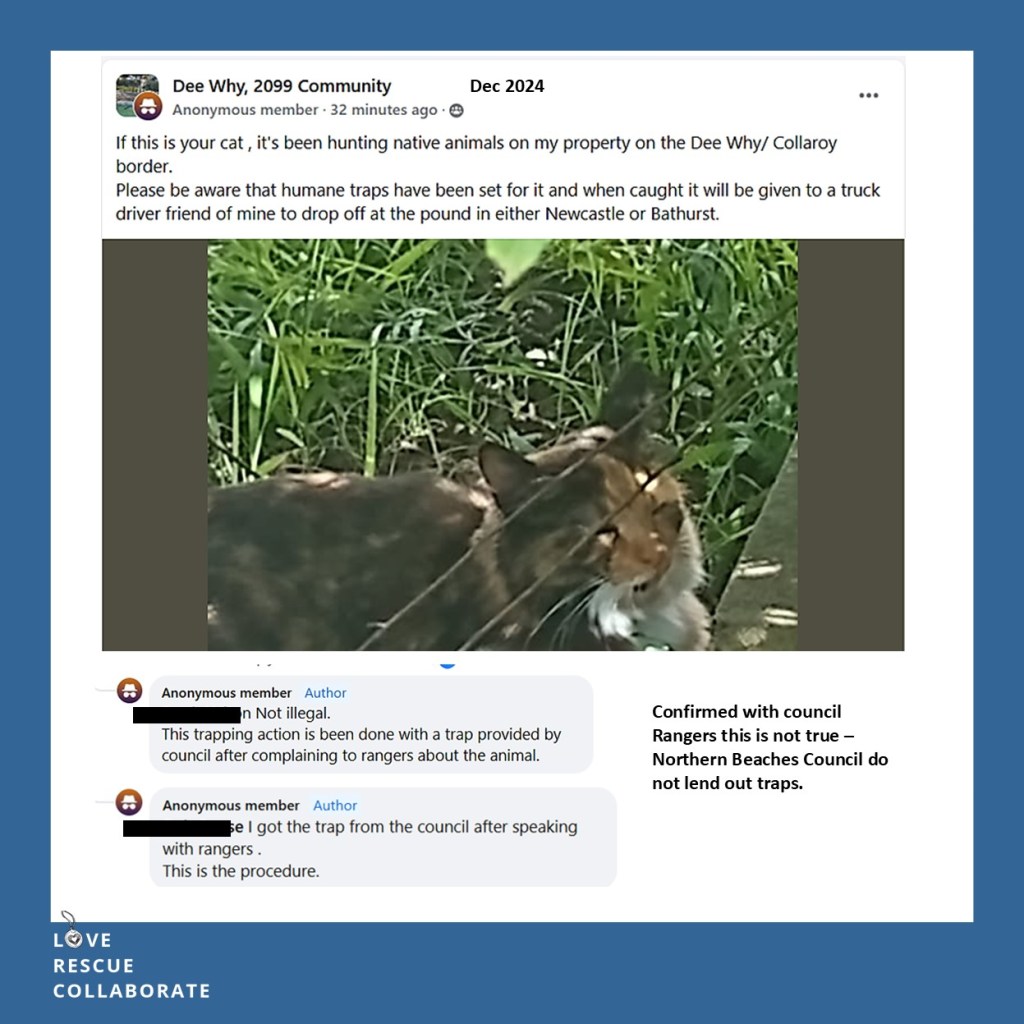
CA Act clause 32. 1 example
[RSPCA Australia quote]
Q group 2: Compliance and enforcement role of councils
- What changes to NSW laws, regulations, codes or guidelines could be provided to councils and other enforcement authorities to better support responsible pet ownership?
- How could NSW laws, regulations, codes or guidelines be improved to support councils to better manage dangerous and restricted dogs?
- Are the current enforcement provisions under the Act (including penalties for offences – see Appendix B of the discussion paper) appropriate? If not, what enforcement provisions should be changed?
- Are there other compliance and enforcement matters that should be considered?
Q group 3. Companion animal population and rehoming
- What more could be done to reduce stray and homeless cats and dogs in NSW?
- What changes can be made to NSW laws, regulations, codes or guidelines to reduce the number of companion animals entering the pound and rehoming system in the first place?
- For companion animals needing to enter the ‘pound’ system, what could be done to increase rehoming?
- Are there other dog and cat population and rehoming matters that should be considered?
 LRC
LRC 