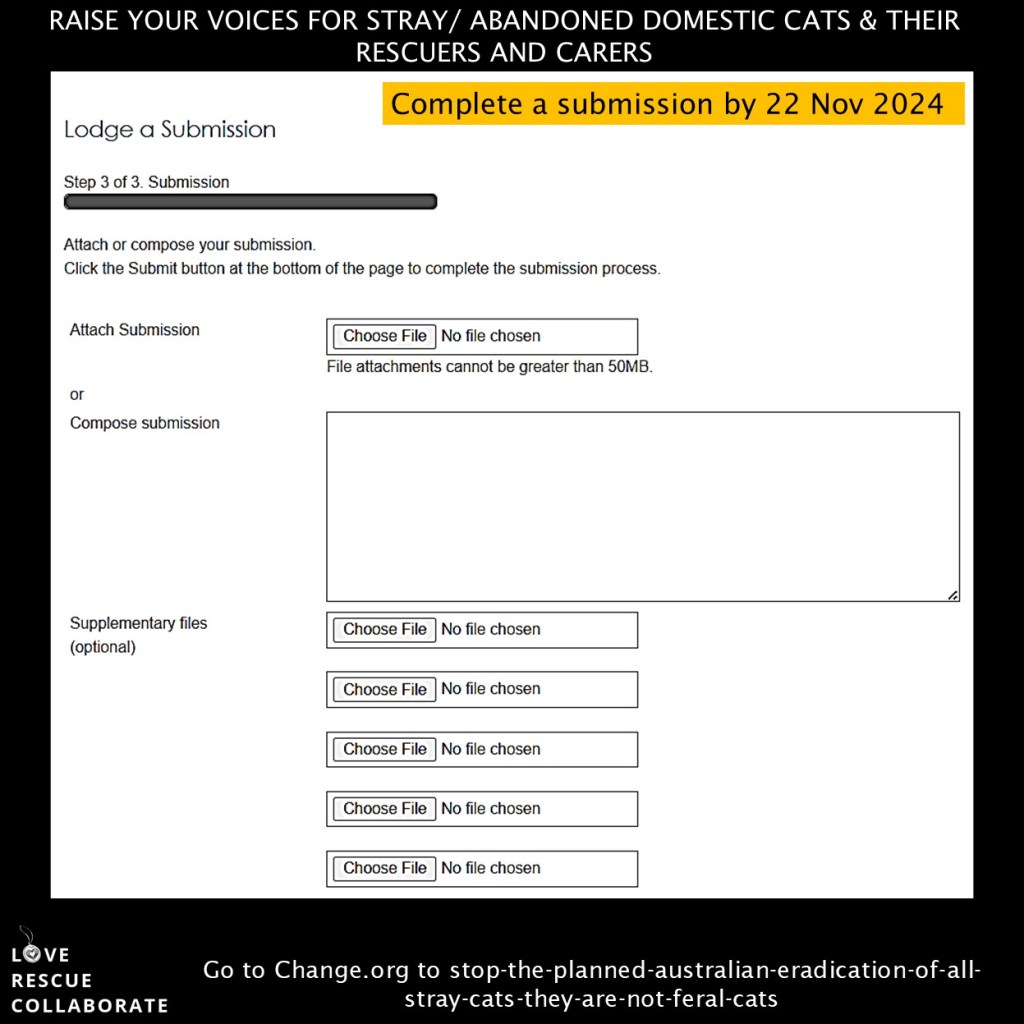
Why does it appear that the NSW government with our councils do not recognise community cat rescuers? The community cat rescuers’ efforts assist with collectively thousands of abandoned cats being desexed and rehomed each year, and directly minimise the burden of pets entering the council pound systems and large animal welfare shelters. It is critical that rescuers speak up and complete a submission by Friday 22 November 2024 – you can enter information in a free form entry or upload as documents (many formats will be accepted).
- Summary of top issues per TOR
- Community Cat Rescuers Response Guide & Suggestions
- Inquiry & Submission Information
- Suggestions for responses to specific TOR points
- TOR (j) any other related matters
- TOR (a) the impact of cats on threatened native animals in metropolitan and regional settings
- TOR (b) the effectiveness of cat containment policies including potential barriers
- TOR (c) welfare outcomes for cats under contained conditions
- TOR (d) the effectiveness of community education programs and responsible pet ownership initiatives
- TOR (e) implications for local councils in implementing and enforcing cat containment policies
- TOR (f) the effectiveness and benefits to implementing large scale cat desexing programs
- TOR (g) the impact of potential cat containment measures on the pound system
- TOR (h) the outcomes of similar policies on cat containment in other Australian states or territories
- TOR (i) options for reducing the feral cat population
Summary of top issues per TOR
We offer a four page flyer covering the ten Terms of Reference (TOR) topics, starting with “other related matters” which set the context for responses to include community cats (semi owned or unowned “strays”) and the community cat rescuers and Good Samaritans who show care for these cats. You are welcome to consider these and leverage the referenced quotes and URLs.
Community Cat Rescuers Response Guide & Suggestions
It is a significant concern that community cat rescuers appear not to be recognised in the NSW Pound Inquiry and it appears similar in this inquiry (i.e. those not listed as Approved Rehoming Organisations).
If your time / capacity is limited, we suggest you focus on just three of the Terms of Reference topics (b), (f) and (j).
PLEASE CUSTIOMISE e.g. add: a) your personal experiences; b) examples of rescuers, you can refer to “friends” in rescues or specifically name rescues; and c) use references to expert organisations (many provided to assist you).
TOR (b) the effectiveness of cat containment policies including potential barriers
Promoting cat containment is fully supported, however mandatory containment is not supported. The views, research and findings of the Australian Pet Welfare Foundation are supported in that mandatory cat containment in forms of curfews, 24/7 or banning cats from selected suburbs or Local Government Areas (LGAs) is not effective, nor will achieve value for money in terms of outcomes for the costs.
The APWF findings are based on review of a number of Australian councils which indicates complaints and costs rise under mandatory cat containment.
It is also recognised that cat haters may be incited to increase levels of cruelty under any open trapping and culling policies which are not effectively monitored, and harass or harm community cat rescuers who are actively helping abandoned cats.
“Mandated cat containment has been proven to be an ineffective strategy; a failure at reducing wandering cats in the short and long term, both in Australia and internationally. Mandated cat containment is not an effective strategy to reduce wandering cats because most wandering cats are strays with no owner to contain them. Even for cats with an owner, containment is often not achievable due to factors such as housing limitations, lack of financial resources and concerns about the welfare of confined cats.” https://petwelfare.org.au/2022/08/31/australian-pet-welfare-foundation-position-statement-on-cat-containment/
“…in the 30 years since the Halls Gap cat ban was introduced, there has yet to be any sort of survey conducted by local or state government bodies to determine whether or not the ban has actually been a success” “The ban on domestic cats has done little to dissuade feral cats from hunting” https://www.abc.net.au/news/2023-06-15/mayor-says-halls-gap-cat-ban-success-native-wildlife/102337372
TOR (f) the effectiveness and benefits to implementing large scale cat desexing programs
Large scale (mass / high intensity) desexing programs for owned, semi owned and unowned cats are supported for their effectiveness in minimising cat populations. This is achieved by significantly limiting the breeding of cats, which also benefits each cat and the communities.
These funded programs should be offered free for those on low incomes, carers and rescuers of semi owned and unowned cats (community cat rescuers), and areas of high intensity cat populations to make a rapid and effective reduction in numbers of cats.
The research and studies of highly successful free cat desexing programs were completed in a number of councils involving the APWF in Queensland, Banyule Council in Victoria, and the Keeping Cats Safe at Home (KCSAH) program managed by RSPCA for the NSW government.
The Banyule free desexing program offered over several years is supported, it was cost effective by council funding offset by savings and achieved significant results in minimising the cat population. For owned and semi-owned cats this included “decreases in impoundments by 66%, euthanasia by 82%, and cat-related calls by 36% over 8 years, with savings to council of AU $440,660 for an outlay of AU $77,490”.
This program critically involved AMO roles in effective face-to-face, coal-face engagement with the community, and included owned and stray (semi owned and unowned) cats.
“Impact of a Local Government Funded Free Cat Sterilization Program for Owned and Semi-Owned Cats” https://www.mdpi.com/2076-2615/14/11/1615
TOR (j) any other related matters
It is strongly recommended that community cat rescuers are recognised as: 1) their collective efforts save thousands of cats each year across NSW; 2) they complement and relieve the council pound systems, and should receive government funding support; and 3) any future pound assessments for capacity and funding and the management of cat populations must take into account the numbers of cats and kittens for which these volunteers and Good Samaritans are unfairly burdened, and provide care, desexing and rehoming solutions.
Community Cat Rescuers work alongside and take the burden of abandoned domestic cats from council pounds
These rescues may be vet practices, and/or registered charities (with Australian Charities and Not-for-profits Commission) and registered businesses (with Australian Business Numbers under the Australian Taxation Office). Many are small-home based volunteers. These rescuers take in animals from “the streets”, or as surrenders from the public.
It is strongly recommended that community cat rescuers are offered support for free desexing and vaccinations through initiatives such as:
a) the RSPCA NSW Weddin, Campbelltown and Hornsby councils’ initiatives; and
b) with grants for councils and vets who have historically and directly rescued abandoned animals and may then help rescuers with reduced vet charges.

The Australian Veterinary Association raised “formal provisions for veterinary practices reimbursement when receiving stray cats” plus more in their AVA Rehoming Review submissions. www.ava.com.au/member-updates/nsw/ava-submission-to-nsw-rehoming-practices-review/
Devastating impact on Community Cat Rescuers when community cats are cruelly culled
The trap and culling/killing approach not only may be seen to be cruel to community cats, it also raises a significant likelihood of having a devastating impact to the community members or community cat rescuers who have been taking care of these cats/ kittens.
It is strongly recommended that the Australian research into the Newcastle breakwater cats culling is taken into consideration for the advice that authorities considering potential legal ramifications based on the devastating impacts to the community cat rescuers which were considered worse than the negative impacts of the cats.
“…the severity of the adverse psychological impacts, and the morbidity rate amongst the cat caregivers we interviewed, was far greater than would be expected as a risk to the community if the cats had remained at the site. We therefore suggest that potential legal ramifications should be considered before authorities intentionally choose a method of management that is likely to inflict substantial harm on community members.”
“It is strongly recommended that a care-centred management approach be taken, whereby authorities identify and assist caregivers to implement neutering and, if possible, adoption.”
The Impact of Lethal, Enforcement-Centred Cat Management on Human Wellbeing: Exploring Lived Experiences of Cat Carers Affected by Cat Culling at the Port of Newcastle https://www.mdpi.com/2076-2615/13/2/271
Inquiry & Submission Information
On the 11 October the New South Wales (NSW) government opened an inquiry into managing cat populations, for submissions by Friday 22 November 2024. In our opinion, this inquiry and the previous related NSW Pound Inquiry are failing to recognise community cat rescuers and the valuable work they achieve as volunteers in assisting abandoned domestic cats to be rescued, desexed and rehomed.
URLs for inquiry etc
The inquiry information: https://www.parliament.nsw.gov.au/committees/inquiries/Pages/inquiry-details.aspx?pk=3011
The Terms of Reference and topics for submissions: https://www.parliament.nsw.gov.au/committees/inquiries/Pages/inquiry-details.aspx?pk=3011#tab-termsofreference

A submission complete personal information, privacy option, then upload up to 6 files of different formats or a free-form entry: https://www.parliament.nsw.gov.au/committees/inquiries/Pages/inquiry-details.aspx?pk=3011#tab-submissions
Suggestions on wording your submission
A submission will be easier to assess by the government team if your issues and recommendations are sorted under each of the provided Terms of Reference topics.
However, you are not required to respond to each and every TOR topic – just select the ones most important to you. Do not feel intimidated if you just choose TOR (j) any other related matters, or if you don’t use any of the TOR topics.
We suggest you use a format where there are two distinct points, sentences or paragraphs, e.g.
It is a concern that… [issue and its negative impact]
It is strongly recommended to… [improvement/ change and its benefit]
Sources of information you may find helpful
These trusted sources of information provide a range of issues and recommendations which you may quote and reference in your submissions. Further, you are able to show your support for these organisations and their expertise, findings and successful approaches.
APWF Submission to NSW Pound Inquiry
Getting to Zero Submission to NSW Pound Inquiry
https://www.parliament.nsw.gov.au/lcdocs/submissions/81315/0121%20Getting%202%20Zero.pdf
RSPCA Australia position on mandatory containment
https://kb.rspca.org.au/wp-content/uploads/2024/05/PP-A8-Cat-Containment-2024.pdf
Suggestions for responses to specific TOR points
TOR (j) any other related matters
NSW needs Cat terms & definitions, a Cat Management Plan, Key Stakeholder Consultation
It is strongly recommended:
- the terms and definitions from the RSPCA are accepted and used in NSW, which provide two classes of cat: feral and domestic, with three subclasses of domestic being owned, semi owned, and unowned, it is long overdue to replace the stray cat term, and the semi owned cats term recognises community cat rescuers and carers,
- the ongoing evolution of terms based on evidence-based research by the APWF is incorporated, including their Community Cat Programs findings,
- a NSW strategic cat management committee is established (similar to Victoria’s) including: RSPCA, APWF, AVA, AIAM, and representatives from key stakeholders includes veterinary practice representatives and community cat rescuers and approved rehoming organisations who help manage owned, semi owned and unowned cats,
- for development of a cat management plan including separate management strategies for each of these classes as though “the populations overlap to varying extents, each requires a distinct management strategy” AVA, and AIAM copy of KCSH presentation – noting pages 12-14 for targeted desexing including semi owned cats and semi owners (community cat rescuers and carers).
Supporting information: https://kb.rspca.org.au/wp-content/uploads/2019/01/Identifying-Best-Practice-Domestic-Cat-Management-in-Australia-RSPCA-Research-Report-May-2018.pdf
https://engage.vic.gov.au/cat-management-strategy
https://petwelfare.org.au/community-cat-program-news-2/
AIAM Presentations from Panel Members, RSPCA NSW The Keeping Cats Safe at Home experience https://aiam.org.au/page-18158
Community Cat Rescuers work alongside and take the burden of abandoned domestic cats from council pounds
It is strongly recommended that community cat rescuers are recognised as: 1) their collective efforts save thousands of cats each year across NSW; 2) they complement and relieve the council pound systems, and should receive government funding support; and 3) any future pound assessments for capacity and funding and the management of cat populations must take into account the numbers of cats and kittens for which these volunteers and Good Samaritans are unfairly burdened, and provide care, desexing and rehoming solutions.
These rescues may be vet practices, and/or registered charities (with Australian Charities and Not-for-profits Commission) and registered businesses (with Australian Business Numbers under the Australian Taxation Office). Many are small-home based volunteers. These rescuers take in animals from “the streets”, or as surrenders from the public.
It is strongly recommended that community cat rescuers are offered support for free desexing and vaccinations through initiatives such as:
a) the RSPCA NSW Weddin, Campbelltown and Hornsby councils’ initiatives; and
b) with grants for councils and vets who have historically and directly rescued abandoned animals and may then help rescuers with reduced vet charges.
Supporting information:
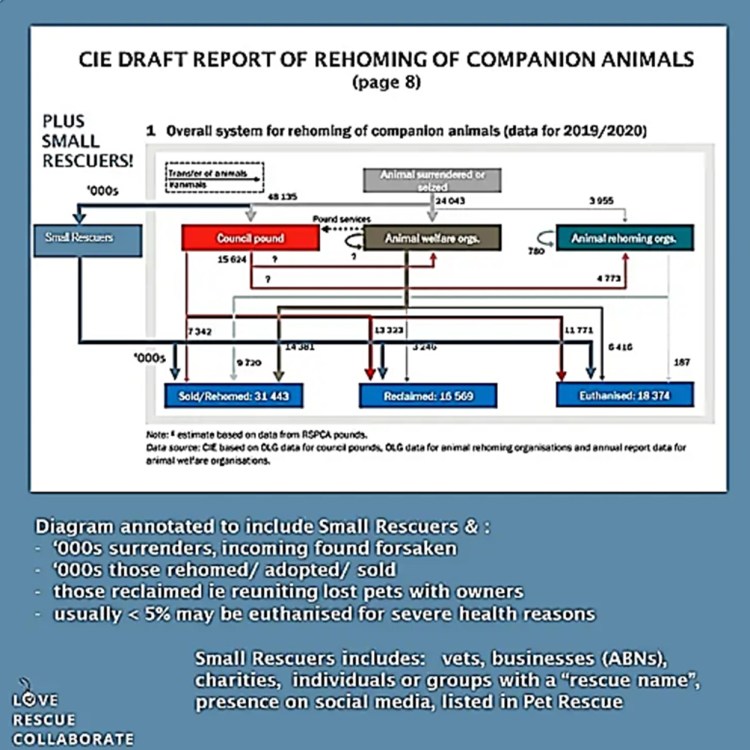
RC Diagram showing community cat rescuers
Download
The Australian Veterinary Association raised “formal provisions for veterinary practices reimbursement when receiving stray cats” plus more in their AVA Rehoming Review submissions. www.ava.com.au/member-updates/nsw/ava-submission-to-nsw-rehoming-practices-review/
Devastating impact on Community Cat Rescuers when community cats are cruelly culled
The trap and culling/killing approach not only may be seen to be cruel to community cats, it also raises a significant likelihood of having a devastating impact to the community members or community cat rescuers who have been taking care of these cats/ kittens.
It is strongly recommended that the Australian research into the Newcastle breakwater cats culling is taken into consideration for the advice that authorities considering potential legal ramifications based on the devastating impacts to the community cat rescuers which were considered worse than the negative impacts of the cats.
The relationships between the community cat rescuers (cat care givers) has also been researched and shows the significant bond between the rescuers, who were extracting social cats to desex and rehome, and the cats with whom they had invested time, effort and financial resources.
It appears that community cat rescuers / care givers do not so much choose not to be formal owners of the semi owned and unowned cats, it can easily be seen that these rescuers are limited by their own resources and finances to formally take on ownership of many cats abandoned by others.
Supporting information:
“…the severity of the adverse psychological impacts, and the morbidity rate amongst the cat caregivers we interviewed, was far greater than would be expected as a risk to the community if the cats had remained at the site. We therefore suggest that potential legal ramifications should be considered before authorities intentionally choose a method of management that is likely to inflict substantial harm on community members.”
“It is strongly recommended that a care-centred management approach be taken, whereby authorities identify and assist caregivers to implement neutering and, if possible, adoption.”
The Impact of Lethal, Enforcement-Centred Cat Management on Human Wellbeing: Exploring Lived Experiences of Cat Carers Affected by Cat Culling at the Port of Newcastle https://www.mdpi.com/2076-2615/13/2/271
“Published research demonstrates very strong bonds between semi-owners and their stray cats, and positive psychological impacts on semi-owners from this unique human-animal bond (HAB), similar to the positive well-being impacts owners derive from companionship with their pet cats (Zito 2015, Centonze and Levy 2002; Khor 2018, Scotney 2023, Finkler and Terkel 2011). For example, caregivers state they are “attached” to the stray cat they are feeding and that feeding the stray cat makes them.”
“These findings suggest that feeding stray cats can have substantial meaning and value in people’s lives, which is why caregivers are traumatised and suffer profound negative mental health impacts
when their cats are killed by authorities, including post-traumatic stress (Scotney 2023).” https://petwelfare.org.au/wp-content/uploads/2023/09/Inquiry-into-pounds-in-NSW-APWF-submission-final.pdf
TOR (a) the impact of cats on threatened native animals in metropolitan and regional settings
The widely used and often quoted, generalised extreme numbers of wildlife impacts should be considered misinformation as these appear based on inappropriate studies with flawed numbers involving many estimates and assumptions, producing wildlife populations effects implied rather than investigated. There are many researched findings that are evidence-based that have been ignored when these show that the impact of cats, especially domestic cats in urban areas is not as drastic nor significant.
It is a significant concern that very few NSW councils have gathered evidence of cat impacts to wildlife in their Local Government Areas (LGAs). This information is critical for informed decision-making and should be included in each council’s Biodiversity Report and Cat Management Plans, which would both involve consultation with local communities.
It is recommended for each NSW council to deliver a Biodiversity Report and Cat Management Plan with evidence of impacts to wildlife, and in perspective of other major contributing factors and councils’ responses to those e.g. habitat loss, climate change impacts in terms of bush fires, floods, droughts and vegetation/food constraints, car accidents and other human actions. These local evidence-based studies will complement evidence-based research across LGAs.
It is a significant concern that the generalised and exaggerated estimates of the impacts of cats to wildlife have been broadly published over several years. From evidence on social media and in the communities, this contributes/ encourages a negative focus on cats (cat haters boasting of harming and killing cats) and physical and social media abuse to community cat rescuers and carers. This takes the focus away from proactive and successful actions to assist wildlife, especially in urban areas.
It is recommended that our NSW government and all councils provide an ethical and evidence-based view and fulfil social licensing obligations in the interests of all stakeholders, including community cat rescuers and carers.
Supporting information:
https://petwelfare.org.au/wp-content/uploads/2023/11/Rand-Myth-cats-Wildlife-2023.pdf
AJP Australia includes “claim of 2 billion animals killed by cats is exaggerated as it is not based on sound counting methodologies” and recommends to
“Develop more stringent and scientific methods for determining the impacts of cats on wildlife before developing plans based on guess-work and unscientifically derived data”
“Acknowledge the significant impact that land clearing, especially for grazing, has on compounding the effect that cats have on the environment by giving them an unfair advantage over native animals, who become much more vulnerable to threats such as predation.”
“Consider the full range of factors known to impact the survival of native species when developing management plans. Consider research in northern Australia that indicates that across most of these landscapes, managing herbivores and fire rather than culling cats, is likely a more effective way of protecting small mammals.”
“Prioritise maintaining habitat for native species by significantly reducing land clearing
and re-wilding areas to convert previously-cleared land back into habitat.”
“RSPCA advocates that further research is undertaken to provide evidence of the positive and negative outcomes of cat containment before 24/7 containment can be adequately assessed.”
“Support for the introduction of mandatory 24/7 cat containment would need to be based on evidence that it can achieve the stated objectives for cats, wildlife, and the broader community, and that the potential negative consequences can be eliminated or effectively mitigated…
If mandatory 24/7 cat containment is introduced, effective monitoring is needed that will provide evidence of outcomes (positive and negative) and inform a better understanding of potential negative consequences and strategies to eliminate or effectively mitigate these.”
https://kb.rspca.org.au/wp-content/uploads/2024/05/PP-A8-Cat-Containment-2024.pdf
Invasive Species Council social media condones cruelty to all cats, e.g. 17 March 2024 FB post comments: “Time to destroy all cats”, “To be shot in sight !”, “Kill em all”, “Eels like cats”, “Neighbourhood cats make great hats”, “Targets”, “You need to put up photos of some of the cats that have been shot and tell them when their cat doesn’t come home doesn’t mean it has found a new family”, “they are also supposed to taste like Rabbit!”, “chute the cat”
TOR (b) the effectiveness of cat containment policies including potential barriers
Promoting cat containment is fully supported, however mandatory containment is not supported. The views, research and findings of the Australian Pet Welfare Foundation are supported that mandatory cat containment in forms of curfews, 24/7 or banning cats from selected suburbs or Local Government Areas (LGAs) is not effective, nor will achieve value for money in terms of outcomes for the costs. The APWF findings are based on review of a number of councils which indicates complaints and costs rise under mandatory cat containment.
There are many barriers to owners containing cats, and not all cat owners are able to contain their cats for a number of reasons, including:
- housing limitations on leased properties by landlords, body corporate in strata managed apartments, and complaints from neighbours;
- homes do not have air conditioning, nor are owners able to afford air con operating throughout the very long and more humid summers (increasing due to climate change);
- not being able to afford outdoor cat enclosures;
- the lack of acceptance of cat enclosures by neighbours putting owned cats at risk in their own backyards;
- concerns about the welfare of cats as not all accept being in small enclosures.
Stray cats (semi owned and unowned cats) are likely the most common roaming cat and also found to have been abandoned in the most recent 12 months. However, mandated containment usually cannot be achieved, and the causes and problems with abandoned cats are not addressed, which means the “supply chain” of new abandoned cats continues. Mandated containment with punitive enforcement involving and high intensity euthanasia gives a false sense of actions for roaming stray cats, and high intensity euthanasia, is not an effective response nor cost effective.
Mandated cat containment becomes a barrier to those assisting stray cats, it may be interpreted that all roaming cats are “illegal” which may also mean the community members and specifically community cat rescuers are also seen to be “illegal”. This can halt all efforts to save, desex and rehome/ adopt abandoned cats.
It is also recognised that cat haters may be incited to increase levels of cruelty under any open trapping and culling policies which are not effectively monitored and harass or harm community cat rescuers who are actively helping abandoned cats.
A number of councils in ACT, WA, SA, Vic, Qld have mandated cat containment, but where is the evidence of measured impacts and improvements on wildlife? Halls Gap has totally banned cats for 30 years, but they have no measurements and it has not stopped feral cats impacting wildlife. It appears the number of cats being abandoned is not decreasing, and there still remains a need for community cat rescuers who take on the burden of abandoned cats.
Supporting information
The APWF position provides: “…the APWF is strongly opposed to mandated cat containment (night curfews and 24/7) because it leads to increased cat nuisance complaints, increased cat impoundments, increased cat and kitten euthanasia, increased costs and enforcement difficulties for local governments, increased mental health damage to veterinary staff and community residents caused by euthanasing healthy cats and kittens and no reduction in the overall number of wandering cats.”
“Mandated cat containment has been proven to be an ineffective strategy; a failure at reducing wandering cats in the short and long term, both in Australia and internationally. Mandated cat containment is not an effective strategy to reduce wandering cats because most wandering cats are strays with no owner to contain them. Even for cats with an owner, containment is often not achievable due to factors such as housing limitations, lack of financial resources and concerns about the welfare of confined cats.” https://petwelfare.org.au/2022/08/31/australian-pet-welfare-foundation-position-statement-on-cat-containment/
“Even for cats with an owner, containment is sometimes not achievable due to factors such as
housing limitations (e.g., rental properties), lack of financial resources and concerns about the
welfare of confined cats.
Mandatory cat containment actively prevents resolution of the longstanding free-roaming stray cat
issue because it creates a major barrier to cat semi-owners adopting the stray cat they are feeding.”
The APWF information “Key issues to consider related to mandated 24 7 cat containment” includes the following.
“RSPCA Australia Identifying Best Practice Domestic Cat Management in Australia 2018 report acknowledges: Overall, councils with cat containment regulations have not been able to demonstrate any measurable reduction in cat complaints or cats wandering at large following the introduction of the regulations.”
“In the City of Yarra Ranges (Victoria), in the 3rd year after mandating 24/7 cat containment: …cat-related complaints increased by 143%; …Yarra Ranges Council acknowledged that the significant increase in cat complaints, is likely to be a result of the introduction of a 24-hour cat curfew in 2014; …impoundments increased by 68%; [and] …euthanasia increased by 18% (human population only increased by 2%) (Yarra Ranges 2021).
“In the City of Casey (Victoria), 20 years after introducing mandated 24/7 cat containment: …the number of cats impounded was still 296% higher than baseline (from 264 cats in 1998 to 1,047 cats in 2019/20), more than double the rate of the human population increase.“
“In 2000, Casey received 349 cat nuisance and related complaints which had increased to 376 complaints in 2020/2021 (Casey Council 2001 & 2021”
“Stray cats are usually overlooked when mandated 24/7 cat containment is proposed, even though stray cats represent the majority of wandering cats. Most cats entering animal welfare shelters and council pounds are classed as strays, originate from low socio-economic areas and were born in the preceding 6 to 12 months (Kerr 2018, Alberthsen 2013 & 2016, Miller 2014, Ly 2021, Rinzin 2008, Zito 2016).”
“…high level culling is cost prohibitive for local governments and unacceptable to the majority of the community (Rand 2019) and there are no published reports of high-level culling at the suburb or city level being successful (Boone 2019).”
Mandated containment: “Increases risks of cruelty towards cats, increasing animal pain and suffering.”
“…in the 30 years since the Halls Gap cat ban was introduced, there has yet to be any sort of survey conducted by local or state government bodies to determine whether or not the ban has actually been a success”
“The ban on domestic cats has done little to dissuade feral cats from hunting” https://www.abc.net.au/news/2023-06-15/mayor-says-halls-gap-cat-ban-success-native-wildlife/102337372
TOR (c) welfare outcomes for cats under contained conditions
Similar to council pounds and animal welfare shelters, contained housing for owned cats is often limited by financial budgets, resources, space / capacity of properties, and legal obligations for owned or leased properties in urban or other zoned areas.
While a number of animal welfare organisations (e.g. RSPCA), experts (AVA, APWF, Jackson Galaxy) and cat rescue groups provide advice on keeping a cat happy and healthy being contained, only a proportion of cat owners can achieve these steps, and some cats, especially cats who have been free roaming will not instantly take to being contained. RSPCA Australia includes that some cats will not cope with containment and that mandatory containment may increase negative animal welfare impacts. APWF includes mandatory containment negatively impacts “the welfare, quality of life, and health of some
contained cats which can include obesity, immobility, lower urinary tract disease and behaviour
problems increasing risk of relinquishment or abandonment (RSPCA Australia 2018, Palmer &
Sandoe 2014)“.
Cats have natural instincts to explore and hunt, although both of these vary per domestic cat based on a number of factors, such as their heritage/breed/genes, early conditioning from a mother and father cat, and just plain personality characteristics of each cat (just like humans).
It is recommended that any implementations of containment should:
- be promoted and encouraged (not made mandatory) through effective face to face community engagement to understand local community issues and challenges,
- be initially recommended for kittens rather than the acquisition of older cats who likely have preset conditioning (Grandfather clause),
- include adequate planning based on evidence of the need in local evidence-based quantified research, have quantified measurable benefits for cats and their owners, and mitigate risks of negative consequences as recommended by RSPCA Australia.
Supporting information:
“You want to create spaces that really satisfy your cat’s primal instinct and challenge them the way being outdoors does… chances are you need to create additional spaces for them to do this… If your cat is showing signs of aggression or behavioral issue, it might be because one (or several) of their primal needs aren’t being met.” https://www.jacksongalaxy.com/blogs/news/what-is-catification
For owned cats: “Contained cats require an appropriate environment with enrichment that meets the cats’ physical and mental needs, allows expression of natural behaviours, promotes good health and welfare and minimises stress. This should include controlled outdoor access where possible. Significant further research is required to optimise the health and welfare of contained cats.” https://www.ava.com.au/policy-advocacy/policies/companion-animals-management-and-welfare/management-of-cats-in-australia/
“There are some circumstances under which a cat’s physical and mental needs will not be successfully met in containment due to a range of factors including the presence of other animals, space available, human factors, and ability to modify the property. There are also some cats who are unable to cope with containment. In situations where the cat is unable to be contained, alternate strategies should be implemented.
Mandatory 24/7 containment may increase the potential for negative impacts on animal welfare and the community, compared to voluntary implementation of 24/7 containment on an individual basis, by imposing it on people and cats who are not suited or capable of implementing it appropriately (see 4.2).
Due to the ambiguity surrounding the risks and effectiveness of 24/7 containment, the RSPCA advocates that further research is undertaken to provide evidence of the positive and negative outcomes of cat containment before 24/7 containment can be adequately assessed.”
“Support for the introduction of mandatory 24/7 cat containment would need to be based on evidence that it can achieve the stated objectives for cats, wildlife, and the broader community, and that the potential negative consequences can be eliminated or effectively mitigated. The RSPCA supports and encourages such research.
If mandatory 24/7 cat containment is introduced, effective monitoring is needed that will provide evidence of outcomes (positive and negative) and inform a better understanding of potential negative consequences and strategies to eliminate or effectively mitigate these.”
“A ‘grandfathering’ clause: a transition period that exempts existing companion cats from mandatory 24/7 cat containment by implementing the requirements only for new cats acquired after a determined date.”
https://kb.rspca.org.au/wp-content/uploads/2024/05/PP-A8-Cat-Containment-2024.pdf
APWF re mandated cat containment:
“Criminalises cat ownership for low-income households and people with ‘door-dasher’ cats.
Mandated 24/7 cat containment ignores social justice of legislation and the inability of low-income households and those with difficult to contain door-dasher cats to comply. Even an expensive containment enclosure does not prevent door-dasher cats from escaping. “
“Increases cat relinquishment and abandonment due to the imposition of an added responsibility and potential penalty to cat ownership (RSPCA SA 2022a).”
“Negatively impacts the welfare, quality of life, and health of some contained cats which can include obesity, immobility, lower urinary tract disease and behaviour problems increasing risk of relinquishment or abandonment (RSPCA Australia 2018, Palmer & Sandoe 2014).”
2021 research includes “there is growing evidence of environmental contamination from home furnishings and dust affecting cat health (16, 17). Keeping cats indoors can cause frustration and unwanted behavioral challenges leading to stress and compromised health, especially in multi-cat homes (4, 18).”
“One potential solution is to allow cats controlled outdoor access through a property-based containment system, such as a cat-proof fence. However, there is a lack of research on the impact of these devices on cat welfare and owner perceptions of well-being.”
“Time spent outside after installation had a significant effect on positivity and, to a lesser extent, maintenance behaviors. Overall, installation was associated with positive changes in both owner and cat quality of life, which seem to be particularly associated with an increased sense of security. This suggests that housing cats within a controlled outside environment with physical barriers can provide a practical solution for many of the problems associated with cats being allowed out.“
https://pmc.ncbi.nlm.nih.gov/articles/PMC7829302/
TOR (d) the effectiveness of community education programs and responsible pet ownership initiatives
Education and obligations for responsible pet ownership on webpages, brochures, and social media is fairly static and low on engagement levels. This may be due to the predominant “serious” nature preferred by many government and animal welfare organisations. Jackson Galaxy has identified that the use of humour and charm (including realistic love for cats) draws people to his advice and his guidance.
It appears our state government and local councils have a punitive and minimalistic approach to animal welfare, including companion animals / pets of all kinds. When a council can approve paying $400k for a single adult palm tree for landscaping in one area where $millions are spent, it is questionable why it is so difficult to prioritise to spend $100k/year on funding free and subsidies desexing and vaccinations, free registration to help reduce the populations of both cats and dogs.
Further, it is clear from either low socio economic and/or multi-cultural areas (different cultural backgrounds) that there is low regard for an animal’s welfare and/or lack of financial ability to afford the high costs for desexing and containing pets. This is obvious from the community and pet pages on social media, for which council teams rarely officially will engage.
It is strongly recommended that new face to face engagement activities in the community parks etc be funded to achieve better outcomes than in the past. Working groups involving Animal Management Officers (AMOs) and community cat rescuers should be established under the One Welfare approach for providing solutions in collaborations with community stakeholders. The community cat rescuers have established relationships with the community members and with roaming and stray cats. However, they need recognition from the state government and councils, and support dealing with the cat haters.
The current scope of animal management and pound services appear to have become minimal and enforcement oriented, for which the value to residents and community is questionable.
It is acknowledged that pets are considered of great value to people, especially to those alone, vulnerable or with physical or mental challenges. It appears that few councils do more than the very minimal with a focus on warnings or enforcement of legal obligations.
- Yet some of our councils have outsourced their pet days with the community, instead of ramping up their involvement, many councils do not operate activities of engagement with their communities.
- In contrast have been two councils in Western Australia (WA) Sunbury and Bayswater to encourage cat containment which included market days with cat enclosure suppliers and installers, and smaller $100 to $200 subsidies towards cat enclosures for many residents. These approaches appear much more successful over the NSW KCSAH $1k subsidies for just ten residents with conditions and without active physical engagement.
- The highly successful Vic Banyule Council desexing programs was critically dependent on the AMO roles being active in the community and assisting owners and unowned cats in achieving desexing procedures. The NSW KCSAH programs that were most successful in Campbelltown, Hornsby and Parramatta were dependent on working with AMOs and community cat rescuers. The Qld APWF Community Cat Programs were critically dependent on working with cat care givers (rescuers where cats were successfully rehomed to the public). [Refer to other sections in this submission]
It is recommended:
- Funding from the state and local governments should be invested in transforming council services to assist pet owners, and offer solutions when individual pet ownership problems arise. This aligns with the One Welfare approach in providing solutions over punitive enforcements. This will be most beneficial to the vulnerable, and those in the low socio-economic bracket who are financially constrained when seeking help/ options.
- The NSW government lead, and each council delivers face-to-face cultural education and change management programs to respect and care for companion animals. The councils and their animal management officers (AMOs) may work collaboratively with community cat rescuers and community leaders on solutions for the vulnerable / low incomes and for cultural groups where respect for animals is currently not a priority nor meeting our NSW legal obligations.
Supporting information
“Person-centered and culturally competent policies and programs that focus resources on addressing root causes of pet health and welfare issues as opposed to an emphasis on code enforcement can create more positive, scalable, and sustainable improvements in human, other animal, and environmental health and welfare outcomes. This shift from punishment-oriented approaches to support-based models of animal control aligns the animal welfare field with the modern human social justice movement.”
“There are substantial barriers to implementing animal control policies that promote One Health and One Welfare, including inherent biases regarding how and why individuals living in poverty may require additional support resources (e.g., they are just “lazy” and need to get a job so they can pay for their pet’s care on their own, rather than relying on government handouts); the animal welfare field’s historic commitment to a specific definition of “responsible pet ownership” that is driven by racism, classism, and the White dominant culture; an absence of strategies for engaging with marginalized populations in a culturally competent manner; over-policing in communities of color; lack of transparency and oversight in data regarding enforcement; lack of a concerted effort to address structural barriers to accessing pet support services; lack of animal control officer training to perform basic animal handling and zoonoses prevention tasks or in de-escalation strategies; and limited funding opportunities for projects aimed at achieving One Health and One Welfare outcomes [4,5,25,26,27,28,29,30]. Without identifying specific strategies for overcoming each of these barriers, the implicit bias that is present in animal control policy will continue, resulting in disproportionately negative impacts on the pet owners of color and their pets that live in low-income communities.”
Punishment to Support: The Need to Align Animal Control Enforcement with the Human Social Justice Movement www .mdpi.com/2076-2615/10/10/1902
“Introduce NSW pound and shelter initiatives to support vulnerable or at-risk animal owners or caregivers during periods of intense need, in order to keep animals in homes and ensure the welfare and wellbeing of both humans and animals” www .al.org.au/nsw-pound-shelter-reform/
What are the benefits of companion animals to human health?
“A One Welfare approach promotes the direct and indirect links of animal welfare to human welfare and environmentally friendly animal-keeping systems.“ https://www.onewelfareworld.org/
One Welfare “In practice, this concept calls for veterinarians and related animal services such as trainers, an animal’s owner, environmental scientists and human psychiatrists to collaborate and share expertise in order to care for the welfare of both animals and their owners.”
“Community health programs for pet owners – The bond between owners and their pets can decrease social isolation, increase a person’s sense of purpose and bring joy to someone’s life. This is especially true for more socially isolated groups such as elderly people or people struggling with homelessness. However, these circumstances can also make it difficult for these people to give their pets adequate care.” https://kb. rspca.org.au/knowledge-base/what-is-one-welfare/
TOR (e) implications for local councils in implementing and enforcing cat containment policies
Implications for councils in implementing and enforcing cat containment policies include the following (these summary points are supported by 16 evidence-based points from the APWF):
- escalating cat nuisance and new roaming cat complaints,
- additional costs, effort and resources to manage a higher number of captured roaming cats,
- additional monitoring and reporting to be able to measure results, which to date have not provided value for money in several councils who have just basic information,
- escalating euthanasia rates (due to the limit of rehoming by each council based on their funding/ budgets and facilities),
- traumatic impacts to council and pound staff due to very high rates of euthanasing healthy adoptable animals,
- traumatic impacts to the communities, community cat rescuers, also care givers, and feeders seeing their cats in colonies decimated by either authorities or cat haters (which can happen now, but certainly will escalate under any mandated containment obligations to any roaming or semi owned or unowned cat (stray)
- taking responsibility for, and managing cat haters falsely interpreting cat containment legislation and regulations to empower themselves to trap and harm/ cull cats with inhuman methods – all state and council communications (and the Companion Animal Act with focus on clause 32, and Prevention of Cruelty to Animals Act) need to be improved and provide clear interpretation of clauses.
Supporting Information
“32 Action to protect persons and animals against cats
(1) Any person may lawfully seize a cat if that action is reasonable and necessary for the protection of any person or animal (other than vermin) from injury or death.
(2) (Repealed)
(3) If a cat that is not under the effective control of some competent person enters any inclosed lands within the meaning of the Inclosed Lands Protection Act 1901 and approaches any animal being farmed on the land, the occupier of the land or any person authorised by the occupier can lawfully injure or destroy the cat if he or she reasonably believes that the cat will molest, attack or cause injury to any of those animals.
(4) An authorised officer who finds a cat attacking or harassing an animal (other than vermin) within a wildlife protection area (as defined in section 30 (1) (b)) can lawfully injure or destroy the cat if there is no other reasonably practicable way of protecting the animal.
etc…”
NSW Companion Animal Act https://legislation.nsw.gov.au/view/whole/html/inforce/current/act-1998-087
“Based on the evidence, mandated 24/7 cat containment has many negative consequences including:
(1) Increases well-documented and life-threatening mental health damage to staff and community
residents caused by the euthanasia of healthy cats and kittens including depression, traumatic stress
and increased suicide risk (Baran 2009, Reeve 2005, Rohlf 2005, Rollin 2011, Tiesman 2015, Whiting
2011).
(2) Increases cat nuisance complaints to local governments because an expectation is created in the community that cats should not be seen.
(3) Increases cat impoundments because increased nuisance complaints and community expectations that cats should not be seen both lead to increased cat trapping and impoundment (Yarra Ranges 2021, RSPCA SA 2022b).
(4) Increases euthanasia of healthy and treatable cats and kittens in council pounds, shelters and veterinary clinics because the more cats impounded, the more cats euthanased (Kreisler 2022, Marsh 2010).
(5) Increases costs to local government for cat trapping and management.
Costs of impounding, returning to owner, rehoming or euthanasing cats are typically $500/cat ($250
to $750 or more per cat). Trapping, impounding and managing 100 more cats per year costs
approximately $500,000, ultimately paid by rate-payers.
(6) Increases staff burnout, staff turnover and attrition rates associated with the euthanasia of healthy and treatable cats and kittens (Australian Veterinary Association 2022, Rogelberg 2007).
(7) Promotes continuation of the reactive and ineffective typical approach to domestic cats in Australia known as Trap, adopt or kill which has failed to reduce the number of wandering cats over many decades (Boone 2019, NSW Animal Seizures – Pound Data Reports, RSPCA Australia 2021).
(8) Creates a major disincentive for cat ownership, reducing cat adoption and increasing euthanasia.
(9) Actively prevents resolution of the wandering cat issue because it creates a significant barrier to semi-owners taking full ownership of the stray cat they are feeding – this is the key solution to significantly reduce the number of unwanted kittens born and the number of wandering cats and associated issues (Banyule City Council 2020, Cotterell 2021, APWF 2021).
- Semi-owners represent a huge pool of potential cat adopters for shy and timid stray cats which are difficult to adopt and are at high risk of euthanasia in shelters, pounds and veterinary clinics. Semi-ownership of cats is common with 3% to 9% of Australian adults feeding daily an average of 1.5 cats they do not perceive they own (Rand 2019, Zito 2015).
- Cost is the main barrier to desexing, not lack of education or knowledge about the benefits of desexing. Most semi-owners will take full ownership of the stray cats they are feeding, registering their details on the cat’s microchip and registration databases if offered free desexing and microchipping as part of Community Cat Programs (please see below).
- But mandated containment is a major barrier to this process because most semi-owners are in low socio-economic areas in low-income households unable to afford containment system costs ($700-$2000+), and many are in rental properties. On average across Australia, 20% of households (2.4 people) live on less than $650 per week (Rand 2021, ABS data 2022).
(10) Criminalises cat ownership for low-income households and people with ‘door-dasher’ cats. Mandated 24/7 cat containment ignores social justice of legislation and the inability of low-income households and those with difficult to contain door-dasher cats to comply. Even an expensive containment enclosure does not prevent door-dasher cats from escaping.
(11) Increases cat relinquishment and abandonment due to the imposition of an added responsibility and potential penalty to cat ownership (RSPCA SA 2022a).
(12) Places semi-owned stray cats being fed by people who have an emotional attachment to the cat at significant risk of being impounded and killed. 42% of all cats impounded by Australian councils are euthanased (Chua 2022 MPhil thesis).
(13) Increases risks to pet cats of being trapped and killed.
- One third of cat owners lose their pet at least once in the pet’s lifetime and 41% of lost cats are indoor-only cats, as pet cats can still become lost through windows or doors accidently left open.
- Even microchipped pet cats aren’t guaranteed to be safe as microchips are not necessarily found on the first scan of a cat, and it is recommended that if no microchip is found, that cats should be scanned over 3 consecutive days. Even then, microchips can be faulty or move around the cat’s body and may not be found, leading to pet cats being killed (Lord 2008, Lancaster 2015).
(14) Negatively impacts the welfare, quality of life, and health of some contained cats which can include obesity, immobility, lower urinary tract disease and behaviour problems increasing risk of relinquishment or abandonment (RSPCA Australia 2018, Palmer & Sandoe 2014).
(15) Increases risks of cruelty towards cats, increasing animal pain and suffering.
(16) Increases the number of wandering cats due to influxes of new cats after dominant resident cats are trapped and removed and increased survival of juveniles (Lazenby 2015, Miller 2014).”
…
“Based on the evidence in Australia and internationally, mandated 24/7 cat containment is essentially unenforceable, rendering mandated 24/7 cat containment impractical and unfeasible. Hume City Council in Melbourne Victoria stated in 2018 that ‘cat impoundment statistics and learnings from other councils demonstrate that a cat curfew would be largely unenforceable’ (Hume Council 2018). The City of Hobsons Bay (Victoria) also acknowledged in 2014 that introduction of mandated cat containment would lead to community expectations about enforcement that cannot be delivered (RSPCA Australia 2018, Hobsons Bay 2014). This is consistent with findings from USA (Smithfield Virginia USA 2003, Edmonds City Council Washington USA 2012, Greta City Council LA USA 2014, Police Chief Rowland Payson City Council Utah USA 2003, Alley Cat Allies 2022).”
TOR (f) the effectiveness and benefits to implementing large scale cat desexing programs
There is more than adequate and relevant evidence from Australian councils in New South Wales, Queensland, and Victoria that targeted and intense desexing of cats (owned, semi owned and unowned) can achieve results in minimising and reducing cat populations. This is supported by successful evidence from other countries.
Intense/ high volume desexing programs
Large scale (mass / high intensity) desexing programs for owned, semi owned and unowned cats are supported for their effectiveness in minimising cat populations. This is achieved by significantly limiting the breeding of cats, which also benefits each cat and the communities. There are benefits to councils in terms of reduced complaints, intakes to pounds, euthanasia numbers, less stress on staff. Australian examples include:
- the Australian Pet Welfare Foundation (APWF) Community Cat programs in Queensland in a number of Ipswich suburbs have been operating since 2021 targeting stray cats;
- the highly successful desexing program operated over several years in Banyule council Victoria that provided evidence with minimising cat populations for owned and stary cats; and
- the Keeping Cats Safe at Home (KCSAH) in NSW included key desexing programs coordinated by RSPCA NSW in a number of councils where approaches under the Weddin, Parramatta, Hornsby and Campbelltown councils achieved high results with minimising cat populations with targeted desexing including semi owned cats and semi owners (community cat rescuers and carers).
It is strongly recommended that evidence-based research of highly successful programs offering free desexing for owned, semi owned, and unowned cats should be considered an integral part of cat management plans for NSW.
- These desexing programs provide value for money, and return on investment (e.g. Banyul financial metrics), in reducing the number of cats, roaming cats, abandoned stray cats (semi owned or unowned), and impacts to wildlife.
- It is critical that these are implemented in high volume and high intensity, which is understood to mean the number of cats being desexed will exceed the breeding rate in a local area or group or colony of cats. These areas may have several causes behind the high populations i.e. due to human behaviours rather than just free roaming undesexed cats. And these causes need to be addressed in parallel with desexing programs to stem the supply chain.
It is noted that RSPCA SA is aiming to embark on a “TDAR (trap, desex, adopt or return) trial in a selected area in South Australia to trial its effectiveness” with associated actions
It is strongly recommended
- for an immediate rapid and intense response across NSW to be implemented in parallel methods desexing programs for owned, semi owned and unowned cats, which have already been proven: APWF Community Cat Programs; RSPCA NSW supported programs across councils; and Council/Vet/Community Cat Rescuers collaborative efforts,
- that funded intense and high-volume desexing programs should be offered free for those on low incomes, carers and rescuers of semi owned cats (community cat rescuers), and areas of high intensity cat populations,
- that targeted desex and vaccinate programs are also implemented in areas with high cat impoundment rates – i.e. ‘hot spots’”,
- that free desexing programs for semi owned and unowned cats be coordinated by council AMOs and community cat rescuers who have the existing closest face to face relationships with communities,
- to improve the training, obligations and processes for behaviour assessments in council pound facilities to stop euthanasing cats who have not had adequate time to decompress and are likely scared domestic cats rather than feral cats, to request assistance from approved rehoming organisations and community cat rescuers with assessments and rehoming,
- to improve and be transparent with the council policies and processes for the range of illnesses / health concerns and appropriately fund facilities and staff to care for cats who may then be available for adoption.
Supporting information: Evidence for intense/ high volume desexing programs assisting with managing cat populations
The research and studies of highly successful free cat desexing programs is supported in specific Australian councils from the APWF in Queensland, Banyule Council in Victoria, and RSPCA in NSW. This is supported by evidence from a number of similar programs from other countries.
Australian Pet Welfare Foundation Community Cat Programs for owned and semi owned cats
The Australian Pet Welfare Foundation (APWF) Community Cat programs in Queensland in a number of Ipswich suburbs have been operating since 2021 targeting stray cats, including:
“…desexing of urban stray cats… provided with other veterinary care, such as vaccinations and microchipping… if they are healthy and have been thriving outdoors, the cats are returned to where they live in their home territories… will also desex pet cats if their owners cannot afford to do so themselves… [and] adopting friendly cats and kittens found outdoors, increasing responsible pet cat ownership, decreasing abandonment and mediating resident conflicts involving outdoor cats”, “desexed over 2750 cats… achieved >30% reduction in cat intake & >50% less euthanasia”, and provided several evidence-based findings for research papers, international conference papers, a number of Australian submissions. https://petwelfare.org.au/community-cat-program-faq/, https://petwelfare.org.au/community-cat-program-news-2/, https://petwelfare.org.au/wp-content/uploads/2024/05/Aust-Community-Cat-Program-2024-Report.pdf
The highly successful Community Cat Programs operated over several years by the APWF which provide evidence with managing cat populations are supported:
“Community Cat Programs involve high-intensity free desexing, microchipping and registration of owned, semi-owned and unowned cats targeted to areas of high cat intake and complaints. CCPs are proven to be very effective at reducing stray cat numbers, pound intake and euthanasia, complaints and costs. CCPs are also very effective at assisting semi-owners to desex and adopt the stray cat they are feeding and continue to feed and care for their cat, significantly reducing the number of unwanted kittens born. Semi-owners represent a large pool of potential cat adopters, particularly for shy and timid cats, and are integral to resolving the stray cat issue and associated high intake and high euthanasia rates of cats in pounds and shelters. Community Cat Programs proactively manage stray cats in the community keeping cats with their owners, and because they are non-lethal they do not cause devastating mental health impacts to staff or community members, consistent with a One Welfare approach which optimises the well-being of people, animals and their environment.” https://www.parliament.nsw.gov.au/lcdocs/submissions/81381/0132%20Australian%20Pet%20Welfare%20Foundation.pdf
Banyule Victoria desexing program over several years
The highly successful desexing program operated over several years in Banyule that provided evidence with managing cat populations is supported.
“Completely free cat desexing
- The implantation of a microchip so the cats could be traced back to an owner
- Free council registration for the first year
- A transport service provided by council AMOs for those that had none”.
Submission #141 Inquiry into the problem of feral and domestic cats in Australia https://www.aph.gov.au/Parliamentary_Business/Committees/House/Former_Committees/Environment_and_Energy/Feralanddomesticcats/Submissions
“The program proposed and approved by the city of Banyule was that sterilization, microchipping, and the first year of registration would be funded by the council. The purpose of this program was to increase ownership responsibilities for owned and stray cats being fed by residents (semi-owned cats) and to reduce unwanted kittens being born and, therefore, the number of cats and kittens killed in the council-contracted facility (CPS). This was provided at no cost for all owned cats and semi-owned cats in the target areas.”
“When the medium-intensity targeted program resumed in 2017/18, and the trapping process changed from enforcement-orientated to assistive, cats impounded city-wide decreased by 51% over four years, from 284 in 2016/17 to 134 in 2020/21”.
“…the traditional methods of trapping wandering and nuisance cats have not resulted in long-term reductions in cat-related calls to councils. However, following the implementation of a microtargeted free sterilization program for owned and semi-owned cats, marked reductions in cat-related calls, impoundments, euthanasia, and costs were realized, similar to that reported in US programs. It is recommended that urban cat management policies and programs are revised and, instead of being focused on a traditional compliance-based approach, are focused on being assistive, helping owners and semi-owners have their cats sterilized and identified with a microchip.”
Impact of a Local Government Funded Free Cat Sterilization Program for Owned and Semi-Owned Cats https://www.mdpi.com/2076-2615/14/11/1615
NSW Keeping Cats Safe at Home with RSPCA, councils, vet clinics, and community cat rescuers
The Keeping Cats Safe at Home (KCSAH) in NSW included key desexing programs where approaches under specific councils achieved high results with managing cat populations.
The Weddin Council KCSAH desexing program offered free microchipping and desexing which included: collaboratively working to achieve results for over 100 cats, the view this approach “represents the future of local cat management, it is the answer to reducing cat euthanasia rates and keeping cats out of pounds and shelters”. https://weddinlandcare.com.au/milestone-for-keeping-cats-safe-at-home-project
The Parramatta Council KCSAH desexing program included: an aim “to locate unowned cat hotspots and engage with overwhelmed cat carers and volunteer cat rescue groups”; and results where cat-related nuisance complaints decreased by 49% and cats arriving at the council pound decreased by 41%. https://acrobat.adobe.com/id/urn:aaid:sc:AP:4d1d5b58-63b5-4a70-8196-212fded377d1
Anecdotally, Campbelltown and Hornsby KCSAH desexing programs also critically included local carers and rescuers for semi owned and unowned cats. With these community cat rescuers (volunteers) a high take up of desexing was arranged with cat owners, supported transport and scheduling. These roles are critical to achieve a high number of desexing procedures to minimise cat populations with community engagement.
At the AIAM conference a KCSH presentation was provided – noting pages 12-14 for targeted desexing including semi owned cats and semi owners (community cat rescuers and carers). https://aiam.org.au/page-18158
RSPCA SA Proposed TDAR
“In TDAR, unowned or semi-owned cats are trapped, heath checked, desexed, vaccinated and then either rehomed or returned to their original location. Cats who are unsuitable for rehoming, unhealthy and unfit for release are humanely euthanised.”
“Action 23: Reduce strays taken to shelters by helping community members understand that sometimes cats are better left where they are. Promote the approach of “leave a healthy cat where they are and monitor” to stray cats.
Action 24: Undertake a ‘trap, desex and adopt or return’ (TDAR) trial in a selected area of SA, as an attempt to reduce uncontrolled breeding in urban stray cat populations.
Action 25: Educate the public about semi-owned cats as a separate category of cats, helping members of the public who feed stray cats to understand the importance of desexing and microchipping.”
https://www.rspcasa.org.au/cat-plan-explainer/
TNR/ TNVR/ RTF/ SNR
It is strongly recommended that the NSW government invest funding into more intensive programs of desexing including Trap Neuter Return, Trap Neuter Vaccinate Return, Return To Field, and Shelter Neuter Return which are adequately researched over years. The evidence gathered from NSW, Queensland, and Victorian councils indicated benefits with minimising cat populations including stray cats, and therefore continuing with similar efforts will provide benefits across NSW. It is noted that both the Qld CCPs and NSW KCSAHs involved semi owned and unowned cats under community cat rescuers. The success of TNR, TNVR, RTF, and SNR techniques have also been documented in a number of studies.
Please refer to the section Evidence on desexing programs assisting with managing cat populations, of this submission document for information on the Queensland, NSW and Victorian desexing programs. These included desexing of stray cats (semi owned and unowned) where these cats were under managed colonies operated by community cat rescuers. The following are just a small sample of the evidence-based research in these techniques.
Trap-Neuter-Return Activities in Urban Stray Cat Colonies in Australia
“We conclude that trap, neuter and return associated with high desexing rates in colonies, and adoption of kittens and friendly adults substantially reduces colony size, and improves the welfare of cats and kittens. This model is cost-effective for municipalities, and should be legalized in Australia.” https://www.mdpi.com/2076-2615/7/6/46
“Colony populations, when grouped by the number of years enrolled in the program, declined by a mean of 54% from entry and 82% from peak levels. Results from coexistent TNR programs in the Chicago area are consistent with these findings.” https://pubmed.ncbi.nlm.nih.gov/29346278/
An Examination of an Iconic Trap-Neuter-Return Program: The Newburyport, Massachusetts Case Study
“Available evidence indicates that an estimated 300 free-roaming cats were essentially unmanaged prior to the commencement of the TNR program; a quick reduction of up to one-third of the cats on the waterfront was attributed to the adoption of sociable cats and kittens; the elimination of the remaining population; over a 17-year period; was ascribed to attrition.” https://www.mdpi.com/2076-2615/7/11/81
“New approaches, including return-to-field (RTF) and targeted trap-neuter-return (TNR) appear to have transformative potential. …formal RTF and targeted TNR protocols, collectively referred to as a community cat program (CCP), were added to ongoing community-based TNR efforts and a pilot RTF initiative. As part of the three-year CCP, 11,746 cats were trapped, sterilized, vaccinated and returned or adopted. Feline euthanasia at the Albuquerque Animal Welfare Department (AAWD) declined by 84.1% and feline intake dropped by 37.6%; the live release rate (LRR) increased by 47.7% due primarily to these reductions in both intake and euthanasia. Modest increases in the percentage of cats returned to owner (RTO) and the adoption rate were also observed, although both metrics decreased on an absolute basis, while the number of calls to the city about dead cats declined.” https://www.semanticscholar.org/paper/The-Impact-of-an-Integrated-Program-of-and-Targeted-Spehar-Wolf/473bbf487fce3cf6a3743f73e2c1ca7b431d25a1
Integrated Return-To-Field and Targeted Trap-Neuter-Vaccinate-Return Programs Result in Reductions of Feline Intake and Euthanasia at Six Municipal Animal Shelters
“In the past decade, two new variants of TNVR, return-to-field (RTF) and high-impact targeting, have exhibited the capacity to contribute to significant reductions in shelter intake and euthanasia. The present study examines changes in feline intake and euthanasia, as well as impacts on associated metrics, at municipal shelters located in six diverse U.S. communities after integrated programs of RTF and targeted TNVR (collectively termed “community cat programs,” CCPs) were implemented. A total of 72,970 cats were enrolled in six 3-year CCPs, 71,311 of whom (98%) were sterilized, vaccinated, and returned to their location of capture or adopted. A median reduction of 32% in feline intake, as well as a median decline of 83% in feline euthanasia occurred across the six CCPs; median feline live-release rate increased by 53% as a result of these simultaneous declines in cat admissions and euthanasia. The integration of RTF and targeted TNVR protocols appears to result in greater feline intake and euthanasia reductions than programs lacking such an integrated approach.” https://www.frontiersin.org/articles/10.3389/fvets.2019.00077/full
Association between a shelter-neuter-return program and cat health at a large municipal animal shelter
“RESULTS Number of cats admitted to the shelter each year decreased significantly over 8 years; beginning in 2010, duration of stay decreased. Proportion of cats euthanized decreased from 66.6% (28,976/43,517) in the pre-SNR period to 34.9% (11,999/34,380) in the post-SNR period, whereas prevalence of URI increased from 5.5% to 6.8%, and median duration of shelter stay decreased from 6 to 5 days for cats < 4 months of age and from 8 to 6 days for older cats. With implementation of the SNR program and a new treatment policy for cats with URI, more cats received treatment with less medication, yielding cost savings.” https://pubmed.ncbi.nlm.nih.gov/26799109/
TOR (g) the impact of potential cat containment measures on the pound system
The impacts to council pounds is strongly related to the section: TOR (e) implications for local councils in implementing and enforcing cat containment policies.
It is strongly recommended that council pound systems and resources will need to be significantly increased based on an assessment of the additional needs from the number of: the estimated un-microchipped yet owned cats allowed to roam and b) the domestic semi owned and unowned cats (strays).
- The largest numbers will be represented by latter group. If mandatory cat containment is implemented, then it significantly impacts the community cats – semi owned and unowned, who are likely being assisted by community cat rescuers and carers, and Good Samaritans in the local government area.
- Local councils and their pounds must be ready for a large influx of semi owned and unowned cats., which includes policies and priorities for addressing health issues, desexing, vaccinating and rehoming these cats, policies which will have been agreed by the stakeholders in the community.
It is strongly recommended that each council consult extensively with their communities on the council pound budget/finances/ additional staff for key aspects including:
- council pounds to support and increase rehoming, and temporary care for pet owners going through difficulties e.g. financial, domestic violence, and the housing and rental crisis,
- escalating euthanasia rates and additional resources needed to humanely process higher numbers of unwanted pets, and to ensure council pound staff are supported through compassion fatigue and secondary trauma for destroying healthy adoptable animals,
- communication with stakeholders and the whole community, including community cat rescuers, care givers, and feeders seeing their cats in colonies decimated, through compassion fatigue and potential primary trauma themselves,
- communication and engagement in addressing and repressing cat hate and cat haters who may be encouraged to take matters into their own hands with uncontrolled and unmonitored cat trapping and harming/ killing with inhumane methods, which happens now but certainly will escalate under any mandated containment obligations to any roaming or semi owned or unowned cat (stray), and repressing cat haters surrendering cats to ensure cats are treated humanely, meeting social licensing and governmental obligations,
- planning for increased administrations, customer service representatives, AMO and Ranger roles being staffed and trained to cater for the above and punitive actions to try to enforce mandatory containment legislation and regulations, rather than proactively engaging with the communities.
Supporting Information
The APWF information “Key issues to consider related to mandated 24 7 cat containment” includes the following.
“RSPCA Australia Identifying Best Practice Domestic Cat Management in Australia 2018 report acknowledges: Overall, councils with cat containment regulations have not been able to demonstrate any measurable reduction in cat complaints or cats wandering at large following the introduction of the regulations.”
“In the City of Yarra Ranges (Victoria), in the 3rd year after mandating 24/7 cat containment: …cat-related complaints increased by 143%; …Yarra Ranges Council acknowledged that the significant increase in cat complaints, is likely to be a result of the introduction of a 24-hour cat curfew in 2014; …impoundments increased by 68%; [and] …euthanasia increased by 18% (human population only increased by 2%) (Yarra Ranges 2021).
“In the City of Casey (Victoria), 20 years after introducing mandated 24/7 cat containment: …the number of cats impounded was still 296% higher than baseline (from 264 cats in 1998 to 1,047 cats in 2019/20), more than double the rate of the human population increase.“
“In 2000, Casey received 349 cat nuisance and related complaints which had increased to 376 complaints in 2020/2021 (Casey Council 2001 & 2021”
“Stray cats are usually overlooked when mandated 24/7 cat containment is proposed, even though stray cats represent the majority of wandering cats. Most cats entering animal welfare shelters and council pounds are classed as strays, originate from low socio-economic areas and were born in the preceding 6 to 12 months (Kerr 2018, Alberthsen 2013 & 2016, Miller 2014, Ly 2021, Rinzin 2008, Zito 2016).”
“…high level culling is cost prohibitive for local governments and unacceptable to the majority of the community (Rand 2019) and there are no published reports of high-level culling at the suburb or city level being successful (Boone 2019).”
Mandated containment: “Increases risks of cruelty towards cats, increasing animal pain and suffering.”
“…euthanasia was a common practice in shelters, averaging 869 dogs and cats annually per shelter. In response to performing euthanasia, sadness (83.3%), crying (68.5%), anger (57.4%), and depression (57.4%) were the most commonly reported staff reactions. Most shelter managers (74.0%) agreed that euthanasia contributed to burnout in staff… Shelter managers indicated that support programs were important for staff who perform euthanasia services. The most commonly offered support programs were training and education (offered in 48.1% of shelters), staff rotation (38.9%), informal peer support (38.9%), and breaks after euthanasia (35.1%). The vast majority of managers (74.0%) identified funding as the primary barrier to offering support programs.”
“At the heart of the ethical debate is the question of when, if ever, euthanasia is justified. On one side of the argument are those who believe that euthanasia can be a compassionate choice, sparing animals from unnecessary suffering. They argue that in cases where an animal is terminally ill or experiencing extreme pain, euthanasia may be the most humane option available.
On the other side of the coin are those who advocate for a more optimistic approach, one that prioritizes finding alternative solutions to euthanasia. They argue that every animal deserves a chance at life, regardless of their medical condition or behavioral issues. Instead of resorting to euthanasia, they believe that shelters should invest in resources such as medical care, behavior training, and adoption programs to give animals the best possible chance at finding a loving home.“
https://thewoof.org/animal-welfare/understanding-euthanasia-in-animal-shelters
TOR (h) the outcomes of similar policies on cat containment in other Australian states or territories
It is understood that cat containment obligations have been mandated in a number of councils in other states and territories, including: Western Australian (WA), South Australia (SA), Victoria (Vic), the Australian Capital Territory (ACT), and Queensland (QLD).
However, there is no strong evidence provided that these obligations are successful. Refer the APWF summary across a number of Victorian councils (e.g. Hobsons Bay, Hume, Casey, Yarra Ranges) where the costs have not been justified in terms of minimal measured outcomes. The total ban on cats in Halls Gap Vic has never provided evidence in the 30 years this ban has been operating (reported by the Mayor).
It is also noted that there are many community cat rescuers and groups who continue to operate given many cats and kittens are still being abandoned as “strays”, and colonies (semi owned groups of cats) continue to operate in every state/ territory (refer Pet Rescue listings, and social media activities).
It is questionable that safety for cats and wildlife results, or better, may be achieved by proactive promotion and face to face community engagement for effective education and addressing local and cultural issues, and root causes for cats roaming and not desexed (supported by APWF).
It is strongly recommended that before a council chooses to apply mandated cat containment, effective quantified measurements should be completed to acknowledge the real impact of domestic cats on wildlife, the quantified risks to wildlife, with a detailed plan for monitoring and further measuring of effectiveness (supported by RSPCA Australia).
Supporting Information
“Based on the evidence in Australia and internationally, mandated 24/7 cat containment is essentially unenforceable, rendering mandated 24/7 cat containment impractical and unfeasible. Hume City Council in Melbourne Victoria stated in 2018 that ‘cat impoundment statistics and learnings from other councils demonstrate that a cat curfew would be largely unenforceable’ (Hume Council 2018). The City of Hobsons Bay (Victoria) also acknowledged in 2014 that introduction of mandated cat containment would lead to community expectations about enforcement that cannot be delivered (RSPCA Australia 2018, Hobsons Bay 2014). This is consistent with findings from USA (Smithfield Virginia USA 2003, Edmonds City Council Washington USA 2012, Greta City Council LA USA 2014, Police Chief Rowland Payson City Council Utah USA 2003, Alley Cat Allies 2022).” https://petwelfare.org.au/2022/09/02/key-issues-to-consider-related-to-mandated-24-7-cat-containment/
The APWF information “Key issues to consider related to mandated 24 7 cat containment” includes the following.
“RSPCA Australia Identifying Best Practice Domestic Cat Management in Australia 2018 report acknowledges: Overall, councils with cat containment regulations have not been able to demonstrate any measurable reduction in cat complaints or cats wandering at large following the introduction of the regulations.”
“In the City of Yarra Ranges (Victoria), in the 3rd year after mandating 24/7 cat containment: …cat-related complaints increased by 143%; …Yarra Ranges Council acknowledged that the significant increase in cat complaints, is likely to be a result of the introduction of a 24-hour cat curfew in 2014; …impoundments increased by 68%; [and] …euthanasia increased by 18% (human population only increased by 2%) (Yarra Ranges 2021).
“In the City of Casey (Victoria), 20 years after introducing mandated 24/7 cat containment: …the number of cats impounded was still 296% higher than baseline (from 264 cats in 1998 to 1,047 cats in 2019/20), more than double the rate of the human population increase.“
“In 2000, Casey received 349 cat nuisance and related complaints which had increased to 376 complaints in 2020/2021 (Casey Council 2001 & 2021”
“Stray cats are usually overlooked when mandated 24/7 cat containment is proposed, even though stray cats represent the majority of wandering cats. Most cats entering animal welfare shelters and council pounds are classed as strays, originate from low socio-economic areas and were born in the preceding 6 to 12 months (Kerr 2018, Alberthsen 2013 & 2016, Miller 2014, Ly 2021, Rinzin 2008, Zito 2016).”
“…high level culling is cost prohibitive for local governments and unacceptable to the majority of the community (Rand 2019) and there are no published reports of high-level culling at the suburb or city level being successful (Boone 2019).”
“…in the 30 years since the Halls Gap cat ban was introduced, there has yet to be any sort of survey conducted by local or state government bodies to determine whether or not the ban has actually been a success”
“The ban on domestic cats has done little to dissuade feral cats from hunting”
Mandated containment: “Increases risks of cruelty towards cats, increasing animal pain and suffering.” https://petwelfare.org.au/2022/09/02/key-issues-to-consider-related-to-mandated-24-7-cat-containment/
“Due to the ambiguity surrounding the risks and effectiveness of 24/7 containment, the RSPCA advocates that further research is undertaken to provide evidence of the positive and negative outcomes of cat containment before 24/7 containment can be adequately assessed.”
“Support for the introduction of mandatory 24/7 cat containment would need to be based on evidence that it can achieve the stated objectives for cats, wildlife, and the broader community, and that the potential negative consequences can be eliminated or effectively mitigated. The RSPCA supports and encourages such research.
If mandatory 24/7 cat containment is introduced, effective monitoring is needed that will provide evidence of outcomes (positive and negative) and inform a better understanding of potential negative consequences and strategies to eliminate or effectively mitigate these.” https://kb.rspca.org.au/wp-content/uploads/2024/05/PP-A8-Cat-Containment-2024.pdf
TOR (i) options for reducing the feral cat population
Feral cats represent the class of cats “are unowned, unsocialised, have no relationship with or dependence on humans and reproduce in the wild“. This definition from RSPCA in 2018 is widely accepted by government authorities and leading animal welfare organisations including APWF, AVA and AIAM. Feral cats do not include domestic semi owned and unowned cats (out of date stray cat term).
It is strongly recommended that different approaches for feral cats should be developed according to the geographical and climatic regions and the density of feral cat populations. Humane techniques such as conservation fencing, gene technology for effectively “desexing”, are supported. Inhumane techniques such as 1080 poisoning need to cease, including as 1080 indiscriminately poisons other animals including native animals.
Time to revisit the use of TNR with selected areas of feral cats since the 2014 NSW Bill
It recommended it is timely to review and update position of the 2014 NSW bill in relation to feral cats: a) as cat terms need to be more tightly classed in line with the RSPCA 2018 definitions etc, b) new evidence-based science is gathered on feral cats near urban areas (peri-urban areas), c) new evidence-based research is gathered on impacts to wildlife in specific LGAs and locations, and d) communities expecting humane methods for feral cats where they most recently were domestic cats and it is difficult to assess if they are generation-old feral cats or recent domestic abandoned cats.
“A major feature of the Animal Welfare (Population Control Programs) Bill 2014 is that it provides legal certainty for participants in TNR programs. As for the practical effectiveness of TNR programs for feral cats, the evidence is far from conclusive. It suggests high adoption rates, high sterilisation rates, small and stable cat populations and confined locations removed from native wildlife are necessary requirements for successful TNR programs. If that is the case, it begs the question whether feral cat TNR programs should only be sponsored in prescribed circumstances; for example, where they:
– Operate only in metropolitan Sydney?
– Manage small stable populations of cats?
– Sterilise a high proportion of adult cats?
– Adopt cats to responsible homes?
-Identify and sterilise any new cats that enter the population?
– Provide an indication of their likely impact on wildlife? 100
– Have the resources to operate over many years?”
The use of 1080 poison needs to cease
Neither the RSPCA nor Animal Liberation considers 1080 a humane approach to killing any animal. Other animal welfare organisations agree such as the APWF and the Animal Justice Party. The impacts of 1080 include convulsions likened by a vet to be electrocuted for up to 2 days.
It is strongly recommended that the use of 1080 ceases.
Conservation fencing to keep feral cats away from at risk native animals
Conservation fencing is the most effective way to protect native animals. For native animals most at risk, then the removal of feral cats should be the priority, rather than broad techniques under processes which are not effectively monitored nor controlled for being humane.
The Australian Wildlife Conservancy is leading the establishment of feral predator-free areas with conservation fencing, with relocation and reintroduction of native wildlife. These have been shown to effectively keep feral animals out of these areas.
It is strongly recommended that our governments including NSW provides more funding for conservation fencing projects to be implemented and operated where rare native animals are most at risk, and that these will be priority areas for the humane removal of feral cats.
Conservation fencing areas also include a “training” zone
In conjunction with areas excluding all predators, the Australian Wildlife Conservancy projects are increasingly including training zones where a small number of predators are allowed. The objective is to train native animals to manage (learning defensive skills) with introduced predators. This has been active for a number of years and reported by the ABC news in 2020.
It is strongly recommended that our governments including NSW provides more funding for the conservation fenced training zones and the associated work in establishing, operating and reporting on these.
Genetic technologies
The AWC and other organisations are investigating gene technologies to reduce the populations of feral cats. Where feral cats are in very high densities these approach offers many benefits over traditional shooting and culling approaches, in a humane method.
It is strongly recommended that our governments including NSW provides more funding for assisting more rapid development of gene technologies which appear to offer the most effective and humane approach.
Supporting Information
“All jurisdictions should define all cats with some dependence (direct or indirect) on humans as domestic cats. Cats who are unowned, unsocialised, have no relationship with or dependence on humans and reproduce in the wild should be defined as feral cats.” https://kb.rspca.org.au/wp-content/uploads/2019/01/Findings-and-Recommendations-Identifying-Best-Practice-Domestic-Cat-Management.pdf
“The available evidence on the effect of 1080 on affected species indicates that it is not a humane poison.
A review of Sherley 2007 reported that animals who suffer convulsions are not unconscious during or between convulsions so they are able to perceive pain and experience fear and distress [1]. Other signs observed include manic behaviour (including running into objects risking injury), vomiting, whimpering and muscle spasms. The welfare concerns associated with the use of 1080 in different species have also been identified by others [2, 3] and that it causes moderate to severe suffering [4].”
“Veterinarian, Howard Ralph, stated “1080 poisoning is like being electrocuted for two-plus days””
“…has been banned in most countries, due to concerns for humans and non-target species. Its use was banned in the United States in the early 1970s after people died. Australia and New Zealand use 95% of the world’s 1080″
“1080 poison is a chemical used to kill unwanted or unwelcome wildlife across Australia. It is a white, odourless, and tasteless poison and is considered a chemical of national security concern by the Federal Australian government, based on its fatality to all lifeforms. It is one of the most toxic substances found anywhere on earth and is in the same restricted regulatory schedule as other notorious poisons like arsenic and cyanide.”
Death “…can take anywhere from half an hour to up to 48 hours. During this time, the victim experiences severe suffering and stress. They endure prolonged seizures, bleeding from bodily orifices, including the eyes, mouth, and anus. There is no antidote to 1080 poisoning. Scientists from the RSPCA have concluded that 1080 is not a humane poison.”
“…1080 targets the body’s natural functioning and disrupts the animal’s CNS and heart. Animals who ingest 1080, exhibit signs of extreme distress and pain. They are noted to scream, cry, vomit, defecate, and suffer violent and prolonged seizures [8]. People who have witnessed animals dying of 1080 state that they often run into walls or objects and lose control of their limbs [9]. They die with a final convulsion up to 48 hours (two entire days) after ingesting the poison”
“Governments across the country use it to kill dingoes, possums, wallabies, pademelons, rabbits, foxes, pigs, and cats.”
https://www.al.org.au/ban-1080
“A critical strategy for reducing the impact of foxes and cats on native wildlife is the establishment of large feral predator-free areas, surrounded by conservation fences…
Wildlife translocation and reintroduction programs conducted inside these fenced reserves are proven to be the most effective way of keeping native fauna safe and ecosystems intact.”
https://www.australianwildlife.org/conservation-fencing-provides-hope-for-threatened-wildlife/
“We’re trying to train native animals to cope with a certain number of feral cats because we’d like to have bilbies and bettongs surviving outside fences one day” (Doctor Katherine Moseby)
“…we’re being practical about it, accepting the cats are here to stay in some form for a while, and building the capacity for our native animals to cope”.
“AWC has signed an agreement with CSIRO to explore whether emerging genetic technologies can be used to effectively remove feral cats from the landscape. Initial priorities include sequencing and mapping sex chromosomes of feral cats, and undertaking the extensive research required to better understand the population ecology and mating behaviour of feral cats.
This information is critical to ensure the spread of any genetic control. Gene drive technology is a long-term prospect requiring years of research and development, but may represent our best chance at dealing with the scourge of feral cats.”
https://www.australianwildlife.org/our-work/feral-cat-and-fox-control
 LRC
LRC 
Love your work! I am a foster carer in NSW and have taken many of your points into my submission to the cat population inquiry and recommended you as an organisation they consult further with, along with RSPCA Australia.
LikeLiked by 1 person