
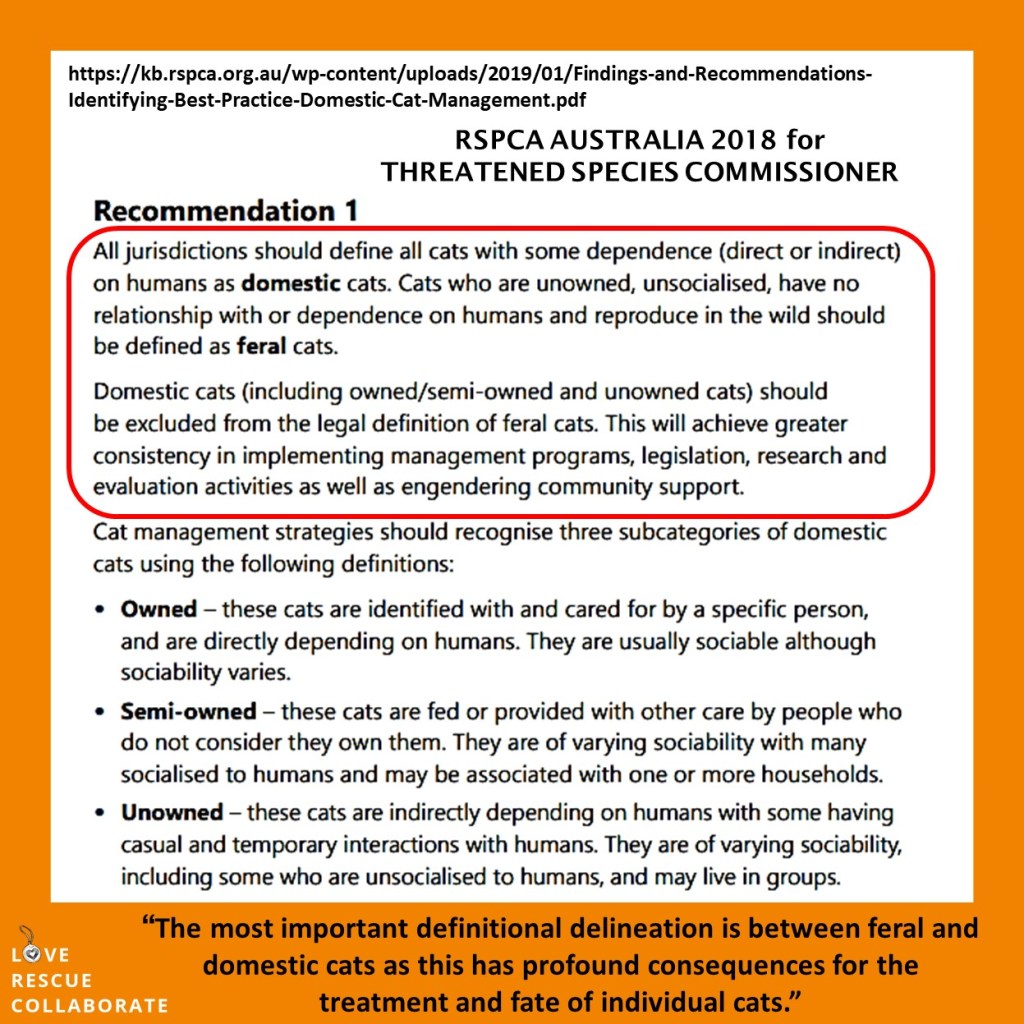
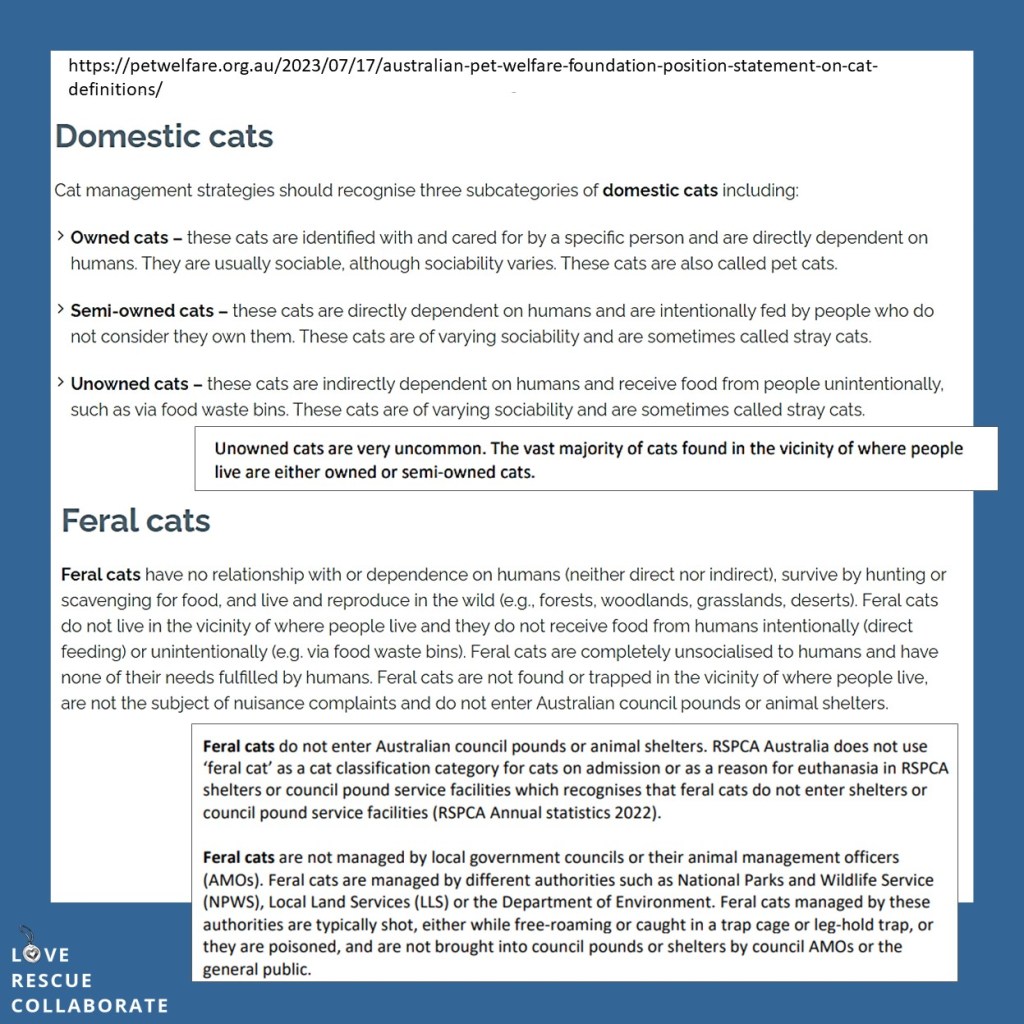
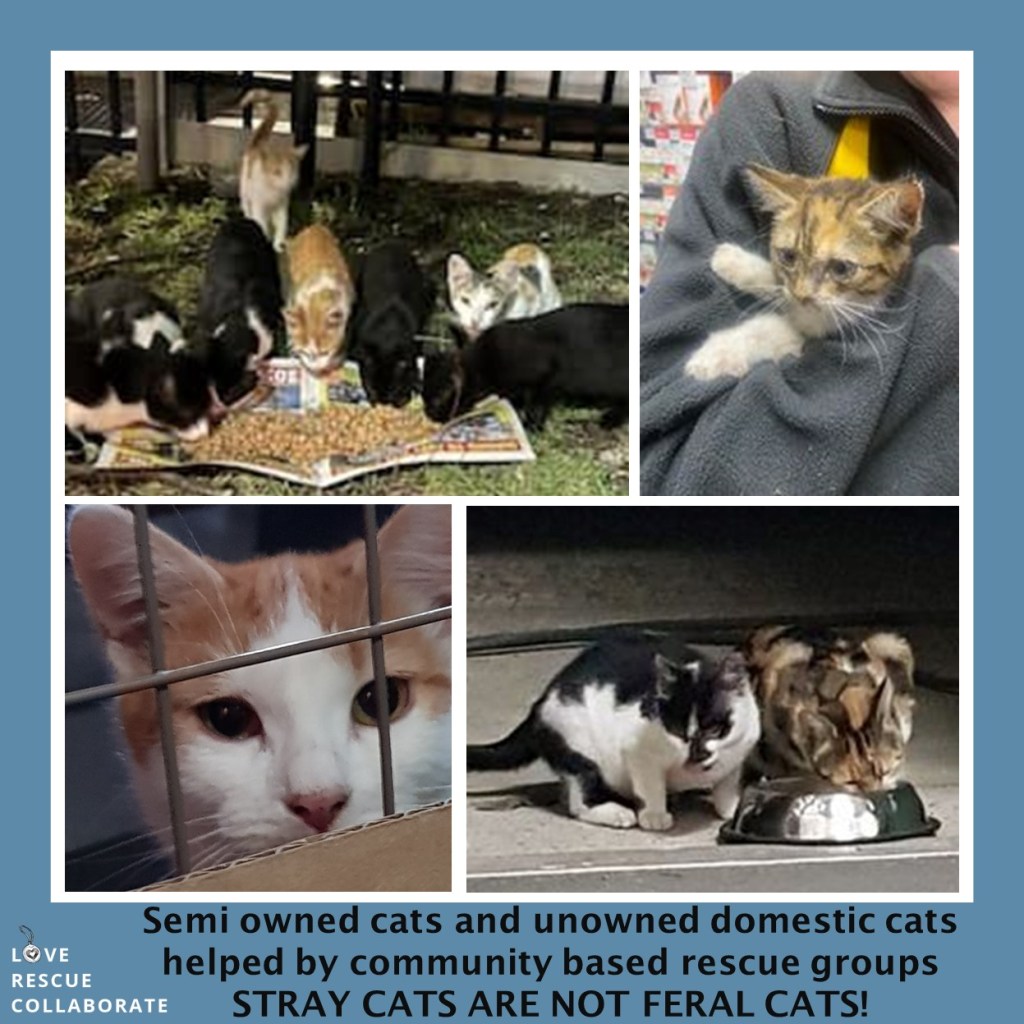
Contrary to our federal government proposal, the animal welfare experts define stray cats as domestic semi owned (eg community cats, colony cats etc) and unowned (many being recently abandoned) & that stray cats are NOT feral cats.
If this changes it means no more rescuing nor rehoming for stray cats labelled as a PEST animal as are feral cats & foxes.
The LRC team is offering help to respond to the draft Threat Abatement Plan (TAP) focused on feral cats. Of greatest concern is that this draft TAP includes a significant scope creep to treat stray cats as feral cats with the same lethal approaches, which has not been transparent, and the draft TAP was developed without the engagement of key experts in domestic cat management.
Here’s a TOC for this BLOG – we are updating information in steps
- Simple Guides
- Where is the draft TAP & where to submit a response?
- 3 ways to provide a submission
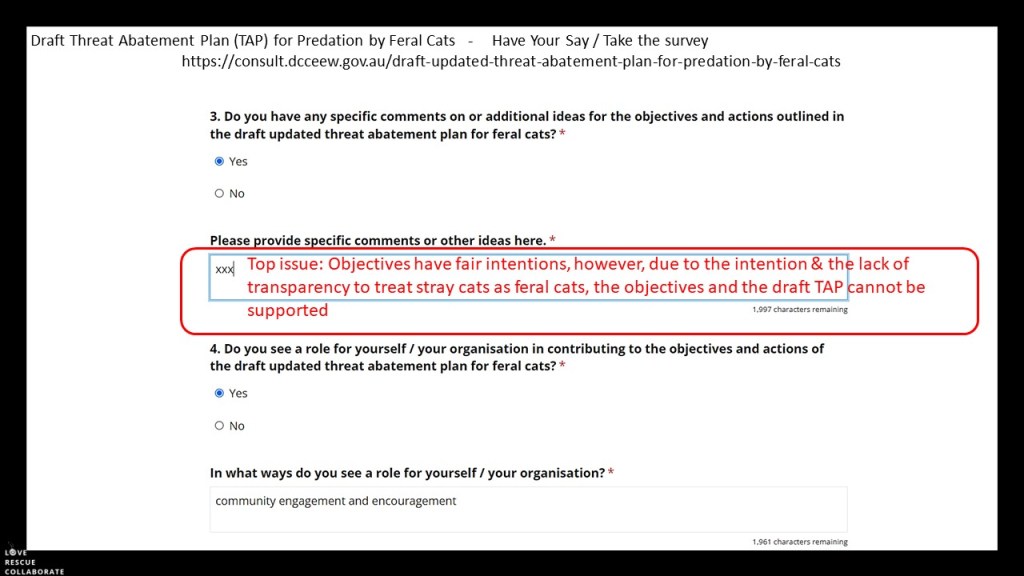
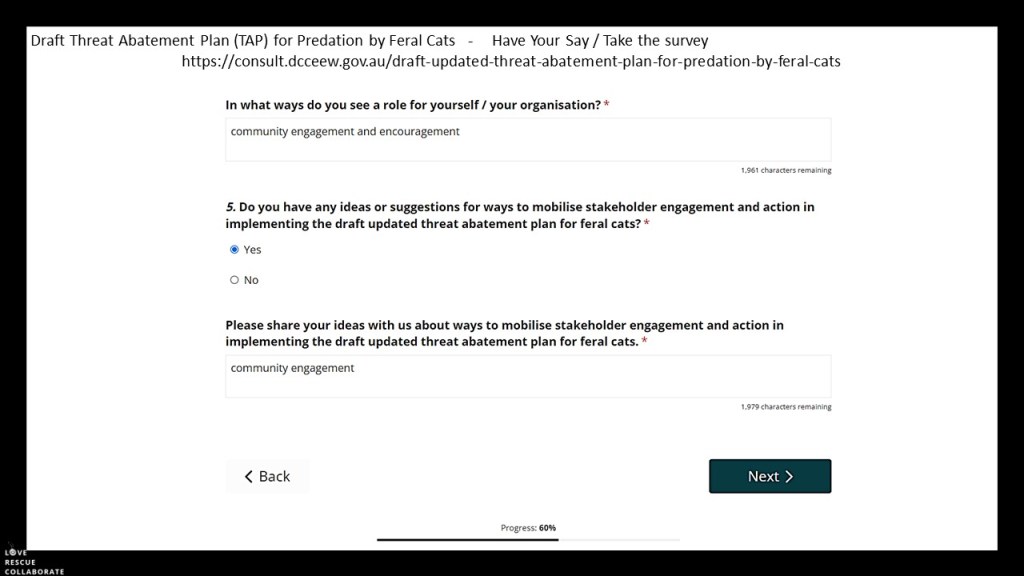
- What does the survey look like?
- LRC Top Issues for those with very limited time
- Background on the proposed re-classing of strays cats as feral cats
- LRC Top Issue #1 : Stray cats should NOT be classed as feral cats!
- LRC Top Issue #2 : Domestic cat management should NOT be under the scope of feral cat management!
- LRC Top Issue #3 : Stop the killing instead of rehoming of many tens of thousands stray domestic cats each year, and impacts to their carers / rescuers
- LRC Top Issue #4: Tanya’s news video with domestic cat images, the Felixer Machine which has software bugs & kills other animals, and 1080 the inhumane poison
- The Australian Pet Welfare Foundation top issues & to which draft TAP sections these apply
- Vigilante / concerned citizen trapping roaming cats & worse
Simple Guides
Stop the designation of stray cats as a subset of feral cats, as this means all “street” cats (be they abandoned or under care in colonies, community programs, etc) will be destroyed as a pest animal. There will be no rescue nor rehoming by any organisation or individual, these cats will now be treated like foxes.
For those with just mobile access or other limited online access
Here is suggested wording for you to customise a simple response due 4pm Monday 11 Dec 2023. If you reside in Australia, complete the following submission linked below.
STEP 1: Go to: https://consult.dcceew.gov.au/draft-updated-threat-abatement-plan-for-predation-by-feral-cats
Scroll down to the HAVE YOUR SAY, and click on the TAKE THE SURVEY button
STEP 2: Complete the personal information
STEP 3: You MUST complete the first 5 mandatory questions of the survey:
1. Have you referred to and / or used the current (2015) threat abatement plan for predation by feral cats? select YES
How have you referred to / used the 2015 plan? E.G. To confirm that stray cats were a separate category
2. Do you support the objectives and actions listed in the drafted updated threat abatement plan select NO
3. Do you have any specific comments on or additional ideas for the objectives and actions outlined in the draft updated threat abatement plan for feral cats? select YES
Please provide specific comments or other ideas here [EG below, plus more at the end of this guide if you are able to add more]
I oppose the stray cat category being changed to be a subclass of the feral cat category, if classed as a feral cat pest animal then all stray cats will be also be killed, and not rescued nor rehomed. This is not clearly explained.
4. Do you see a role for yourself / your organisation in contributing to the objectives and actions of the draft updated threat abatement plan for feral cats? select YES
In what ways do you see a role for yourself / your organisation?
E.G. Community engagement, education, community cat rescue and rehoming, adoption of stray cats
5. Do you have any ideas or suggestions for ways to mobilise stakeholder engagement and action in implementing the draft updated threat abatement plan for feral cats? select YES
Please share your ideas with us about ways to mobilise stakeholder engagement and action in implementing the draft updated threat abatement plan for feral cats
E.G. I support reducing the number of domestic cats with free targeted high intensity desexing, APWF Community Cat Programs, Oscar’s Law, supporting community rescuers & vets with grants for desexing and rehoming cats
STEP 4: (skip question 6 subsections these are optional responses) complete 7 and 8 questions
7. Do you have any feedback to provide on the background document? select NO (unless you have read it)
8 – Rate your overall impression of the draft Updated Threat Abatement Plan for Predation by Feral Cats Select Very Poor for all 3 areas
as the draft TAP and its consultation process are flawed & lack relevant information
STEP 5: SUBMIT your survey 😊
————————
OTHER CONCERNS FOR STEP 3, Q 3 if you are able to easily add:
- The draft TAP lacks transparency on the significant change to stray cats, as the stray category has “disappeared” and each reader is left to interpret the outcomes of this.
- I support our council pounds, animal welfare organisations, community rescue groups, and any individual to continue to rehome abandoned stray cats/kittens, many tens of thousands of abandoned stray cats find new owners each year. Stray cats are domestic cats: semi owned or unowned (RSPCA, APWF).
- Domestic cat management policies and practices need to include experts such as APWF, AVA, AIAM, AWL QLD, must be in a separate group and plan not under the Feral Cat Taskforce nor Invasive Species, and be based on proven scientific evidence based research.
- The draft TAP lacks domestic cat management information that should be acknowledged for the best proven solutions for responding to domestic semi owned and unowned cats.
- I oppose community based enabled trapping as there is no possible enforcement of controls for the humane treatment of the cats, and it is likely to further incite cat haters to trap roaming cats, regardless of the cats being owned or semi owned or other, with potentially lethal consequences (animal cruelty).
- Poisoning and shooting actions are not humane treatments for cats. I oppose a) engaging with shooting clubs/organisations b) 1080 and the Felixer Machine as these kill native and other animals, and are likened to being electrocuted for days by a vet.
- The draft TAP lacks clarity on the legal implications for stray cats at/from the date the draft TAP is approved.
- The Have Your Say process is not effective nor efficient, it is difficult for engagement with citizens & those on mobile phone devices, with no simple way to provide a reasonable submission, beyond this.
—————————–
Reside in another country? please contact Tanya Plibersek, the Minister https://www.tanyaplibersek.com/contact/
Want to know more? refer to: https://petwelfare.org.au/response-to-draft-tap/ and/or https://loverescuecollaborate.org/2023/11/23/australian-draft-threat-abatement-plan-for-predation-by-feral-cats-due-4pm-11-dec-2023/
Questions? Contact: https://www.facebook.com/loverescuecollaborate
Other earlier guides with more information
Two of our earlier versions of the guide
Here’s our simple guide to raising the essential issues that stray cats should not be a subset of feral cats & domestic cat management should not be under the feral cat plan. In MS Word and PDF formats. We also offer a more comprehensive guide below. Perhaps you have adopted a stray cat? at the end of the online survey you may upload a file which may be a photo of the cats you have helped 🙂
Our next guide with Top Issues is a little bit more, which contains other important points is below. We provide suggestions for responses, please feel welcome to add your own words, including your background and experience with saving, rescuing, and rehoming stray cats (abandoned domestic cats to the streets, managed community cats or colony cats, or just one or more in a group for which you provide care). The top issues are described below in our BLOG, if you would like to know more on these.
Where is the draft TAP & where to submit a response?
Draft Threat Abatement Plan (TAP) for predation by feral cats, including the Background document and appendices for each:
https://consult.dcceew.gov.au/draft-updated-threat-abatement-plan-for-predation-by-feral-cats
Scroll down the same page to find the “Have your say” with its Survey button.
Don’t forget Q8 to rate your overall impression of the draft TAP: “Very Poor”?
3 ways to provide a submission
There is no simple way to provide a submission. It is suggested you draft a response and keep a copy yourself.
- Provide your response/ submission via the online “Survey”, noting that it includes three sections: your personal information & privacy needs; 5 survey questions for which any free form responses have a limited length in characters indicated; and the sections of the draft TAP which appears not to be limited. And you may at the end, upload a document and associated files.
- Provide the bulk of your response in say a MS Word document/ PDF, but only at the end of the survey process, therefore you still need to complete the personal information & privacy needs; for the first 5 questions you still need to enter responses there; though you may skip over responses to the draft TAP headings/sections.
- Send an email or hardcopy, with a privacy & personal information form (which will need to be printed, completed by hand, then scanned/photo-ed) :
“Complete this form and submit it to invasivespecies@dcceew.gov.au if you are providing a
submission via email, or post it with your hardcopy submission to:
Department of Climate Change, Energy, the Environment and Water
Attention: Threatened Species Commissioner Branch / Threat Policy and Planning Section
(invasivespecies@dcceew.gov.au)
GPO Box 3090
Canberra ACT 2601
Australia”
What does the survey look like?
(Skipping the personal information & privacy choices.)



LRC Top Issues for those with very limited time
Background on the proposed re-classing of strays cats as feral cats
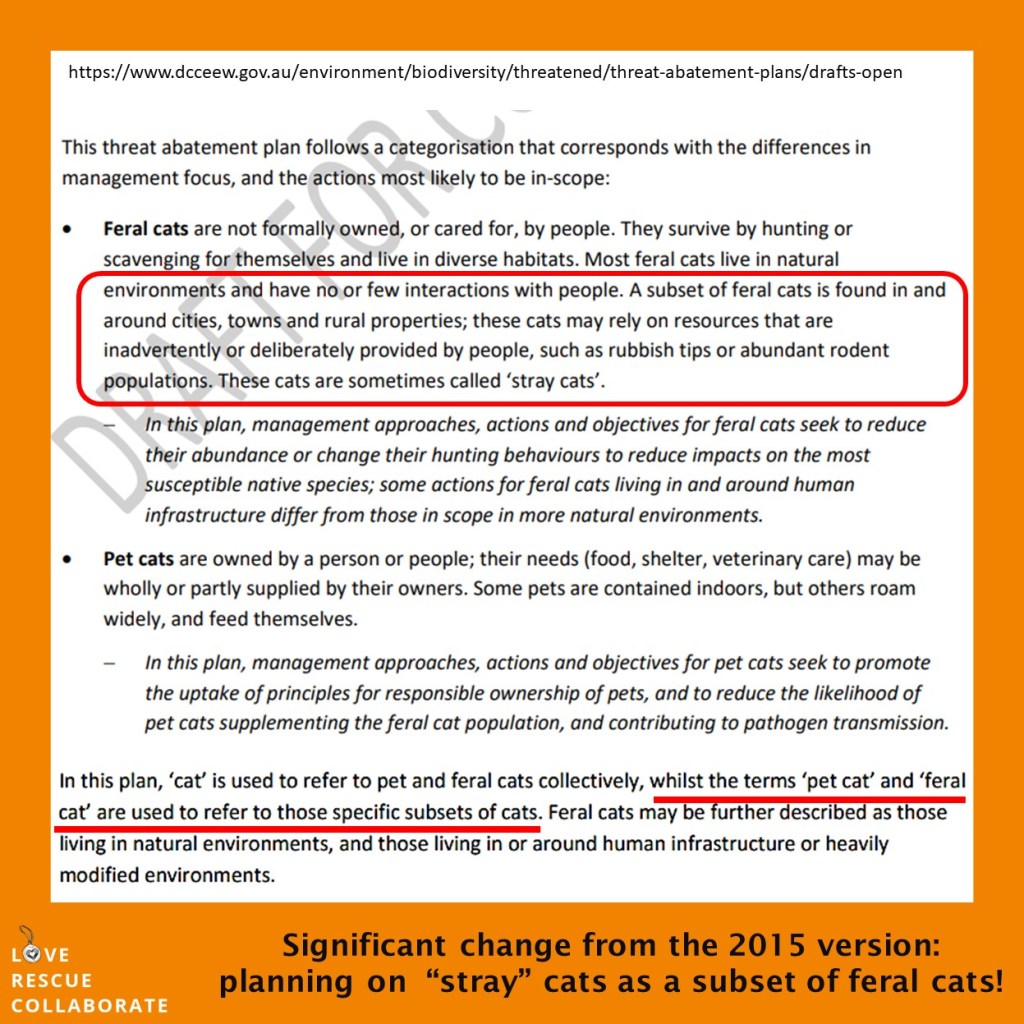
Look into the fine print in the draft TAP section 3.1 to find that stray cats have become a subset of feral cats.
The Department of Environment (DoE) removed the separate category for stray cats, and removed other references in the draft TAP that existed in the 2015 TAP . In this new draft, this is now the ONLY place where the “stray cats” term is used.
The 2015 TAP shows stray cats as a separate category, separate from domestic owned cats, and separate from feral cats.
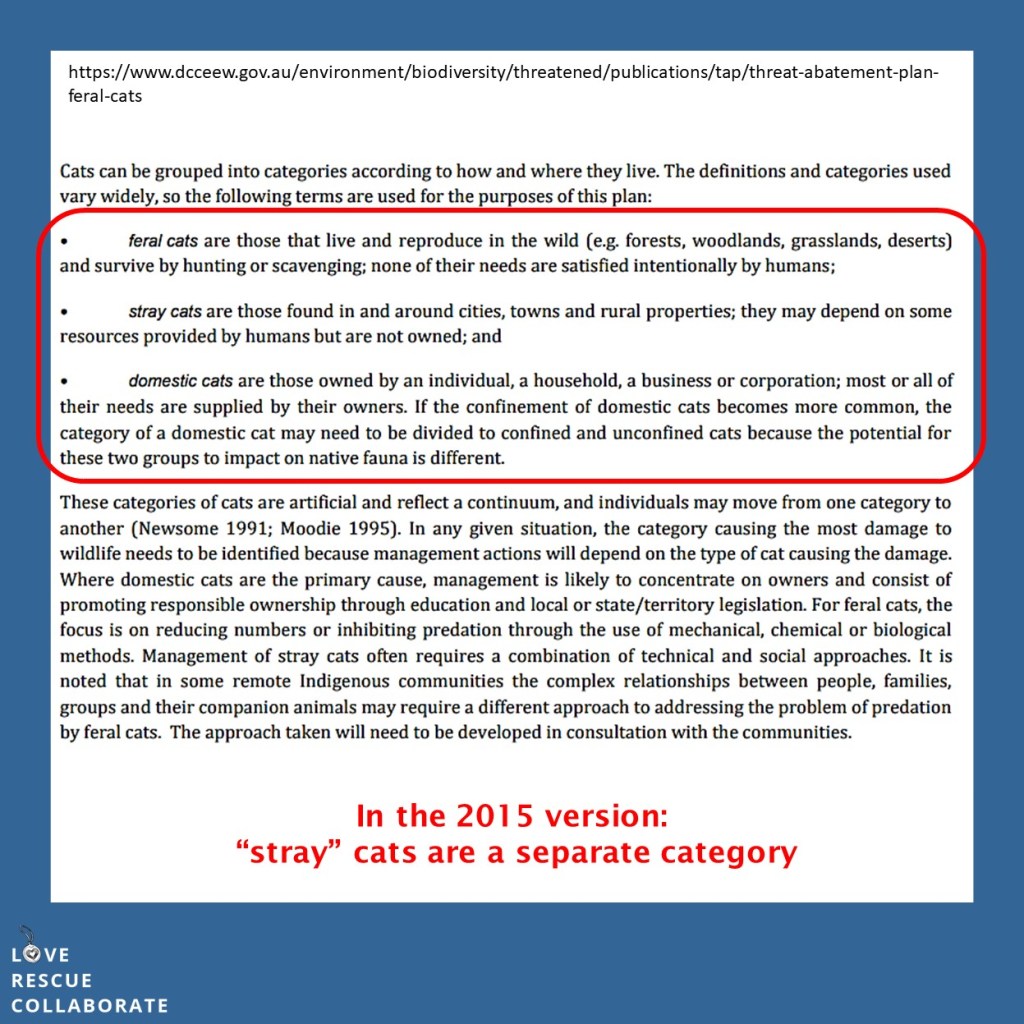
2015 Threat Abatement Plan for feral cats can be found here:
LRC Top Issue #1 : Stray cats should NOT be classed as feral cats!
In response to the draft TAP section 3.1 Cat definitions, the reclassing of stray cats to be a subset of feral cats and applying the same lethal approaches is strongly opposed. Stray cats are domestic cats, and have been identified as domestic semi owned and domestic unowned cats since 2018, by the Royal Society for Prevention of Cruelty to Animals (RSPCA) Australia for the Threatened Species Commissioner. Since then the Australian Pet Welfare Foundation (APWF) has been promoting and evolving these same terms, with community cats and others being subclasses of the domestic semi owned cats category based on scientific evidence. It is strongly recommended that the term for stray cats must be reinstated and renamed to domestic semi owned and unowned cats, aligning with the RSPCA and APWF expert advice.
If you would like to add more… feral cats are classed as “pest” animals and are to be destroyed, and not rehomed nor rescued
- “In 2015, environment ministers made a commitment to the national declaration of feral cats as a pest, and most jurisdictions accordingly now recognise feral cats as a pest. Feral pest species are to be destroyed (not rescued and rehomed). Throughout the draft TAP, wherever the feral cat term is used, the same responses and actions would then appear to apply to stray cats. As cat definitions are non-existent or loose in each state/territory legislation, it may also be implied that from the date the TAP is approved by the Minister, the TAP cat definitions will flow down to all legislation in states/territories and all local governments.” APWF response to draft TAP
- The 2018 RSPCA cat terms and definitions have also been supported by many trsuted and respected animal welfare organisations: the Australian Institute of Animal Management (AIAM); Animal Welfare League QLD; Cat Welfare Society Inc. T/A Cat Haven; Australian Veterinary Association (AVA).
- Stray cats are domestic semi owned or unowned cats do not deserve to be poisoned, shot or trapped to be killed immediately on site like feral cats.
- Tens of thousands, if not over one hundred thousand stray cats are taken in and rehomed each year around our nation, from council pounds through community based rescue groups. Domestic semi owned and unowned cats deserve the opportunity to be rehomed, not killed asap.
- Carers & community rescuers of stray / semi owned and unowned cats do not deserve to be treated as providing illegal assistance to a “pest” animal – groups and even cat Rehoming Organisations may be shut down or worse.
- Vets and council staff do not deserve to be engaged in killing/ euthanasing tens of thousands of stray cats per year.
- Encouraging citizens in self trapping and destroying stray cats is viewed as negligent due to the lack of controls and enforcement, and likely to encourage animal cruelty. The guidelines for destroying feral cats are not monitored effectively in action nor are there enforcement roles.
Reference Sources
[AIAM submission #63 https://www.aph.gov.au/Parliamentary_Business/Committees/House/Former_Committees/Environment_and_Energy/Feralanddomesticcats/Submissions]
[Animal Welfare League QLD submission #87 https://www.aph.gov.au/Parliamentary_Business/Committees/House/Former_Committees/Environment_and_Energy/Feralanddomesticcats/Submissions]
[Cat Welfare Society Inc. T/A Cat Haven submission #161 https://www.aph.gov.au/Parliamentary_Business/Committees/House/Former_Committees/Environment_and_Energy/Feralanddomesticcats/Submissions]
[AVA Management of cats in Australia – Policies https://www.ava.com.au/policy-advocacy/policies/companion-animals-management-and-welfare/management-of-cats-in-australia/]
LRC Top Issue #2 : Domestic cat management should NOT be under the scope of feral cat management!
In relation to the draft TAP section 5 Cat management, for the management of feral cats must not include domestic cat management responsibilities. It confusingly and wrongly presents lethal cat management options for ALL cats, including “poison-baiting (deployed from the ground or air)” and “Trapping, hunting and shooting”. Domestic cats includes: owned cats; and semi owned and unowned cats ( terms supported by RSPCA, APWF, AWL QLD, AVA for stray cats). Different approaches and strategies are required for each different cat category as supported and promoted by experts in the animal welfare field to the federal government in the past (RSPCA, APWF, AVA, AIAM, AWL QLD, etc). Stray cats are domestic not feral cats. Roaming or abandoned domestic cats do not immediately become feral cats in nature and behaviour. It is recommended that cat management policies, processes and procedures for ALL domestic cats be the responsibility under an independent office of animal welfare, with a national group, heavily involving expert stakeholders in domestic cat knowledge and scientific evidence-based research.
The APWF assessment is fully supported: “The draft plan reflects lack of consultation with expert scientists in contemporary urban cat management. The proposed actions in the plan regarding cat curfews, caps on cat ownership and restricting ownership of cats in local government areas demonstrates a lack of understanding of the cause of the free-roaming cat problem in our cities and towns based on current Australian research. Therefore, the proposed solutions are highly flawed, will be costly to enforce and will be ineffective at protecting wildlife populations of concern.” APWF Response to draft TAP
What does work? and what doesn’t? “The scientific basis for contemporary community cat programs shows that when high intensity desexing of all cats, targeted to areas of high cat impoundments or complaints, is combined with components of trap-adopt-or-return home methods, this can be successful in managing semi-owned and unowned cats in urban areas. There are now half a dozen publications documenting the basis for successful trap-adopt-or-return home programs at the suburb or city level (Levy et al. 2014, Spehar 2017, 2018a, 2018b & 2019, Kreisler et al. 2019). …Notably, there are no reports in the Australian or international literature of high intensity trapadopt-or kill programs being successful at the city or suburb level.” (APWF https://petwelfare.org.au/wp-content/uploads/2023/09/APWF-Submission-to-Inquiry-of-Feral-Domestic-Cats-2020.22.jr_.n-t.pdf)
If you would like to add more… further supporting expert advice
The AIAM assessment is fully supported:
- “These two distinct populations of cats [domestic and feral cats] require different approaches to their management.
- Cultural norms are quickly becoming more critical and less accepting of traditional methods of cat management. The community is placing considerable pressure on Local Government that wholesale euthanasia is not acceptable in 2020 and beyond.
- Domestic cats who are accessible to humans and veterinary resources can and should be managed more ethically and effectively with other methods than those being used currently for feral cats i.e. baiting, shooting.
- Now is the time to explore alternative management options that fit with community
expectations and respects the human-cat bond.”
The Animal Welfare League Qld assessment is fully supported:
- “Revise definitions of domestic cats to be consistent across local, state and
federal governments to include owned, semi-owned and unowned cats in urban and suburban environments and living within several kilometres of rural homes and barns. This is to enable legislation and policy for these domestic cats to be separate from feral cats. - Define stray cats in urban, suburban and farm areas as wandering cats who may be owned, semi-owned or unowned.
- Prioritise ethical, acceptable and effective strategies i.e. those which
maximise well-being of people and minimise death, harm and suffering, rather than negative categorising of cats as “pests” to enable more harmful behaviours.”
The Cat Welfare Society Inc. T/A Cat Haven assessment is fully supported:
“Domestic cats do not become “feral”, the link between feral and domestic cats can be
attributed to an unsterilized domestic cat wandering, and as a result breeding, with the
resulting offspring not receiving any human contact.
A domestic cat can fall into three categories: a cat that is owned, a cat that is semiowned, or an unowned domesticated cat. These cats are vastly found within urban areas, and are the overwhelming majority that are successfully rehomed through community-based rescue groups and shelters such as Cat Haven.”
The AVA Cat Management policies are fully supported:
- “The management of cats in Australia must be evidence-based, must prioritise animal welfare, use practices that mitigate negative impacts to animals, and have clear measurable outcome-based objectives which are reported transparently.
- Effective cat management programs involve all stakeholders working together in a coordinated collaborative manner. Appropriate stakeholder engagement and education is also essential.
- Practices used to manage cats need to be targeted to the specific cat population (i.e. owned, semi-owned, unowned or feral cats). They should aim to improve cat welfare, minimise cats’ negative impacts and, where possible, use non-lethal management.
- Adequately funded research to continually improve knowledge and to advance best-practice cat management is essential.“
Reference Sources
[https://petwelfare.org.au/response-to-draft-tap/]
[AIAM submission #63 https://www.aph.gov.au/Parliamentary_Business/Committees/House/Former_Committees/Environment_and_Energy/Feralanddomesticcats/Submissions]
[Animal Welfare League QLD submission #87 https://www.aph.gov.au/Parliamentary_Business/Committees/House/Former_Committees/Environment_and_Energy/Feralanddomesticcats/Submissions]
[Cat Welfare Society Inc. T/A Cat Haven submission #161 https://www.aph.gov.au/Parliamentary_Business/Committees/House/Former_Committees/Environment_and_Energy/Feralanddomesticcats/Submissions]
[AVA Management of cats in Australia – Policies https://www.ava.com.au/policy-advocacy/policies/companion-animals-management-and-welfare/management-of-cats-in-australia/]
LRC Top Issue #3 : Stop the killing instead of rehoming of many tens of thousands stray domestic cats each year, and impacts to their carers / rescuers
In response to the draft TAP section 5 Cat management, if stray domestic cats are a subclass of feral cats, and like feral cats are to be destroyed without the opportunity to be rehomed, then this significantly impacts many tens of thousands of cats nationally, as well as the people who care for them. Council pounds, shelters and vets will become killing machines rather than rehoming facilities. This also takes a psychological impact to pound, shelter, vet and community based rescuers. Killing tens of thousands of domestic cats nationally each year, takes Australia back several decades. It also is recognised that the mental health toll on vets, shelter staff and community rescuers may lead to significant issues for our governments. It is recommended that instead, our government invest in One Welfare, proven rehoming practices, and proven approaches for semi owned and unowned cats. Refer to Australian Pet Welfare Foundation for best cat management practices [https://petwelfare.org.au/2017/07/13/best-practice-communities-shelters-pounds/]
If you would like to add more… who is involved in rehoming abandoned / found domestic cats and how significant is the impact to cat carers/ rescuers when they are under threat
Potential impacts to stray cats & rehoming organisations and individuals
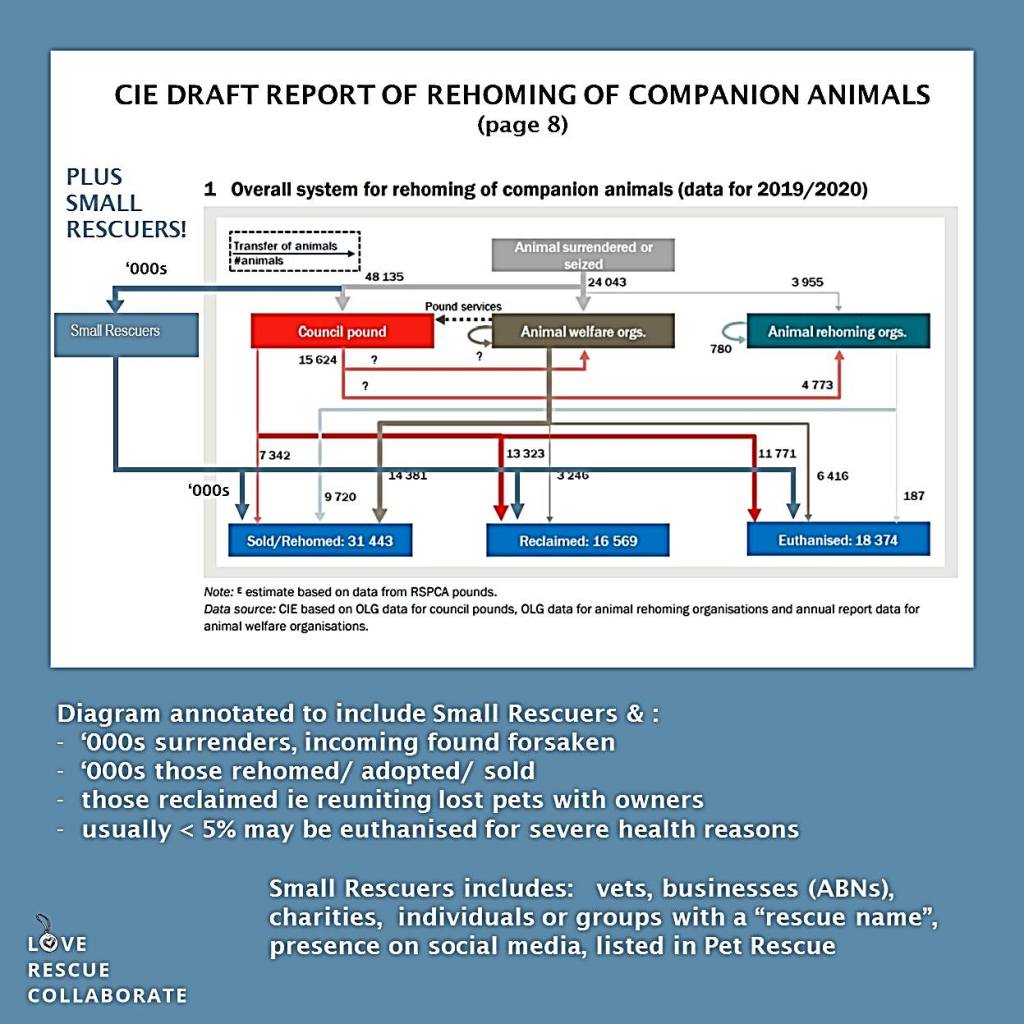
The diagram from the draft report for the NSW review to increase rehoming and reduce euthanasia performance by council pounds, was updated by our team and also submitted to the NSW Pound Inquiry. It was annotated with the community (small) rescuers and vets who help abandoned cats from the streets etc. In NSW it is estimated that there are over 100 community rescuers and vets who assist collectively with taking in and rehoming thousands of stray / semi owned and unowned cats per year. The diagram reflects dog and cats numbers.
It is further estimated that currently many tens of thousands of abandoned / stray cats are being rehomed around the nation (all states and territories). This estimate also takes into account that several years ago, it was not uncommon for around 250,000 cats to be euthanised around the nation each year by the large animal welfare organisations and council pounds.
It is believed that under the draft TAP, each year many tens of thousands of cats who are semi owned or unowned cats across our states and territories will no longer be given the opportunity to be rehomed and find new families, instead these cats will be poisoned, shot or trapped to be killed / euthanased.
By just shifting the stray cat category to be a subset of feral cats rather than as a separate category as in the 2015 TAP, this implies that if and once the new draft TAP is approved, then as in each state and territory as there are “loose” or non existent definitions for categories of cats, that:
- the existing feral cat legislation and supporting protocols, processes/ procedures will then apply to stray cats, both semi owned domestic cats (eg in communities or colonies managed by carers), or unowned domestic cats (eg roaming abandoned cats)
- both feral cats and stray cats (semi owned and unowned cats), must be destroyed and not rescued and rehomed(as a “pest” animal, like a fox)
- the activities to care for, take in and rehome stray / semi owned and unowned domestic cats may be seen as illegal (eg in the past the Qld authorities have already charged feral cat feeders)
- across our nation, all council pounds, the large animal welfare organisations (eg RSPCA, AWL, CPS, etc), hundreds of vets, and hundreds if not thousands of largely volunteer based cat rehoming and community based rescue groups and individuals (carers), will need to cease caring for, and taking in strays as semi owned or unowned domestic cats for rehoming etc.
Impacts to community based cat carers and rescuers when their cats are under threat or harmed
Killing semi owned and unowned cats, deeming rescue and rehoming as illegal activities, and closing down rescue and rehoming outcomes for abandoned domestic cats will also have a significant devastating impact on rescue/ carer groups and individuals. Carers and rescuers have an extremely strong bond with the cats under their care.
In NSW alone, each year tens of thousands of cats are rehomed by the council pounds, the large animal welfare organisations, designated rehoming organisations, which in 2019/2020 provided new families for over 30,000 cats and dogs in NSW. In addition to these organisations who provide reports to the NSW government, there are veterinarians, and small community-based rescue organisations and individuals (sometimes considered carers), who also take in, desex etc and rehome cats. In NSW alone, there are hundreds of these groups and individuals across the state, who are believed to collectively rehome thousands of cats each year. and may no longer do so as the stray cats are to be killed.
For example, the impact of the shooting “cull” incident on the Newcastle Stockton breakwall cats (domestic semi owned cats) and their rescuers/ rehomers/ carers has been researched, including:
“caregivers described the scene they were met with on the morning after the event using words such as ‘horrific’ and ‘bloodbath’. In response to this event, caregivers described their immediate emotional responses using words such as ‘traumatic’, ‘mortified’, ‘disbelief’, and ‘shock’. Their immediate responses to the cull also included feelings of betrayal”
“the severity of the adverse psychological impacts, and the morbidity rate amongst the cat caregivers we interviewed, was far greater than would be expected as a risk to the community if the cats had remained at the site. We therefore suggest that potential legal ramifications should be considered before authorities intentionally choose a method of management that is likely to inflict substantial harm on community members.” [https://www.mdpi.com/2076-2615/13/2/271]
LRC Top Issue #4: Tanya’s news video with domestic cat images, the Felixer Machine which has software bugs & kills other animals, and 1080 the inhumane poison
In response to section 5 Cat Management (poison baiting, trapping, hunting and shooting techniques), there are a number of significant concerns with the Tanya Plibersek MP promotion of the draft TAP for feral cats, using multiple images of likely domestic cats, showing the Felixer Machine for which the developers admit has software faults and hits other animals, and the use of the extremely toxic inhumane 1080 poison which is likened by a vet as being electrocuted for days and is not at all like the big fat lie that animals go away to die quietly.
It is recommended to cease use of 1080, the Felixer Machine and to invest in other approaches such as “accepting the cats are here to stay in some form for a while, and building the capacity for our native animals to cope” (Doctor Katherine Moseby).
Domestic stray cats are not feral cats, domestic cats should not be treated with the same lethal solutions. There should be different strategies and actions to reduce their numbers as defined under a separate domestic cat management plan, which the draft TAP should recognise. These draft TAP and related proposals are strongly opposed:
1080 is an inhumane poison that is not instant and not painless, likened to being electrocuted for days and will kill native animals as well as introduced species. It has been banned in other countries for decades, our governments must cease using 1080 (RSPCA, Howard Ralph Veterinarian, Animal Liberation Australia).
The Felixer Machine, inappropriately named after a domestic cat icon, for which developers admit there are faults / software bugs, has a likelihood of hitting other native animals (quolls, dingo pups), includes constraints with AI and photo identifications being based on human intervention, with the potential to be used on domestic cats in suburban areas (PetSmart/Invasive Species Solutions, Thylation the developers).
Tanya promotion to launch the new draft TAP (video) promoting 1080 and the Felix Machine on Channel 9 [https://youtu.be/4iHJa7W7t94] includes:
- The Thylaton representative describing that a cat hit with the highly toxic poison “dies quite peacefully” which is incorrect, as 1080 causes an excruciating death.
- The blurring of the lines between feral cats and domestic cats, mainly in the form of the images used, and the lack of mentioning that the feral cat term in the draft TAP is proposed to be expanded for stray cats who are domestic semi owned and domestic unowned cats, ie that stray cats may also be targets for the Felixer Machine, shooting programs and increased baiting, shooting etc.
- Video of a domestic cat in a typical suburban backyard is used during the initial discussion of the Felixer Machine to lure feral cats. Multiple images of cats used throughout the program are likely domestic cats, as feral cats avoid humans and would not be still even for a photo.
- Tanya confidently claiming “cats kill about six million animals every night in Australia” repeating the misleading figures based on assumptions rather than evidence based science.
- The promotion video also includes that feral cat shooting programs, increased use of baiting will be used without any further explanation, nor that this will impact stray cats as a subclass of feral cats.
If you would like to add more…
1080 an Inhumane Poison
1080 is not humane, not instant, not painless, it kills all animals: natives and introduced.
“Veterinarian, Howard Ralph, stated “1080 poisoning is like being electrocuted for two-plus days”.”
“…has been banned in most countries, due to concerns for humans and non-target species. Its use was banned in the United States in the early 1970s after people died. Australia and New Zealand use 95% of the world’s 1080″
“1080 poison is a chemical used to kill unwanted or unwelcome wildlife across Australia. It is a white, odourless, and tasteless poison and is considered a chemical of national security concern by the Federal Australian government, based on its fatality to all lifeforms. It is one of the most toxic substances found anywhere on earth and is in the same restricted regulatory schedule as other notorious poisons like arsenic and cyanide.”
Death “…can take anywhere from half an hour to up to 48 hours. During this time, the victim experiences severe suffering and stress. They endure prolonged seizures, bleeding from bodily orifices, including the eyes, mouth, and anus. There is no antidote to 1080 poisoning. Scientists from the RSPCA have concluded that 1080 is not a humane poison.”
“…1080 targets the body’s natural functioning and disrupts the animal’s CNS and heart. Animals who ingest 1080, exhibit signs of extreme distress and pain. They are noted to scream, cry, vomit, defecate, and suffer violent and prolonged seizures [8]. People who have witnessed animals dying of 1080 state that they often run into walls or objects and lose control of their limbs [9]. They die with a final convulsion up to 48 hours (two entire days) after ingesting the poison”
“Governments across the country use it to kill dingoes, possums, wallabies, pademelons, rabbits, foxes, pigs, and cats.”
Animal Liberation Australia [https://www.al.org.au/ban-1080#gsc.tab=0]
Wild Woman Wildlife Rescue on native animals being killed with baits
‘Signs “Warning 1080 bait laid here” and instantly I knew . My poor babies did suffer ! They had died a long agonizing death . It didnt seem fair ..
Now Ive never been one to care what other people do , unless of course it affects me or my children. Well I believe THIS affects ALL of us . This is one of our rarely seen extremely special natives !
Through the first lot of baiting I lost a total of 12 bandicoots , entire families went down. I had to lift their helpless little bodies , some still just hanging on and either bury them or attempt to save them once again . Not 1 survived and I can no longer release from my property … I have no bandicoots left , none . I used to sit on my verandah at night and watch them as they came into the joeys yard for pellets but I have not seen even 1 for months .. I cannot understand how 1080 is still legal to use . It targets every species and rarely gets the one they say they are targetting .. ‘
Wild Woman Wildlife Rescue [https://www.facebook.com/wildwomanwildliferescue/posts/pfbid09VupHQeq95vFaqGF4SDSpsFEZQr6PiQDxytsue9CPmauCX8iYjUnMwqh9sfh3y7Zl]
ABC Report
The ABC report on tests in SA included that the device “uses lasers and poison gel to kill feral cats and foxes” in a trials “on Kangaroo Island and the remote Anangu Pitjantjatjara Yankunytjatjara (APY) Lands, …[and] Arid Recovery nature reserve, near the state’s Roxby Downs”.
This report also interestingly included:
“Some of the other trials around Australia have had very low levels of non-target firings”
“We’re trying to train native animals to cope with a certain number of feral cats because we’d like to have bilbies and bettongs surviving outside fences one day” (Doctor Katherine Moseby)
“…we’re being practical about it, accepting the cats are here to stay in some form for a while, and building the capacity for our native animals to cope”
ABC [https://www.abc.net.au/news/2020-05-29/feral-cat-management-device-felixer-tested-at-animal-reserve/12296874?]
FELIXER Machine
Felix Machine Developers and Invasive Species Solutions webpages include:
- Misinformation on impacts of cats on wildlife eg “Cats have driven many mammals and some birds to extinction”, when this cannot be conclusively proved.
- Admit that other animals may be targeted eg potentially the larger spotted-tail quoll, dingo pups, or other animals of this size.
- Admit there are bugs “software faults” and software upgrades “fixes” for problems, and the machine is not perfect.
- There is no way to differentiate a feral cat from a domestic cat, though the AI software version claims it is to minimise false positive targeting… and its weakness may be the gathering of photos that need to be verified by humans who likely cannot tell a photo of a feral cat from a domestic cat from a photo.
- Further research is needed to confirm or optimise efficacy at fox control (meaning the machine and software need further work).
- “Thylation received $1.2M in grant funding from the Australian Government’s Environment Restoration Fund to support the commercialisation of Felixers” in 2020
- Biased information in “studies”/ reference works against cats is included under the developers webpage.
[https://pestsmart.org.au/toolkit-resource/felixer-feral-cat-grooming-traps-under-development/, https://thylation.com/felixer-faqs/, https://thylation.com/resources/%5D
Tanya video promotion of draft TAP
Below is a very brief list of interesting aspects presented, with words to the effect presented/ spoken during the video.
Around 10 secs: “the federal government plan which may affect your pet cat”
17 secs: “the Felixer which lures in feral cats”
20 secs: a short video clip of a domestic cat going through a broken wooden fence, the type which is often used in suburban residences, with the presenter referring to a feral cat
28 secs: a tabby cat cut out image is moved in front of the machine (likely a domestic tabby as a feral cat would avoid all human contact for a photo for the image)
29 secs: presenter “the machine detects the shape of a cat, firing a toxic gel”
34 secs: the Thylaton representative :”the cat then will walk off, lick it… in a couple of hours it starts getting the symptoms it dies quite peacefully” contrary to all knowledge and research of the effects of 1080 and other poisons.
44 secs: taxidermy tabby with a parrot stuffed in its mouth.
48 secs: Tanya “cats kill about six million animals every night in Australia” repeating the misleading figures based on assumptions rather than evidence based science.
54 secs: presenter “the federal governments draft plan to tame the population of feral cats in Australia also includes a trial of feral cat shooting programs, increased use of baiting, and expanding cat free fenced off areas. For those with domestic cats, the plan is looking at desexing requirements, a household limit on numbers of cats, and a nation wide curfew to keep pet cats inside at night.
1:18: Tanya “about two thirds of animals that have gone extinct in Australia, have had cats as a factor” (gets cut short, and “factor” is not explained, eg where other contributing factors have played a bigger factor such as habitat clearing, fires etc)
1:26: video shows Tanya with a range of wildlife eg wombats, blue tongues, and a wallaby(?), noting these are not common prey of cats who generally prefer vermin (rats and mice).
1:39 : another tabby (most likely domestic rather than feral as feral cats would not choose to be physically close to humans)
1:41 : a still image of a cat with a small possum in its mouth (most likely domestic rather than feral as feral cats would not choose to be physically close to humans), and possums are not a threatened species and very common in suburban areas having become accustomed to urban environments with non native gardens and food sources from humans.
[Note, the LRC promotes cat enclosures by all cat owners, we do not agree with mandatory / legislation requirements as it is not easy nor easily affordable for every cat owner.]
The Australian Pet Welfare Foundation top issues & to which draft TAP sections these apply
The APWF advice can be found here:
APWF have on 5 Dec provided a new summary statement which can be found here:
In relation to sections 3 and 5 of the draft TAP, this PDF can be attached to your submission either as a PDF or a reference link, with you indicating in your submission that your fully support the APWF advice on the draft TAP.
It contains information on the following: 1. Cat Definitions, 2. Management of Domestic Cats, 3 Language, 4. Non-lethal Methods of Cat Management, 5. Evidence-based strategies to protect native wildlife of conservation concern, and 6. Targeted desexing.
The APWF response to the draft TAP also contains links to more detailed position statements on the following:
- Cat Curfews are not successful with the APWF position on Mandated Cat Containment
- Cat Definitions for domestic and feral cats, with a position statement
- Wildlife and owned and stray cats, with a position statement
Then scroll down for even more information on each of these.
Vigilante / concerned citizen trapping roaming cats & worse
Objective 2 and Object 9 include actions including shooting, baiting and enabling community member to complete trapping. These are included in our email simple guide near the top of this blog.
 LRC
LRC 
Omg .. kill the snakes and sharks not our cats that people have left them or past away
LikeLike
We support all animals, but understand your angst, the killing of domestic cats who have been abandoned by their original owner, and now are likely under the care of someone helping to feed, desex and rehome or denying these cats the opportunity to be rehomed in council pounds etc is government negligence and a horror to citizens
LikeLike