Across Australia many rescuers and carers as volunteers are providing assistance to the once abandoned cats in urban areas – and these efforts need to be clearly legal! Currently there are “grey areas” that need to be replaced with clear terms and definitions.
With care, food, and desexing, these little ones have opportunities to be rehomed. This involves the hierarchy of organisations from rescue groups, veterinary practices, rehoming organisations and animal welfare organisations too. The latter in New South Wales includes the Royal Society for Prevention of Cruelty to Animals (RSPCA) NSW, Animal Welfare League (AWL) NSW and the Cat Protection Society (CPS) NSW.
There are many domestic cat experts who have provided evidence and recommendations to the recent Inquiry for Management of Cat Populations NSW, and experts from other countries with highly relevant experiences applicable to the current review of legislation. This is a small sample of the advice and benefits for improving legislation to assist and enable to processes and the hard grunt by many volunteers in supporting animal welfare for the once abandoned community cats in urban areas.
- Sydney cat rescuers’ recommendation to NSW government
- APWF Recommendations for legislative Improvements for community cats and programs
- International Cat Care recommendation for community cats and TNR
- Alley Cat Allies legal terms etc for community cats, caregivers, TNR etc
- Flatbush Cats NYC improvement with Mayor Mamdani
- Legislative improvements will benefit addressing the hate towards cats and cat rescuers & carers
Sydney cat rescuers’ recommendation to NSW government
In a request for increased funding and related initiatives to achieve more rapid results in addressing cat management issues, the following recommendation was included.
“It is strongly recommended that the NSW Review of the Companion Animals Act include the definition as, or close to as, proposed by ACA for community cats, caregivers, and TNR or desexing community cats, etc. Legal clarification across the whole state of NSW is essential. It is critical that humane care and other activities with community cats are deemed legal. This will also enable individuals, organisations and charities assist with support and funding with these activities, and provide a sound base for councils with rescuers and carers.”
This was in addition to submissions for the Review, which recommended adoption of the RSPCA Australia 2018 cat terms and definitions, including the “semi owned” cat term. https://www.nsw.gov.au/have-your-say/review-of-nsw-companion-animals-laws
APWF Recommendations for legislative Improvements for community cats and programs
“Legislation should explicitly recognise and enable Community Cat Programs, which provide humane, cost-effective solutions for managing semi-owned and unowned cats while reducing nuisance complaints and shelter intake. Case studies show that when carers are supported rather than penalised, outcomes improve for animals, residents, and local governments alike. The outcomes need to be aligned with One Welfare principles and balance and optimise the well-being of animals, people, and the environment.”
“Abolish registration for cats and increase the effectiveness of microchipping for returning lost cats home.”
“Recognise and support the role of managed community cat programs, including in urban areas with highest cat impoundments and complaints, farms and in Indigenous and remote communities, as essential to both animal and environmental health.”
“We recommend urgent reform of current laws to ensure cats are classified using the RSPCA Australia (2018) definitions of ‘domestic’ cats, as those who rely on humans for food and/or shelter, whether owned, semi-owned, or unowned. Classification must be based on how and where the cat lives, not behaviour exhibited after capture, as stress responses are common and should not be misinterpreted as indicators of temperament, sociability, or whether the cat is feral or domestic.”
“Additionally, removing legislative barriers is essential; this involves permitting the sterilization of cats cared for by semi-owners without requiring formal ownership, with cats microchipped and the secondary contact and phone numbers are for an organisation (welfare or rescue group) or business (for farm and factory cats)(Crawford 2025) and allowing Return to Field (RTF) programs in areas without conservation concerns. These return to field programs involve returning unclaimed, healthy stray cats that would otherwise be euthanised, to the address they were found, after desexing, microchipping and ear-tipping.”
Australian Pet Welfare Foundation, Submission for NSW Office of Local Government- Companion Animals Act 1998 Review https://petwelfare.org.au/government-submissions/new-south-wales
International Cat Care recommendation for community cats and TNR
It is strongly recommended that this ICatCare Australia 18-month strategies and initiatives are incorporated in to the NSW review of the Companion Animal Act, and associated strategy planning for cat management. ICC recognise the value of improving upstream initiatives to address root causes of cats being abandoned and surrendered, or left un desexed. Leveraging the ICatCare strategy recommendations will improve the animal welfare and minimise the growing cat populations.

The key strategic objectives and phases (steps) for community cats, and their rescuers and carers include the following, though all areas are of interest and value to consider.
“5. Promote, support, and help scale effective TNR models [noting a primary model is desexing of community cats under managed colonies in a semi owned arrangement]: Identify and strengthen existing TNR programmes, support best practice, and lay the groundwork for legal recognition of regulated TNR as part of mainstream cat population management where appropriate and effective.”
https://icatcare.org/cat-friendly-solutions-for-unowned-cats/welfare-and-population-management
Alley Cat Allies legal terms etc for community cats, caregivers, TNR etc
It is strongly recommended that the NSW Review of the Companion Animals Act include the definition as, or close to as, proposed by ACA for community cats, caregivers, and TNR or desexing community cats, etc, which includes their groundbreaking laws to save cats’ lives.
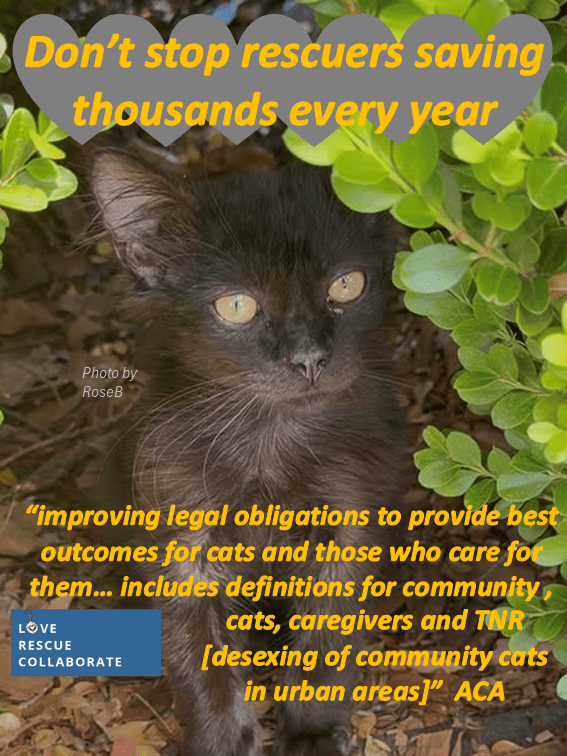
Refer to Alley Cats Allies webpage for guidance on cat ordnance / legal specifications. For decades, ACA has been assisting improving legal obligations to provide best outcomes for cats and those who care for them. They have provided a guideline which is beneficial for assessing and improving existing specifications and practices. This includes definitions for community cats, caregivers and TNR [most commonly used for desexing of community cats in urban areas].
https://www.alleycat.org/resources/ordinance-drafting-guidelines/
Legal clarification across the while state of NSW is essential. It is critical that humane care and other activities with community cats are deemed legal. This will also enable individuals, organisations and charities assist with support and funding with these activities, and provide a sound base for councils with rescuers and carers.
Flatbush Cats NYC improvement with Mayor Mamdani
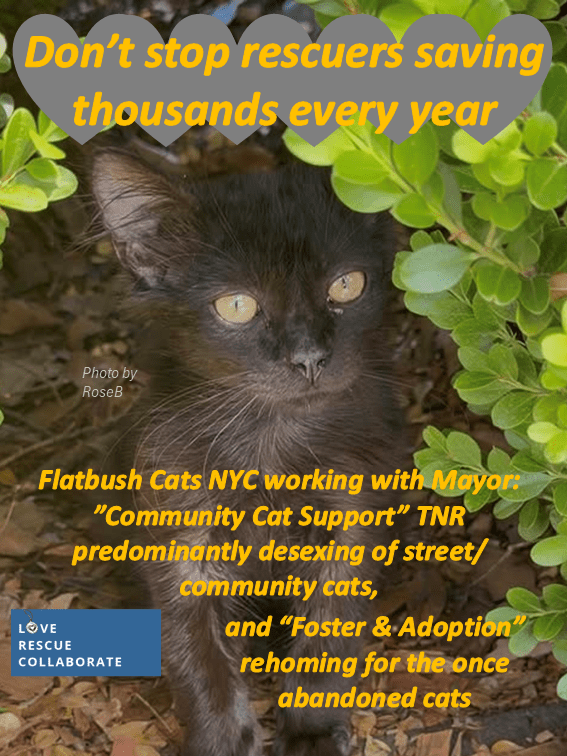
The Flatbush organisation is well known and respected, based around New York city they seek to humanly end the cat overpopulation crisis with cats being abandoned, over crowded shelters and community cats on the streets. They have three main focus areas: “Access to Veterinary Care” with a nonprofit clinic, “Community Cat Support” TNR predominantly desexing of street/ community cats, and “Foster & Adoption” meaning rehoming for the once abandoned cats.
Flatbush has been addressing the cat crisis in New York , and recently produced ground breaking podcasts titled Underfoot covering the issues and the approaches needed for improvements.
The team has also produced an additional episode “What Mayor Mamdani Can Do to Fix NYC’s Animal Welfare Crisis” . This is significantly relevant to our NSW cat crisis covering cost-of-living, housing, and that the number of intact non-desexed pets has been growing. The major issue is funding, significant investments in affordable vet care (especially for desexing). Community outreach and education / communication is also key in building connections and aligning community pet owners with the resources.
These issues are being raised with the new Mayor Zohran Mamdani. In NSW, we need to shift the mind set of traditional ineffective methods to be open to leveraging techniques being proven in New York the biggest municipality in the USA, such as low costs clinics (which has commenced but is limited in NSW at this time) and specifically desexing.
Flatbush Cat Crisis in New York https://www.youtube.com/watch?v=Pkae4nYzZOk
Flatbush Cats Underfoot podcasts https://www.youtube.com/watch?v=DH8xP5-Fzr4
Flatbush & Mayor Mamdani https://www.youtube.com/watch?v=b7V5yFiTl9w&t=388s
Legislative improvements will benefit addressing the hate towards cats and cat rescuers & carers
Minister Ron Hoenig spoke during parliament on responding to hate following the horrific attack in Bondi. We believe that the concern for hate is appreciated to all classes of people. Minister Ron included:
“There is no place for hate, fear, intimidation or violence in this state… If you propose to incite hate, fear, intimidation or violence towards another person or class of persons you will be met with the most severe consequences. The priority of all levels of government is to ensure the safety of its citizens regardless of their individual characteristics or their religion.” https://www.facebook.com/reel/1645976230106800
Community cat caregivers (rescuers and carers) are similar in their compassion and characteristics in volunteering their time, finances and efforts to rescue and rehome community cats.

Hate towards all cats and domestic cats in urban areas still continues and appears to have increased with the lodging and communications of the Control of Cats bill and its mandatory cat containment change.
If cat culling in targeted LGAs/ councils begins then it will definitely encourage more harm and violence to cats and their caregivers everywhere in NSW. Cat haters will not respect LGA boundaries, especially as these are generally unmarked. There are examples of cat haters boasting to treat domestic cats as feral cats (shoot, poison etc) or take roaming cats from their suburbs and abandon the cats is native bushland or suburbs far from an owner’s property.
Legislative improvements will also assist with addressing cat hate and hate towards the class of volunteers we call cat rescuers and carers.
Currently, there appears unabated division across communities, with vastly different council approaches and disparate cat welfare systems contributing to, rather than addressing hate towards cats, owners and caregivers.
 LRC
LRC 