It is rational to recognise that humans changing, replacing or removing native landscapes will impact all native species. A new study confirms that impacting natural native landscapes affects the stability of bird species and communities including in urban areas. The scientists recommend protecting and restoring functional resilience of bird species and assemblages – for example, protecting native habitats and restoring degraded (developed) environments.
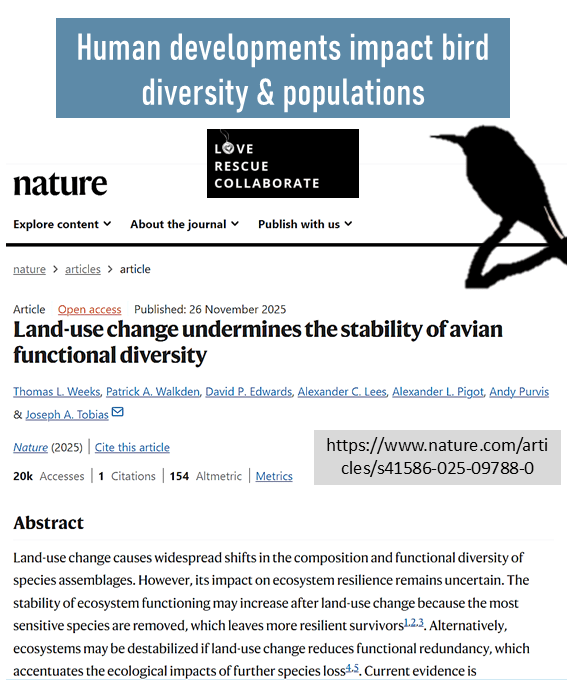
This new study brings together a vast set of information to date, including “3,696 bird species in 1,281 focal assemblages worldwide, sampled across land-use gradients from primary vegetation to urban habitats”.
The authors suggest “that the long-term impacts of land-use change may be underestimated” and recommend further research.
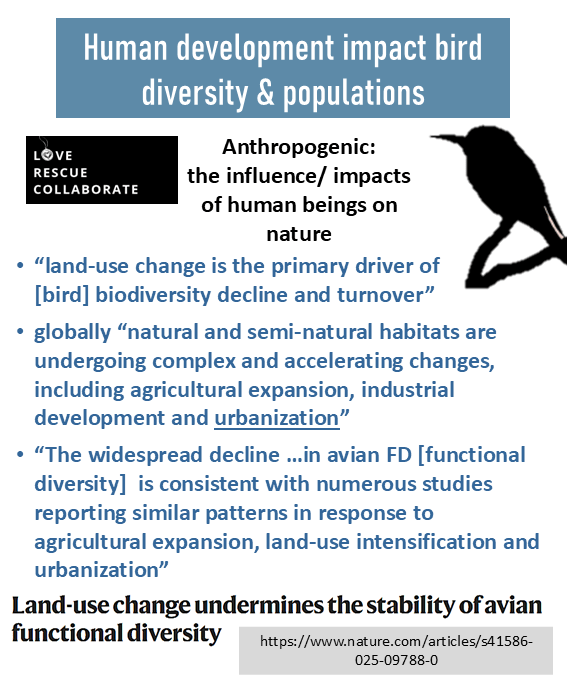
Human developments that involve significant change to natural native environments are the primary driver of bird biodiversity decline and turnover.
Though in some places birds may appear to be in adequate numbers, their role in the holistic ecosystems is significantly at risk.
Birds play an important role with dispersing seeds and controlling insect populations. As bird populations decline so do these beneficial influences on ecosystems.
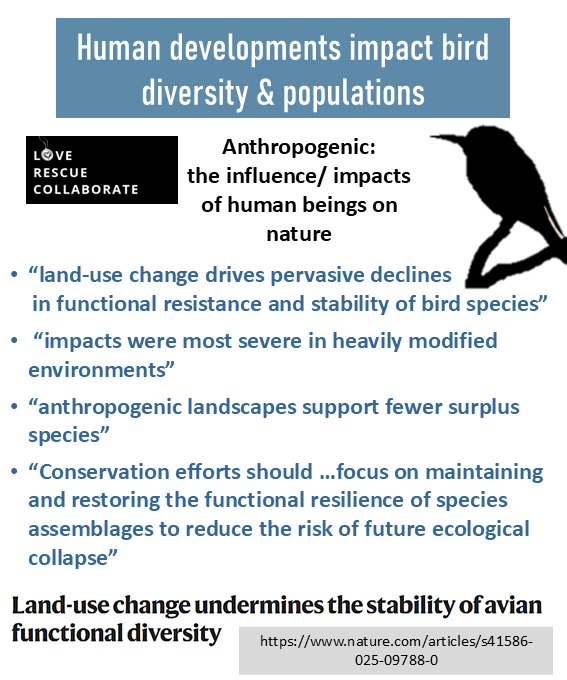
While several species may share these roles, as birds decline so too does the collaborative and cumulative efforts. These are viewed as declines in surplus or buffer species, which places the bird communities at risk.
The authors view that these risks in even small declines may result in major functional changes.
References
Land-use change undermines the stability of avian functional diversity November 2025 https://www.nature.com/articles/s41586-025-09788-0
 LRC
LRC 