RSPCA Inquiry Submission
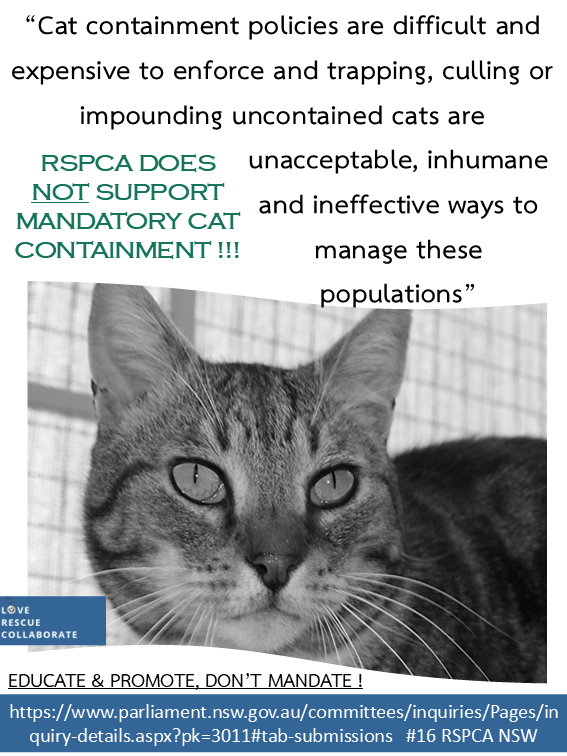
The Royal Society for Prevention of Cruelty to Animals (RSPCA) New South Wales (NSW) clearly indicated support for containing cats, but NOT for mandatory cat containment for many reasons, which was provided in their submission to the recent Inquiry Management of Cat Populations NSW.
This position was based on research including their own with a focus on the recent years of the Keeping Cats Safe At Home (KCSAH) program across over ten NSW councils.
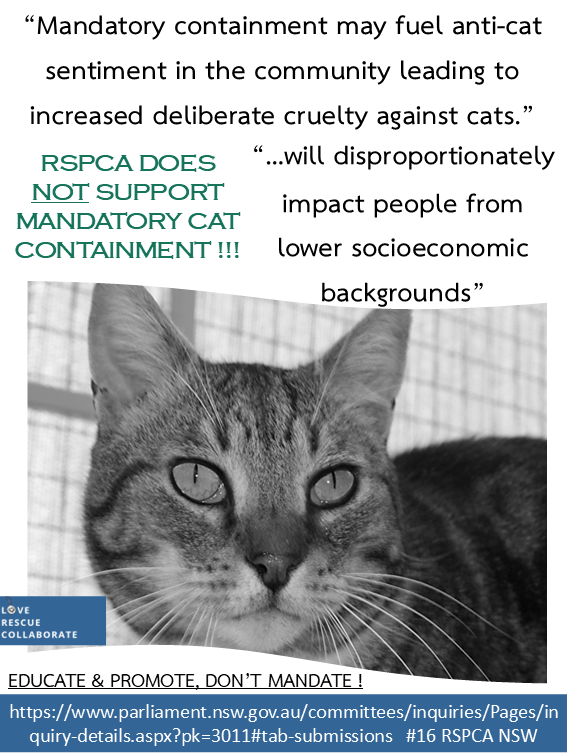
This blog page has been created to assist with clarifying misleading interpretations that the RSPCA does support mandatory containment.
There is a wealth of substantiated information provided in the RSPCA submission for the Inquiry.
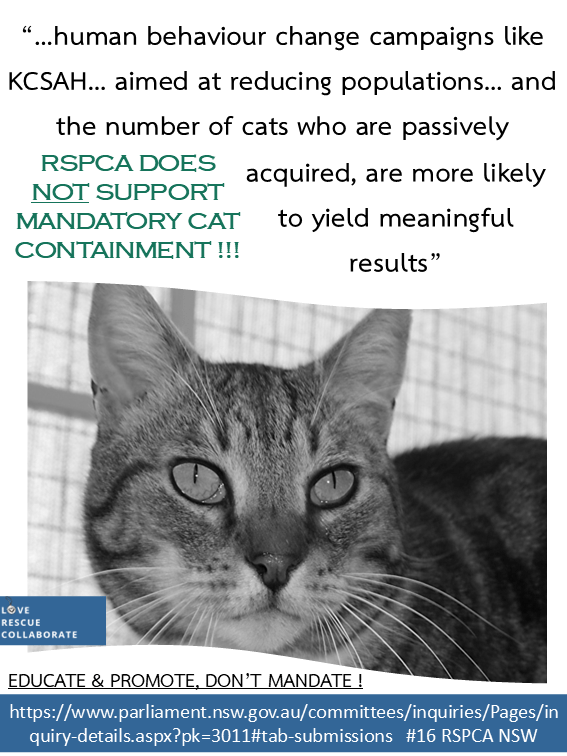
The RSPCA has shown increased uptake of cat containment through multiple initiatives in the KCSAH program over years with over ten NSW councils.
This proactive human behaviour change approach aligns with One Welfare approaches aligning human and animal welfare improvements.
RSPCA Representatives at Inquiry Hearings
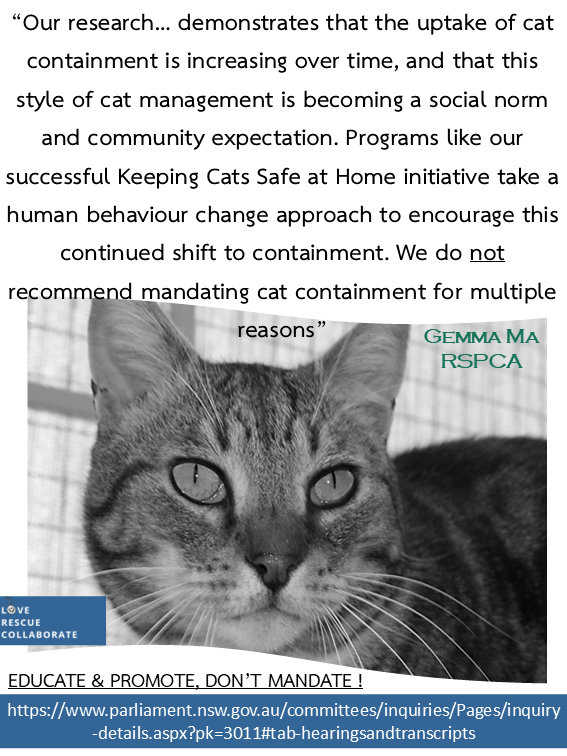
During the 16 December 2024 hearings for the recent Inquiry Management of Cat Populations NSW, Gemma Ma Project Manager for Keeping Cats Safe At Home program, Royal Society for Prevention of Cruelty to Animals, provided the RSPCA position on mandatory cat containment, including:
- cat owners using enclosures and containment techniques is increasing
- cat containment is becoming a social norm
- the RSPCA KCSAH program included a targeted program for human change in relation to encourage the uptake of containment practices.
RSPCA Answers to Supplementary Questions
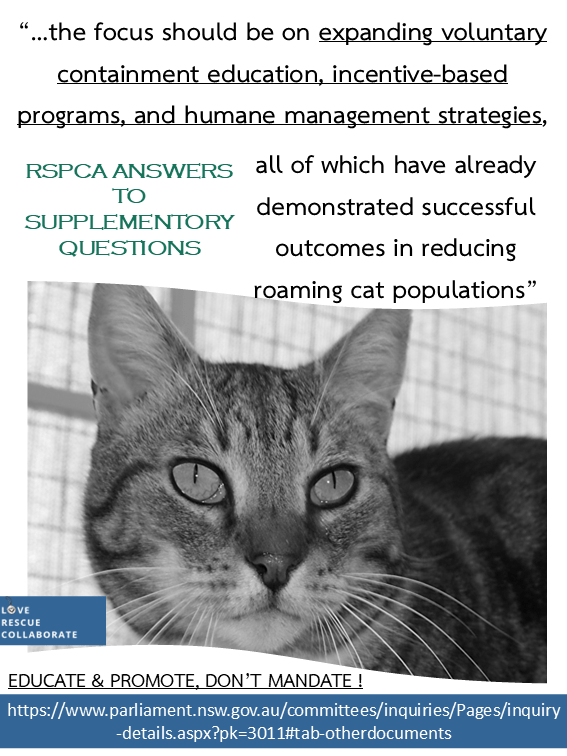
The RSPCA team were asked for further information on their cat containment change program under the Keeping Cats Safe at Home program funded by the NSW government, and associated findings.
The RSPCA “Answers to Supplementary Questions” response is summarised as it contained a significant amount of information, with justification for their recommendations for not supporting mandatory cat containment.
This is a very information document covering many related subjects,
KCSAH positive outcomes exceeded many targets:
- Significant reductions in roaming cat populations in key council areas:
o Blue Mountains: 25% reduction
o Campbelltown: 35% reduction
o Tweed Shire: 50% reduction - Decrease in nuisance complaints related to roaming cats:
o Over 40% decrease in seven project councils.
o Over 60% decrease in four project councils. - Reductions in the number of cats impounded by councils:
o Blue Mountains: 54% decrease
o Campbelltown: 59% decrease
o Parramatta: 73% decrease
o Kyogle & Walgett: 100% decrease”
RSPCA NSW KCSAH beyond desexing, involved holistic human behaviour change program initiatives included:
- “A tailored behaviour change strategy was developed in consultation with expert Dr
Lynette McLeod. - A dedicated email newsletter (“The Cat-ch Up!”) with over 4,000 subscribers providing
ongoing cat care advice and support. - A comprehensive social marketing campaign, including radio, TV, and social media
outreach reached more than 3.5 million people. - School-based education programs engaged over 1,400 children and normalised
responsible cat ownership from an early age. - More than 30 community events directly engaging over 36,000 people.
- Information resources distributed through more than 80 partner veterinary clinics,
councils, and rehoming organisations.”
The RSPCA opposes mandatory containment for a number of reasons, including:
- “There is an unacceptable welfare impost on cats. Not all cats can be contained without
suffering poor welfare. Some cats struggle with full-time containment due to their
behavioural needs. - Not all cat caregivers can contain cats where they live. Renters, and people with less
disposable income are likely to be disproportionately affected, as many landlords do not allow indoor cats or pet modifications, and containment infrastructure (e.g. catios, secure fencing) can be costly. - Mandatory containment is likely to lead to increased surrenders and abandonment. Pet
owners who cannot comply due to financial or housing constraints may be forced
to surrender or abandon their cats, placing greater burdens on council pounds and animal
welfare organisations that are already struggling with overpopulation. - Mandating cat containment undermines unowned cat management efforts. Many unowned cats (semi-owned cats) rely on informal caregivers who provide food and care but do not consider themselves owners. Adding legal containment requirements will discourage these caregivers from taking on ownership responsibility, undermining interventions designed to manage and reduce unowned cat populations through desexing and support programs.”
- AND detailed additional concerns related to the cost of living crisis, including:
- “Financial burden on pet owners“
- “Disproportionate impact on vulnerable groups“
- “Increased pressure on pounds & rescue organisations“
- “Lack of evidence that containment laws are effective“.
RSPCA findings include seeing no value in punitive containment laws
“There is no evidence that education and targeted behaviour change programs are ineffective without containment laws. The results of the KCSAH evaluation (described above and attached herewith) demonstrate the opposite. The important point is that education-based approaches, when coupled with complementary strategies such as subsidised desexing, microchipping, and behaviour change programs, have been shown to be highly effective in increasing voluntary cat containment.”
RSPCA does not support councils being given power to introduce cat containment laws at this time, with concerns including:
- “an inherent unfairness in legislating when residents in one LGA will be subject to strict enforcement” while others are not
- “legislation to promote behaviour change… cannot be at the risk of significant unintended consequences, including poor animal welfare outcomes”
RSPCA provides that “Mandating cat containment without adequate resourcing and preparation risks a range of negative outcomes” and detailed under the following:
- “Increased deliberate harm and cruelty to roaming cats”
- “Increased abandonment and surrender of owned cats”
- “Increased “stray” cat intake and euthanasia at council pounds”
- “Additional barriers to humane management of unowned cat populations”
RSPCA concludes with:
“Rather than rushing to introduce containment laws without proper funding and capacity building in a targeted way across NSW, the focus should be on expanding voluntary containment education, incentive-based programs, and humane management strategies, all of which have already demonstrated successful outcomes in reducing roaming cat populations.”
Referenced Information
RSPCA Submission #16 https://www.parliament.nsw.gov.au/committees/inquiries/Pages/inquiry-details.aspx?pk=3011#tab-submissions
 LRC
LRC 