July 2025
BRIEF UPDATE POST RALLY
The rally was successfully held. As an inaugural event it attracted 150 attendees on a Saturday when many rescuers are busy with adoption interviews and events.
This short video is an interim update.
Audio and text support messages from domestic cat experts will be uploaded soon,
OVERVIEW

SAVE COMMUNITY CATS is a peaceful public assembly 11am Saturday 23 August Sydney to raise our voices for community cats and their rescuers and carers.
COMMUNITY CATS is a widely accepted term for STRAY cats. Most stray cats are domestic semi owned, meaning a person or people are involved in providing food and care.
The volunteers represent an “army” across NSW seeking to work with the state and council governments to improve outcomes for community cats.

This page is associated with the Save Community Cats event on Facebook: https://www.facebook.com/events/1223866125691956/
We seek One Welfare solutions for better outcomes for community cats, & for rescuers and carers to be integrated with NSW state and local government cat management strategies, plans, delivery of desexing programs, research, and critical education programs with communities.
- BRIEF UPDATE POST RALLY
- OVERVIEW
- How you can help
- Save Community Cats Movement – Background & Press Release
- Rally Overview
- Messages of support to be delivered at the rally
- Rally & Movement Flyers
- Compelling evidence on desexing programs for owned and community cats
- Key Messages & Images
- Shared images for the Rally
- You can’t ban compassion (there’s no stopping rescuers & carers)
- Issues with poorly defined categories of cats – especially “stray” cats
- Stray (Community) cats are not Feral cats and should not be treated in the same way
- Desexing! Desexing!! Desexing!!!
- The value of rescuers & carers saving & rehoming thousands of abandoned cats every year
- Promote Cat Containment don’t make it mandatory
- The issues with NSW registration system & why it deters owners
- Wildlife impacts by domestic cats are flawed estimates & overstated
- Stop the War, stop demonising cats, influences cat hate
How you can help
- attend the rally!
- sign our petition https://www.change.org/p/save-community-cats-nsw
- distribute our online posts and physical flyers (see next section to download)
Save Community Cats Movement – Background & Press Release
SAVE COMMUNITY CATS is a peaceful public assembly 11am Saturday 23 August Sydney to raise our voices for community cats and their rescuers and carers.
We seek One Welfare solutions for better outcomes for community cats, and for rescuers and carers to be integrated with NSW state and local government cat management strategies, plans, delivery of desexing programs, research, and critical education programs with communities.
Our top priorities include high intensity desexing for community cats, promoting not mandating cat containment, a moratorium on pet registrations, and enabling other legal obligations to support rather than hinder the rescue and rehoming of community cats.
BACKGROUND
Are you aware there is a “cat crisis” across Sydney and other major urban areas? Cats are being abandoned at a higher rate than before, mainly driven by cost-of-living concerns with owners struggling to afford increases in vet costs.
While some councils assist owners on welfare with desexing and pet registration, many owners are not aware of this, or it is a subsidy or the owners may not have transport, or commitments to much needed jobs. This becomes a bigger burden when one owns multiple cats, or when their young cat becomes pregnant and within two months there are now several kittens.
The burden of abandoned cats and kittens most often falls on community cat rescuers and carers – kind people, volunteering their time and effort, and resources and finances. These Good Samaritans help feed, care, desex, cover vet bills for treatments for illnesses too, and they rehome cats and kittens to new caring families.
Council pounds are often at their limited capacity and there has been a challenge to the councils’ understanding of taking in and caring for “stray” cats. For years, many councils have claimed they are not able to take in stray cats as cats are allowed to roam under the Companion Animal Act in NSW.
The burden on community cat rescuers and carers has recently increased further with RSPCA NSW also recently indicating their shelters will not be taking in stray animals.
Under Labor, over the last few years the NSW government has been operating a number of reviews and inquires for animal welfare and management, with a specific focus on cat management to better understand the concerns and recommended steps forward for improvements. Just this week, the report including findings and recommendations was published for the Management of Cat Populations.
One area that is of great concern is the lack of recognition of community cat rescuers and carers, and the integral role played as part of the holistic animal welfare system. Without recognising the efforts of thousands across the state, how will adequate planning and funding be achieved for improvements?
SAVE COMMUNITY CATS RALLY FORMATION
Rescuers and carers have provided submissions and emails to our NSW government. However, we felt that a collaborative rally was the most appropriate way to raise awareness of both the efforts and the burden carried by volunteers. Many independent and groups of rescuers and carers are taking part in this event.
We have support from a number of domestic cat experts. This includes:
- Emma Hurst Animal Justice Party NSW, and Chairperson for the Inquiry Management of Cat Populations NSW
- Jacquie Rand Australian Pet Welfare Foundation, Community Cat Programs and relevant Research
- Kristina Vesk Cat Protection Society NSW, Subsidised Desexing and DIVA programs
- Gemma Ma RSPCA NSW Keeping Cats Safe at Home and the Stray Care programs
We are receiving their messages of support that we will share at the rally. Their experiences, scientific knowledge and recommendations is greatly appreciated.
The rally will also include key messages from a small number of experienced rescuers with hands on experience over many years. They have been helping to rehome many hundreds of cats and kittens alongside the rally attendees.
COMMUNITY CATS is a widely accepted term for stray cats. Most stray cats are domestic semi owned, meaning a person or people are involved in providing food and care.
The volunteers represent an “army” across NSW seeking to work with the state and council governments to improve outcomes for community cats.
Rally Overview
Location
East top of Martin Place (near Macquarie Street & Parliament House) Sydney NSW
Purpose
To raise to NSW Minister for Companion Animals and Councils the need for recognition, respect and support for community cats and their rescuers / carers, and appreciation of all those who have adopted a once abandoned kitty.
We seek One Welfare solutions for better outcomes for community cats, & for rescuers and carers to be integrated with NSW state and local government cat management strategies, plans, delivery of desexing programs, research, and critical education programs with communities.
Objectives
- Establish a respectful working relationship between the NSW state and local governments with grassroots community cat rescuers/carers, to leverage their valuable lived experiences, resources and community contacts with formulating cat management strategies and plans, at state and local levels.
FACTS: Across NSW hundreds of rescuers/ carers collectively assist thousands of community cats, delivering care, desexing & rehoming for the once abandoned cats, with contacts with the public in local areas to deliver education & welfare improvements for cats.
- Encourage and promote funding and support for the highest priority One Welfare initiatives to effectively manage cat populations where rescuers/ carers are already involved. Critical proven successful initiatives include to promote cat containment (don’t make it mandatory), community cat programs, high intensity desexing programs, vaccinations, resolving registration processes, assistance for rehoming programs, community engagement, education & cultural change programs.
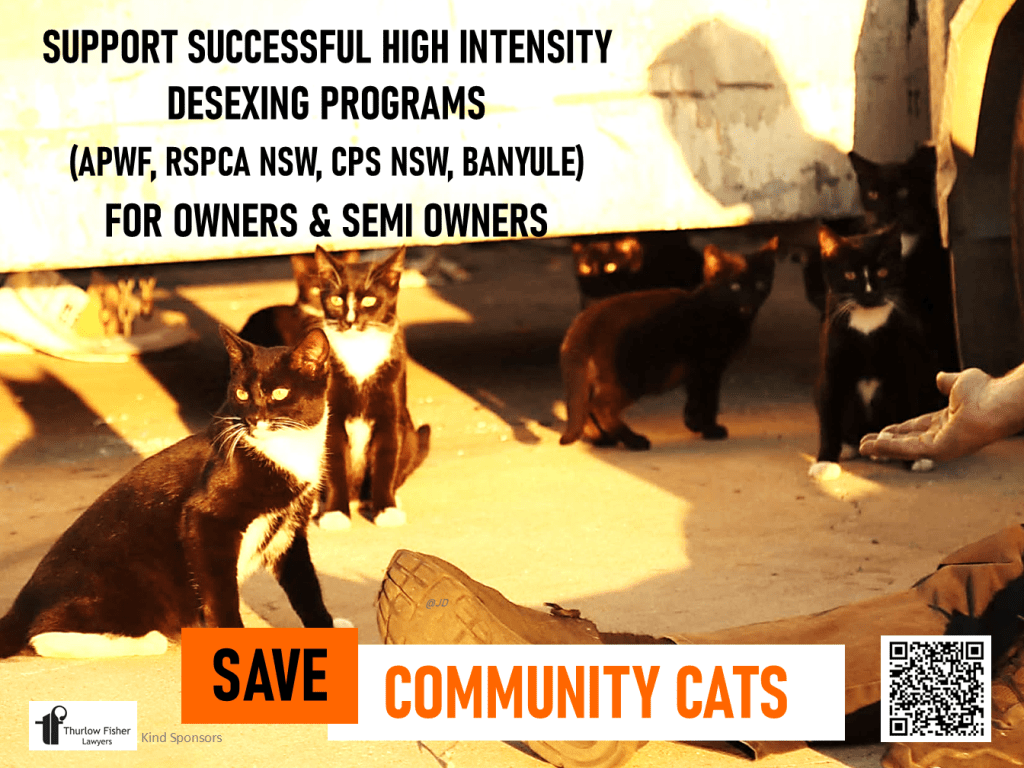
FACTS: Refer proven examples from RSPCA NSW stray cats programs, APWF Community Cat Programs, CPS NSW DIVA & desexing programs, Banyule Council research where 4 times the financial savings were achieved for the costs with funded desexing, and Rosewood Council NSW research.
- Ensure rescuer/ carers will assist and be integrated with new localised programs and research for managing cat populations, to enrich the knowledge base and clarify financial justifications with local evidence. This includes local research on cat impacts including on wildlife and council resources. Further, to actively decrease the significant risks of cruelty associated with demonising roaming and abandoned cats, and those who care for them.
FACTS: The lived experiences of rescuers/ carers will provide insights to local communities, and they are able to effectively work with council Animal Management Officers, vets and local communities, providing an “army” of volunteers and experiences. Refer APWF, AIAM, RSPCA.
Aligned with APWF, RSPCA Aust, RSPCA NSW, CPS NSW, AIAM
We strongly support the research, findings & recommendations from domestic cat experts including Australian Pet Welfare Foundation, RSPCA Australia and NSW, Cat Protection Society NSW, Australian Institute of Animal Management & more.
Collaboration with other rescuers & carers
This event is a collaboration involving a number of rescuers & carers as individuals and groups with valid lived experiences, including:
PROTECT ALL CATS https://www.facebook.com/groups/protectallcats/
LOVE RESCUE COLLABORATE https://www.facebook.com/loverescuecollaborate
https://loverescuecollaborate.org/
WESTIE CAT SUPPORT SERVICES
https://www.facebook.com/share/16YJFMNG75/
CATMINT COTTAGE RESCUE
https://www.facebook.com/CatmintCottageFelineRescue
STREET CAT RESCUE
https://www.facebook.com/streetcatsatcatmintcottage
NO KILL COLLECTIVE (webpage and social media under development)
Messages of support to be delivered at the rally
After preliminaries, the rally will kick off with messages of support, first from domestic cat experts, and then local representatives of community cat rescuers & carers.
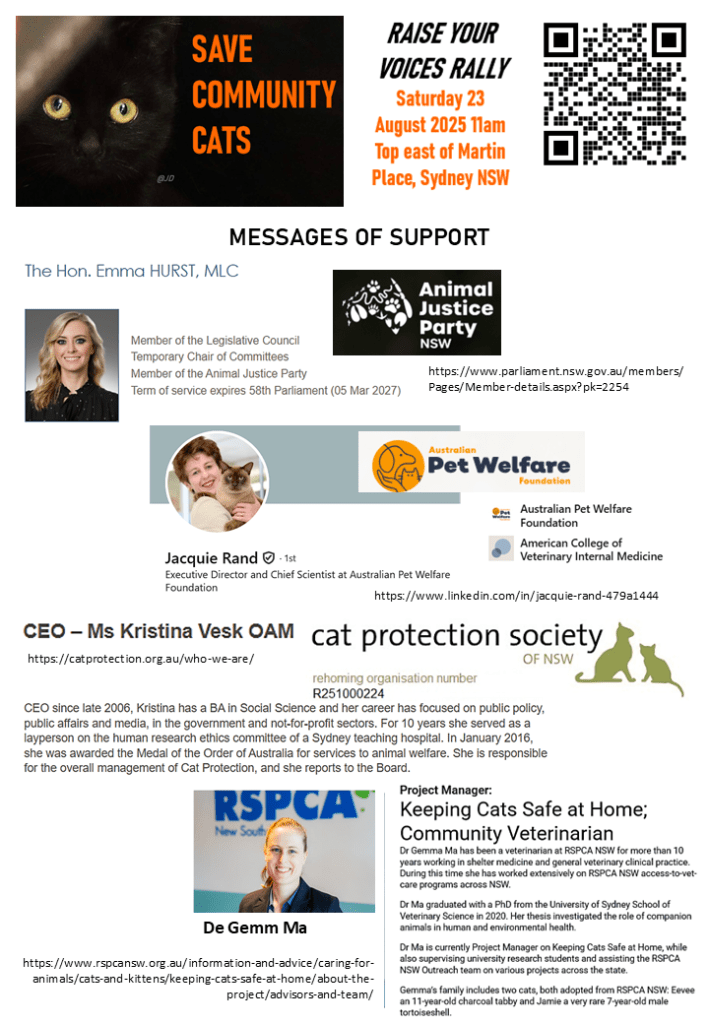
Domestic cat experts include:
Emma Hurst, NSW Legislative Council & Animal Justice Party NSW
Jacquie Rand, Australian Pet Welfare Foundation
Kristina Vesk, Cat Protection Society NSW
Gemma Ma, Project Manager, RSPCA NSW Keeping Cats Safe at Home
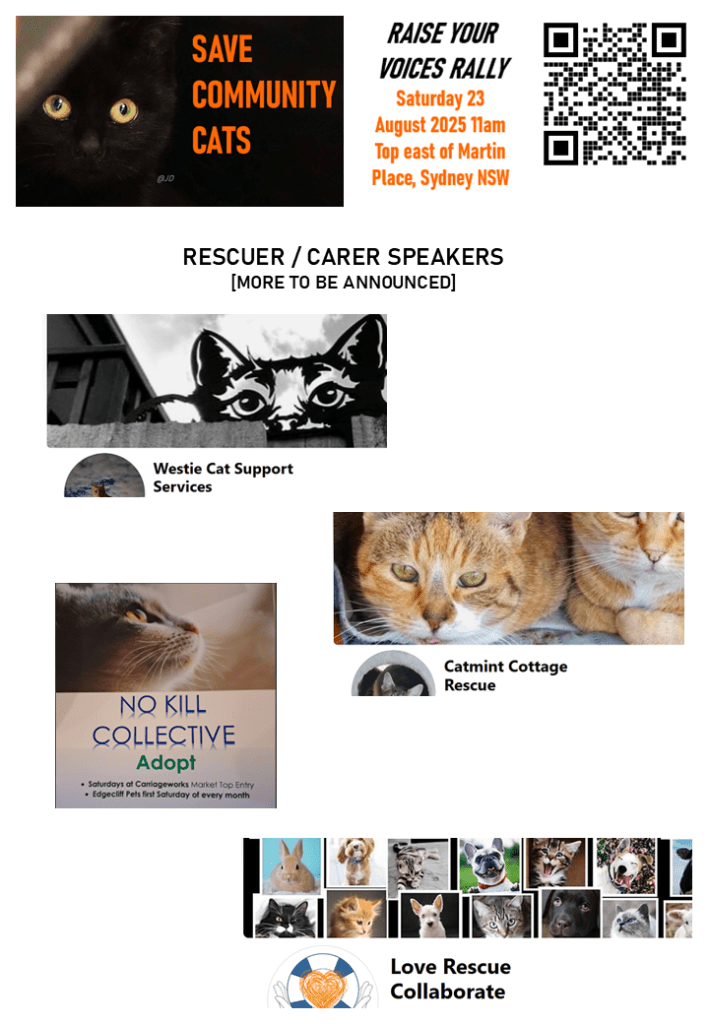
A number of rescuers and carers will also speak at the rally, bringing their lived experiences that will be relevant to all community cat rescuers and carers. These include:
Steph Bates Westie Cat Support Services
Margaret Dalziel, Catmint Cottage and Street Cat Rescue
Jonine Penrose, No Kill Collective
Deb Rouse Love Rescue Collaborate
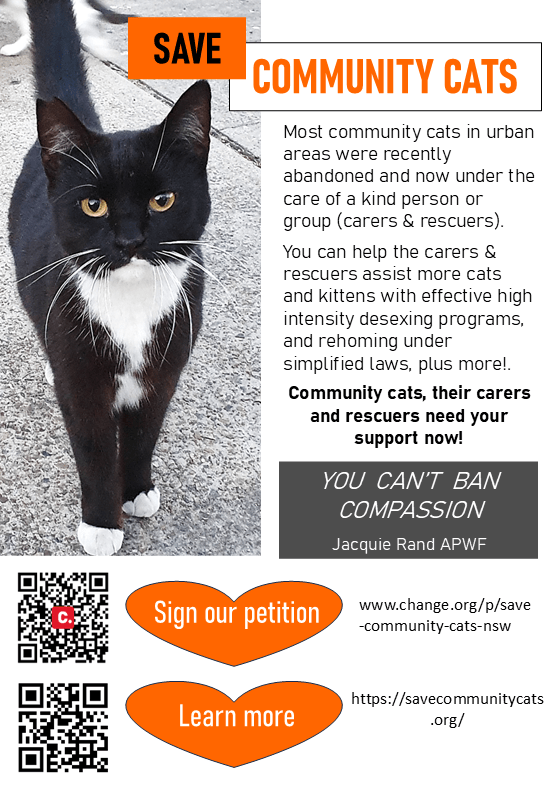
Rally & Movement Flyers
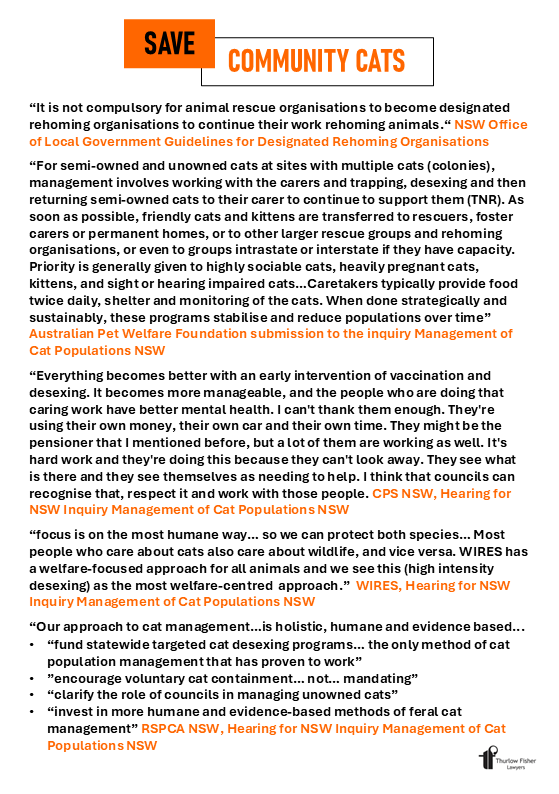
Compelling evidence on desexing programs for owned and community cats
The following summary may be downloaded and shared with interested councils and organisations. It focuses on Australian based desexing programs by a number of organisations and inclusion of community cats and their rescuers/ carers.
Key Messages & Images
Shared images for the Rally
SCC Standup Banner

Save Community Cats FB Event Rally Banner
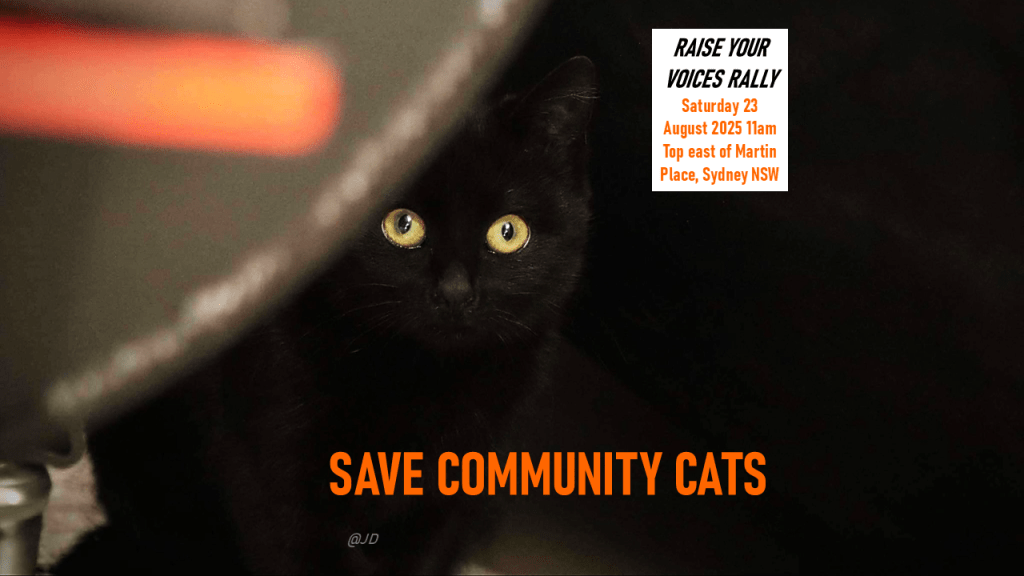
Facebook Event banner
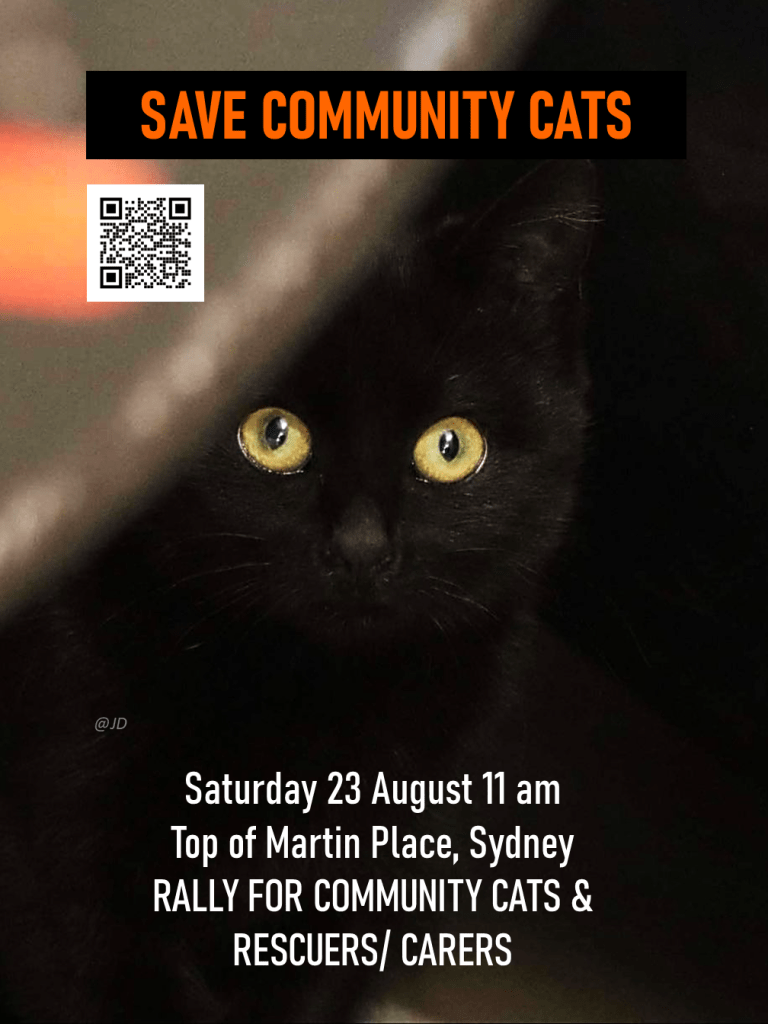
A3 Portrait
You can’t ban compassion (there’s no stopping rescuers & carers)
You can’t ban compassion of all the rescuers and carers who go out in their own time to save, feed, rescue, desex, rehome abandon cats.
Jacquie Rand’s view was based on the attitudes and efforts of community cat rescuers and carers across Australia. Read more here: https://www.theguardian.com/lifeandstyle/2025/feb/23/you-cant-ban-compassion-helping-stray-cats-is-in-much-of-australia-but-for-some-its-worth-the-risk
Read just one of the related Australian research items on successful strategies here: Urban Cat Management in Australia—Evidence-Based Strategies for Success https://www.mdpi.com/2076-2615/15/8/1083
The quote from NSW Office of Local Government indicating rescuers and rescuing is “not illegal” is in the Guidelines for Designated Rehoming Organisations on the NSW OLG webpage: https://www.olg.nsw.gov.au/public/dogs-cats/information-for-professionals/information-for-animal-rescue-organisations/
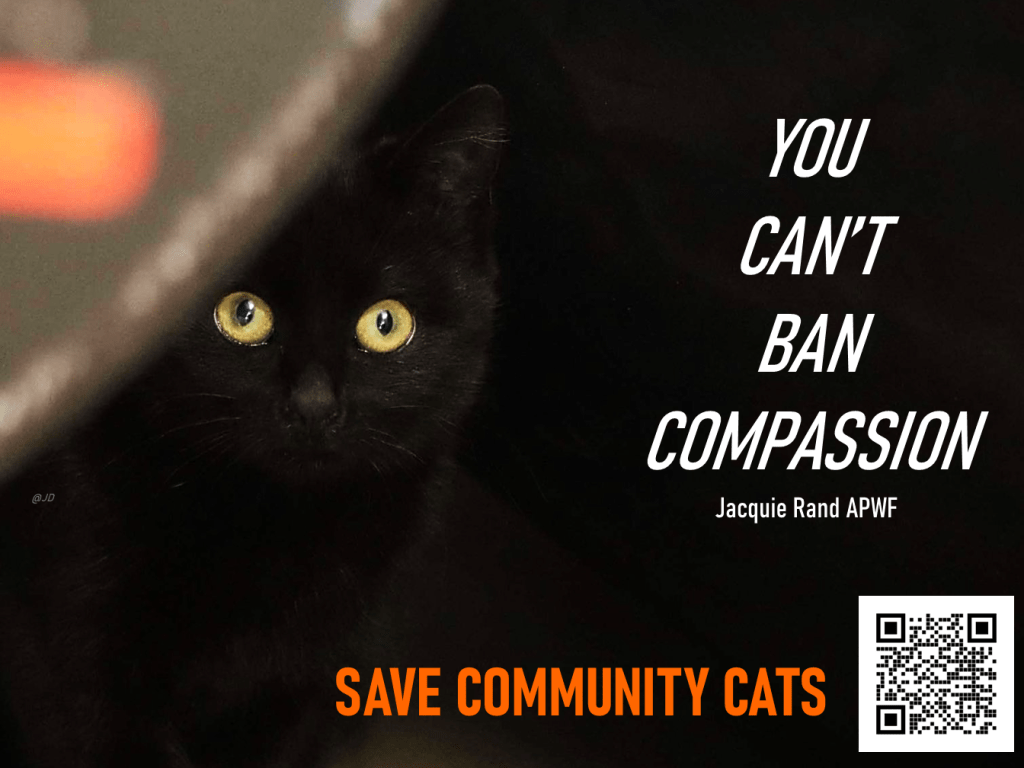
A3 Landscape

A3 Portrait
Issues with poorly defined categories of cats – especially “stray” cats
Don’t stop rescuing, desexing, rehoming of thousands of cats every year
There is a risk that stray cats may be deemed “illegal” under mandatory cat containment rules, and/ or as a subset of feral cats (refer national Threat Abatement Plan for predation by feral cats). Don’t allow either of these to occur when thousands of cats are being loved and rehomed every year.
Community Cat rescuers and carers have valid lived experiences. APWF has included a view on these in their submission to the inquiry into the Management of Cat Populations NSW, including
“Multi-cat sites (colonies)
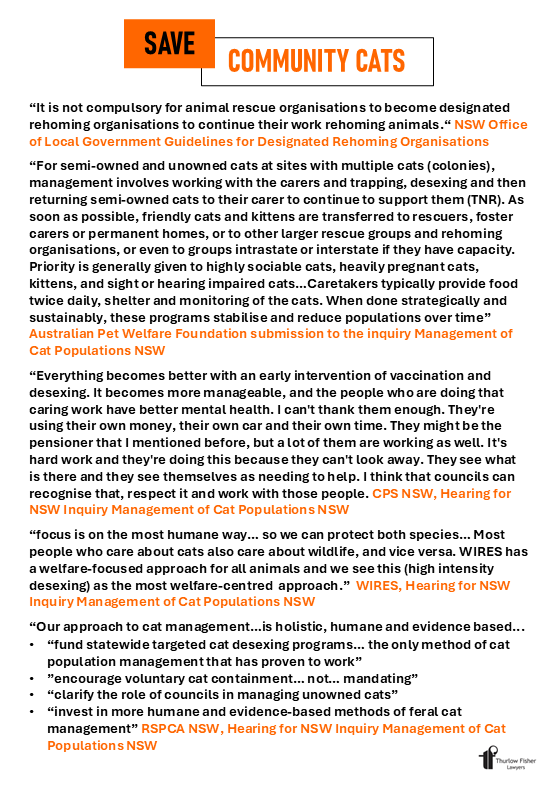
For semi-owned and unowned cats at sites with multiple cats (colonies), management involves working with the carers and trapping, desexing and then returning semi-owned cats to their carer to continue to support them (TNR). As soon as possible, friendly cats and kittens are transferred to rescuers, foster carers or permanent homes, or to other larger rescue groups and rehoming organisations, or even to groups intrastate or interstate if they have capacity. Priority is generally given to highly sociable cats, heavily pregnant cats, kittens, and sight or hearing impaired cats. Cats with significant injuries or other health issues affecting their welfare such as severe dental disease should be a priority for veterinary care. Caretakers typically provide food twice daily, shelter and monitoring of the cats. When done strategically and sustainably, these programs stabilise and reduce populations over time (Swarbrick 2018; Tan 2017; Levy 2014; Boone 2019, Rand 2024b).”
“In NSW, with 76.21% of the 8,186,000 residents over 18 years of age (and using 5% of adults being semi-owners feeding an average of 1.5 cats each) means that more than 311,900 adults are feeding over 467,800 semi-owned cats each day in NSW.”
https://petwelfare.org.au/government-submissions

It is what community cat rescuers & carers do:
“trapping, desexing… As soon as possible, friendly cats and kittens are transferred to rescuers, foster carers or permanent homes, or to other larger rescue groups and rehoming organisations, or even to groups intrastate or interstate”
APWF Submission
Stray cats are at risk of being a subclass of feral cats. Feral cats are to be destroyed and there exists a risk that rescue & rehoming for stray cats may be deemed illegal.
A3 landscape
Stray (Community) cats are not Feral cats and should not be treated in the same way
Our stray / community cats deserve the opportunity to be rescued and rehomed, stray cats should NOT be treated as a subclass of feral cats to be destroyed.
We need our Companion Animal Act NSW to be updated with terms and definitions for the different classes / categories of cats. It is critical for cats to be recognised and treated in ways that are appropriate to their category.
“Cats should be categorized based on how and where they live This will enable the implementation of effective domestic cat management strategies, supported by the community. Research shows that pet cats can react with more aggressive behaviours to humans than feral cats when highly stressed.”
https://petwelfare.org.au/position-statements/cat-definitions
The NSW cat management framework, legislation and regulations need to follow and incorporate the 2018 RSPCA definitions for feral versus domestic cats, the latter being owned, semi owned and unowned.
https://kb.rspca.org.au/wp-content/uploads/2019/01/Identifying-Best-Practice-Domestic-Cat-Management-in-Australia-RSPCA-Research-Report-May-2018.pdf

A3 portrait


Desexing! Desexing!! Desexing!!!
Funded desexing for community cats is needed and to relieve the burden on rescuers / carers
In the past the traditional methods for fining, trapping & euthanasing meant cat death rates at council pounds of 70% to 90% with devasting impacts on all people involved without solving the cat crisis.
Read more recent research: Rethinking Urban Cat Management—Limitations and Unintended Consequences of Traditional Cat Management
“…enforcement-driven policies face significant challenges. They are costly for local governments, resource-intensive, and fail to address the root causes of free-roaming cat populations, such as financial barriers and the prevalence of semi-owned or stray cats, particularly in disadvantaged areas. Animal management officers are central to enforcing these measures, often issuing fines and trapping cats identified as causing a nuisance. Despite these efforts, compliance remains low, and issues like high shelter intakes, cat-related complaints, and euthanasia persist. Moreover, the punitive nature of these policies can place additional financial strain on vulnerable communities and negatively impact the mental health of animal management officers and shelter staff. This approach, focused on penalties, addresses symptoms rather than systemic issues. A shift toward addressing the root causes—through financial support, including support for cat sterilization, resource accessibility, and community engagement—presents a more effective and compassionate solution. Such strategies benefit both the cats and their caregivers while reducing the burden on local governments, promoting sustainable and humane outcomes for communities while better protecting wildlife.”
https://www.mdpi.com/2076-2615/15/7/1005
A3 Landscape
Urgent need for high intensity desexing for owned & semi owned cats
Community cat rescuers / carers struggle under the burden of undesexed cats being abandoned by owners and multiplying rapidly. The costs are high and unfairly reliant on good Samaritans to donate their personal resources.
Many cat desexing programs have been executed with success by NSW RSPCA, APW Community Cat Programs, CPS Diva program and councils. A summary is available here: https://loverescuecollaborate.org/2025/02/27/nsw-ca-act-discussion-paper-review-due-4-may/#compelling-evidence-on-australian-desexing-initiatives-involving-community-cats-their-rescuers
The APWF views include:
“High intensity desexing initiatives
This is critically important to address the number of free-roaming domestic cats, because more than 50% of cats entering shelters and pounds in Australia were born in the last 6 months (Albertson 2016; Kerr 2018), and recent modelling from the UK found that owned cats are the substantial contributor to domestic cat populations (McDonald 2023). Australian research suggests that in areas of high cat impoundments and cat-related calls to councils, owned cats and semi-owned cats contribute similarly to number of kittens being born (Rand 2024a). Programs for free and highly subsidized cat
registration, microchipping and desexing for owned cats, especially in areas of socioeconomic disadvantage are essential. However, stopping litters from semi-owned and unowned cats is also essential.”
APWF submission to Inquiry Management of Cat Populations NSW.
https://petwelfare.org.au/publications
APWF Community Cat Programs in detail: https://petwelfare.org.au/community-cat-programs
A3 landscape
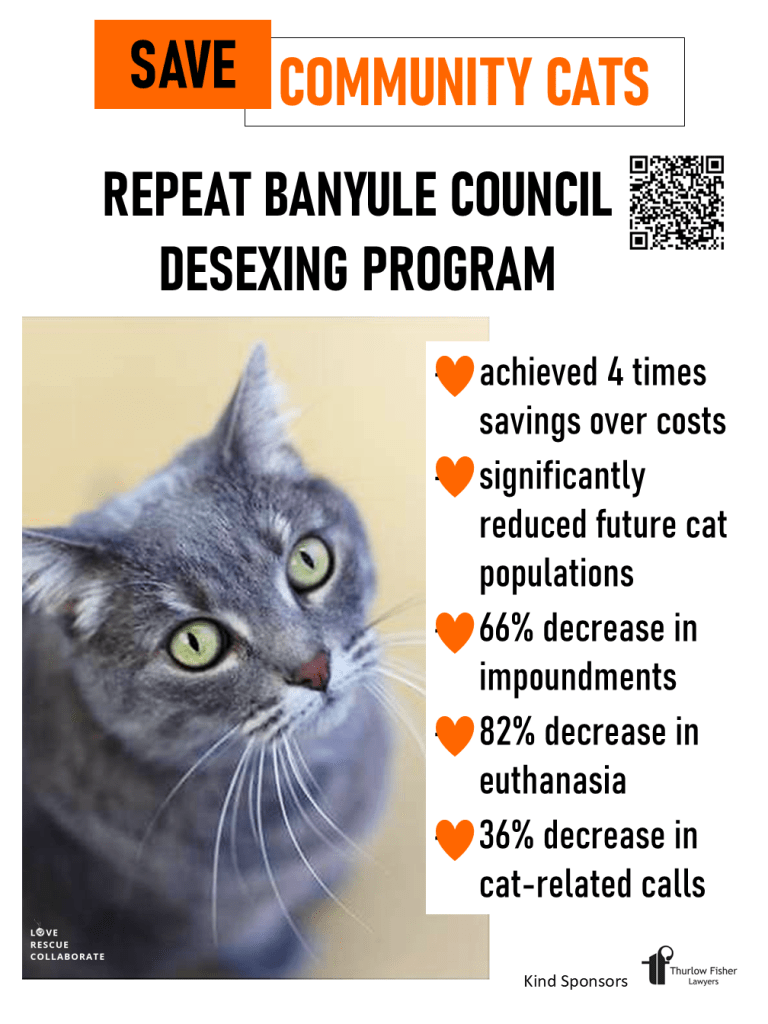
Banyule Council highly successful desexing program
Are you aware of the highly successful & researched Banyule Council desexing program that ran for several years? We ask: why aren’t more councils following this program?
The Banyule Council in Victoria operated their own self-funded desexing program over several years, where the investment was returned 4 times in terms of savings over costs. For owned and semi-owned cats this included several benefits “decreases in impoundments by 66%, euthanasia by 82%, and cat-related calls by 36% over 8 years, with savings to council of AU $440,660 for an outlay of AU $77,490”.
The research also concluded:
“the traditional methods of trapping wandering and nuisance cats have not resulted in long-term reductions in cat-related calls to councils. However, following the implementation of a microtargeted free sterilization program for owned and semi-owned cats, marked reductions in cat-related calls, impoundments, euthanasia, and costs were realized, similar to that reported in US programs. It is recommended that urban cat management policies and programs are revised and, instead of being focused on a traditional compliance-based approach, are focused on being assistive, helping owners and semi-owners have their cats sterilized and identified with a microchip. Legislative changes need to be implemented to facilitate this approach to assist people caring for multiple stray cats, instead of the current approach to trap and euthanize most of these cats which are poorly socialized, which is documented to damage the mental health of shelter and pound staff and cat caregivers”
Impact of a Local Government Funded Free Cat Sterilization Program for Owned and Semi-Owned Cats www.mdpi.com/2076-2615/14/11/1615
A3 portrait
The value of rescuers & carers saving & rehoming thousands of abandoned cats every year
Rescuers & carers are a force for community cats & desexing programs

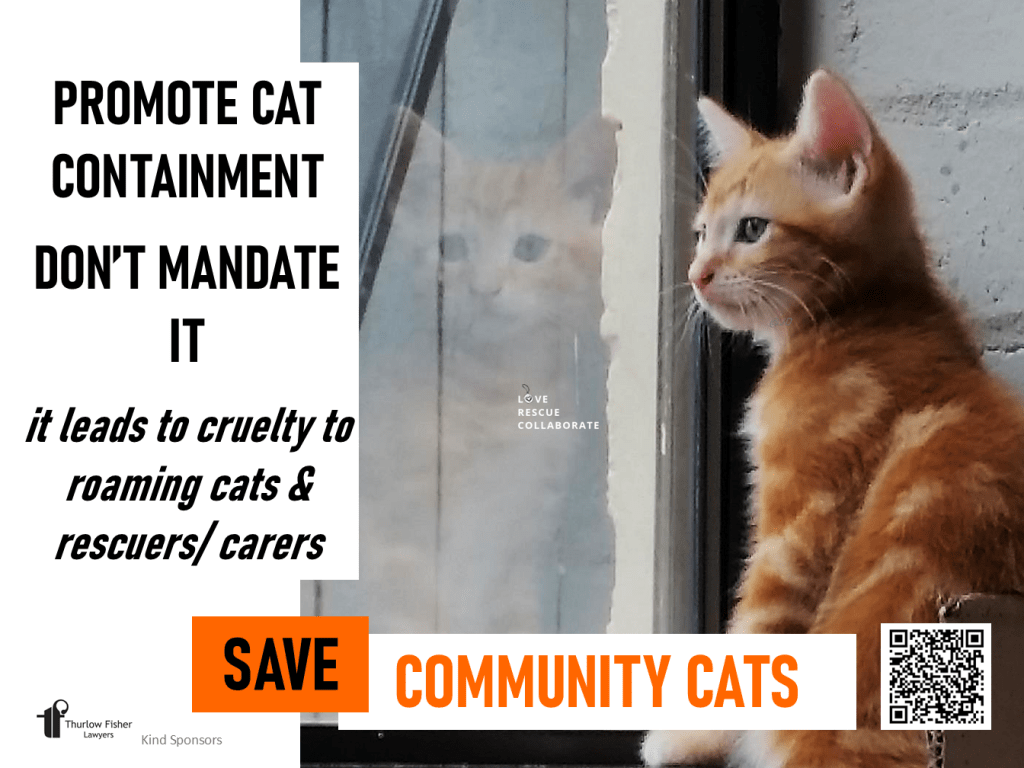
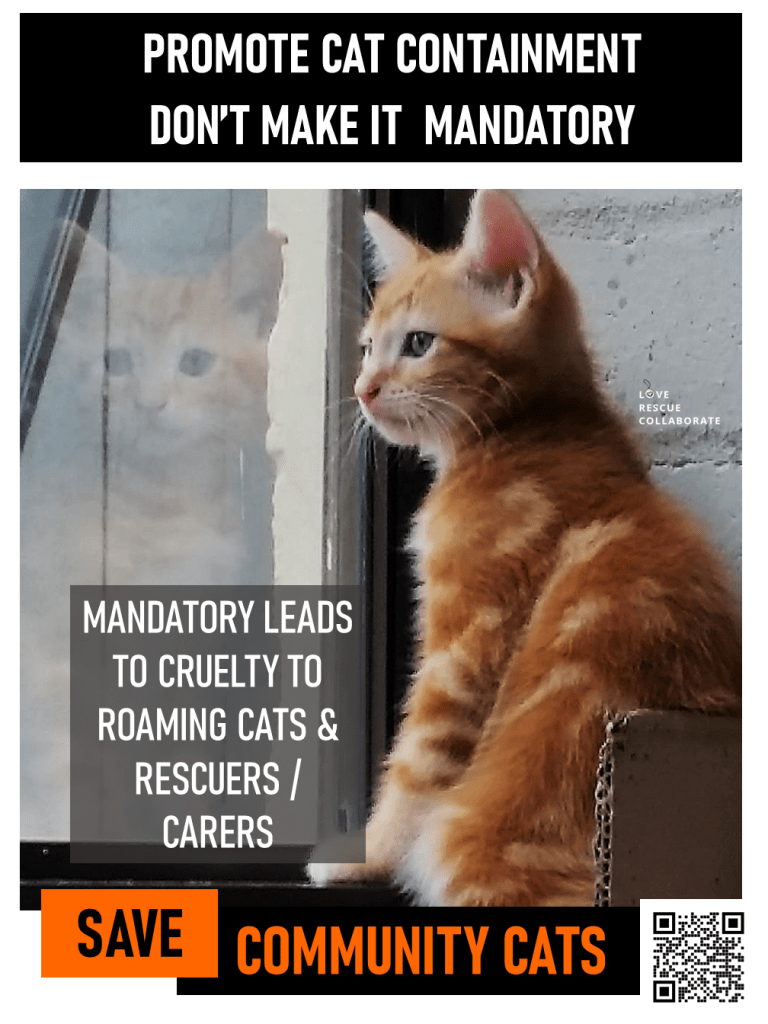
Promote Cat Containment don’t make it mandatory
The increase in cruelty if roaming cats are seen as illegal
Love Rescue Collaborate: The Darkside of Mandatory Cat Containment, includes
“We promote cat enclosures to keep cats and wildlife safe.”
“Cat enclosures may involve significant costs for cat owners, difficult to erect due to other resident complaints, and difficult and costly for a council to enforce.
We also see the dark side, which may include to incite or encourage violence to cats.”
https://loverescuecollaborate.org/2022/09/27/the-dark-side-of-mandatory-cat-confinement/
APWF Position Statement on Cat Containment: APWF encourages cat containment, but not making it mandatory.
“Mandated cat containment has been proven to be an ineffective strategy; a failure at reducing wandering cats in the short and long term, both in Australia and internationally.”
“Criminalises cat ownership for low-income households and people with ‘door dasher’ cats”
“Places semi owned stray cats being fed by people who have an emotional attachment to the cat at significant risk of being impounded and killed.”
“Increases risks of cruelty towards cats, increasing animal pain and suffering.” https://petwelfare.org.au/position-statements/cat-containment
A3 Landscape
A3 portrait
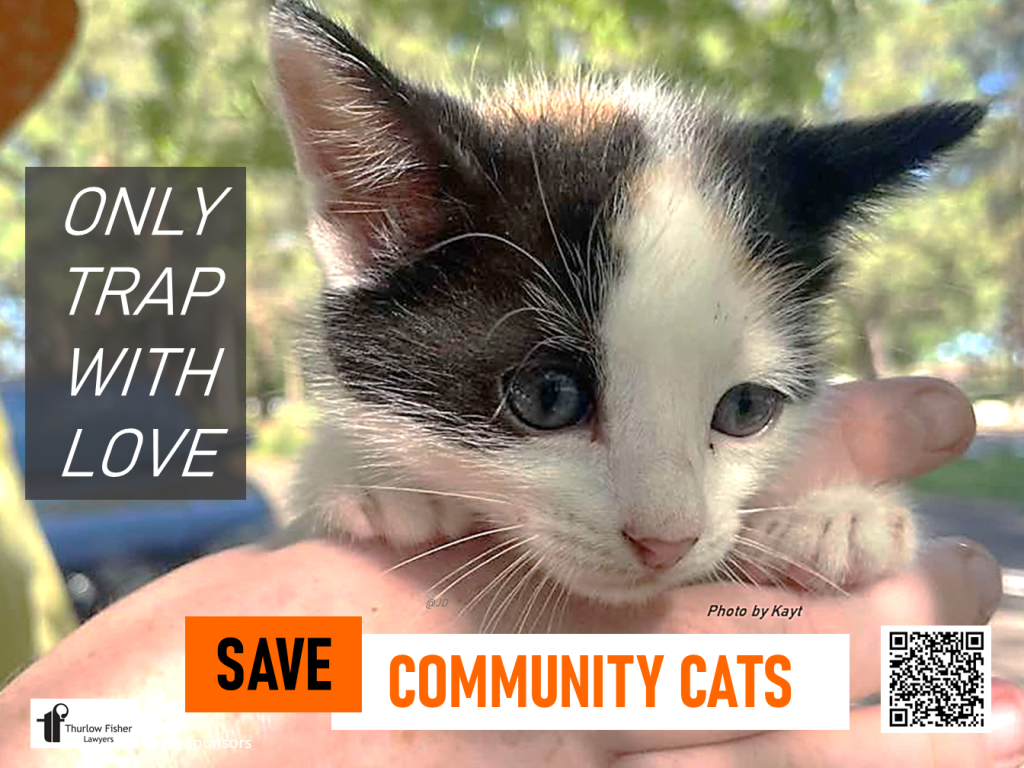
The issues with NSW registration system & why it deters owners
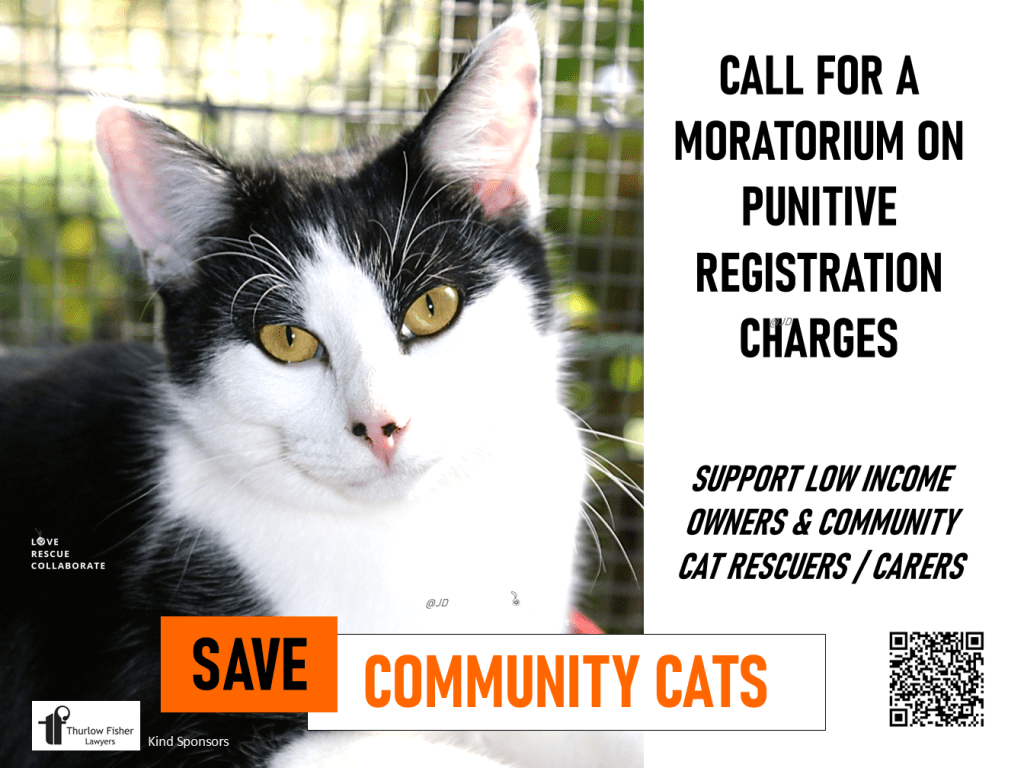
Moratorium on Punitive Registration Charges
Rescuers & carers are carrying a burden for desexing and registering cats older than 4 months of age, anecdotally older cats are more often abandoned in urban areas due to costs to owners.
APWF raised concerns their submission to the NSW government for Management of Cat Populations:
“To reduce free-roaming domestic cats, legislation and policy need to reflect an understanding of the true causes of the problem and must pursue solutions that are shown scientifically to be effective.”
“In NSW, the registration and breeder-permit fees are cost barriers to taking ownership. If a domestic cat is acquired that is older than 4 months and is not desexed, there is an annual permit fee payable ($96) as well as life-time registration ($69) These fees apply even if the cat was desexed, microchipped, and registered immediately at, or soon after, acquisition (NSW Government 2024 a, b.)
In NSW, return to owner rates are almost half those in Victoria and Queensland (3% versus 7%) (Chua 2023). This might reflect that the state microchip register can be used to identify cat owners who have not paid for registration, creating a financial disincentive to microchipping.
In NSW, costs to local governments for managing cats, not including administration costs for registration, are approximately 7 to 10 times the income to the state government from registration fees (NSW Gov. Pet Registration Fees 2024). Therefore, it makes little fiscal sense to create cost barriers which discourage cat owners from microchipping and thereby reduce return to owner rates.
It is recommended instead that mandatory registration be abolished and microchipping made affordable and included with free or affordable desexing. The effectiveness of microchips for facilitating reuniting cats with their owners can be increased by sending regular SMS messages or email messages reminding owners to update contact details if they have changed (CIE 2022).”
A3 landscape
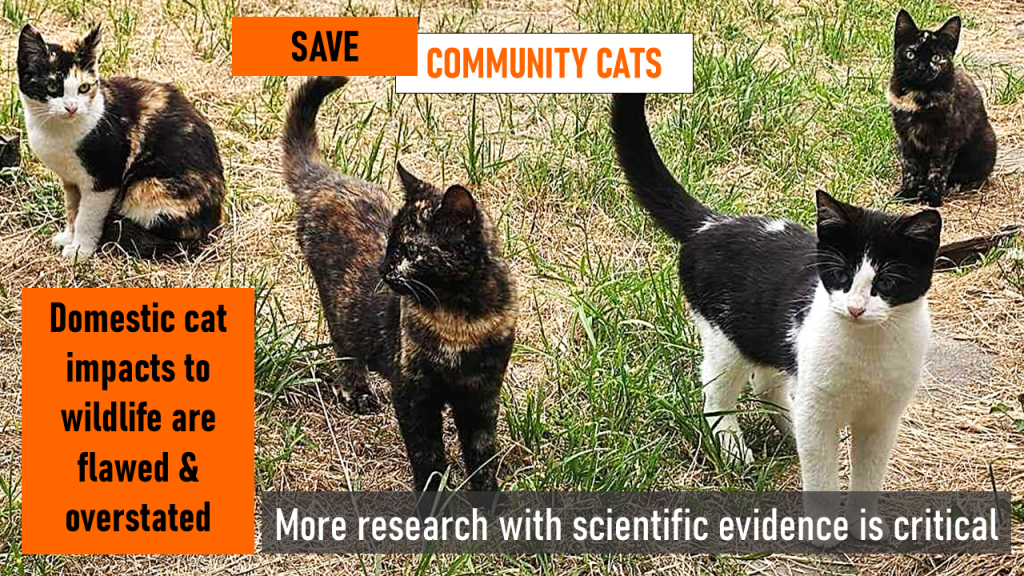
Wildlife impacts by domestic cats are flawed estimates & overstated
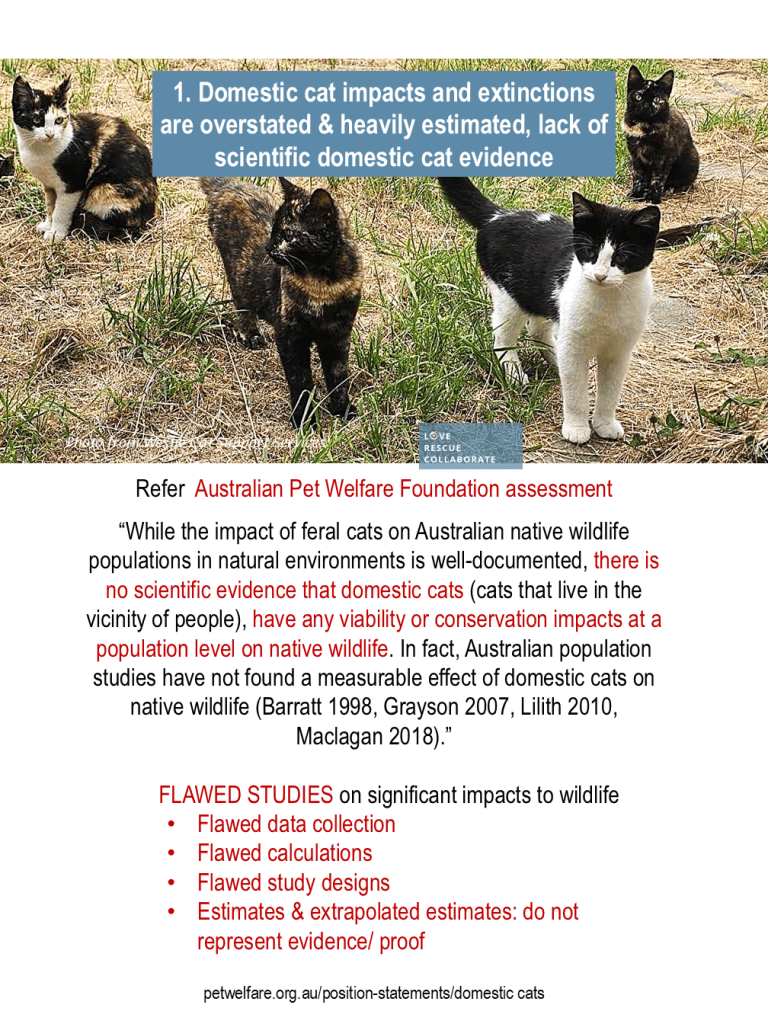
The APWF researched assessment of current “studies” shows the flaws in detail in the AWPF position statement https://petwelfare.org.au/position-statements/domestic-cats
A3 landscape
Stop the War, stop demonising cats, influences cat hate
[WIP]
 LRC
LRC