This summary is based on our view of the misleading information on the impacts of Aussie domestic cats and how this influences cat hate.
Cats do hunt, but not all cats, and cat containment should be promoted rather than legislated for more successful outcomes.
This assessment is based on contents and features of traditional and social media artefacts. The assessment is summarised in five steps to show the trail that contributes to increased cat hate, animal cruelty to roaming cats, and abuse to the volunteer community members who care & rehome abandoned cats.
The trail starts with studies on the impacts of domestic cats which contain flaws and are heavily estimate based.
There are also flawed statements on the number of native animal extinctions attributed to cats, usually phrased in a misleading manner.
Often the differentiation between domestic cats owned (pets), semi owned and unowned (strays) and feral cats is blurred and challenging for the public to ascertain.
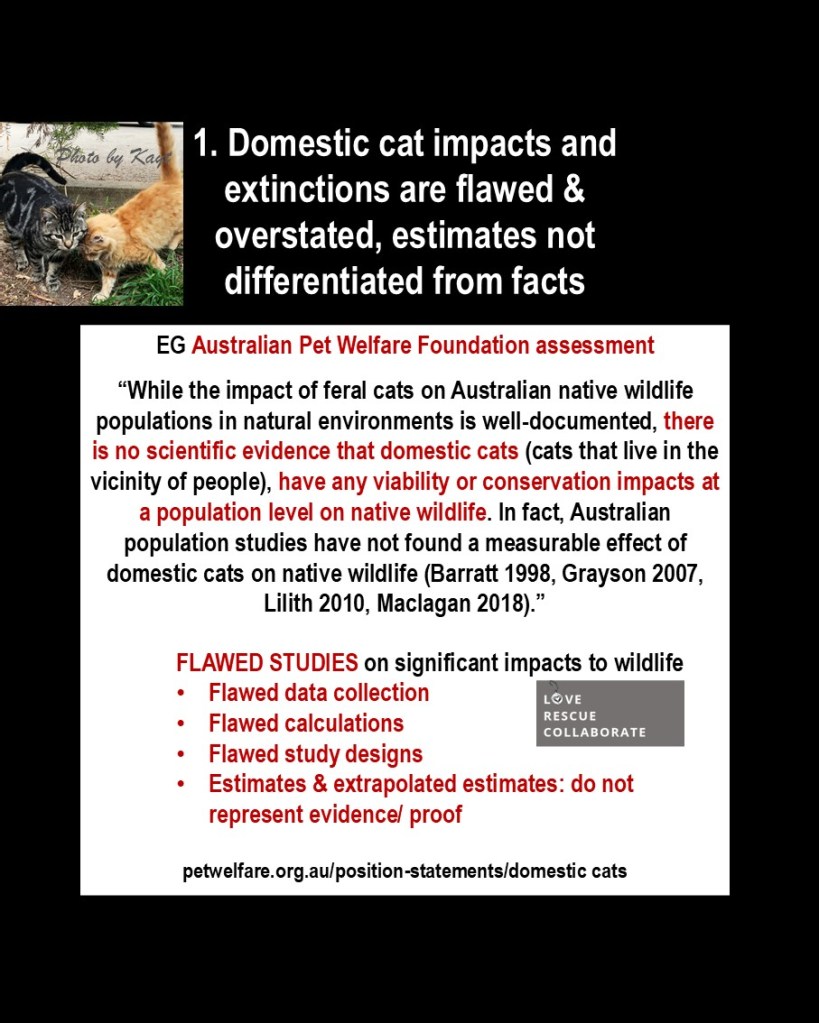
More studies are required for domestic cat impacts. The current studies are flawed in several ways. These studies are reliant on feral cat studies and heavily assumption based.
This has been assessed by the Australian Pet Welfare Foundation (APWF) and included in their position paper Domestic Cats and Australian WIldlife Populations https://petwelfare.org.au/position-statements/domestic-cats
“While the impact of feral cats on Australian native wildlife populations in natural environments is well-documented, there is no scientific evidence that domestic cats (cats that live in the vicinity of people), have any viability or conservation impacts at a population level on native wildlife. In fact, Australian population studies have not found a measurable effect of domestic cats on native wildlife (Barratt 1998, Grayson 2007, Lilith 2010, Maclagan 2018).”
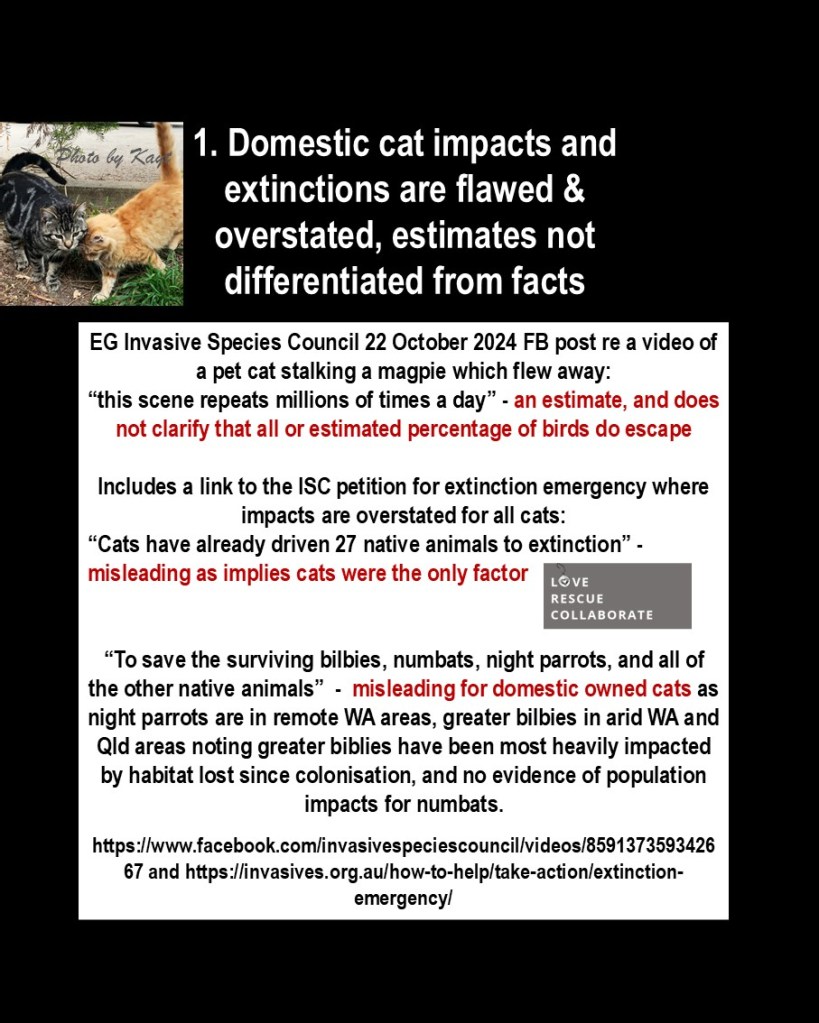
Be wary of social media posts, traditional media, and webpages where lines are blurred between domestic owned (pet cats), domestic semi owned and unowned (strays), versus feral cats who are truly wild and avoid humans.
We provide just a few examples to illustrate how estimates, impacts, and the native animals most at risk are not clearly articulated.
Wildlife and domestic cat experts are concerned that these approaches divert attention and funding from the most appropriate actions and funding for wildlife.
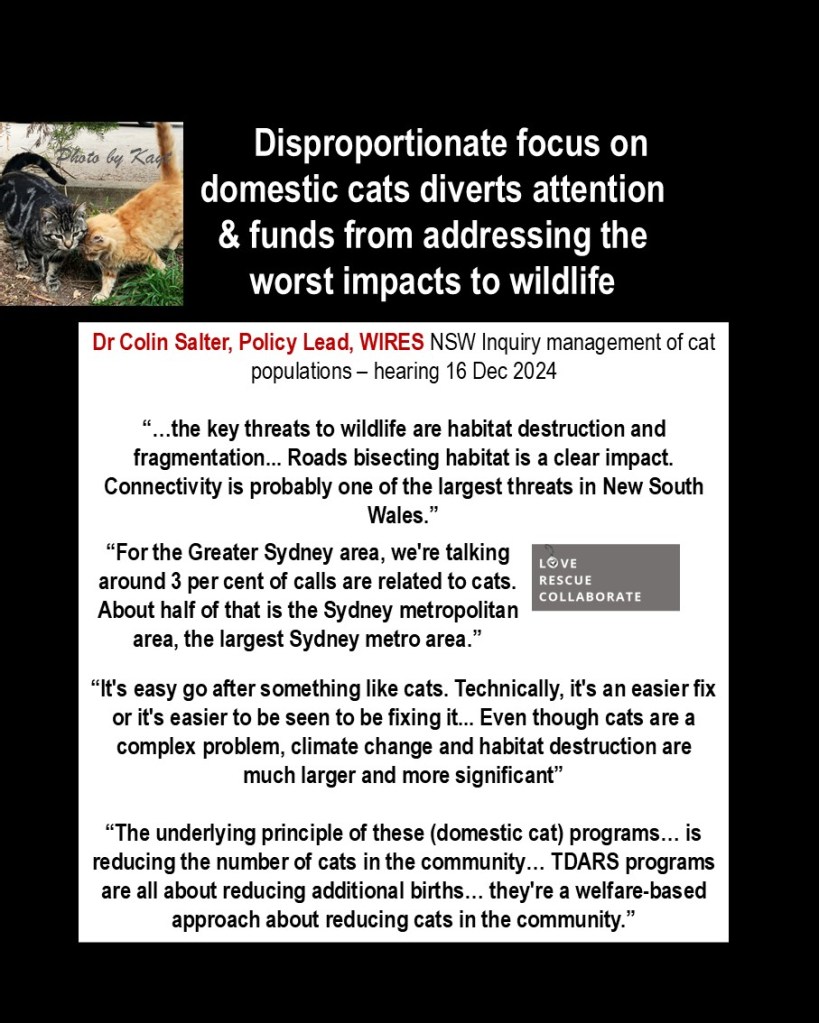
Several organisations call out the disproportionate focus on domestic cats where it is obvious in large urban areas and peri urban areas that land clearing of native habitat has caused the worst impacts to native wildlife.
Rewilding native animals in urban areas needs to carefully consider conservation fencing to protect wildlife and natural habitat from all threats, including human developments, road accidents, dog attacks etc not just domestic cats.
 LRC
LRC 