Updated October 2025 Hate speech towards groups of people is well known, but how did it become disturbingly acceptable towards all cats in Australia and their rescuers & carers, and even cat owners?
Articles and social media posts with overstated impacts, misleading content and extreme language, followed with comments of hate/ violence towards all cats, are major factors which have influenced the physical violence towards cats and their rescuers/carers.
Tired of the overstated impacts of cats, the misunderstanding information, the demonising almost hysterics against domestic cats? We are starting to build a kitbag / tool kit to help cat owners, supporters, rescuers & carers raise their voices & call out where Aussie domestic cats are being targeted with cat hate.
Content:
- Invasive Species misleading information influences cat hate and cruelty to cats
- What is hate speech & its impacts?
- Declaring a War on the War on Domestic Cats
- Overstating all cat & domestic cat impacts on wildlife
Invasive Species misleading information influences cat hate and cruelty to cats
Feel welcome to download our view based on many examples and assessments based on facts and factors from experts. The trail commences with overstated and questionable studies, which are emotionally charged and demonising across media, and social media comments which are not moderated that fuel others with a freedom to express acts of cruelty to animals and people. Repeated copies and similar pitched articles are proliferated across internet pages which floods the searches and AI summaries providing a false narrative.
What is hate speech & its impacts?
It is believed this wave of anger and violence has grown from the combination of the following:
- the national “War on Cats” initiated a decade ago, now blurring the lines between feral and domestic cats,
- articles providing overstated impacts, dramatised headlines, language demonising cats, and more misleading approaches,
- that many councils will not acknowledge volunteer cat carers and rescuers in their local government area, and
- the social media posts and comments of hate speech towards all cats.
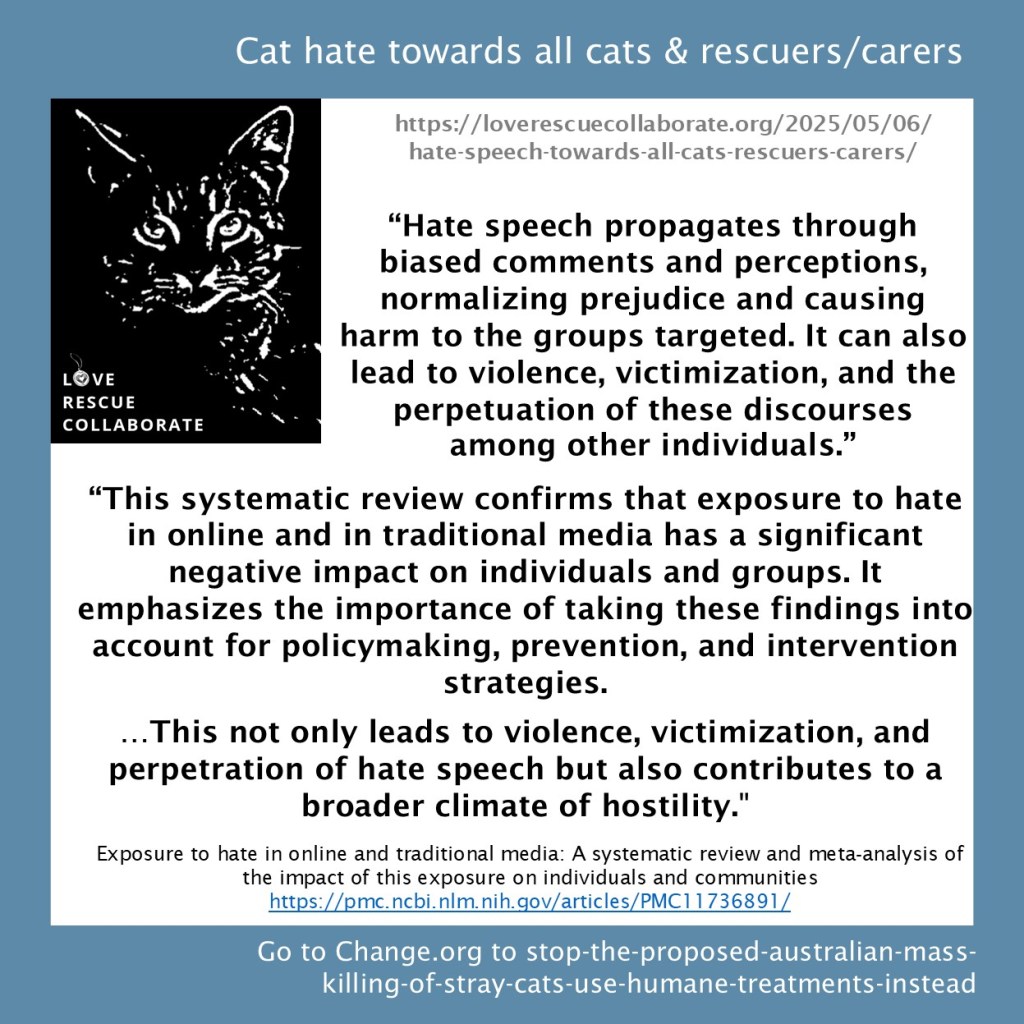
Very recent research across hate expressed in online and in traditional media includes:
the significant negative impact published forms of hate may have on individuals and groups,
that unchecked forms of hate have the potential to “grow”,
the importance of responding to these findings within policymaking, prevention, and intervention strategies.
Exposure to hate in online and traditional media: A systematic review and meta‐analysis of the impact of this exposure on individuals and communities https://pmc.ncbi.nlm.nih.gov/articles/PMC11736891/

Facebook’s standards include prohibiting criminal or harmful activities targeted at people, businesses, property or animals.
However, we do not have great confidence in its ability to assess hate speech beyond simple single statements.
In traditional and online media, cat hate speech can be drawn from a single overstatement of impacts to wildlife through combinations producing misleading context and views.
Online safety and social media regulation in Australia: eSafety Commissioner v X Corp
https://www.tandfonline.com/doi/full/10.1080/10383441.2024.2405760#d1e165
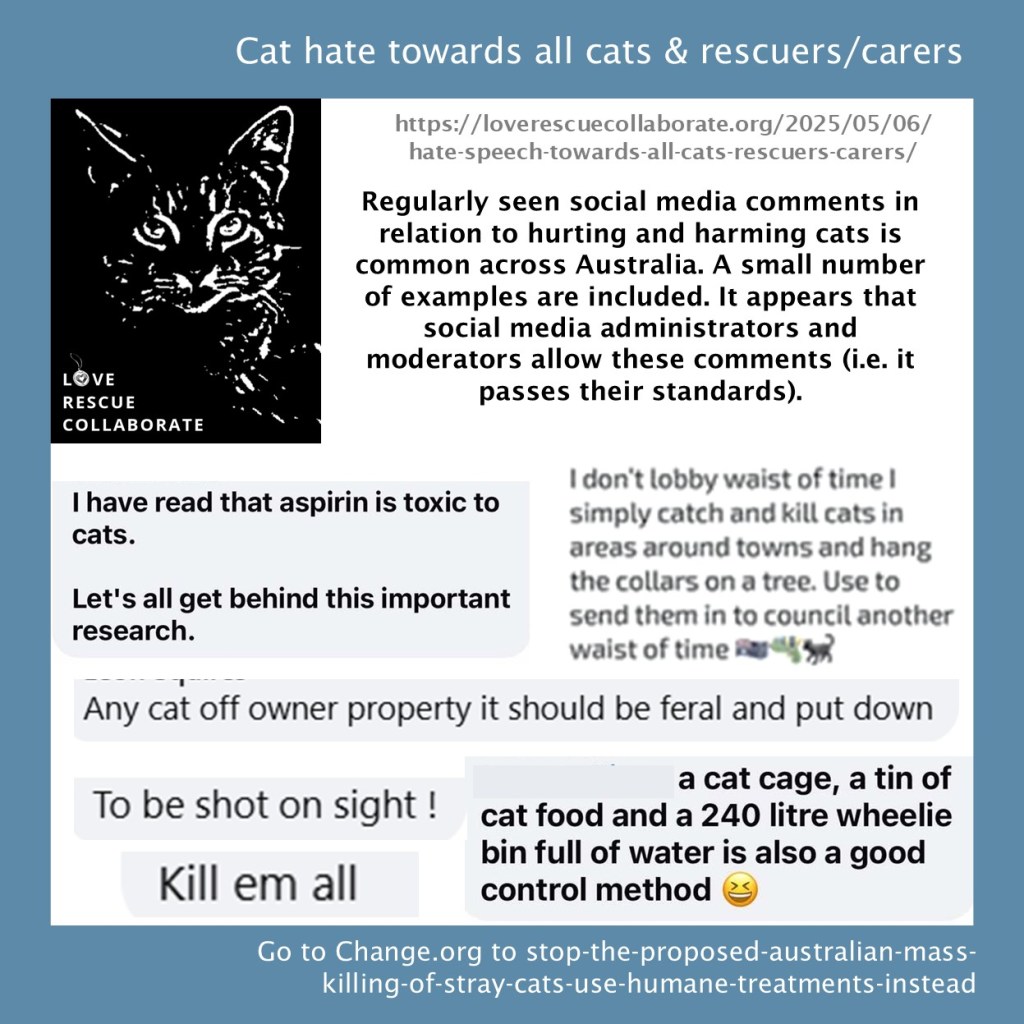
Another issue, is that the Facebook etc tools do not or cannot distinguish when harming or killing animals is not acceptable.
We too often see FB pages and groups where the administrators/ moderators do not include automated tools, nor appear to respond to reports from viewers on valid concerns for harming or killing cats.
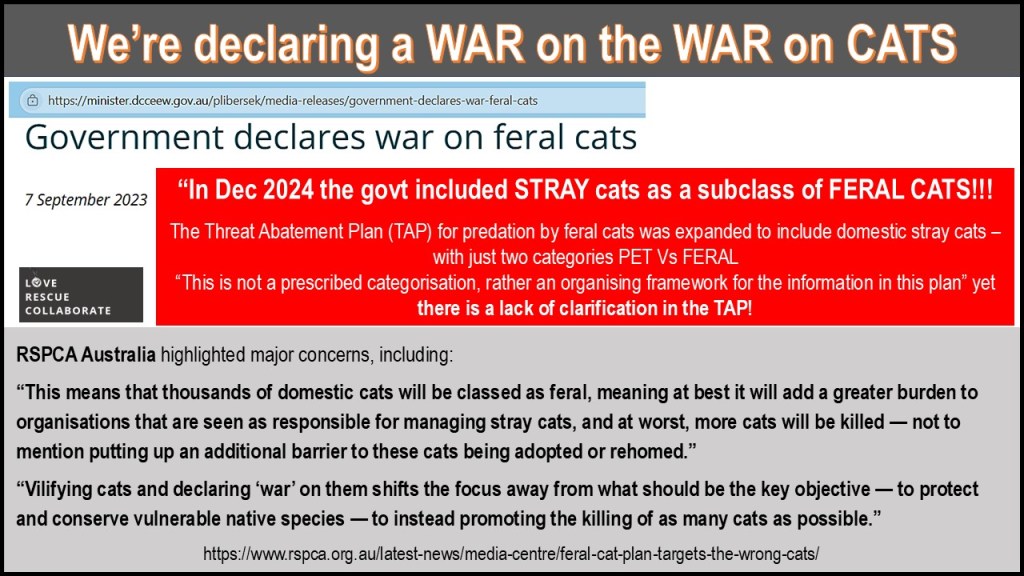
Declaring a War on the War on Domestic Cats
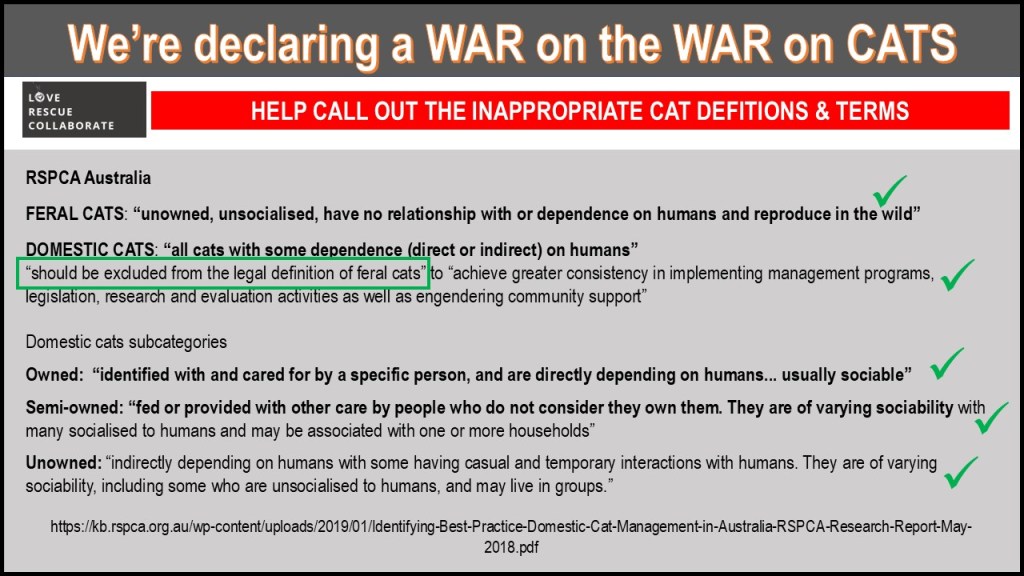
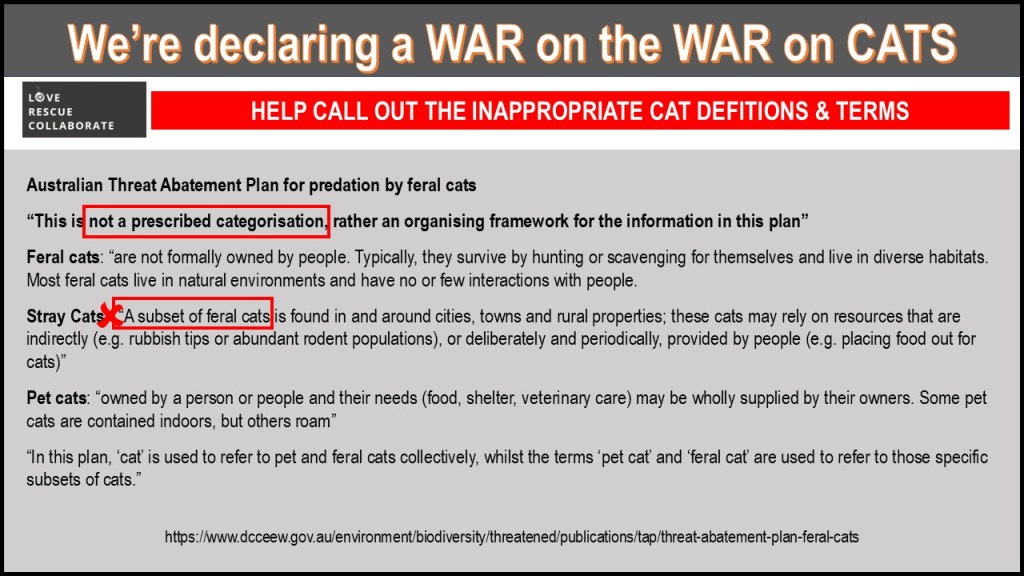
The Aussie Threat Abatement Plan (TAP) for predation by feral cats is inappropriately grouping “stray” cats as a subclass of “feral” cats allegedly for documentation purposes. This blurs the lines between quite distinct categories of cats, and will likely cause much confusion, which likely will influence domestic cats being harmed / destroyed by community members who dislike cats.
Below we take a look at the TAP versus the appropriate and trusted definitions by Royal Society for the Prevention of Cruelty to Animals (RSPCA) Australia.
Overstating all cat & domestic cat impacts on wildlife
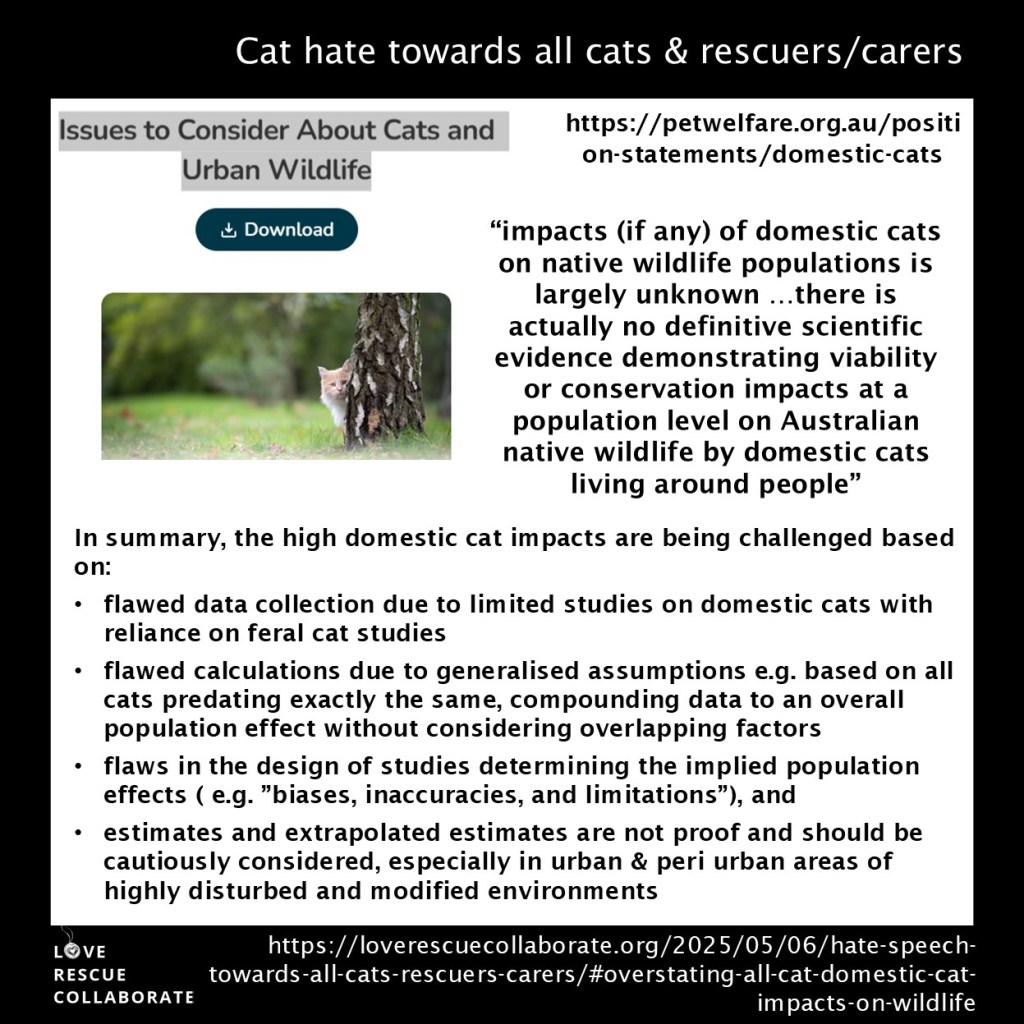
There is trusted analysis by the Australian Pet Welfare Foundation (APWF) of the current weaknesses in the research which is proliferated on the national impacts of all cats and domestic cats on our precious wildlife.
The data gathered and methods are validly questionable.
Quotes from the APWF position statement include:
- “impacts of feral cats on wildlife are often wrongly attributed to domestic cats, even though they are two distinct and geographically separate populations with different behaviour and ecology”
- “impacts (if any) of domestic cats on native wildlife populations is largely unknown …there is actually no definitive scientific evidence demonstrating viability or conservation impacts at a population level on Australian native wildlife by domestic cats living around people”
- “Australian studies were unable to detect a measurable impact in urban areas of domestic cats on native mammals (Maclagan 2018, Lilith 2010), or birds (Barratt 1998, Grayson 2007), but found that vegetation quality, housing density, distance from bushland and size of bushland were significant factors”
- “studies demonstrate the positive impact cat predation has by reducing the numbers of rats that predate bird nests (Matthews 1999)”
- “domestic cats that are obtaining food intentionally or unintentionally from humans predate significantly fewer animals than feral cats, which have to hunt to supply all their nutritional needs (Murphy 2019, Woinarski 2017)”
The APWF Issues to Consider About Cats and Urban Wildlife position statement may be downloaded from here: https://petwelfare.org.au/position-statements/domestic-cats
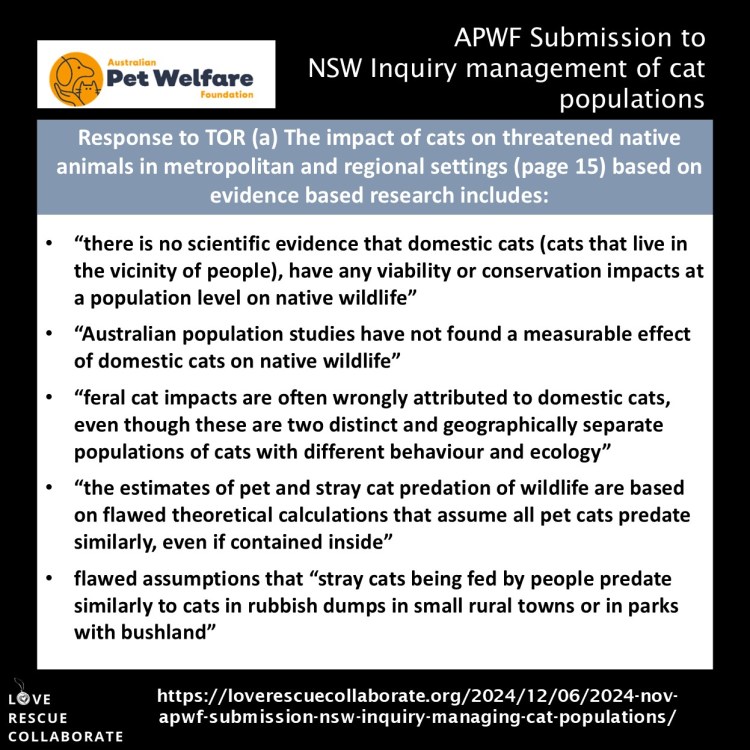
APWF’s recent submission to the NSW government included a number of concerns on the research that is widely published and publicised in traditional media articles and social media posts.
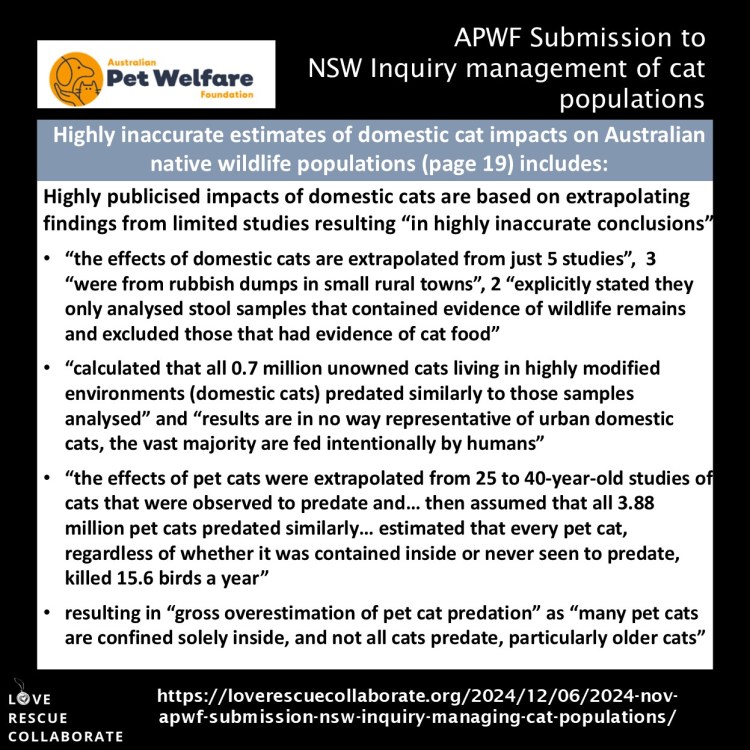
The APWF submission included specific examples of limitations, and flaws in the assumptions applied to overstate national and average totals of the impacts of domestic cats and then all cats (where feral and domestic cats impacts are combined).
 LRC
LRC 