February 2025 Australia
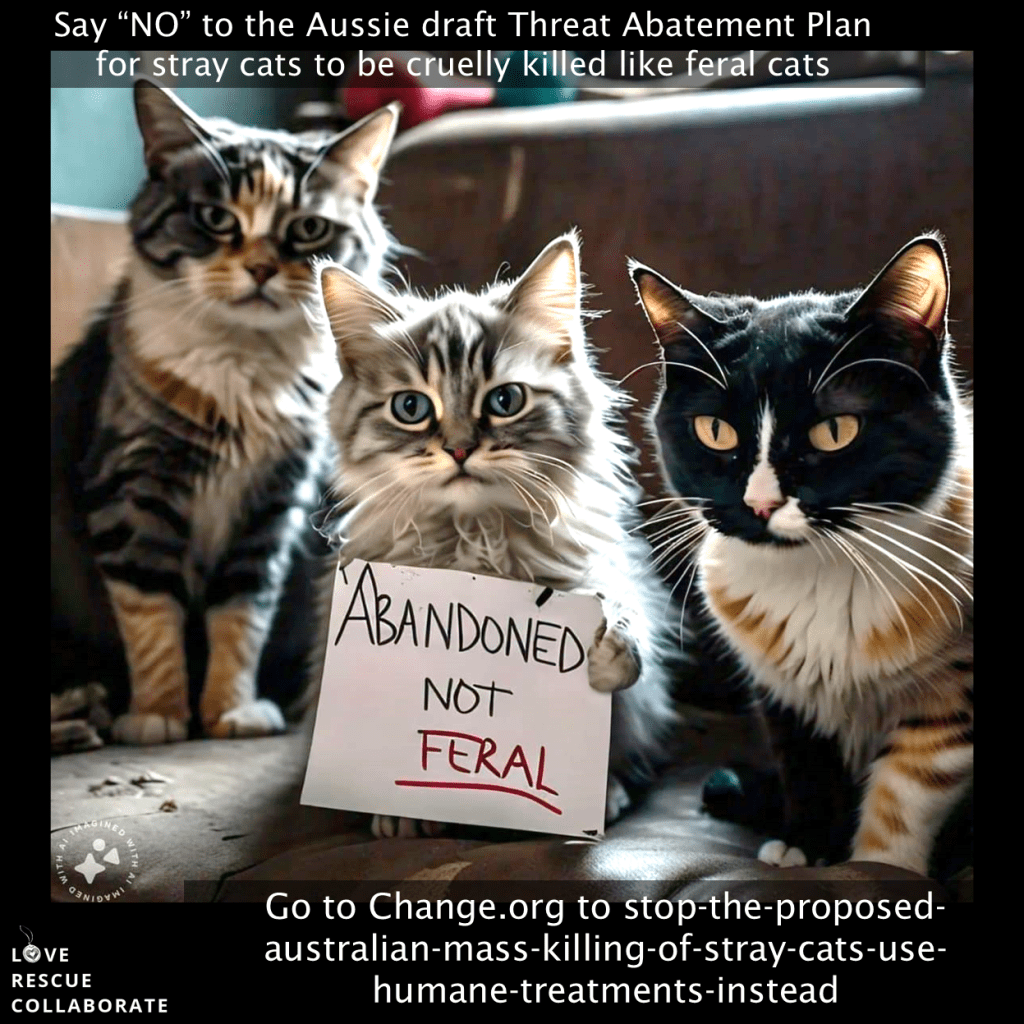
The LRC team provides key up-to-date information related to Trap Neuter Return (and other variations), as we wait for the NSW government recommendations on the NSW Inquiry for managing cat populations. A number of organisations have provided views, research and recommendations in support of TNR etc as effective approaches for managing cat populations.
Sign our petition for humane methods such as mass desexing & TNR are used instead of trapping & eradicating ALL stray cats: https://www.change.org/p/stop-the-planned-australian-eradication-of-all-stray-cats-they-are-not-feral-cats
Overview of contents
- Recent Aussie desexing programs involving TNR
- The LRC summary of desexing programs assisting semi owned cats & rescuers
- Australian Pet Welfare Foundation Community Cat Programs for owned and semi owned cats
- Banyule Victoria desexing program over several years
- NSW Keeping Cats Safe at Home with RSPCA, councils, vet clinics, and community cat rescuers
- RSPCA SA Proposed TDAR
- Download our summary of the three Australian programs involving free desexing & TNR
- Examples of TNR/ TNVR/ RTF/ SNR
- Trap-Neuter-Return Activities in Urban Stray Cat Colonies in Australia
- A Case Study in Citizen Science: The Effectiveness of a Trap-Neuter-Return Program in a Chicago Neighborhood
- An Examination of an Iconic Trap-Neuter-Return Program: The Newburyport, Massachusetts Case Study
- The Impact of an Integrated Program of Return-to-Field and Targeted Trap-Neuter-Return on Feline Intake and Euthanasia at a Municipal Animal Shelter
- Integrated Return-To-Field and Targeted Trap-Neuter-Vaccinate-Return Programs Result in Reductions of Feline Intake and Euthanasia at Six Municipal Animal Shelters
- Association between a shelter-neuter-return program and cat health at a large municipal animal shelter
Recent Aussie desexing programs involving TNR
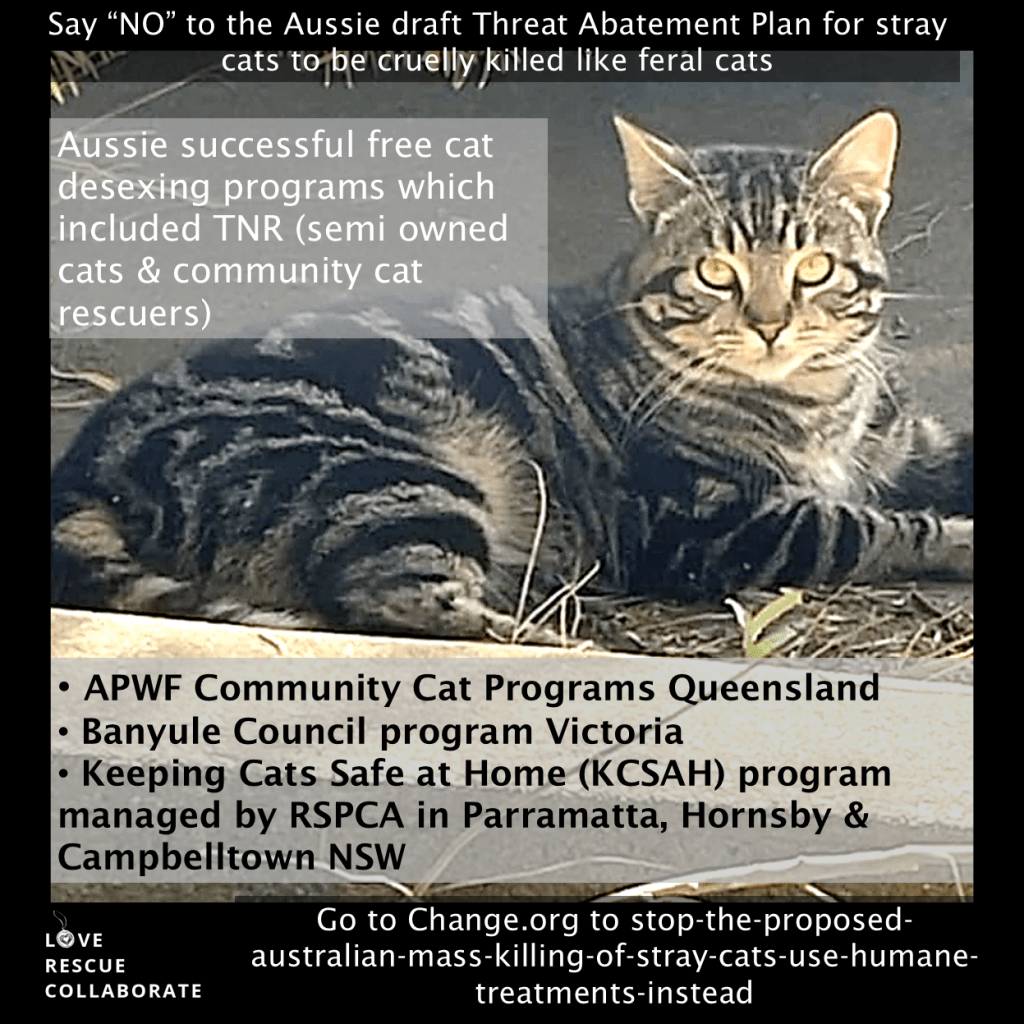
Large scale (mass / high intensity) desexing programs for owned, semi owned and unowned cats are supported for their effectiveness in minimising cat populations. This is achieved by significantly limiting the breeding of cats, which also benefits each cat and the communities.
The research and studies of highly successful free cat desexing programs were completed in a number of Australian councils including:
- the APWF Community Cat Programs in Ipswich Queensland,
- Banyule Council in Victoria, and
- the Keeping Cats Safe at Home (KCSAH) program managed by RSPCA for the NSW government.
The semi owned cats were returned to managed colonies or groups.
The LRC summary of desexing programs assisting semi owned cats & rescuers
Australian Pet Welfare Foundation Community Cat Programs for owned and semi owned cats
The Australian Pet Welfare Foundation (APWF) Community Cat programs in Queensland in a number of Ipswich suburbs have been operating since 2021 targeting stray cats, including:
“…desexing of urban stray cats… provided with other veterinary care, such as vaccinations and microchipping… if they are healthy and have been thriving outdoors, the cats are returned to where they live in their home territories… will also desex pet cats if their owners cannot afford to do so themselves… [and] adopting friendly cats and kittens found outdoors, increasing responsible pet cat ownership, decreasing abandonment and mediating resident conflicts involving outdoor cats”, “desexed over 2750 cats… achieved >30% reduction in cat intake & >50% less euthanasia”, and provided several evidence-based findings for research papers, international conference papers, a number of Australian submissions. https://petwelfare.org.au/community-cat-program-faq/, https://petwelfare.org.au/community-cat-program-news-2/, https://petwelfare.org.au/wp-content/uploads/2024/05/Aust-Community-Cat-Program-2024-Report.pdf
The highly successful Community Cat Programs operated over several years by the APWF which provide evidence with managing cat populations are supported:
“Community Cat Programs involve high-intensity free desexing, microchipping and registration of owned, semi-owned and unowned cats targeted to areas of high cat intake and complaints. CCPs are proven to be very effective at reducing stray cat numbers, pound intake and euthanasia, complaints and costs. CCPs are also very effective at assisting semi-owners to desex and adopt the stray cat they are feeding and continue to feed and care for their cat, significantly reducing the number of unwanted kittens born. Semi-owners represent a large pool of potential cat adopters, particularly for shy and timid cats, and are integral to resolving the stray cat issue and associated high intake and high euthanasia rates of cats in pounds and shelters. Community Cat Programs proactively manage stray cats in the community keeping cats with their owners, and because they are non-lethal they do not cause devastating mental health impacts to staff or community members, consistent with a One Welfare approach which optimises the well-being of people, animals and their environment.” https://www.parliament.nsw.gov.au/lcdocs/submissions/81381/0132%20Australian%20Pet%20Welfare%20Foundation.pdf
Banyule Victoria desexing program over several years
“Completely free cat desexing
- The implantation of a microchip so the cats could be traced back to an owner
- Free council registration for the first year
- A transport service provided by council AMOs for those that had none”.
Submission #141 Inquiry into the problem of feral and domestic cats in Australia https://www.aph.gov.au/Parliamentary_Business/Committees/House/Former_Committees/Environment_and_Energy/Feralanddomesticcats/Submissions
The Banyule free desexing program was cost effective by council funding offset by savings and achieved significant results in minimising the cat population. For owned and semi-owned cats this included “decreases in impoundments by 66%, euthanasia by 82%, and cat-related calls by 36% over 8 years, with savings to council of AU $440,660 for an outlay of AU $77,490”.
This program critically involved AMO roles in effective face-to-face, coal-face engagement with the community, and included owned and stray (semi owned and unowned) cats.
“The program proposed and approved by the city of Banyule was that sterilization, microchipping, and the first year of registration would be funded by the council. The purpose of this program was to increase ownership responsibilities for owned and stray cats being fed by residents (semi-owned cats) and to reduce unwanted kittens being born and, therefore, the number of cats and kittens killed in the council-contracted facility (CPS). This was provided at no cost for all owned cats and semi-owned cats in the target areas.”
“When the medium-intensity targeted program resumed in 2017/18, and the trapping process changed from enforcement-orientated to assistive, cats impounded city-wide decreased by 51% over four years, from 284 in 2016/17 to 134 in 2020/21”.
“…the traditional methods of trapping wandering and nuisance cats have not resulted in long-term reductions in cat-related calls to councils. However, following the implementation of a microtargeted free sterilization program for owned and semi-owned cats, marked reductions in cat-related calls, impoundments, euthanasia, and costs were realized, similar to that reported in US programs. It is recommended that urban cat management policies and programs are revised and, instead of being focused on a traditional compliance-based approach, are focused on being assistive, helping owners and semi-owners have their cats sterilized and identified with a microchip.”
Impact of a Local Government Funded Free Cat Sterilization Program for Owned and Semi-Owned Cats https://www.mdpi.com/2076-2615/14/11/1615
NSW Keeping Cats Safe at Home with RSPCA, councils, vet clinics, and community cat rescuers
The Keeping Cats Safe at Home (KCSAH) in NSW included key desexing programs where approaches under specific councils achieved high results with managing cat populations.
The Weddin Council KCSAH desexing program offered free microchipping and desexing which included: collaboratively working to achieve results for over 100 cats, the view this approach “represents the future of local cat management, it is the answer to reducing cat euthanasia rates and keeping cats out of pounds and shelters”. https://weddinlandcare.com.au/milestone-for-keeping-cats-safe-at-home-project
The Parramatta Council KCSAH desexing program included: an aim “to locate unowned cat hotspots and engage with overwhelmed cat carers and volunteer cat rescue groups”; and results where cat-related nuisance complaints decreased by 49% and cats arriving at the council pound decreased by 41%. https://acrobat.adobe.com/id/urn:aaid:sc:AP:4d1d5b58-63b5-4a70-8196-212fded377d1
Anecdotally, Campbelltown and Hornsby KCSAH desexing programs also critically included local carers and rescuers for semi owned and unowned cats. With these community cat rescuers (volunteers) a high take up of desexing was arranged with cat owners, supported transport and scheduling. These roles are critical to achieve a high number of desexing procedures to minimise cat populations with community engagement.
At the AIAM conference a KCSH presentation was provided – noting pages 12-14 for targeted desexing including semi owned cats and semi owners (community cat rescuers and carers). https://aiam.org.au/page-18158
RSPCA SA Proposed TDAR
“In TDAR, unowned or semi-owned cats are trapped, heath checked, desexed, vaccinated and then either rehomed or returned to their original location. Cats who are unsuitable for rehoming, unhealthy and unfit for release are humanely euthanised.”
“Action 23: Reduce strays taken to shelters by helping community members understand that sometimes cats are better left where they are. Promote the approach of “leave a healthy cat where they are and monitor” to stray cats.
Action 24: Undertake a ‘trap, desex and adopt or return’ (TDAR) trial in a selected area of SA, as an attempt to reduce uncontrolled breeding in urban stray cat populations.
Action 25: Educate the public about semi-owned cats as a separate category of cats, helping members of the public who feed stray cats to understand the importance of desexing and microchipping.”
https://www.rspcasa.org.au/cat-plan-explainer/
Download our summary of the three Australian programs involving free desexing & TNR
Examples of TNR/ TNVR/ RTF/ SNR
It is strongly recommended that Australian governments invest funding into more intensive programs of desexing including Trap Neuter Return, Trap Neuter Vaccinate Return, Return To Field, and Shelter Neuter Return which are adequately researched over years. The evidence gathered from NSW, Queensland, and Victorian councils indicated benefits with minimising cat populations including stray cats, and therefore continuing with similar efforts will provide benefits across NSW. It is noted that both the Qld CCPs and NSW KCSAHs involved semi owned and unowned cats under community cat rescuers. The success of TNR, TNVR, RTF, and SNR techniques have also been documented in a number of other studies.
Please refer to the earlier section for information on the Queensland, NSW and Victorian desexing programs. These included desexing of stray cats (semi owned and unowned) where these cats were under managed colonies operated by community cat rescuers. The following are just a small sample of the evidence-based research in these techniques.
Trap-Neuter-Return Activities in Urban Stray Cat Colonies in Australia
“We conclude that trap, neuter and return associated with high desexing rates in colonies, and adoption of kittens and friendly adults substantially reduces colony size, and improves the welfare of cats and kittens. This model is cost-effective for municipalities, and should be legalized in Australia.” https://www.mdpi.com/2076-2615/7/6/46
A Case Study in Citizen Science: The Effectiveness of a Trap-Neuter-Return Program in a Chicago Neighborhood
“Colony populations, when grouped by the number of years enrolled in the program, declined by a mean of 54% from entry and 82% from peak levels. Results from coexistent TNR programs in the Chicago area are consistent with these findings.” https://pubmed.ncbi.nlm.nih.gov/29346278/
An Examination of an Iconic Trap-Neuter-Return Program: The Newburyport, Massachusetts Case Study
“Available evidence indicates that an estimated 300 free-roaming cats were essentially unmanaged prior to the commencement of the TNR program; a quick reduction of up to one-third of the cats on the waterfront was attributed to the adoption of sociable cats and kittens; the elimination of the remaining population; over a 17-year period; was ascribed to attrition.” https://www.mdpi.com/2076-2615/7/11/81
The Impact of an Integrated Program of Return-to-Field and Targeted Trap-Neuter-Return on Feline Intake and Euthanasia at a Municipal Animal Shelter
“New approaches, including return-to-field (RTF) and targeted trap-neuter-return (TNR) appear to have transformative potential. …formal RTF and targeted TNR protocols, collectively referred to as a community cat program (CCP), were added to ongoing community-based TNR efforts and a pilot RTF initiative. As part of the three-year CCP, 11,746 cats were trapped, sterilized, vaccinated and returned or adopted. Feline euthanasia at the Albuquerque Animal Welfare Department (AAWD) declined by 84.1% and feline intake dropped by 37.6%; the live release rate (LRR) increased by 47.7% due primarily to these reductions in both intake and euthanasia. Modest increases in the percentage of cats returned to owner (RTO) and the adoption rate were also observed, although both metrics decreased on an absolute basis, while the number of calls to the city about dead cats declined.” https://www.semanticscholar.org/paper/The-Impact-of-an-Integrated-Program-of-and-Targeted-Spehar-Wolf/473bbf487fce3cf6a3743f73e2c1ca7b431d25a1
Integrated Return-To-Field and Targeted Trap-Neuter-Vaccinate-Return Programs Result in Reductions of Feline Intake and Euthanasia at Six Municipal Animal Shelters
“In the past decade, two new variants of TNVR, return-to-field (RTF) and high-impact targeting, have exhibited the capacity to contribute to significant reductions in shelter intake and euthanasia. The present study examines changes in feline intake and euthanasia, as well as impacts on associated metrics, at municipal shelters located in six diverse U.S. communities after integrated programs of RTF and targeted TNVR (collectively termed “community cat programs,” CCPs) were implemented. A total of 72,970 cats were enrolled in six 3-year CCPs, 71,311 of whom (98%) were sterilized, vaccinated, and returned to their location of capture or adopted. A median reduction of 32% in feline intake, as well as a median decline of 83% in feline euthanasia occurred across the six CCPs; median feline live-release rate increased by 53% as a result of these simultaneous declines in cat admissions and euthanasia. The integration of RTF and targeted TNVR protocols appears to result in greater feline intake and euthanasia reductions than programs lacking such an integrated approach.” https://www.frontiersin.org/articles/10.3389/fvets.2019.00077/full
Association between a shelter-neuter-return program and cat health at a large municipal animal shelter
“RESULTS Number of cats admitted to the shelter each year decreased significantly over 8 years; beginning in 2010, duration of stay decreased. Proportion of cats euthanized decreased from 66.6% (28,976/43,517) in the pre-SNR period to 34.9% (11,999/34,380) in the post-SNR period, whereas prevalence of URI increased from 5.5% to 6.8%, and median duration of shelter stay decreased from 6 to 5 days for cats < 4 months of age and from 8 to 6 days for older cats. With implementation of the SNR program and a new treatment policy for cats with URI, more cats received treatment with less medication, yielding cost savings.” https://pubmed.ncbi.nlm.nih.gov/26799109/
 LRC
LRC 