Please support domestic stray cats with the petition: https://www.change.org/p/stop-the-planned-australian-eradication-of-all-stray-cats-they-are-not-feral-cats
We call on the Minister for Environment, Tanya Plibersek to correct the cruel 2023 draft Threat Abatement Plan (TAP) for predation by feral cats, which intends to incorporate all stray cats as feral cats and apply the same lethal approaches to ALL urban domestic cats. This also implies there will be an end to rescue and rehoming efforts for all domestic abandoned cats: cats left behind in properties, left in parks, schools, churches, etc. as feral cats are not to be rescued nor rehomed.
- 2023 Draft Threat Abatement Plan (TAP) Key Sections
- Summary of how eradicating stray domestic cats is included in the 2023 draft TAP
- Current TAP 2015 includes stray cats as a separate class/ category needing different approaches to feral cats
- Draft TAP 2023 proposes significant changes for stray cats
- Lack of transparency in draft TAP 2023 for significant change in scope to stray cats
- “Tackling the feral cat pandemic: a plan to save Australian wildlife, Report of the inquiry into the problem of feral and domestic cats in Australia” 2020
- RSPCA Key Points
- APWF Key Points
- AJP NSW Key Points
- Information Sources
2023 Draft Threat Abatement Plan (TAP) Key Sections
Summary of how eradicating stray domestic cats is included in the 2023 draft TAP
- The STRAY cat definition as a separate class or category in the current Threat Abatement Plan (TAP) 2015 has been removed from the draft TAP, with the 2015 recognised need for different management strategies to FERAL cats
- STRAY cats have been proposed to be a subclass of the FERAL cat term in the definition section of the draft TAP 2023.
- The STRAY cat term is not clearly and separately used throughout the draft TAP as wherever the FERAL term is used is also applies to the STRAY cat subclass
- Where the FERAL cat term is used, then FERAL cat response approaches / treatments are provided, which now implies these will apply to the proposed subclass of STRAY cats.
Current TAP 2015 includes stray cats as a separate class/ category needing different approaches to feral cats
The draft TAP 2023 proposes a major shift away from the previous TAP 2015 three separate categories, including the term and definition for ‘stray cats’, where such semi owned cats and unowned cats were obviously and more strongly aligned with domestic owned cats.
“Cats can be grouped into categories according to how and where they live…
- feral cats are those that live and reproduce in the wild (e.g. forests, woodlands, grasslands, deserts) and survive by hunting or scavenging; none of their needs are satisfied intentionally by humans;
- stray cats are those found in and around cities, towns and rural properties; they may depend on some resources provided by humans but are not owned; and
- domestic cats are those owned by an individual, a household, a business or corporation; most or all of their needs are supplied by their owners. If the confinement of domestic cats becomes more common, the category of a domestic cat may need to be divided to confined and unconfined cats because the potential for these two groups to impact on native fauna is different.”
“Management of stray cats often requires a combination of technical and social approaches… the complex relationships between people, families, groups and their companion animals may require a different approach to addressing the problem of predation by feral cats” and “will need to be developed in consultation with the communities.”
Draft TAP 2023 proposes significant changes for stray cats
Section 3 Definitions in the draft TAP 2023 includes the separate “stray” cat term will become a subset of “feral” cats, and then throughout the draft TAP where the term “feral cat” is used the intention is that the scope, e.g. responses/ treatments also applies to the subset “stray cats”.
“A subset of feral cats is found in and around cities, towns and rural properties; these cats may rely on resources that are inadvertently or deliberately provided by people, such as rubbish tips or abundant rodent populations. These cats are sometimes called ‘stray cats’.”
“In this plan, ‘cat’ is used to refer to pet and feral cats collectively, whilst the terms ‘pet cat’ and ‘feral cat’ are used to refer to those specific subsets of cats. Feral cats may be further described as those living in natural environments, and those living in or around human infrastructure or heavily modified environments.”
Lack of transparency in draft TAP 2023 for significant change in scope to stray cats
The draft TAP does not include a document change history to summarise changes from the current TAP 2015.
The document title remains “Threat abatement plan for predation by feral cats 2023”, it does not reflect the change in scope of the draft TAP to pet/ owned cats, nor stray cats (semi owned or unowned) being a subclass of feral cats and now within scope.
Section 1 Summary does not include recognition of the significant change to the “stray cats” class/ category.
Section 2 Introduction does not include recognition of the significant change to the “stray cats” class/ category.
Section 2.3 The review of the 2015 threat abatement plan does not explicitly indicate the significant change to the “stray cats” class/ category, noting this change was not included in the inquiry into the problem of feral and domestic cats.
“This document replaces the previous threat abatement plan published in 2015; it incorporates the knowledge gained since 2015, and has been modified in light of the recommendations from the review of the 2015 plan, and the report from the House of Representatives inquiry into the problem of feral and domestic cats.”
“Tackling the feral cat pandemic: a plan to save Australian wildlife, Report of the inquiry into the problem of feral and domestic cats in Australia” 2020
The report includes the following references and recommendations for stray cats.
The Forward by the Chair includes a number of references to “feral, stray and domestic cats”.
RSPCA Key Points
We agree with and support the 2024 views of the RSPCA Australia:
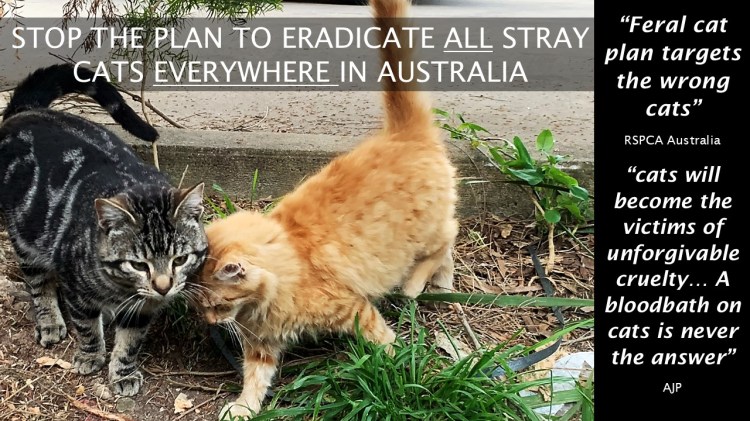
- the “Feral cat plan targets the wrong cats”
- the proposed draft TAP “means that unowned and semi-owned cats — cats who live alongside humans and have some form of contact with and reliance on people — will now be classed as ‘feral’… cats who are provided with care by someone, often multiple people” and the “cat who stops by your neighbours’ houses for a pat and to get fed is not the same as a cat who lives completely wild — but this plan treats them the same”
- “Vilifying cats and declaring ‘war’ on them shifts the focus away from what should be the key objective — to protect and conserve vulnerable native species — to instead promoting the killing of as many cats as possible”
APWF Key Points
We agree with and support the views of the APWF:
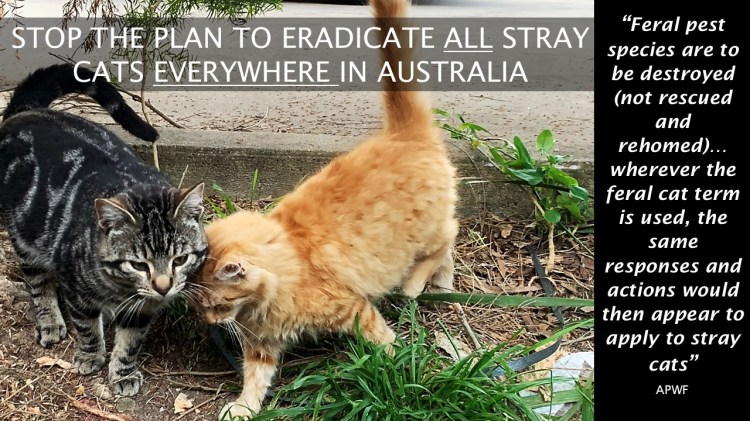
- “In 2015, environment ministers made a commitment to the national declaration of feral cats as a pest, and most jurisdictions accordingly now recognise feral cats as a pest. Feral pest species are to be destroyed (not rescued and rehomed). Throughout the draft TAP, wherever the feral cat term is used, the same responses and actions would then appear to apply to stray cats. ”
- “The proposed actions in the plan regarding cat curfews, caps on cat ownership and restricting ownership of cats in local government areas demonstrates a lack of understanding of the cause of the free-roaming cat problem in our cities and towns based on current Australian research… the proposed solutions are highly flawed, will be costly to enforce and will be ineffective at protecting wildlife populations of concern”
- “Australian research shows that Community Cat Programs based on free desexing of cats in areas with high numbers of free-roaming cats are very effective in reducing complaints, reducing free-roaming cats being impounded, reducing the number of healthy cats being killed and reducing council costs. In these programs”
AJP NSW Key Points
We agree with and support the views of Emma Hurst Animal Justice Party (AJP) NSW:
- Under the draft TAP “cats will become the victims of unforgivable cruelty… A bloodbath on cats is never the answer”
- “Research has shown that killing programs don’t work – they are cruel, and why would you when there are better options?”
- “The science shows that the best way to reduce the number of homeless cats is to run large scale free desexing programs. The Government should also properly fund education programs about the benefits of keeping cats inside.”
Information Sources
https://consult.dcceew.gov.au/draft-updated-threat-abatement-plan-for-predation-by-feral-cats
https://www.rspca.org.au/latest-news/media-centre/feral-cat-plan-targets-the-wrong-cats/
https://www.al.org.au/ban-1080
 LRC
LRC 