It is critical that everyone involved with cat welfare, especially community cat rescuers & feeders, provide a submission as feedback to this strategy. The draft Victorian Cat Management Strategy (the draft strategy) fails to include intrinsic stakeholders in the “main group” for formulation, including domestic cat management experts (eg APWF), the Australian Veterinary Association (AVA) representatives, Australian Institute of Animal Management (AIAM) representatives, and community cat rescuers and carers.
To provide feedback on the draft strategy, you may either
- upload a document (.doc or .docx, no free form entry), OR
- complete a survey which has specific questions and usually only one free form entry per topic of only 350 characters.
The LRC guide provides help on the following aspects & draft strategy topics.
- Overview
- Source documents
- Quick Guide to Survey
- Quick guide & hints for submissions / responses
- Introduction, Managing cats in Victoria (page 6) – gaps with “main groups”
- Key partners and stakeholders, pages 11 & 12
- Top Issues with Theme 1 Promote cat welfare and responsible cat ownership
- Top Issues with Theme 2: Increase cat desexing rates
- Top Issues with Theme 3: Expand cat containment
- Top Issues with Theme 4: Reduce the impacts of semi-owned and unowned cats
- Top Issues with Theme 5: Manage feral cat populations and impacts
- Top Issues with Theme 6: Improve collaboration and information sharing
- Top Issues with Theme 7: Improve laws and processes
Overview
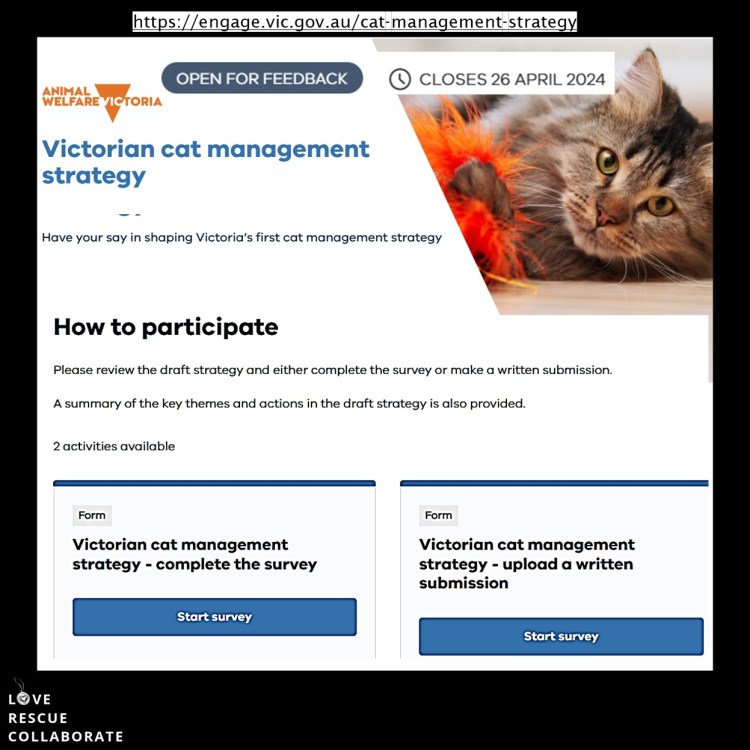
Submissions are open for everyone, regardless of state/ territory.
Though the strategy is for the state of Victoria it will set a precedent for other states & territories.
I.E. it is coming to you soon!!! raise issues now!
Information is here: Victorian cat management strategy | Engage Victoria
On that same webpage you can: download the documents, and provide either a survey or a submission response.
We have yet to assess the limitations in the survey tool, though it indicates you can continue editing over time. However, we always suggest you keep your own notes, which is suitable for an upload and an easy function is available for that.
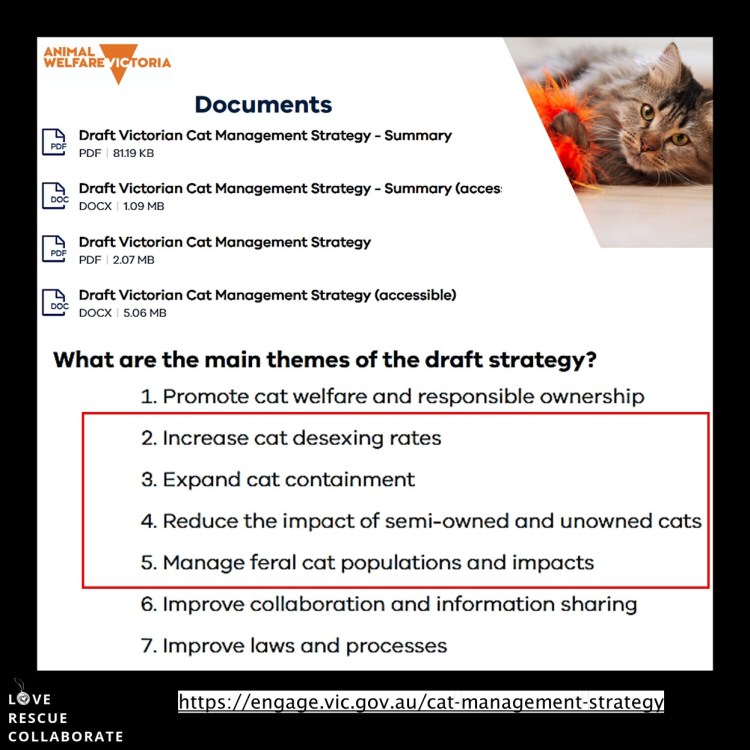
IF you would like to do your own assessment & response, then please start NOW as the strategy document is 27 pages long, and there is a summary document too.
IF your time is limited then perhaps focus on the key themes which are of most interest to you. We have highlighted some we view as critical to assess.
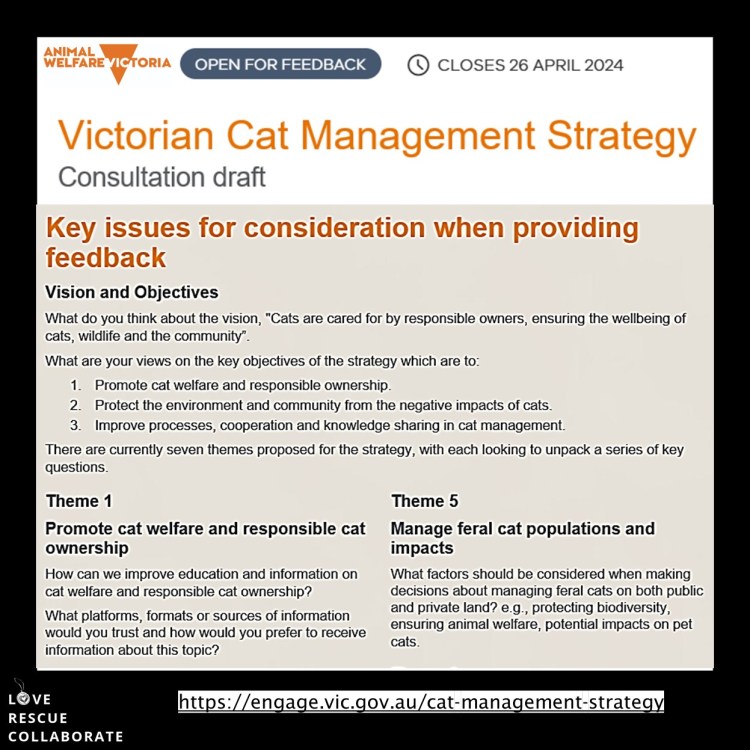
There is a summary of Vic’s key issues & themes, that is on page 5.
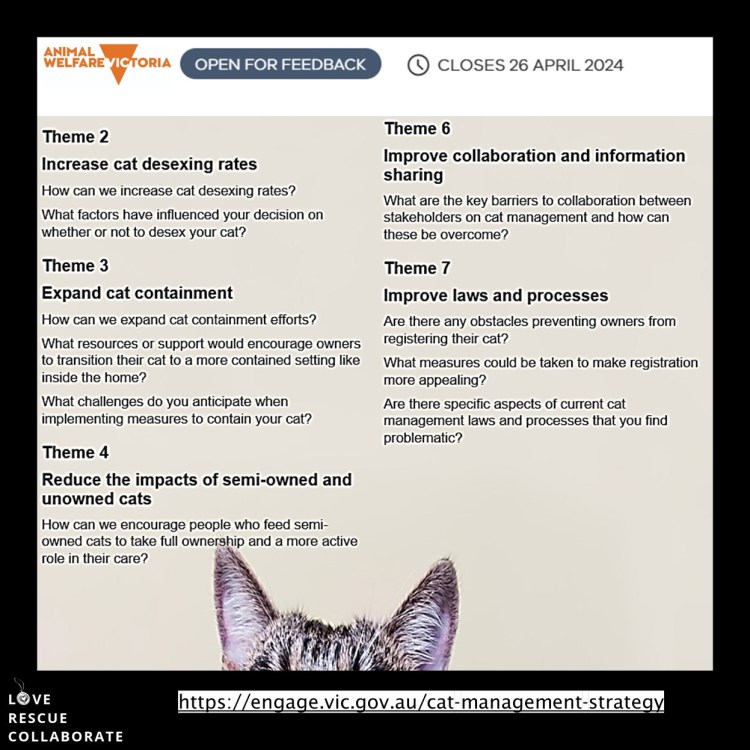
Each of the themes start on page 16, and each is covered in one page each. Therefore if your time is very limited we suggest you focus on just these pages.
The LRC team is working with others to collaborate on our view of the top issues.
We will provide updates in this blog – however initially it appears that there are gaps related to:
- domestic cat management best practices (mandatory cat containment is not effective)
- semi owned & unowned cats deserve more support
- enabling & assisting community cat rescuers
Source documents
Can be found here: Victorian cat management strategy | Engage Victoria
The OVERVIEW tab information includes the source documents in Word and PDF for both the Summary and Strategy documents, which may be downloaded.
The OVERVIEW tab also contains FAQs.
Quick Guide to Survey
We view that the survey is very limited based on a) set discussion questions from actions in the draft strategy (some actions are worded differently in the survey to the draft strategy), and b) limited to just 350 characters (not words, includes spaces) for the few free form responses, mainly one per draft strategy “Theme”.
If possible, and you can create .doc or .docx files, then please write submissions with out these constraints 🙂 and enabling you to include URL/links to quoted findings by other.
The theme pages from the strategy document are included in this blog – a section for each Theme and the top issues in our opinion.
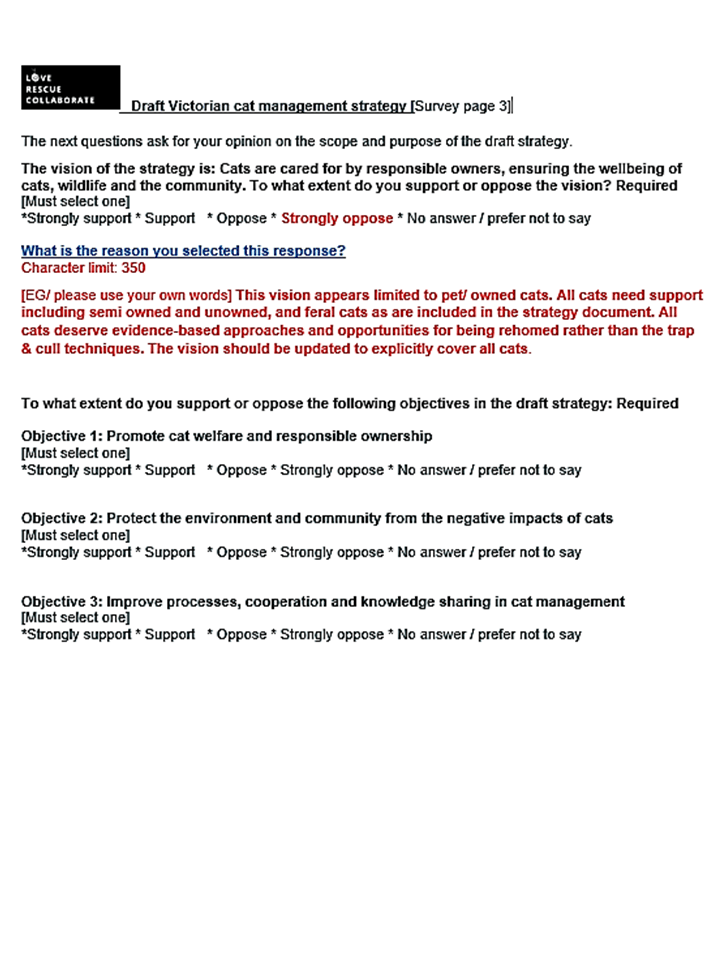
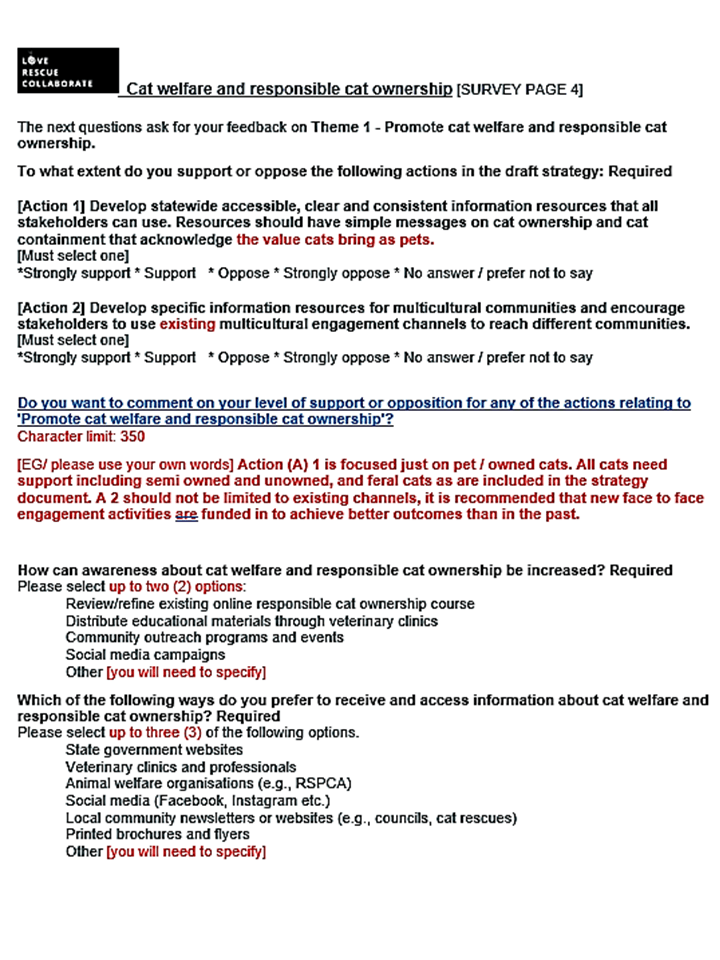
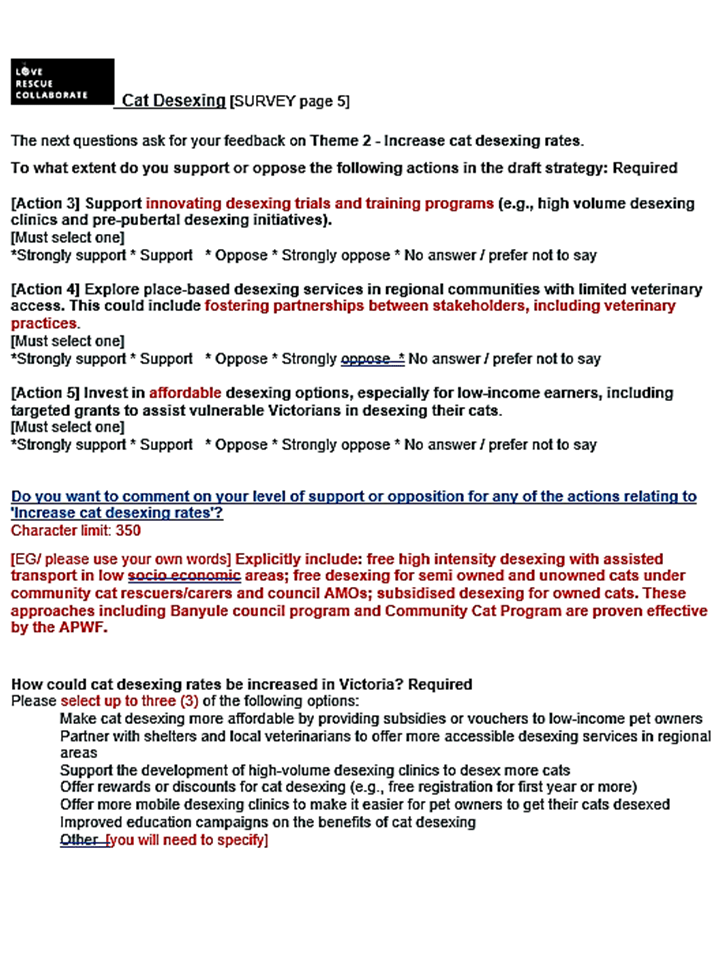
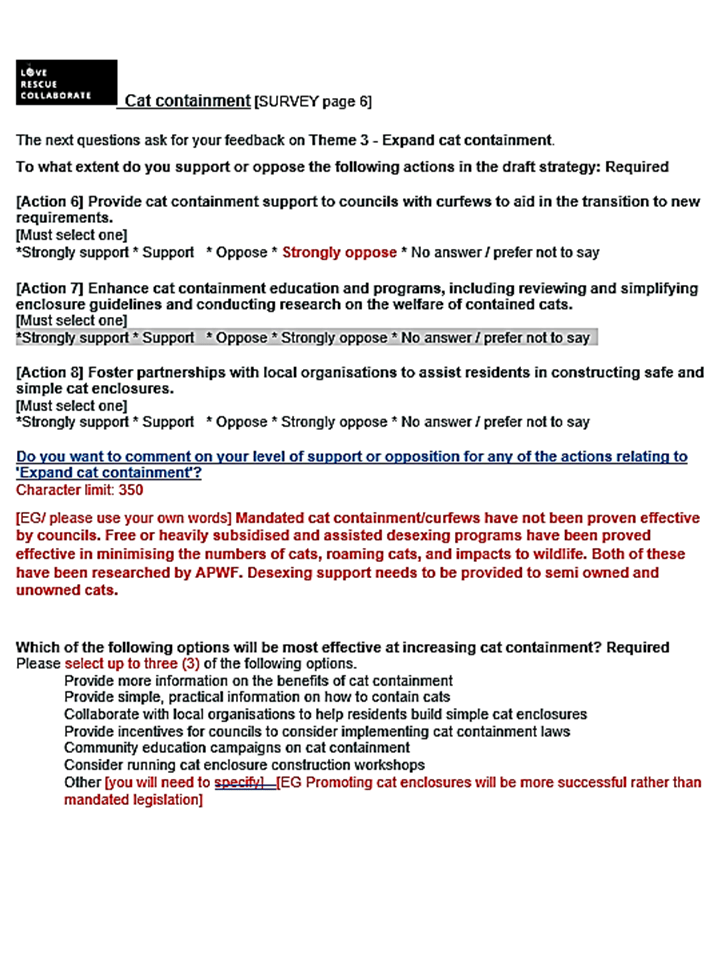
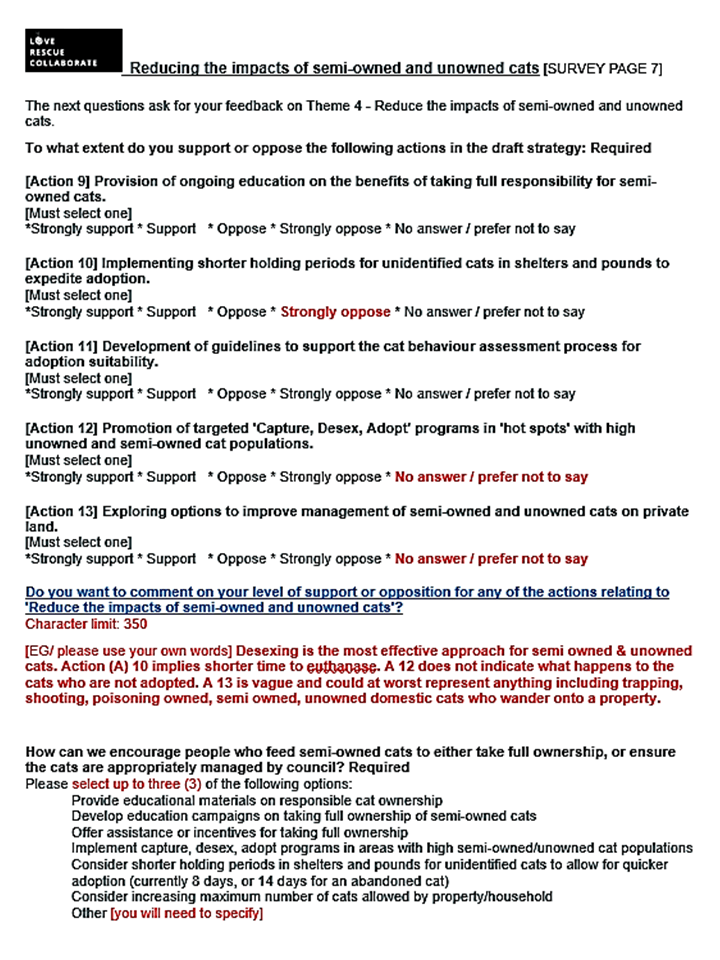
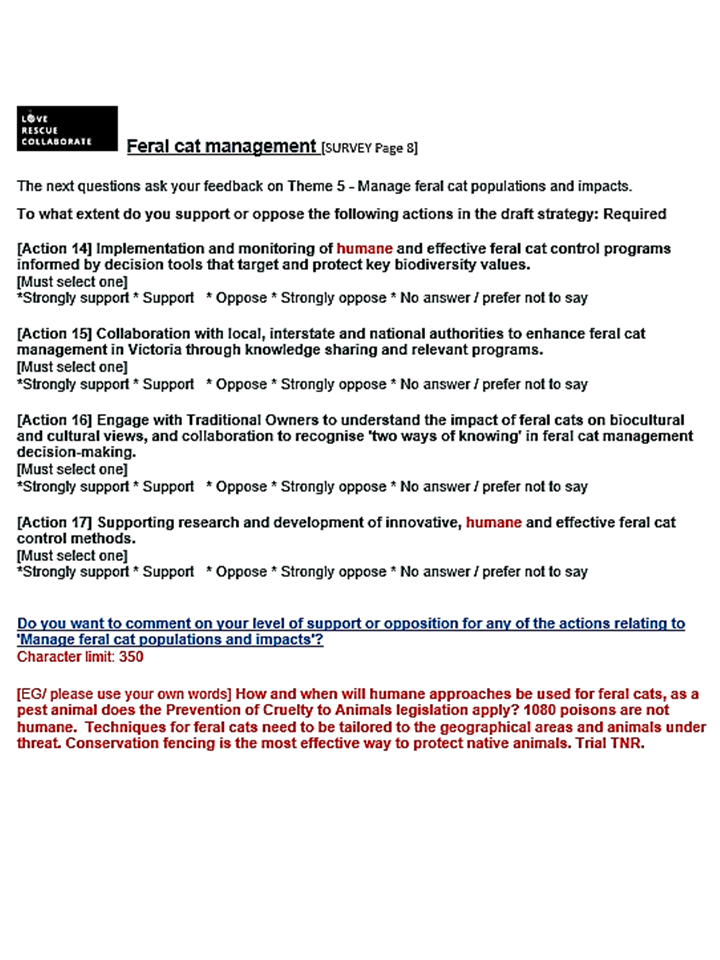
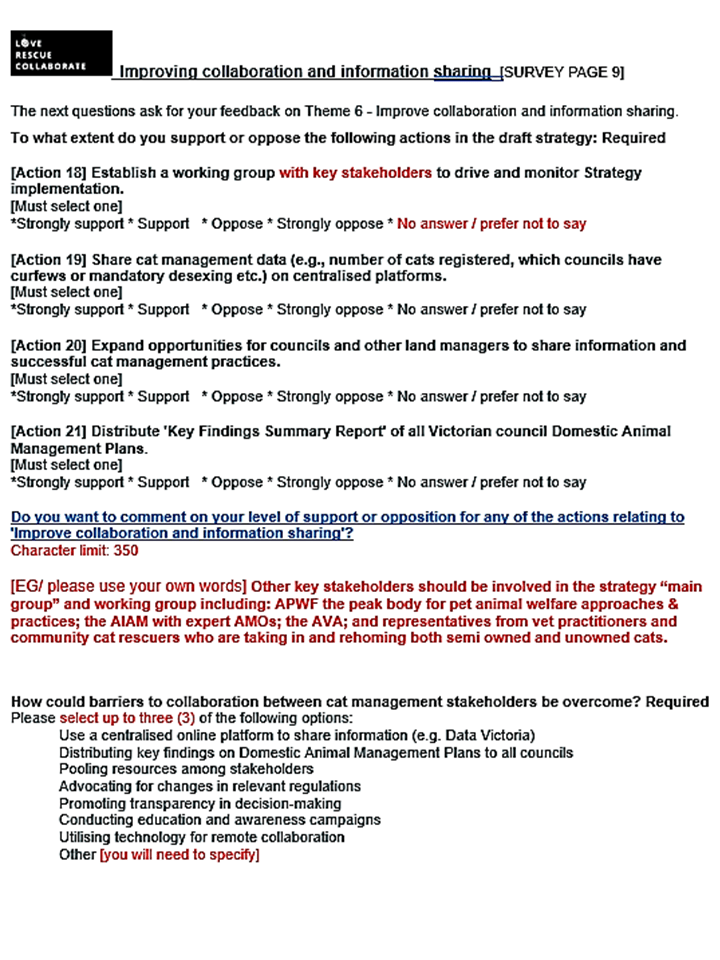
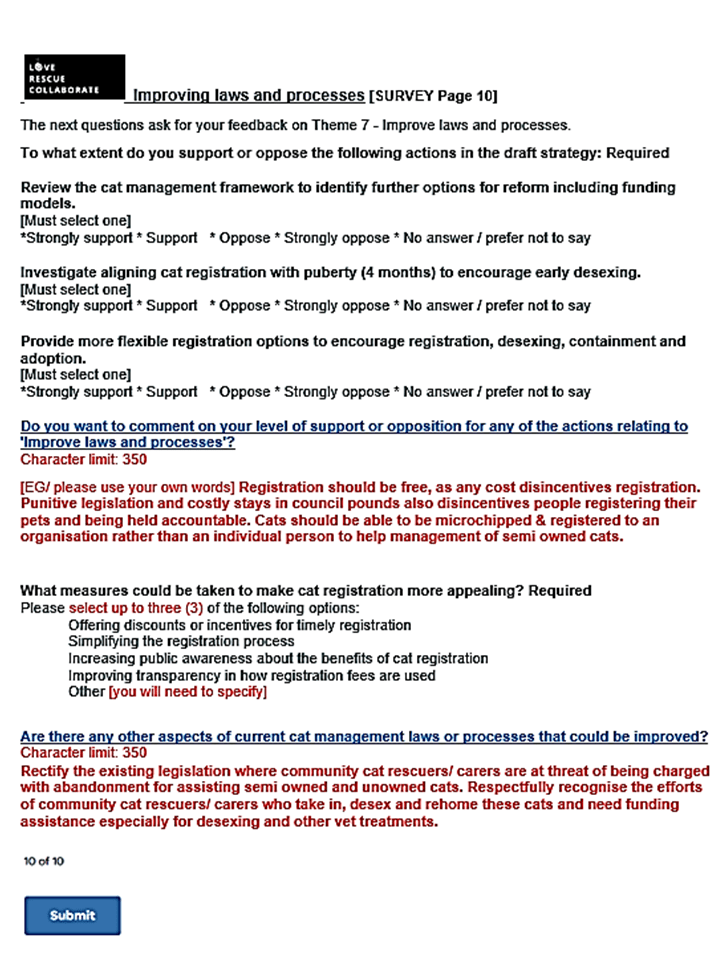
We proved the following images of the survey questions for each pages with
- examples of the free form text responses – you will need to customise these, and
- for all the specific questions with options for you to select – we suggest you choose the last option “No answer / prefer not to say” if you have very limited time and have not read the draft strategy page that is referenced.
The first page of the survey is general FYI etc. Then there is basically an image for each survey page on each Theme. We have highlighted in red any key words in the survey which we believe should be brought to your attention.
The LRC example wording is from the view of community cat rescuers. Everyone is welcome to respond as to their own priorities.

Quick guide & hints for submissions / responses
| HINT | EXAMPLE |
| Start with a reference to the Vic documents. | I provide my submission in response to the Victorian Cat Management Strategy, dated December 2023, and Draft Victorian Cat Management Strategy Summary – Key themes and actions, for your consideration. |
| Include a summary of your background for context of your concerns. | For many years I have assisted community cat rescuers, animal welfare organisations, and council pounds, with taking in, fostering, and rehoming cats. [feel welcome to add more with “numbers” such as years, numbers of animals that each year or in total you have assisted.] |
| Refer to the sections of the documents to which your feedback relates. | Theme 1. Promote cat welfare and responsible cat ownership (as a heading) or In relation to Theme 1… etc |
| Add your concerns & recommendations, use a simple structure for each that you can repeat 🙂 | I am concerned about [issue]. This causes [one or more negative outcomes]. I strongly recommend [a change or improvement]. This will provide benefits [describe tangible and intangible benefits]. |
| Add references to trusted sources/ research, include a quote, and URL (links). | Refer to the Australian Pet welfare Foundation position on mandatory cat containment “Mandated cat containment has been proven to be an ineffective strategy; a failure at reducing wandering cats in the short and long term, both in Australia and internationally.” https://petwelfare.org.au/2022/08/31/australian-pet-welfare-foundation-position-statement-on-cat-containment/ |
The NSW government has provided general information on writing submissions which includes: Key issues; Evidence; Case studies; Recommendations; and a Summary, and can be found here: https://www.parliament.nsw.gov.au/committees/Documents/Committeebrochures/Guide%20to%20writing%20submissions.pdf
Introduction, Managing cats in Victoria (page 6) – gaps with “main groups”
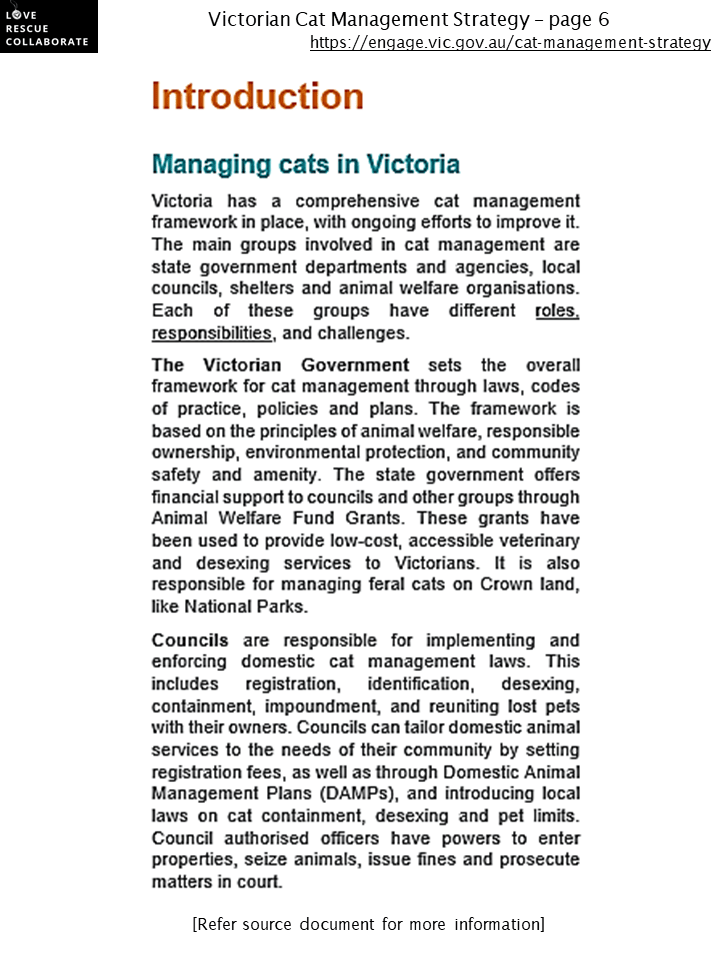
Other key stakeholders and those who deliver animal welfare services should be recognised and incorporated in the development of the framework, strategy, “laws, codes of practice, policies and plans”, including:
APWF the peak body for pet animal welfare approaches & practices,
the AVA, and
community cat rescuers and carers.
Example of very short response [<350 characters]
Other key stakeholders and key deliverers of animal welfare services should
be recognised and involved in the development of the framework, strategy,
“laws, codes of practice, policies and plans”, including: APWF the peak body for pet animal welfare approaches & practices; the AVA; the AIAM; and community cat rescuers and carers.
Areas of concerns & recommendations
Leading experts in domestic cat management APWF
The APWF provides advice and evidence based research (Australian and from overseas), representatives should be actively involved in the “main group” for formulation of the framework, the strategy etc to provide the best outcomes for animals. . https://petwelfare.org.au/
The APWF research assesses holistic cat management approaches, that are effective and proactive to minimise negative outcomes for animals and people. The APWF representatives also participate in advisory committees at the federal and state levels. They work at the local government/ council level “with shelters, pounds and local communities to provide proven methods that help save animals’ lives”, their “research-based strategies provide pounds & shelters with the knowledge they need to get to zero euthanasia of treatable and adoptable dogs and cats”.
Australian Institute of Animal Management (AIAM)
Considering the intrinsic value and support that the AIAM provides to all levels of government and to Animal Management Officers (AMOs), the AIAM should be considered one of the main groups of stakeholders for key consultation during the formulation of the framework etc.
It is noted that the AIAM was not included in the strategy section for Roles and Responsibilities.
Australian Veterinary Association (AVA)
Representatives from the AVA should be included as stakeholders in the “main group” with the formulation of the draft strategy and the framework components, for their expertise in animal welfare, and as many vets and their practices offer assistance with semi owned and unowned cats including rehoming services for the community. The involved vet practices relieve the burden on the local government / council pound animal welfare systems.
Community Cat Rescuers & Carers
Community cat rescuers and carers are generally volunteers providing a critical service to communities for animal welfare outcomes including rehoming, desexing, responding to health issues etc. This community services reduces the number of animals entering council pounds and shelters operated by animal welfare organisations and others.
Community cat rescuers and carers are a critical stakeholder group who need to be effectively engaged in the development of the animal welfare framework etc and delivery of associated services.
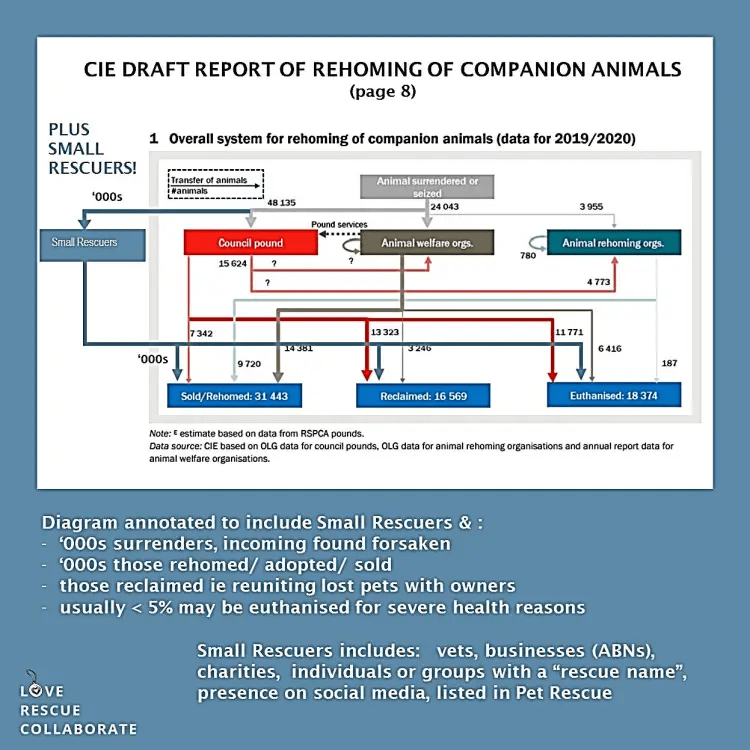
The following diagram has been provided to the NSW government from the LRC team as it amended a government consultant funded diagram to include community rescuers for both cats and dogs to the NSW overview of its systems. This amended diagram includes “small rescuers” in comparison to large animal welfare and rehoming organisations. This includes community groups and vet practices avoiding burdening the council pound systems. It is relevant to Victoria and other states and territories within Australia.
Key partners and stakeholders, pages 11 & 12
Example of very short response [<350 characters]
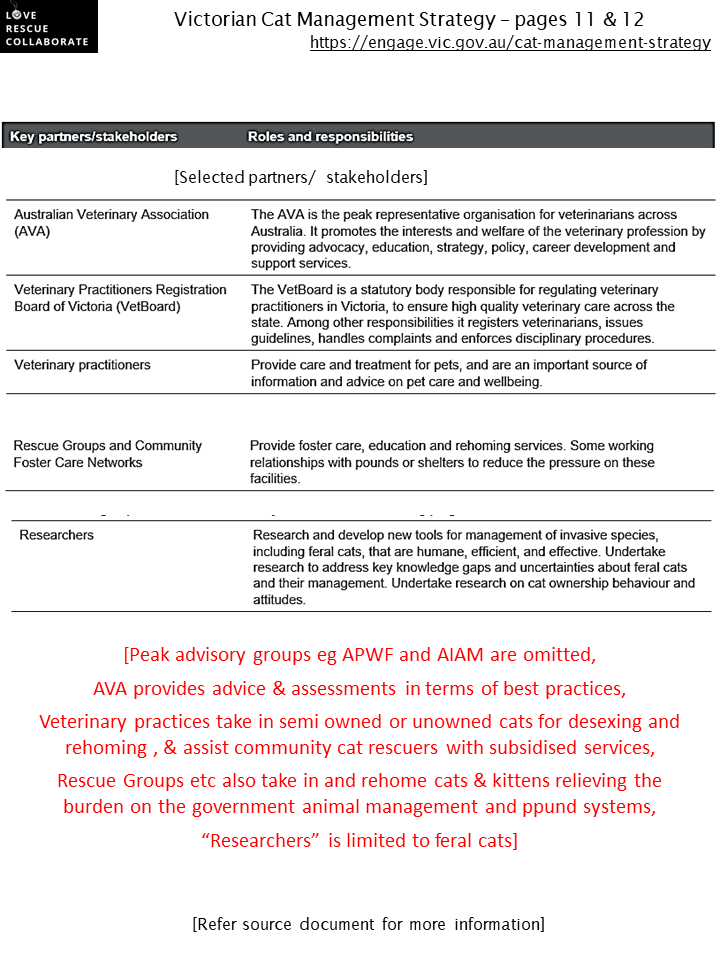
The strategy has: omitted peak advisory organisations eg APWF & AIAM; understated AVA responsibilities; vet practices need to be recognised for treating & rehoming unowned cats/kittens, & subsidised services for rescuers; rescue groups need to be recognised for independent rehoming efforts & financial burden which relieves council pound systems.
[the paragraph above is around 347 characters]
Areas of concerns & recommendations
The strategy section on Roles and Responsibilities omits experts in domestic cat management. A number of organisations and their representatives should be explicitly included with their deliverables and interactions with others forming the cat management framework, monitoring operational performance and escalating needed improvements.
Leading experts in domestic cat management APWF
The strategy section on Roles and Responsibilities needs to include the APWF.
The APWF provides advice and evidence based research (Australian and from overseas), representatives should be actively involved in the “main group” for formulation of the framework, the strategy etc to provide the best outcomes for animals. . https://petwelfare.org.au/
The APWF research assesses holistic cat management approaches, that are effective and proactive to minimise negative outcomes for animals and people. The APWF representatives also participate in advisory committees at the federal and state levels. They work at the local government/ council level “with shelters, pounds and local communities to provide proven methods that help save animals’ lives”, their “research-based strategies provide pounds & shelters with the knowledge they need to get to zero euthanasia of treatable and adoptable dogs and cats”.
AIAM
The AIAM provides support to all levels of government and to council Animal Management Officers (AMOs), the AIAM should be considered one of the main groups of stakeholders for key consultation during the formulation of the framework etc.
The strategy section on Roles and Responsibilities needs to include the AIAM, for their important role and activities, which ultimately are focused on improving outcomes for animals with the improvements to the AMO role in each council.
The focus areas for the AIAM include the following. https://aiam.org.au/About-us
“The Institute seeks to support those engaged in the business of animal management by promoting:
- Animal Management Officer training
- Consistency of legislation
- Recognition of the value of the Animal Management Officer’s role to society
- Support for Animal Management Officer’s from employers and community
- Consultation in the creation and development of legislation and workplace processes
- Resource and network availability and access
- Professionally operated Council shelter facilities with best practice animal care
- Strong healthy relationships with external stakeholders”
Veterinary Practitioners
The draft strategy section on Roles and Responsibilities omits recognition that Veterinary Practitioners: take in stray/ abandoned cats (semi owned or unowned), desex, treat, and rehome to families; and some provide subsidised services to community cat rescuers performing a similar role.
The draft strategy section on Roles and Responsibilities for Veterinary Practitioners needs to recognise these essential services for companion animals, and that these efforts relieve the effort and financial burden on the council pound systems. This is a critical component for the cat management strategy for semi owned and unowned cats.
Community Cat Rescuers & Carers
The draft strategy section on Roles and Responsibilities omits recognition that “Rescue Groups and Community Foster Care Networks” with taking in and rehoming surrendered or abandoned cats/kittens, relieve the burden on the state/council animal welfare systems and resources. And that community cat rescuers and carers are performing a key role: alongside the recognised organisations being council pounds and animal welfare organisations; and these community services dramatically reduce the number of animals entering council pounds and shelters operated by animal welfare organisations and others.
The draft strategy section on Roles and Responsibilities for Rescue Groups and Community Foster Care Networks, needs to include the understanding that that community cat rescuers and carers are providing critical services to semi owned and unowned cats, assisting in these becoming owned pets once more.
This is likely a factor for gaps in other sections of the draft strategy document.
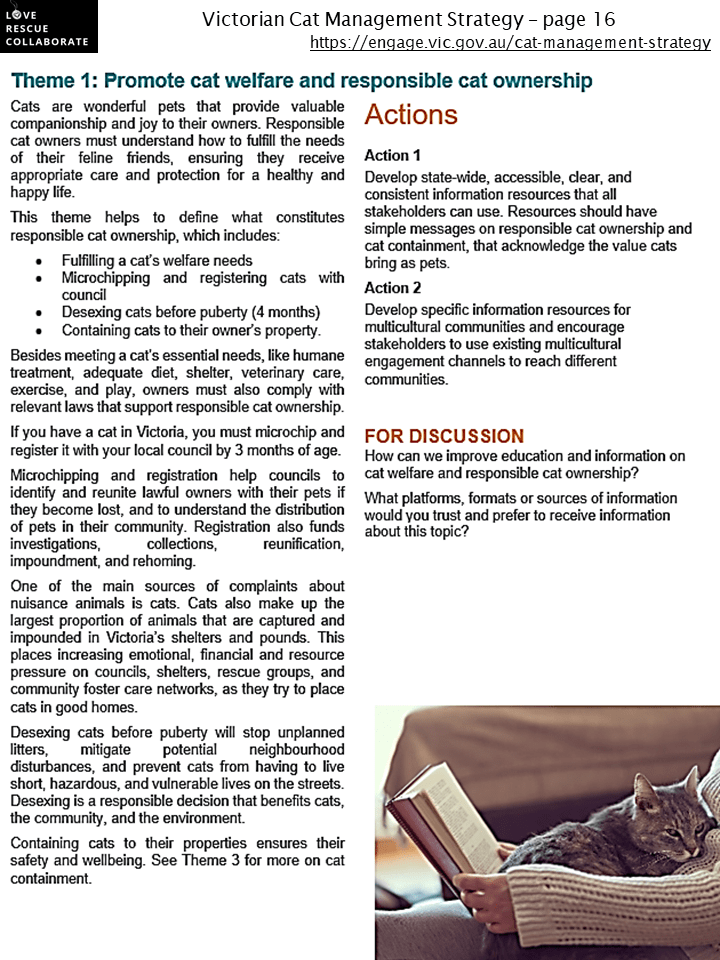
Top Issues with Theme 1 Promote cat welfare and responsible cat ownership
The traditional approaches of passive “education” and punitive legislation with negative consequences ($fines etc) are not effective, we need a transformation in approaches to achieve improvements in animal welfare and to minimise the number of abandoned cats/ kittens.
The advice and research from the Australian Pet Welfare Foundation (APWF) should be followed and incorporated in the Vic strategy document. The APWF promotes “evidence-based solutions to save the lives of pets and people”. https://petwelfare.org.au/
Example of very short response [<350 characters]
Traditional approaches of passive education and punitive legislation with negative consequences ($fines etc) aren’t effective. The APWF advice for better people and animal welfare should be incorporated in this strategy. Mandatory confinement, the Trap/adopt or kill, Trap/kill, or Kill programs, are ineffective. https://petwelfare.org.au/
[The above paragraph is 340 characters]
Areas of concern & recommendations
Legislation & punishment-based approaches are not effective
The benefits of microchipping and registration are supported. However, when other legislative obligations are enforced with punitive costs and actions (potentially removing an animal from their owner and transferring to a pound where euthanasia is likely) then the community cat owners may avoid both microchipping and registration.
APWF advice includes the following (https://petwelfare.org.au/wp-content/uploads/2023/09/Inquiry-into-pounds-in-NSW-APWF-submission-final.pdf).
“Based on the evidence, the current reactive punishment-based model of domestic animal management should be replaced with a proactive support-based model to reduce costs.”
“Legislation and regulation should be amended to remove registration fees for cats and annual permit fees for undesexed cats.” The costs are a disincentive especially for those on low incomes.
“Legislation and regulation should be amended to allow cats to be registered and identified via microchip to an “organisation” rather than only to an individual person” as this assists owners and community cat rescuers and carers of semi owned cats.
“The current punishment-approach of requiring an owner to pay a fine or fee before returning the pet to the owner should be avoided” and “pets should be returned to identified owners and reasonable payment plans for any impoundment fines and fees (where needed) should be organised, instead of continuing to hold the animal after the owner is identified”.
“Legislation and regulation should be amended to prohibit deeming domestic cats that are trapped around where people live or frequent or are admitted to pounds, shelters or similar facilities as being ‘feral’. Cats trapped in response to nuisance complaints or those entering pounds should clearly be defined as domestic cats, regardless of their behaviour.” This also applies to the culture in communities with regarding all roaming cats as “feral” cats.
Proactive coal-face engagement with communities
Communication and cultural change programs should be funded to assist with solutions to increase the rate for desexing, minimise freely roaming pets, and minimise the abandonment of cats and kittens.
The following “hard issues” need to be addressed in the communities with the coal-face teams of Council Animal Management Officers and community cat rescuers:
- low socio economic residents will require assistance with solutions including free desexing, transporting animals, and completing registration processes (One Welfare Approach);
- different country or religious cultures impeding desexing and confinement where possible;
- promotion of cat enclosures and confinement to properties (without legislation), with assistance in addressing the challenges such as strata bylaws, rental agreements with landlords, neighbour disputes with uses of fences etc.
Support-based & proactive approaches from APWF
APWF advice includes the following (https://petwelfare.org.au/wp-content/uploads/2023/09/Inquiry-into-pounds-in-NSW-APWF-submission-final.pdf).
“The current punishment-orientated domestic animal management model should be replaced with a support-based model consistent with the One Welfare concept which optimises the well-being of people, animals and their social and physical environment. Support-based strategies prevent impoundment and reduce council costs for e.g., assisting owners to build dog fencing, providing free pet identification, returning pets to identified owners and organising reasonable payment plans (where needed) instead of continuing to hold the animal after the owner is identified. Please see support-based strategies for reducing intake and euthanasia in pounds detailed throughout this submission.”
“Implement ‘Pets for Life’ concept strategies where dog and cat owners and stray cat semi-owners are supported to keep their pet or stray cat (versus relinquishment), which is a cost-effective. This should include funding for programs to help disadvantaged pet owners to keep pets with their families by assisting with veterinary costs, registration costs, and fencing.”
“Legislation and regulation to prohibit ‘No pets’ clauses in tenancy agreements in the same way it is illegal to discriminate against tenants with children, to ensure pet friendly rental accommodation matches demand across Australia.”
“Funding to promote Bed-time feeding of cats which is a highly effective way for cat owners to keep pet cats safely inside at night voluntarily (but mandatory cat containment should be rejected because it increases cat intake and euthanasia in pounds without reducing stray cats overtime).”
Top Issues with Theme 2: Increase cat desexing rates
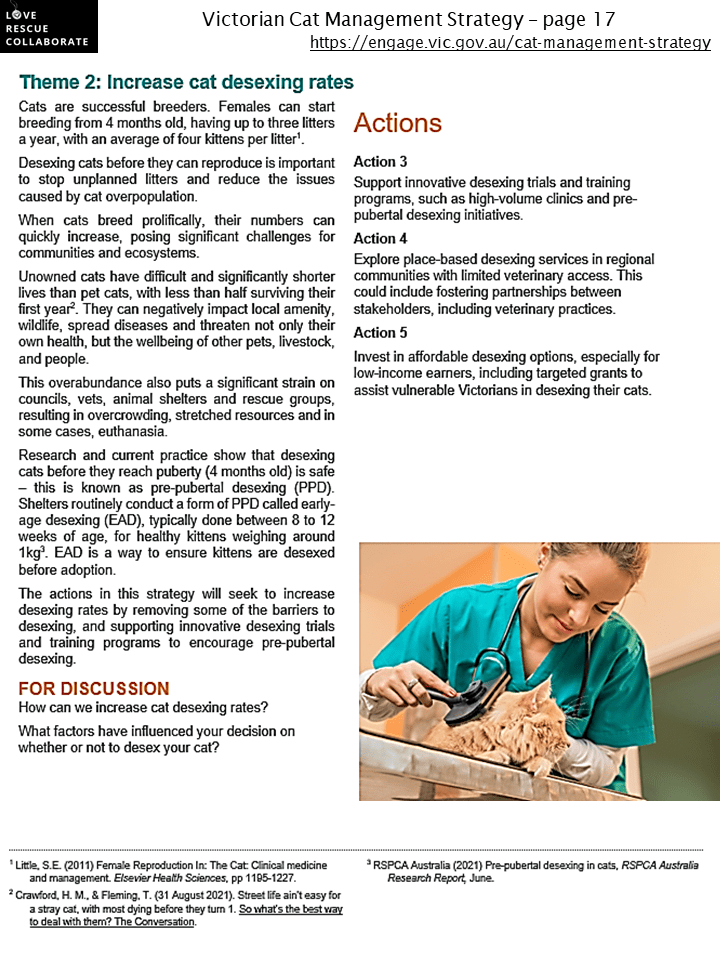
Desexing is the most effective approach to minimise the number of kittens being born each year, and our state and local governments need to assist with solutions beyond webpages with recommendations and occasionally offering subsidised desexing programs with “handcuffs” to microchipping and registration ie waiting for residents to be responsible.
Example of very short response [<350 characters]
The strategy needs to explicitly include: free high intensity desexing with assisted transport in low socio economic areas; free desexing for semi owned and unowned cats under community cat rescuers/carers, and council AMOs; subsidised desexing for owned cats. These approaches are proven effective by APWF research. https://petwelfare.org.au
[The above paragraph is 342 characters]
Areas of concern & recommendations
[Example, customise with your words]
- Explicitly include in the draft strategy
- free high intensity desexing with assisted transport in low socio-economic areas such as the Banyule program over several years;
- free desexing for semi owned and unowned cats under community cat rescuers/carers and council AMOs;
- subsidised desexing for owned cats.
- These approaches including Banyule council program and APWF Community Cat Programs are proven effective by the APWF and with evidence based research.
Supporting Information
[quotes & references may be directly used]
In 2020 Jennifer Cotterell, then the Animal Management Officer (AMO) for Banyule Council recommended to the Australian government:
“To implement free cat desexing programs throughout Australia. The cost of the program itself is considerably less than the price that cats, vets, shelter workers and AMOs currently pay for running trap, impound and adopt or kill programs.”
This was based on the successful cat desexing program Jenny championed at Banyule over a number of years which started with a wish list involving:
“Completely free cat desexing
- The implantation of a microchip so the cats could be traced back to an owner
- Free council registration for the first year
- A transport service provided by council AMOs for those that had none”.
Submission #141 Inquiry into the problem of feral and domestic cats in Australia https://www.aph.gov.au/Parliamentary_Business/Committees/House/Former_Committees/Environment_and_Energy/Feralanddomesticcats/Submissions
2024 preliminary publication of Banyule desexing program research includes:
“Instead of traditional trap-adopt-kill, proactive management of urban cats based on targeted sterilization should be utilized by government and animal welfare agencies in Australia and internationally. These types of programs are effective at reducing intake and euthanasia and are cost-effective.”
“In Australia, traditional methods of cat management by local government (councils) animal management officers (AMO) have been ineffective, with cat-related calls and cat impoundments continuing to increase, resulting in many healthy cats being euthanized. This has detrimental effects on the mental health of AMOs, pound and shelter staff and veterinarians.”
“The City of Banyule, Victoria implemented a free cat sterilization, microchipping and registration (licensing) program in 2013-14. Initially targeted to three low socioeconomic suburbs with the highest cat-related calls and intake, where enforcement action had little effect.”
“The program was available to all cats in the area, including stray cats being fed by caregivers, provided they took ownership of the cats. There were no limitations on the number of cats enrolled per household and free transport was provided if required. The program was later expanded city-wide. Over eight years, city-wide cat intake decreased by 66%, euthanasia by 82%, with an increase in proportion of cats reclaimed by owners from a baseline of 6% of intake (2012-13) to 16% (2020-21). Cat-related calls decreased in the target area by 51% and city-wide by 36%. The council’s financial outlay was 84,000,which [resulted in decreased costs associated with cat−related calls of] 266,225.00. Instead of traditional trap-adopt- kill, proactive management of urban cats based on targeted sterilization should be utilized by government and animal welfare agencies in Australia and internationally. These types of programs are effective at reducing intake and euthanasia and are cost-effective.”
https://www.preprints.org/manuscript/202403.0588/v1
APWF Summary on community cat programs & desexing programs includes:
“The scientific basis for contemporary community cat programs shows that when high intensity desexing of all cats, targeted to areas of high cat impoundments or complaints, is combined with components of trap-adopt-or-return home methods, this can be successful in managing semi-owned and unowned cats in urban areas. There are now half a dozen publications documenting the basis for successful trap-adopt-or-return home programs at the suburb or city level (Levy et al. 2014, Spehar 2017, 2018a, 2018b & 2019, Kreisler et al. 2019). And in contrast to lethal programs that have little public support, non-lethal programs attract support from welfare agencies, rescue groups and individuals who help contribute to the cost.” (page 20) NSW Pound Inquiry submissions webpage /
APWF Community Cat Programs information includes:
Top Issues with Theme 3: Expand cat containment
Areas of Concern & Recommendations
[Example, customise with your words]
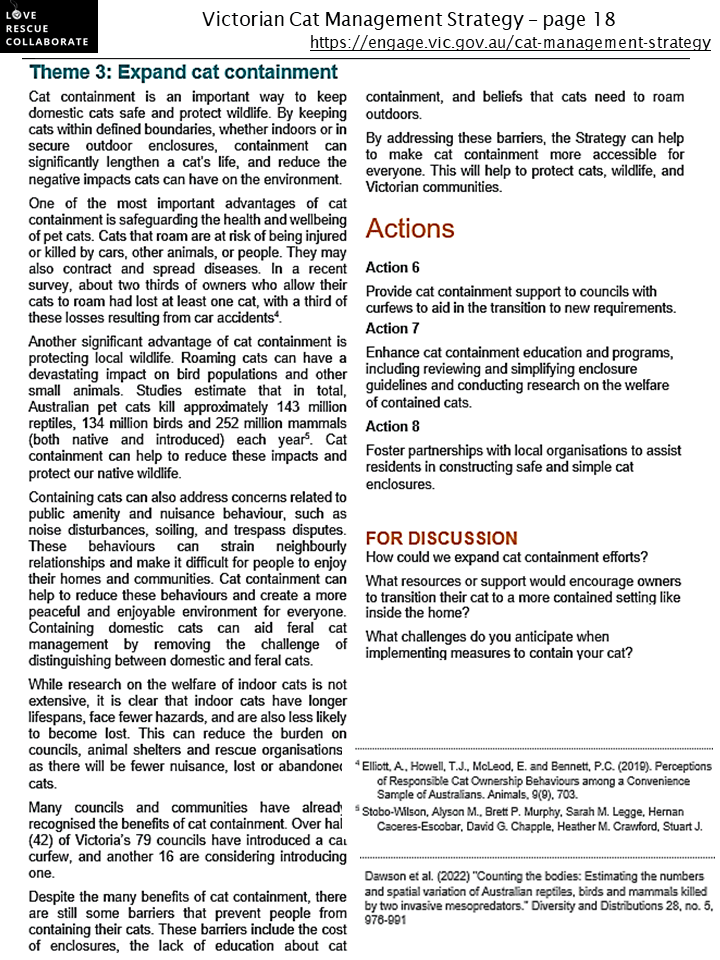
Mandated cat containment/curfews have not been proven effective by councils. Free or heavily subsidised and assisted desexing programs have been proved effective in minimising the numbers of cats, roaming cats, and impacts to wildlife. Both of these have been researched by APWF. Desexing support needs to be provided to semi owned and unowned cats.
Supporting Information
[quotes & references may be directly used]
“The proposed actions in the plan regarding cat curfews, caps on cat ownership and restricting ownership of cats in local government areas demonstrates a lack of understanding of the cause of the free-roaming cat problem in our cities and towns based on current Australian research. Therefore, the proposed solutions are highly flawed, will be costly to enforce and will be ineffective at protecting wildlife populations of concern.” APWF Response to draft TAP https://petwelfare.org.au/response-to-draft-tap/
“The Australian Pet Welfare Foundation (APWF) strongly encourages inside containment of cats at night, and where possible, contained to the owner’s property during the day in a comfortable environment which meets the cat’s physical and mental needs.
However, the APWF is strongly opposed to mandated cat containment (night curfews and 24/7) because it leads to increased cat nuisance complaints, increased cat impoundments, increased cat and kitten euthanasia, increased costs and enforcement difficulties for local governments, increased mental health damage to veterinary staff and community residents caused by euthanasing healthy cats and kittens and no reduction in the overall number of wandering cats.”
“Mandated cat containment has been proven to be an ineffective strategy; a failure at reducing wandering cats in the short and long term, both in Australia and internationally. Mandated cat containment is not an effective strategy to reduce wandering cats because most wandering cats are strays with no owner to contain them. Even for cats with an owner, containment is often not achievable due to factors such as housing limitations, lack of financial resources and concerns about the welfare of confined cats.
Mandated cat containment actively prevents the resolution of the problem of wandering cats because it presents a huge barrier to cat semi-owners taking full ownership of the stray cat they are feeding.”
The APWF information on key issues with cat containment include the following.
“RSPCA Australia Identifying Best Practice Domestic Cat Management in Australia 2018 report acknowledges:
“Overall, councils with cat containment regulations have not been able to demonstrate any measurable reduction in cat complaints or cats wandering at large following the introduction of the regulations”.
In the City of Yarra Ranges (Victoria), in the 3rd year after mandating 24/7 cat containment:
• cat-related complaints increased by 143%
• Yarra Ranges Council acknowledged that the significant increase in cat complaints, is likely to be a
result of the introduction of a 24-hour cat curfew in 2014.
• impoundments increased by 68%
• euthanasia increased by 18% (human population only increased by 2%) (Yarra Ranges 2021)
…
In the City of Casey (Victoria), 20 years after introducing mandated 24/7 cat containment:
• the number of cats impounded was still 296% higher than baseline (from 264 cats in 1998 to 1,047
cats in 2019/20), more than double the rate of the human population increase.
• In 2000, Casey received 349 cat nuisance and related complaints which had increased to 376
complaints in 2020/2021 (Casey Council 2001 & 2021a, b)
…
The number of cat nuisance complaints and impoundments are important parameters because they reflect the size of the wandering cat population in the surrounding area.
The City of Hobsons Bay (Melbourne, Victoria) has publicly acknowledged that mandated 24/7 cat
containment is not an effective strategy for reducing the number of wandering cats or associated issues and has rejected cat curfews (Hobsons Bay 2014).
Some USA jurisdictions have introduced mandated 24/7 cat containment known as cat “leash laws” which have proven to be ineffective and impossible to enforce. When leash laws are passed, animal control impound more stray cats because they do not have an “owner” to contain them. This results in more cats being impounded and then killed but without reducing the overall number of roaming cats in the area. A number of USA jurisdictions have repealed their cat leash laws because they found they were unenforceable (Smithfield Virginia USA 2003, Edmonds City Council Washington USA 2012, Gretna City Council LA USA 2014, Hughes 2002, Alley Cat Allies 2022).
Based on data from councils, 24/7 cat containment regulations would not provide any measurable benefit in reducing complaints, cat impoundments, potential wildlife predation or cat-related costs and would instead increase costs to local governments”
Top Issues with Theme 4: Reduce the impacts of semi-owned and unowned cats
Areas of Concern & Recommendations
[Example, customise with your words]
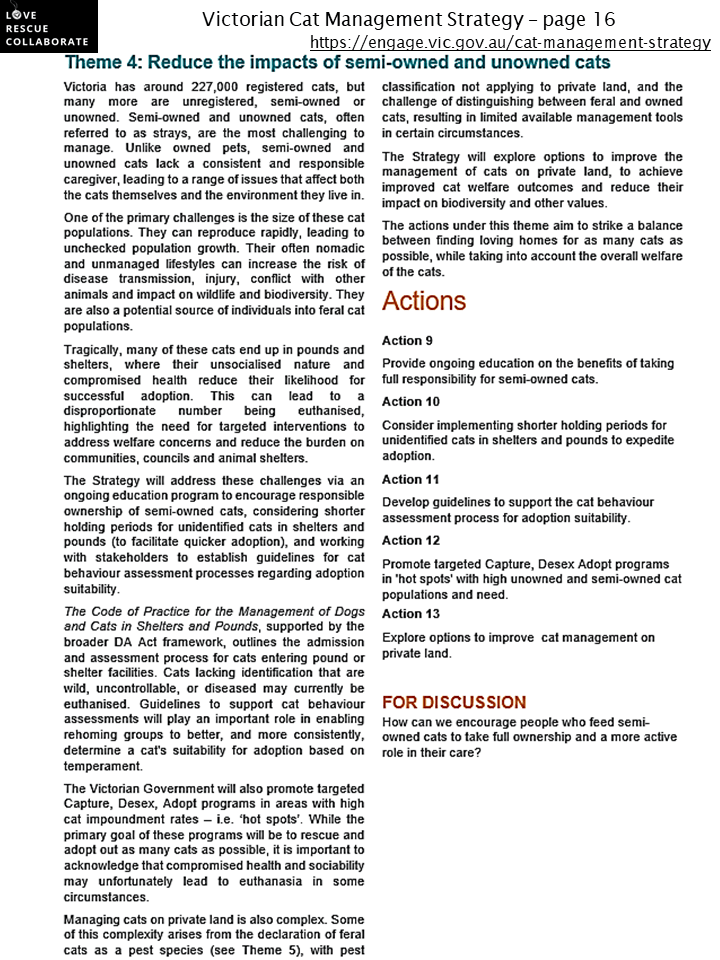
- Desexing is the most effective approach for managing semi owned and unowned cats.
- Action (A) 10 also implies shorter time to euthanase besides shorter times to adopt or transfer an animal. Reduced times for euthanasia are not agreed with.
- A 12 does not indicate what happens to the cats who are not adopted. There needs to be explicitly stated alternatives such as supporting community cats under semi owned arrangements.
- A 13 is vague and could at worst represent anything including trapping, shooting, poisoning owned, semi owned, unowned domestic cats who wander / roam onto a property. There needs to be transparency in the strategy with explicit intended approaches that will be considered.
- [Refer to Theme 2 for effective desexing programs eg Banyule free desexing and APWF community cat programs.]
- Community cat rescuers/ carers and the cats under their assistance need support, including free desexing, and establishing safe environments for the cats and people.
- The prevention of cruelty to animals legislation etc needs to incorporate exemptions to assist community cat rescuers / carers, researchers etc to enable desexing and feeding etc without fear of being charged with abandoning an animal, an animal abandoned by its original owner. [Refer to Theme 7]
- Causes of pets being abandoned need to be addressed at the source, ie the original owners with One Welfare solutions rather than punitive actions usually resulting in deaths of animals at council pounds.
- TNR and RTF techniques have proven successful. In Australia, the APWF and other community cat programs have used these techniques.
Supporting Information
[quotes & references may be directly used]
[Refer to Theme 2 for supporting information (quotes and reference links) for effective desexing programs eg Banyule free desexing and APWF community cat programs.]
APWF advice includes:
“Changes to state and local government bylaws are urgently required to allow management of owned, semi-owned and unowned cats using scientifically proven, best-practice methodologies.” (page 19)
“Notably, there are no reports in the Australian or international literature of high intensity trap adopt-or kill programs being successful at the city or suburb level.” (page 20)
APWF-Submission-to-Inquiry-of-Feral-Domestic-Cats-2020.22.jr_.n-t.pdf (petwelfare.org.au)
The research into the Newcastle cull of semi owed cats, The Impact of Lethal, Enforcement-Centred Cat Management on Human Wellbeing: Exploring Lived Experiences of Cat Carers Affected by Cat Culling at the Port of Newcastle, includes:
“The results demonstrates strong relationships between the caregivers and the cats, and negative impacts on caregiver mental health and quality of life associated with this lethal cat management practice. It is recommended that a care-centred management approach be taken, whereby authorities identify and assist caregivers to implement neutering and, if possible, adoption.”
“the severity of the adverse psychological impacts, and the morbidity rate amongst the cat caregivers we interviewed, was far greater than would be expected as a risk to the community if the cats had remained at the site. We therefore suggest that potential legal ramifications should be considered before authorities intentionally choose a method of management that is likely to inflict substantial harm on community members.”
https://www.mdpi.com/2076-2615/13/2/271
Punishment to Support: The Need to Align Animal Control Enforcement with the Human Social Justice Movement, includes:
“Person-centered and culturally competent policies and programs that focus resources on addressing root causes of pet health and welfare issues as opposed to an emphasis on code enforcement can create more positive, scalable, and sustainable improvements in human, other animal, and environmental health and welfare outcomes. This shift from punishment-oriented approaches to support-based models of animal control aligns the animal welfare field with the modern human social justice movement.”
“…Shifting animal control policies from punishment to support is intended to act on the recognition of the physical and emotional benefits of the human–animal bond and incorporating animal control agencies into a more robust system that supports pet ownership“
https://www.mdpi.com/2076-2615/10/10/1902
Top Issues with Theme 5: Manage feral cat populations and impacts
Areas of Concern & Recommendations
[Example, customise with your words]
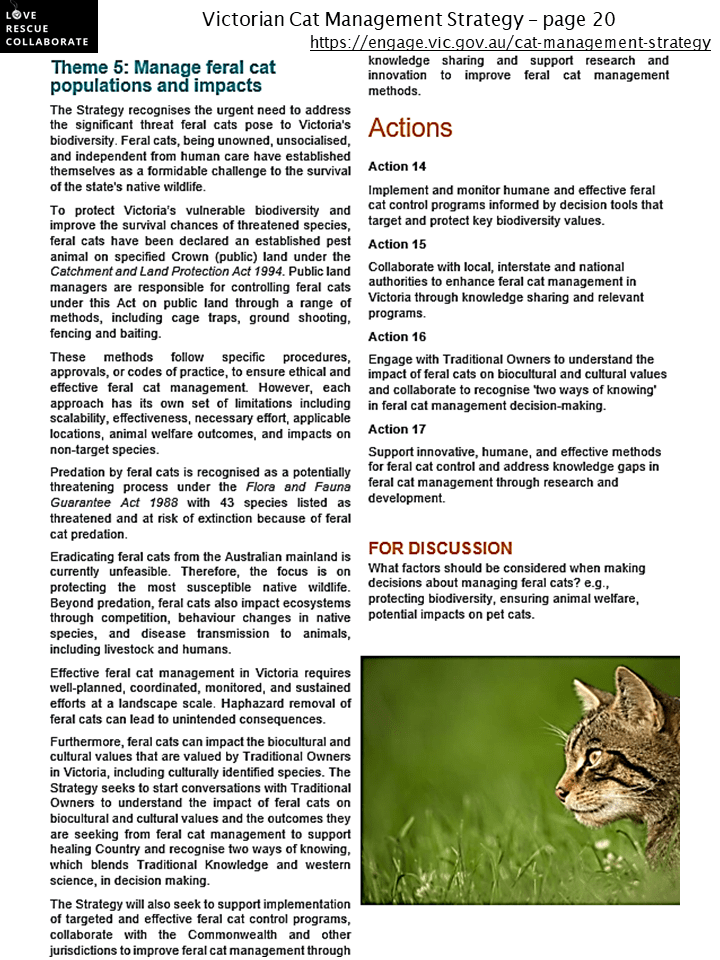
- How and when will humane approaches be used for feral cats, as a pest animal does the prevention of cruelty to animals legislation apply? 1080 poisons are not humane.
- Techniques for feral cats need to be tailored to the geographical areas and animals under threat. A broad-brush mass killing approach across all of Australia is not appropriate, and there are tendencies for the community to apply lethal approaches to any roaming cat.
- Conservation fencing is the most effective way to protect native animals.
- Trial TNR in areas of low threat to wildlife, eg farms, industry based environments.
Supporting Information
[quotes & references may be directly used]
RSPCA Australia advises:
“All jurisdictions should define all cats with some dependence (direct or indirect)
on humans as domestic cats. Cats who are unowned, unsocialised, have no
relationship with or dependence on humans and reproduce in the wild should
be defined as feral cats.”
Findings-and-Recommendations-Identifying-Best-Practice-Domestic-Cat-Management.pdf (rspca.org.au)
Animal Liberation on 1080 advises:
“Veterinarian, Howard Ralph, stated “1080 poisoning is like being electrocuted for two-plus days”.”
“…has been banned in most countries, due to concerns for humans and non-target species. Its use was banned in the United States in the early 1970s after people died. Australia and New Zealand use 95% of the world’s 1080″
“1080 poison is a chemical used to kill unwanted or unwelcome wildlife across Australia. It is a white, odourless, and tasteless poison and is considered a chemical of national security concern by the Federal Australian government, based on its fatality to all lifeforms. It is one of the most toxic substances found anywhere on earth and is in the same restricted regulatory schedule as other notorious poisons like arsenic and cyanide.”
Death “…can take anywhere from half an hour to up to 48 hours. During this time, the victim experiences severe suffering and stress. They endure prolonged seizures, bleeding from bodily orifices, including the eyes, mouth, and anus. There is no antidote to 1080 poisoning. Scientists from the RSPCA have concluded that 1080 is not a humane poison.”
“…1080 targets the body’s natural functioning and disrupts the animal’s CNS and heart. Animals who ingest 1080, exhibit signs of extreme distress and pain. They are noted to scream, cry, vomit, defecate, and suffer violent and prolonged seizures [8]. People who have witnessed animals dying of 1080 state that they often run into walls or objects and lose control of their limbs [9]. They die with a final convulsion up to 48 hours (two entire days) after ingesting the poison”
“Governments across the country use it to kill dingoes, possums, wallabies, pademelons, rabbits, foxes, pigs, and cats.”
Animal Liberation Australia [https://www.al.org.au/ban-1080#gsc.tab=0]
DR Katherine Moseby advises on feral cat management and wildlife and includes”
“We’re trying to train native animals to cope with a certain number of feral cats because we’d like to have bilbies and bettongs surviving outside fences one day” (Doctor Katherine Moseby)
“…we’re being practical about it, accepting the cats are here to stay in some form for a while, and building the capacity for our native animals to cope”
ABC [https://www.abc.net.au/news/2020-05-29/feral-cat-management-device-felixer-tested-at-animal-reserve/12296874?]
Australian Wildlife Conservation organisation advises:
“A critical strategy for reducing the impact of foxes and cats on native wildlife is the establishment of large feral predator-free areas, surrounded by conservation fences…
Wildlife translocation and reintroduction programs conducted inside these fenced reserves are proven to be the most effective way of keeping native fauna safe and ecosystems intact.”
Top Issues with Theme 6: Improve collaboration and information sharing

Concerns & Recommendations
[Example, customise with your words]
Other key stakeholders should be involved in the strategy “main group” and working group including:
- APWF the peak body for pet animal welfare approaches & practices;
- the AIAM with expert AMOs; the AVA; and
- representatives from vet practitioners and community cat rescuers who are taking in and rehoming both semi owned and unowned cats.
Collaboration approaches need to include face to face engagement with various segment of pet owners and communities where cats reside. It is strongly suggested that a matrix of relationships is established for target animal welfare stakeholders, with a detailed communication plan developed to provide the best outcomes for animals and people.
[Refer to the responses to Theme 1 for more information on these critical stakeholders.]
Supporting Information
[quotes & references may be directly used]
[Refer to the responses to Theme 1 for more information on these critical stakeholders.]
RSPCA advices on One Welfare including an example of isolated and vulnerable cat owners:
“Community health programs for pet owners – The bond between owners and their pets can decrease social isolation, increase a person’s sense of purpose and bring joy to someone’s life. This is especially true for more socially isolated groups such as elderly people or people struggling with homelessness. However, these circumstances can also make it difficult for these people to give their pets adequate care.”
Top Issues with Theme 7: Improve laws and processes
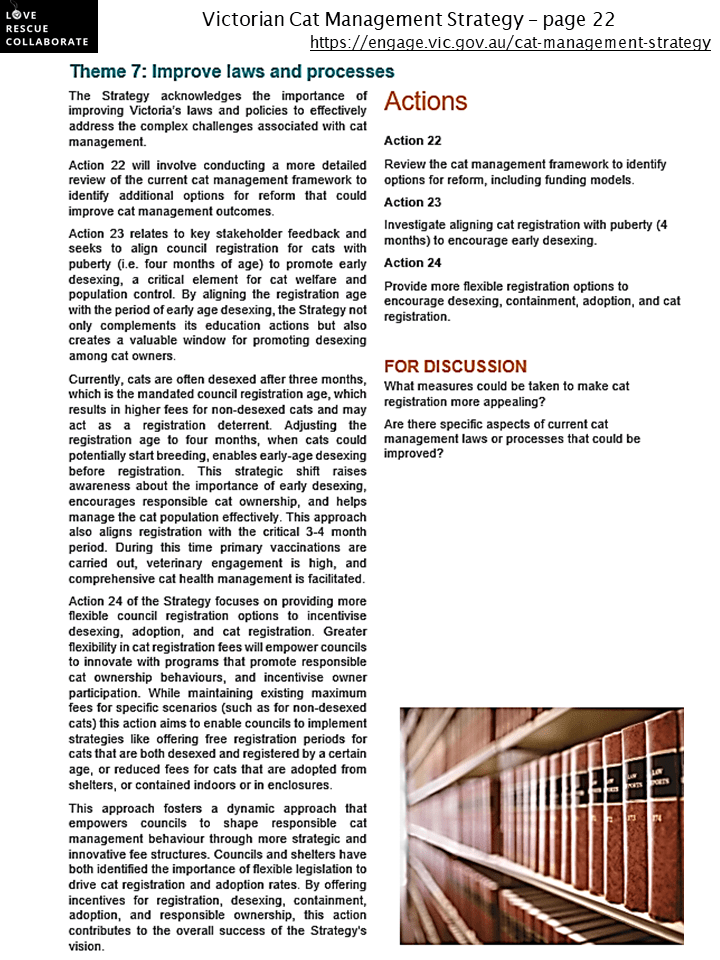
Areas of Concern & Recommendations
[Example, customise with your words]
- Registration should be free, as any cost disincentives registration. Punitive legislation and costly stays in council pounds also disincentives people registering their pets and being held accountable.
- Cats should be able to be microchipped & registered to an organisation rather than an individual person to help management of semi owned cats.
- Rectify the existing legislation where community cat rescuers/ carers are at threat of being charged with abandonment for assisting semi owned and unowned cats.
- Respectfully recognise the efforts of community cat rescuers/ carers who take in, desex and rehome these cats and need funding assistance especially for desexing and other vet treatments.
Supporting Information
[quotes & references may be directly used]
In response to the recent NSW inquiry, APWF recommended a number of legislative imporvements, these include the following.
“Recommendation 3
Domestic cats (owned, semi-owned and unowned) should be excluded from the legal definition of feral cats in legislation and regulation. Feral cats should be defined as having no relationship with or dependence on humans (neither direct nor indirect), surviving by hunting or scavenging for food (not fed intentionally or unintentionally by humans), and living and reproducing in the wild (e.g., forests, woodlands, grasslands, deserts).
Recommendation 4
Legislation and regulation should be amended to allow cats to be registered and identified via microchip to an “organisation” rather than only to an individual person.
Recommendation 5
Legislation and regulation should be amended to remove registration fees for cats and annual permit fees for undesexed cats.
Recommendation 6
Legislation and regulation should be amended to prohibit deeming domestic cats that are trapped around where people live or frequent or are admitted to pounds, shelters or similar facilities as being ‘feral’. Cats trapped in response to nuisance complaints or those entering pounds should clearly be defined as domestic cats, regardless of their behaviour.
Recommendation 9
Legislation and regulation should be amended to prohibit deeming domestic cats that are in traps or entering pounds, shelters or similar facilities as being ‘less socialised’ ‘unsocialised’ ‘feral’ or ‘unsuitable for adoption’ based on fear behaviours exhibited prior to habituation, and prior to providing the cat with reasonable habituation time (based on science) in a non-stressful environment.
Recommendation 11
Legislation and regulation should require cats be given sufficient habituation time (at least 8 days) in a non-stressful environment before behavioural assessment begins. Based on science, the average time for cats to habituate is 5 days to 5 weeks and ranges from a minimum of 3 days to 5 weeks or longer to habituate. Euthanasing cats based on behaviour before sufficient habituation time has been provided in a non-stressful environment and continuous multiple behavioural assessments made, should be prohibited in legislation and regulation.
Recommendation 12
Euthanasing cats based on WHS reasons should be prohibited in legislation and regulation. Cats do not present a WHS concern when staff are trained and proper equipment is used. Proper equipment enables staff to avoid direct handling of any cat (including cats that are exhibiting fear behaviours – for e.g., hissing, growling, striking or hiding).
Recommendation 19
Legislation and regulation should be amended to enable Return-To-Field (RTF) for healthy or
treatable cats (desexed and microchipped).
Recommendation 20
Legislation and regulation should continue to prohibit mandatory cat containment (night and 24/7 mandatory cat containment) because it increases cat intake and euthanasia in pounds without reducing stray cats overtime.
Recommendation 22
Cat feeding bans should be prohibited in legislation and regulation and replaced with effective solutions including Community Cat Programs.
Recommendation 27
In legislation and regulation and in the relevant enforceable Code, the minimum legal requirement for euthanasia and method of euthanasia should be as follows: Euthanasia must only be performed by a registered veterinarian using barbiturate overdose (which may be in combination with sedation and analgesia).”
 LRC
LRC 