This blog is a summary of the evolution of the terms and definitions for cats in Australia, ie how do we categorise cats largely by their behaviours. These terms (however poorly defined) are critical as they dictate or imply legal obligations – whether you agree with them or not. Our LRC post references:
- “The Good” being the latest industry expert knowledge from APWF & others
- “The Bad” being our current government terms & confusions/ misunderstandings
- “The Ugly” being the recent proposal in the Australian draft Threat Abatement Plan that proposed stray cats be a subclass of feral cats
- “The Good”: latest & best from APWF
- “The Bad”: current government terms
- “The Ugly”: Australian draft TAP proposal
- Overview of differences in government versus industry terms for key terms (eg stray cats)
- Reference Information
“The Good”: latest & best from APWF
These images are from sources on the APWF webpage https://petwelfare.org.au/
Feral cats versus Domestic Cats: Owned; Semi owned; Unowned cats

APWF response to the draft TAP,
note the definitions, more is available in the APWF position statement on cat definitions
Note:
use multi-cat or other terms than colonies
eg semi owned such as community cats; & community cat rescuers/ carers
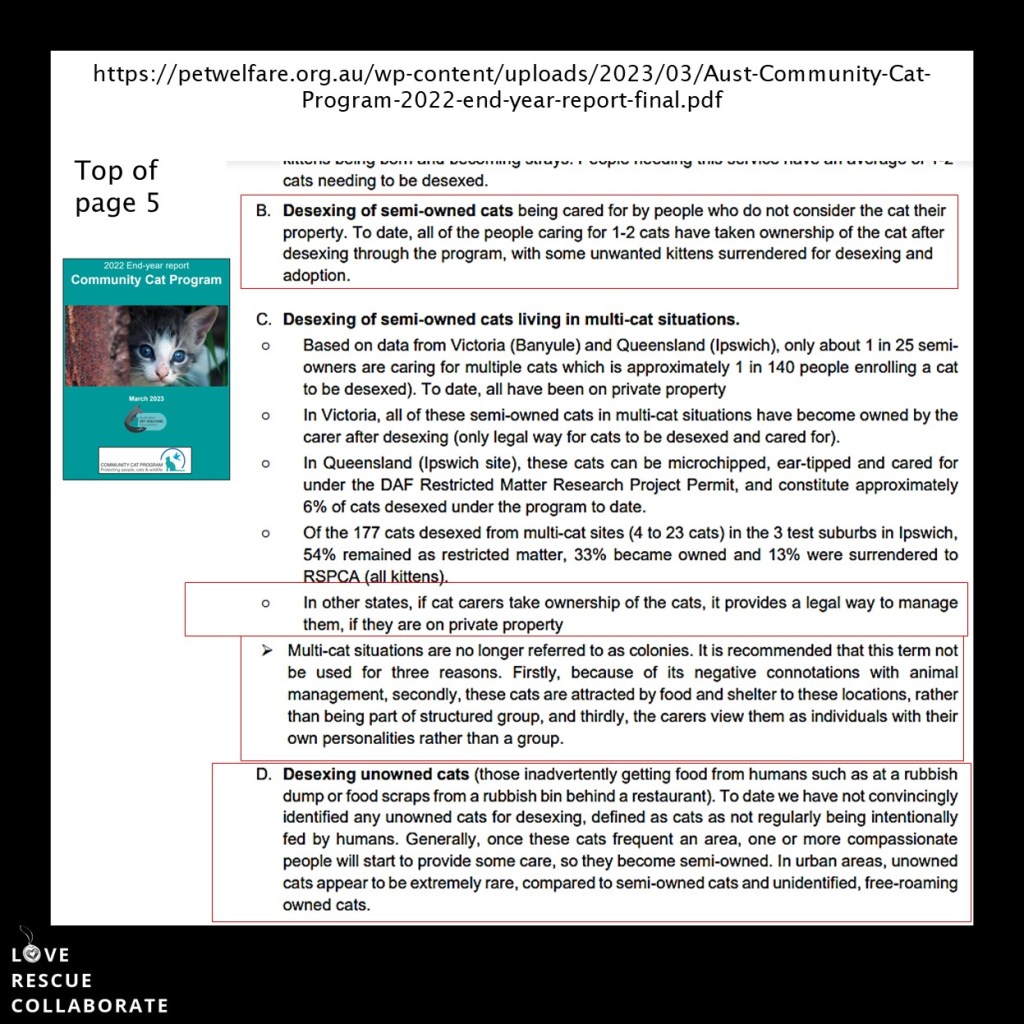
The LRC team considers Jacquie Rand and her team at APWF are leaders in Australian for domestic cat management, and their work is presented overseas and aligned with international organisations. Therefore well considered the latest & the best!
- The strategies for managing cat issues need to be customised based on the categories.
- The best categories for cats have been developed based on shared behaviours and are clearly mutually exclusive, ie it is easy to distinguish what category a cat is assigned to.
- The LRC team notes that various state/ territory, local government and animal welfare organisations use the terms and definitions from RSPCA Australia (2018) and since then the APWF (2023 and earlier).
“The Bad”: current government terms
The feral and stray terms are embedded in various legislation and related documents: Commonwealth, state/ territory and local government (councils). However, there are few definitions. The terms in legislation etc describe the legal obligations for how cats are to be treated and managed. Without shared Australian definitions for these terms, it leads to different interpretations and confusion.
2015 Feral cats declared a pest animal
“At the Meeting of Environment Ministers (Melbourne, 15 July 2015), Ministers endorsed the National declaration of feral cats as pests. As part of this declaration, Ministers agreed to review arrangements within their respective jurisdictions and, where necessary, to remove unnecessary barriers to effective and humane control of feral cats.”
NSW Legislation & obligations as an example
Please note, the LRTC team does not provide legal advice, and the following is our view on complex and vague legislation.
NSW Feral Cats
NSW has a Biodiversity Act and separate protocol document for feral cats.
The NSW Companion Animal (CA) Act 1998 includes a reference to feral cats and it did contain reference to stray cats which appears to have been removed since 2020.
NSW Companion Animal Cats
Section 30 of the CA Act includes where cats may be removed from prohibited areas, and may involved: “any person… may seize a cat that is in a place in which cats are prohibited under this section for the cat’s own protection” providing the cat’s owner is not present; otherwise only authorised persons may remove a cat.
Prohibited areas include food preparation (but not the roadway or walkway next to one of these), and Wildlife Protection Areas (WPA) that each council may designate, and may designate which of these do not allow roaming cats. Therefore, each council WPA needs to be checked. Interestingly in many situations, each council may allow dogs on leashes and it is not rare for dog owners to be found at fault walking dogs off leashes for which there is just a penalty, the dogs are not impounded like cats.
Section 31 includes information on nuisance cats, to be responded by an authorised officer of a council.
Section 32 provides information on actions which may be taken to protect persons and animals against cats, including: ”(1) Any person may lawfully seize a cat if that action is reasonable and necessary for the protection of any person or animal (other than vermin) from injury or death”; ”(3) If a cat that is not under the effective control of some competent person enters any inclosed lands within the meaning of the Inclosed Lands Protection Act 1901 and approaches any animal being farmed on the land, the occupier of the land or any person authorised by the occupier can lawfully injure or destroy the cat if he or she reasonably believes that the cat will molest, attack or cause injury to any of those animals”; and “(6) An authorised officer is not to give a direction under this section for the purpose of causing a cat to be taken to a council pound unless the authorised officer is satisfied that the owner of the cat cannot be identified”.
We note that the CA Act does include definitions for animals (which in some cases, does not mean humans, insects nor birds), nor farmed animals. It is questionable that introduced animals that are considered pests are included. It is also questionable that community cats (singles or groups) may be Semi Owned under community cat rescuers/ carers. At this time (January 2024), it is noted that Green NSW are proposing recognition of Semi Owned cats in alignment with the NSW Pound Inquiry for which the final findings and recommendations have yet to be published.
Rehoming Organisations and Community Rescuers / Carers
It has been and still remains confusing for citizens and designated Rehoming Organisations and community rescue groups in relation to obligations for stray cats being domestic semi owned (eg community cats) or unowned), and for citizens who believe they may seize/ trap a cat.
In 2020 stray cats were included in the Companion Animals Act under section 62. This was referenced and still is referenced in the NSW Rehoming Organisation application form – an obligation that new applicants are still required to sign/agree to:
“I understand that it may be a breach of the Companion Animals Act 1998 for staff or carers of the organisation to accept an animal into care if the animal has been brought in as a stray or surrendered by someone other than the animal’s owner, rather than being surrendered by the animals’ owner or supplied from a council pound, either directly or via another animal welfare organisation (see section 62 of the Act).” was included in the NSW Rehoming Organisation application forms versions June and November 2022.
The previous scheme for 17(c) exemption organisations included “stray/feral and/or colony cat”:
“I understand that it may be a breach of the Companion Animals Act 1998 for staff or carers of the organisation to accept an animal into care if the animal has been brought in as a stray/feral and/or colony cat or surrendered by someone other than the animal’s owner, rather than being surrendered by the animals’ owner or supplied from a council pound, either directly or via another animal welfare organisation (see section 62 of the CA Act).”
This was also confirmed in 2020 by NSW OLG in response to a query on this obligation:
“I can confirm that, if you are an Approved Person (which is something that is approved by our Program Delivery Team), then yes you are able to scan the details of a microchipped animal to enable you to return the stray animal to its rightful owners. If you are NOT an Approved Person, then you must deliver that animal to the closest pound to enable the pound to return the stray animal.
If you wish to apply for a clause 17(1)(c) exemption (previously clause 16(d) exemption), you are not allowed to rehome stray animals under this exemption. Any stray animals, must be delivered to a pound OR as mentioned above, if you are an Approved Person, you may scan the animal and return it to its rightful owner. “
Assessment Officer -Performance Team, Office of Local Government email Oct 6 2020
It appears that this obligation has been repealed/ removed/ replaced under the NSW Companion Animal Act,
These obligations for designated Rehoming Organisations or community rescue groups are vague and confusing, as it is not clear:
- that rehoming organisations are prohibited from rehoming cats removed from non-prohibited places, or perhaps even prohibited places (provided they have not been seized from such places as indicated elsewhere in the Act),
- if a person removes a cat from a non-prohibited area, or perhaps a prohibited area without ‘seizing’ the animal under the Act, then the cat would not need to delivered to the owner, a pound or approved premises,
- how the obligation in the application declaration may be effective if the Act no longer includes the specific stray cat term and obligations.
AWL QLD Assessment in 2020
LRC support the AWL QLD assessment across jurisdictions provided to the government in 2020 (we are waiting on the submissions in 2023) – does it appear that little has changed?
“Currently many Councils are refusing to help local communities desex the unowned cats which live and breed in cities and towns, because most State Government laws identify unowned cats as “feral” cats and make it an offence to feed or manage these cats…
With reclassification of unowned cats in cities and towns as “domestic” cats not “feral”, our
Cooperative Desexing Program could be expanded to incorporate desexing and management of these cats to also reduce their numbers ethically and sustainably.”
“…the Commonwealth Government has avoided the issue of unwanted and unowned cats in
urban and suburban areas or in rural towns and farming areas (despite AWLQ and others discussing and urging this with the Threatened Species Commissioner in 2017). This is counterproductive as state and local governments have struggled to provide a consistent message or develop consistent supportive policies to prevent the breeding, wandering and abandonment of cats in Australia.”
“Current legislative and regulatory approaches to cat management by federal, state and local governments have been largely reactive rather than preventative. In some states, local government has ignored cat management, and expected private not-for-profits to manage an overload of unwanted cats. In other states local government are using punitive and ineffective animal control strategies e.g. fines for people who feed cats or extra charges for people who take in too many abandoned cats.”
“The prevalence of unowned domestic cats has largely been ignored by many Councils as well as state and federal governments. Little work has been put into assessing how many cats there are and ways to prevent these two groups of cats which can contribute to predation and the breeding of unwanted cats.“
“Compassionate members of the community have been left struggling to feed and manage these cats and are often ineffective in reducing their numbers due to limited resources. However, evidence suggests numbers of unowned cats can be reduced if assisted with desexing and monitoring for any further undesexed cat immigration. Because community efforts are sometimes subverted by Councils who conduct random trapping and killing without consultation, compassionate people will not report the location of these cats. According to a Brisbane survey, most people prefer non-lethal management of stray cats by desexing, than by killing, or leaving the cats as they are.” AWL QLD 2020
“The Ugly”: Australian draft TAP proposal
There were two key issues with the 2023 Australian draft Threat Abatement Plan for feral cats:
- Proposing for stray cats to be a subclass of feral cats, which
- is not logical as stray cats are better known as domestic owned, semi owned or unowned cats
- implies stray cats will be destroyed as are feral cats
- Not yet consulting with domestic cat experts and using evidence based research in the strategies, steps and responses for feral cats to be applied to stray cats (domestic owned, semi owned or unowned).
The APWF summarised the impacts of this proposed approach.
“In 2015, environment ministers made a commitment to the national declaration of feral cats as a pest, and most jurisdictions accordingly now recognise feral cats as a pest. Feral pest species are to be destroyed (not rescued and rehomed). Throughout the draft TAP, wherever the feral cat term is used, the same responses and actions would then appear to apply to stray cats. As cat definitions are non-existent or loose in each state/territory legislation, it may also be implied that from the date the TAP is approved by the Minister, the TAP cat definitions will flow down to all legislation in states/territories and all local governments.” APWF response to draft TAP

The draft TAP includes a change which has a significant impact for stray cats.
Feral cats are to be destroyed and not rescued nor rehomed.
Refer to the LRC post for a number of other key issues with the draft TAP https://loverescuecollaborate.org/2023/11/23/australian-draft-threat-abatement-plan-for-predation-by-feral-cats-due-4pm-11-dec-2023/
Overview of differences in government versus industry terms for key terms (eg stray cats)
The diagram below highlights over the last several years, the views of classes or categories of cats. Take note of the Australian government’s definitions, which so far have failed to take into account the cat industry experts knowledge and recommendations, including
- The definitions for these key terms are shown in the next diagram (zoom in 😉 )
- The term for “stray” cats has been replaced by experts with domestic semi owned or domestic unowned cats, yet the government has a different view
- The 2023 draft Threat Abatement Plan (TAP) for feral cats proposed that stray cats be a subclass of feral cats – neither a logical nor appropriate proposal, nor aligned with domestic cat experts.
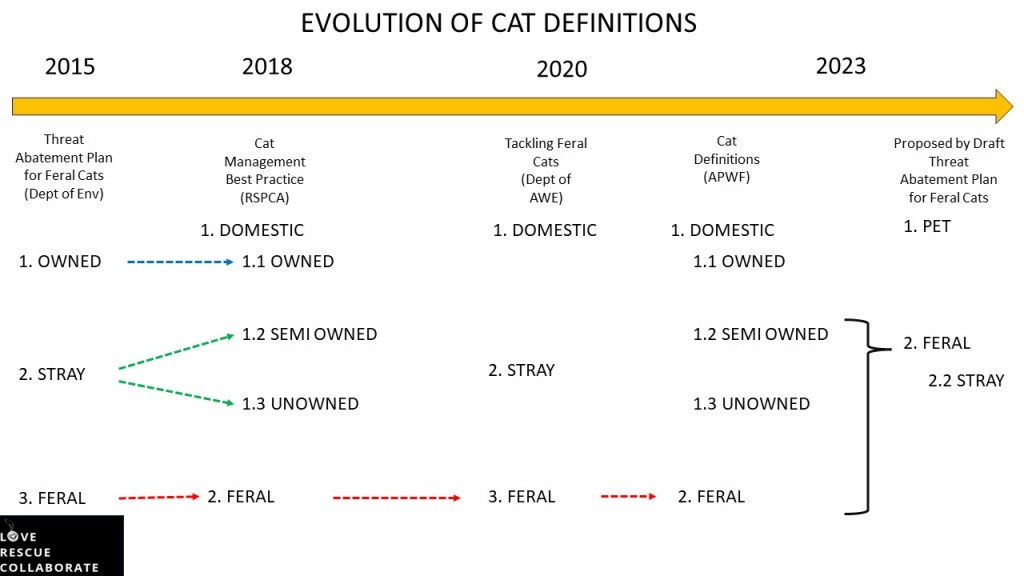
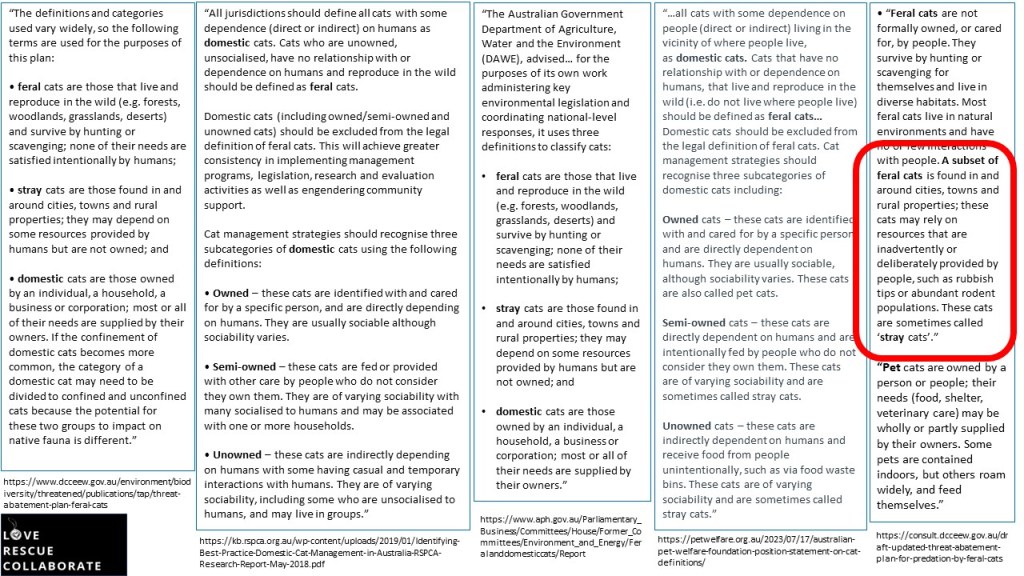
The 2018 RSPCA cat terms and definitions have been supported by many trusted and respected animal welfare organisations: the Australian Institute of Animal Management (AIAM); Animal Welfare League QLD; Cat Welfare Society Inc. T/A Cat Haven; Australian Veterinary Association (AVA). This foundation has been evolved under the APWF based on Australian evidence based research.
Reference Information
APWF Community Cat Program Status Report for EOFY 2023:
APWF Position Statement on Cat Definitions in Australia
AIAM submission #63
Animal Welfare League QLD submission #87
Cat Welfare Society Inc. T/A Cat Haven submission #161
AVA Management of cats in Australia – Policies
NSW OLG Rehoming Organisation Application Form
NSW OLG Rehoming Organisation Guidelines
NSW Companion Animal Act 1998
https://legislation.nsw.gov.au/view/whole/html/inforce/current/act-1998-087
NSW Companion Animal Regulations
https://legislation.nsw.gov.au/view/pdf/asmade/sl-2018-441
Australia Department of Environment (DCCEEW) Feral Cats
https://www.dcceew.gov.au/environment/invasive-species/feral-animals-australia/feral-cats
 LRC
LRC 