LRC provides a range of quotes and reference sources to clarify the impacts of cats on wildlife. The majority of these are based on scientific evidence, however some views are also included (and the distinction between the two is made obvious). These quotes and reference sources are provided due to the assumptions and misunderstandings that have been included in media and “studies”, and some of our governments’ views in the Australian draft Threat Abatement Plan (TAP) on feral cats. https://consult.dcceew.gov.au/draft-updated-threat-abatement-plan-for-predation-by-feral-cats
It has been recognised by our government that the biggest threat to wildlife is habitat loss most often due to land clearing for developments (Australia’s State of the Environment Report 2021). https://soe.dcceew.gov.au/biodiversity/key-findings
“Habitat loss and clearing has caused the extinction of 62 Australian terrestrial species since European colonisation… The state of the environment in Australia is deteriorating as a result of cumulative and increasing pressures from climate change, habitat loss, invasive species, pollution and resource extraction. The massive scale of impacts, for example from the 2019-20 bushfires that burnt more than 8 million hectares of native vegetation, may leave ecosystems susceptible to collapse. We can expect many ecosystems to undergo sudden, unpredictable and often irreversible transitions to new states leading to biodiversity decline, erosion, loss of soil fertility and an increase in greenhouse gas emissions.” https://www.dcceew.gov.au/sites/default/files/documents/6.%20DCCEEW-SOE_factsheet_Habitat%20and%20Natural%20Capital.pdf
With the Australian native wildlife a priority, it is important to responsibly look after cats so our wildlife can be as safe as possible. The LRC team and experts in cat management promote cat enclosures and desexing (not making these mandatory) which is included in our related post https://loverescuecollaborate.org/2024/01/31/mandate-cat-controls-what-doesnt-work-versus-what-does/ .
It has been recognised by our government that the biggest threat to wildlife is habitat loss
TABLE OF CONTENTS
- Questionable opinion that cats occur across 99.9% of Australia very often quoted as a fact
- The estimated number of cats in Australia
- The difference between causing versus contributing to species extinctions
- Debunking the questionable “generalisations” on all cats across Australia re prey (introduced or wildlife)
- Recent Vic Wildlife Report includes habitat loss, road accidents and illegal pet keeping as main causes of harm to wildlife
- APWF findings based on evidence based research
- Do Pet Cats Deserve the Disproportionate Blame for Wildlife Predation Compared to Pet Dogs?
- “The number of native Australian animals killed by feral cats each night is also difficult to calculate”
- “The mystery of the Top End’s vanishing wildlife, and the unexpected culprits”
- “Feral animals in NT putting native wildlife in peril”
- “…managing herbivores and fire rather than culling cats, is likely a more effective way of protecting small mammals”
- “…no evidence that culling has reduced overall numbers of feral cats in Australia”
- What do urban cats mainly eat?
- Don’t judge habitat on its novelty: Assessing the value of novel habitats for an endangered mammal in a peri-urban landscape
- Species richness and community composition of passerine birds in suburban Perth: is predation by pet cats the most important factor?
- Do cat restrictions lead to increased species diversity or abundance of small and medium sized mammals in remnant urban bushland?
- Other related evidence based research
Questionable opinion that cats occur across 99.9% of Australia very often quoted as a fact
The federal government’s draft TAP Background document includes an explanation that feral cats occur in 99.9% of Australia, and that this was calculated by subtracting the percentage of the limited known areas of cat free locations from 100% for the whole nation. That feral cats are prevalent is agreed, however, it is highly questionable that without evidence-based proof, as to why this misinformation spread?
“Based on the total areas of enclosures and the maximum number of islands without cats, the total extent of areas in Australia without feral cats is less than 8681 km2, meaning that feral cats occur in 99.9% of Australia”. https://consult.dcceew.gov.au/draft-updated-threat-abatement-plan-for-predation-by-feral-cats
It is noted that this estimated figure is provided by the Threatened Species Recovery Hub, and they choose to present this estimated assumption in in their material labelled “Science” and “fact”. https://www.nespthreatenedspecies.edu.au/media/eeufmpqx/112-the-impact-of-cats-in-australia-findings-factsheetweb.pdf

It is noted that this estimated figure is provided by the Threatened Species Recovery Hub, and they choose to present this estimated assumption in in their material labelled “Science” and “fact”.
Click to access 112-the-impact-of-cats-in-australia-findings-factsheetweb.pdf
The estimated number of cats in Australia
Estimates of feral cats are a significant range as feral cats have not been effectively counted
It is of great concern that the federal government’s draft TAP includes the statement that there “are 1.4 to 5.6 million feral cats in natural environments (with the number fluctuating depending on environmental conditions), over 0.7 million feral cats in heavily modified habitats, and 5.3 million pet cats (2022 estimate)”, without providing context of how this estimate has been calculated, which has most likely been heavily based on assumptions. These figures are often used by many other media publications.
“There is no consistent figure on the number of feral cats in Australia, but estimates range from 5 to 23 million. Experts say the number is impossible to calculate because of density variation, and the way the population fluctuates with prey availability and climate.” https://www.abc.net.au/news/2014-11-13/greg-hunt-feral-cat-native-animals-fact-check/5858282
It is noted that the TSRH only view two categories of cats being feral and pet/owned. This implies all abandoned / stray domestic cats, either unowned or semi owned (eg in managed colonies or community cats) have been incorporated and classed as feral in behaviour, which is not valid nor logical.
The TSRH have a different view from industry experts on the category of cats and their behaviours. The behaviour and impacts of stray domestic cats predominantly under the care of people are entirely different to true feral / wild cats.
In reality, domestic semi owned cats are usually fed by carers/ rescuers, and even domestic unowned cats may seek food as scraps as left as rubbish from people.
Estimates of owned / pet cats do not reflect the significant fluctuations from recent events
The TSRH provides just one number for the number of pet cats, though the numbers have fluctuated greatly over the last few years.
The TSRH confuses feral cats with stray domestic cats with an also confused understanding of cat colonies.
Therefore, with the “extrapolation and modelling”, their estimates are highly questionable.
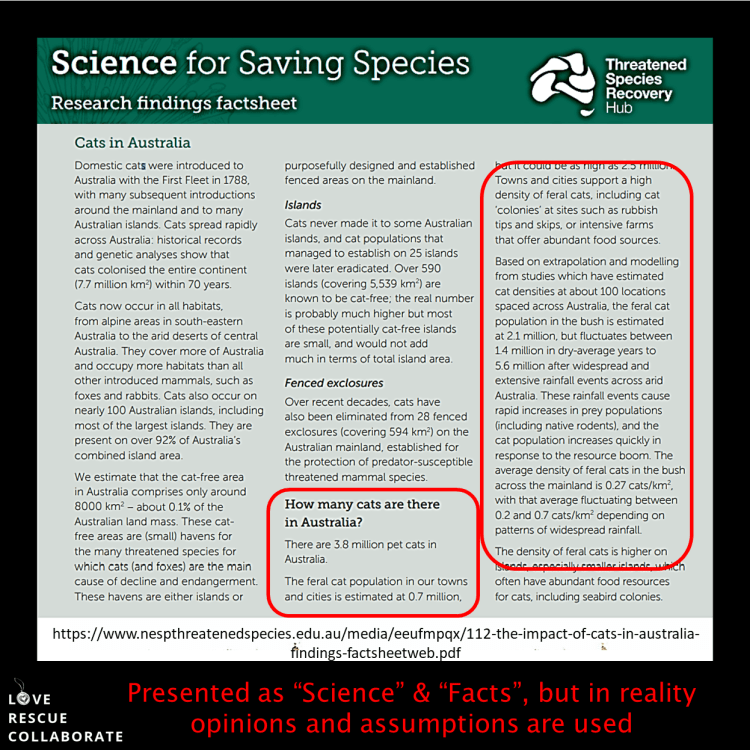
These figures are often used by many other media publications.
It is noted that the Animal Medicines Australia provided new figures on the numbers of pets. However this was produced around the peak of pet adoptions during the first two years of Covid home based restrictions, and since then we are all very aware of now experiencing the worst ever period of pets being surrendered and abandoned.
The difference between causing versus contributing to species extinctions
It is of great concern that the Federal government’s draft TAP includes “Cats have caused profound species loss in Australia” when this it not proved by evidence. Was it just only one situation on an island where cats were able to be identified as the cause of intinction of one species? In other publications it is noted that the impacts of cats is a contributing factor, however, this appears to be often misquoted by many across the internet and social media.
Other contributing factors tend to be habitat loss (the top impact for wildlife), drought, bushfires especially increased in intensity and frequency due to climate change.
[to include references]
Debunking the questionable “generalisations” on all cats across Australia re prey (introduced or wildlife)
Recent Vic Wildlife Report includes habitat loss, road accidents and illegal pet keeping as main causes of harm to wildlife
Sad news for Vic wildlife of record of injuries in 2023 – this is likely similar for all other states & territories. Major causes include:
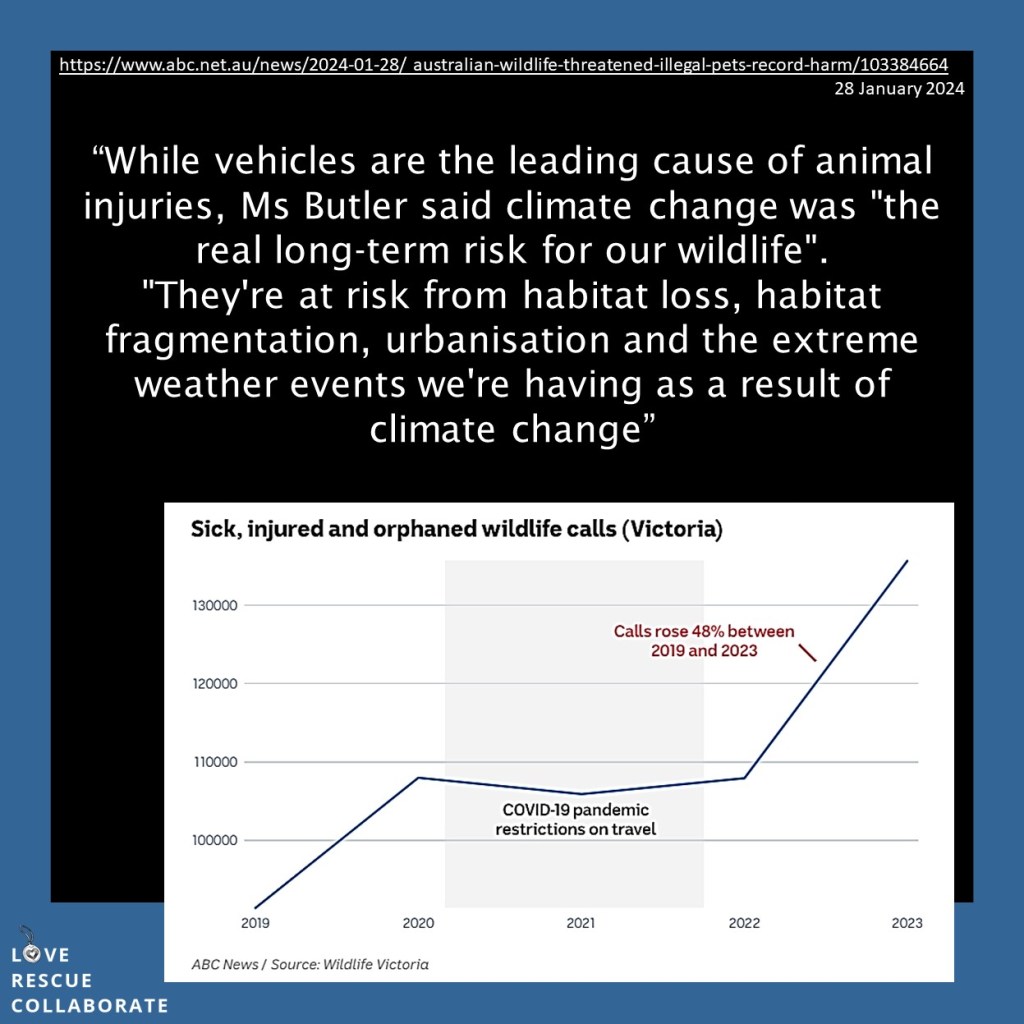
– climate change & loss of habitat (aligns with the 2021 State of the Environment Report)
– accidents, mostly road / vehicle injuries
– people intentionally causing harming or death, mainly roos and possums
– health deteriorations due to being illegally kept as pets by people 
ABC News item titled “Australian animals under record threat from climate, cars, illegal pet-keeping” https://www.abc.net.au/news/2024-01-28/australian-wildlife-threatened-illegal-pets-record-harm/103384664
APWF findings based on evidence based research
“…it is important to note that there is actually no scientific evidence that domestic cats living in the vicinity of people, impact Australian native wildlife populations. In fact, population studies have not found a measurable effect of domestic cats on native birds and mammals (Barratt 1998, Grayson 2007, Lilith 2010, Maclagan 2018). In addition, there is no evidence that cat restrictions in urban areas benefit native wildlife populations.”
“The estimates of wildlife predation by pet and stray cats are also very flawed. For example, it is frequently quoted that pet cats predate 61 million birds each year. This was based on extrapolation of surveys of cat owners 20 to 30 years ago, and the majority of studies (4/6) were not published in peer-reviewed literature. Based on these surveys, the authors concluded the average pet cat predates 15.6 birds per year (the peer-reviewed studies estimated a median of 1.5 birds a year). The researchers then multiplied 15.6 birds by the total number of pet cats, regardless of whether they were confined inside or were elderly or never seen to predate. They then imply pet cats cause devastating effects on native wildlife in our towns and cities. However, the published population studies from urban areas of Australia have not been able to document a population effect on birds or mammals (reptiles and amphibians have not been studied).
Importantly, banning cats from some suburbs has been shown to have no beneficial effect on native mammals in adjacent bushland. Similarly, the presence of cats had no effect on the density and diversity of birds, but density of housing, distance from bushland and decreasing size of remnant bushland had a strong negative effect on bird populations.” https://petwelfare.org.au/response-to-draft-tap/
“Despite the lack of scientific evidence, domestic cats in Australia still receive significant blame for negative impacts on native wildlife populations. False blame for wildlife impacts directed at domestic cats is harmful because it contributes to the implementation of ineffective domestic cat management strategies and can be used as a justification for lethal approaches to domestic cats…
False blame can also promote the use of inhumane killing methods; be used as a justification for cruelty towards cats, increasing pain and suffering; and be used as an argument for mandatory cat containment which is not an effective strategy for reducing free-roaming cats or associated issues such as potential wildlife predation.” https://petwelfare.org.au/2023/07/10/position-statement-on-domestic-cats-and-australian-native-wildlife-populations/
“An ongoing issue is that impacts of feral cats on wildlife are often wrongly attributed to domestic cats, even though they are two distinct and geographically separate populations with different behaviour and ecology. The impact of feral cats on native wildlife in natural environments is well-documented. Surprisingly, however, limited research exists on domestic cat wildlife impacts. The impacts (if any) of domestic cats on native wildlife populations is largely unknown. Contrary to popular belief, there is actually no definitive scientific evidence demonstrating viability or conservation impacts at a population level on Australian native wildlife by domestic cats living around people. Despite this lack of evidence, domestic cats in Australia still receive significant blame for negative impacts on native wildlife populations.” https://petwelfare.org.au/wp-content/uploads/2023/07/Data-to-Support-Position-Statement-on-Domestic-cats-and-native-wildlife.10jn.n-t.pdf
Do Pet Cats Deserve the Disproportionate Blame for Wildlife Predation Compared to Pet Dogs?
“…substantial attention and blame directed at domestic cats for their hunting behavior is disproportionately large compared to that directed toward domestic dogs, given that our results show that of dogs and cats that catch prey, dogs are more likely to catch native species… hunting by domestic dogs and cats appears to be of relatively minor conservation concern compared with issues such as habitat loss and urban development” https://www.frontiersin.org/articles/10.3389/fvets.2021.731689/full
“The number of native Australian animals killed by feral cats each night is also difficult to calculate”
It is noted that even several years ago that the range of findings vary between many different studies of the contents of cats’ stomachs which it appears have predominantly been from feral cats in arid areas. This situation does not appear to have changed in these years with balancing across various studies and gathering more evidence in Australia for domestic cats and drawing findings for all and domestic cats.
“The number of native Australian animals killed by feral cats each night is also difficult to calculate, due to differences in the size of prey. The stomachs of dissected feral cats can contain one rabbit, or up to 50 frogs.” https://www.abc.net.au/news/2014-11-13/greg-hunt-feral-cat-native-animals-fact-check/5858282
There exists research which indicates other factors have a greater impact than feral cats. Without addressing these factors, then the approach of killing / eradicating cats cannot be effectively measured and is unlikely to greatly benefit the wildlife.
“The mystery of the Top End’s vanishing wildlife, and the unexpected culprits”
“The mystery of the Top End’s vanishing wildlife, and the unexpected culprits” includes it was “found that the collective influence of feral livestock — such as buffaloes, horses, cattle and donkeys — has been largely underestimated. Even at quite low numbers, feral livestock can have a big impact on our high-value conservation areas and the wildlife they support.”
“The isolated areas where mammals are persisting have retained good-quality habitat, with a greater variety of plant species and dense shrubs and grasses.”
“Frequent, intense fires also play a big role.”
The Conversation, Stobo-Wilson A., Murphy B., Gillespie G., Dielenberg J. and Woinarski J. (2020) https://theconversation.com/the-mystery-of-the-top-ends-vanishingwildlife-and-the-unexpected-culprits-143268
Researched across the very north of Australia where fires are seldom experienced and including in national parks, native animals such as tree dwelling creatures eg brushtail possums, plus bandicoots and native rodents and more, have dramatically diminished. While feral cats have had an impact, it is the buffalo, horses, etc who though in small numbers have had a much more significant impact on habitat and impacts to native species. Based on the same research as the point above, however highlights habitat loss where fires are not a contributing factor.
“Feral animals in NT putting native wildlife in peril”
“Feral animals in NT putting native wildlife in peril” https://www.abc.net.au/listen/programs/am/feral-animals-in-nt-putting-native-wildlife-in-peril/12501774
“…managing herbivores and fire rather than culling cats, is likely a more effective way of protecting small mammals”
Further comments on this same piece of research include “Cats play a role in mammal declines, but the impact of cats is greatly magnified in areas where vegetation has been degraded by frequent fire and over grazing.”
“This research adds to a growing body of work from northern Australia that indicates that across most of these landscapes, managing herbivores and fire rather than culling cats, is likely a more effective way of protecting small mammals.” https://www.katherinetimes.com.au/story/6857221/ferals-cats-not-the-menace-to-top-ends-native-mammals-as-once-thought/?
“…no evidence that culling has reduced overall numbers of feral cats in Australia”
“Despite culling of cats over many years, there is no evidence that culling has reduced overall numbers of feral cats in Australia, which is difficult in vast, remote landscapes (Stobo-Wilson et al. 2020).” [https://petwelfare.org.au/wp-content/uploads/2023/09/APWF-Submission-to-Inquiry-of-Feral-Domestic-Cats-2020.22.jr_.n-t.pdf]
What do urban cats mainly eat?
For urban cats it is rats and mice that are more preferred over other animals/mammals.
For example, the domestic cat stomach content analysis study (Brisbane, Qld) includes that the stomach contents analysis provided evidence of introduced black rats.
“The preliminary findings from a recent UQ study show that pet cats overwhelmingly catch mice followed by rats and small lizards, and only infrequently native birds, which are common species such as Noisy Mynahs (Franklin & Rand unpublished data). These findings are consistent with data from many studies which report the main component of feral cats’ diet consists of mice, rats and rabbits (Dickman 2009). This is also consistent with the findings from Macquarie Island where cats had a positive effect on wildlife because of their predation of introduced rabbits (Bergstrom 2009).”
Another example from New Zealand urban areas includes: “Rodents were the main prey brought in by domestic cats in the urban/forest fringe habitat, whereas invertebrates were the main prey in the fully urban habitat.” https://zslpublications.onlinelibrary.wiley.com/doi/10.1017/S095283690200328X
Don’t judge habitat on its novelty: Assessing the value of novel habitats for an endangered mammal in a peri-urban landscape
Sarah J. Maclagan, Terry Coates, Euan G. Ritchie “…bandicoot abundance was higher at novel than remnant sites, with the highest abundance at the novel site with the most urbanised surroundings …The majority of bandicoots at novel sites were resident, and breeding activity, recruitment of first-year adults, and survival of mature adults were observed at all novel sites.
Our results demonstrate the potential significance of novel habitats for conserving threatened species within heavily-modified landscapes, and encourage us not to judge the quality of habitats on their novelty alone.” https://www.sciencedirect.com/science/article/abs/pii/S0006320717321262e
Species richness and community composition of passerine birds in suburban Perth: is predation by pet cats the most important factor?
Jacky Grayson, Michael Calver, Alan Lymbery “While cat predation might be significant adjacent to remnant bushland or other areas of conservation significance, blaming cats for bird conservation issues in long-established suburbs may be a scapegoat for high residential densities, inappropriate landscaping at a range of scales or poor conservation of remnant bushland. ” https://www.researchgate.net/publication/43980504_A_Species_richness_and_community_composition_of_passerine_birds_in_suburban_Perth_is_predation_by_pet_cats_the_most_important_factor
Do cat restrictions lead to increased species diversity or abundance of small and medium sized mammals in remnant urban bushland?
Maggie Lilith, Michael Calver, Mark Garkaklis “It appears that pet cats are not the major influence on the species diversity or abundance of small and medium-sized mammals at these sites and that vegetation characteristics may be more important.” https://www.publish.csiro.au/PC/PC100162
Other related evidence based research
Barratt DG (1998) Predation by house cats, Felis catus (L.), in Canberra, Australia. II. Factors affecting the amount of prey caught and estimates of the impact on wildlife, Wildlife Research, 1998, 25, 475–487.
Lazenby B.T., Mooney N.J. and Dickman C.R. (2015) “Effects of low-level culling of feral cats in open populations: a case study from the forests of southern Tasmania”, Wildlife Research, 41(5), 407.
Leis L (2021) What effect does diet have on body condition of unowned cats in the Southern Downs Region, Queensland? A thesis submitted In partial fulfillment of the requirements for the degree of Bachelor of Science (Honours) Submitted: November 2021
Lilith M, Calver M, Styles I, Garkaklis M (2006) Protecting wildlife from predation by owned domestic cats: Application of a precautionary approach to the acceptability of proposed cat regulations Austral Ecology 31 (2), 176-189.
Matthews A., Dickman C.R. and Major R.E. (1999) “The influence of fragment size and edge on nest predation in urban bushland”, Ecography, 22(4), 349-356.
Miller, P.S., Boone, J.D., Briggs, J.R., Lawler, D.F., Levy, J.K., Nutter, F.B., Slater, M. and Zawistowski, S. (2014) “Simulating free-roaming cat population management options in open demographic environments”, PLoS ONE, 9, e113553.
Møller, A., Erritzøe, J. Predation against birds with low immunocompetence. Oecologia 122, 500–504 (2000). https://doi.org/10.1007/s004420050972.
[to be completed]
 LRC
LRC 