Is “Cat Gets Its Tern: A Case Study of Predation on a Threatened Coastal Seabird” an example of shaky science? We believe there are certainly many valid questions about the findings of the study.
This is a brief set of comments and questions in relation to the Mandurah study presented in 2019 related to two Australian Fairy Tern nesting sites. There are questions on a study which is often cited for anti TNR justification and the Invasive Species social media posts on cats.
Please note that the LRC team supports and promotes cat enclosures, and supports our native wildlife.
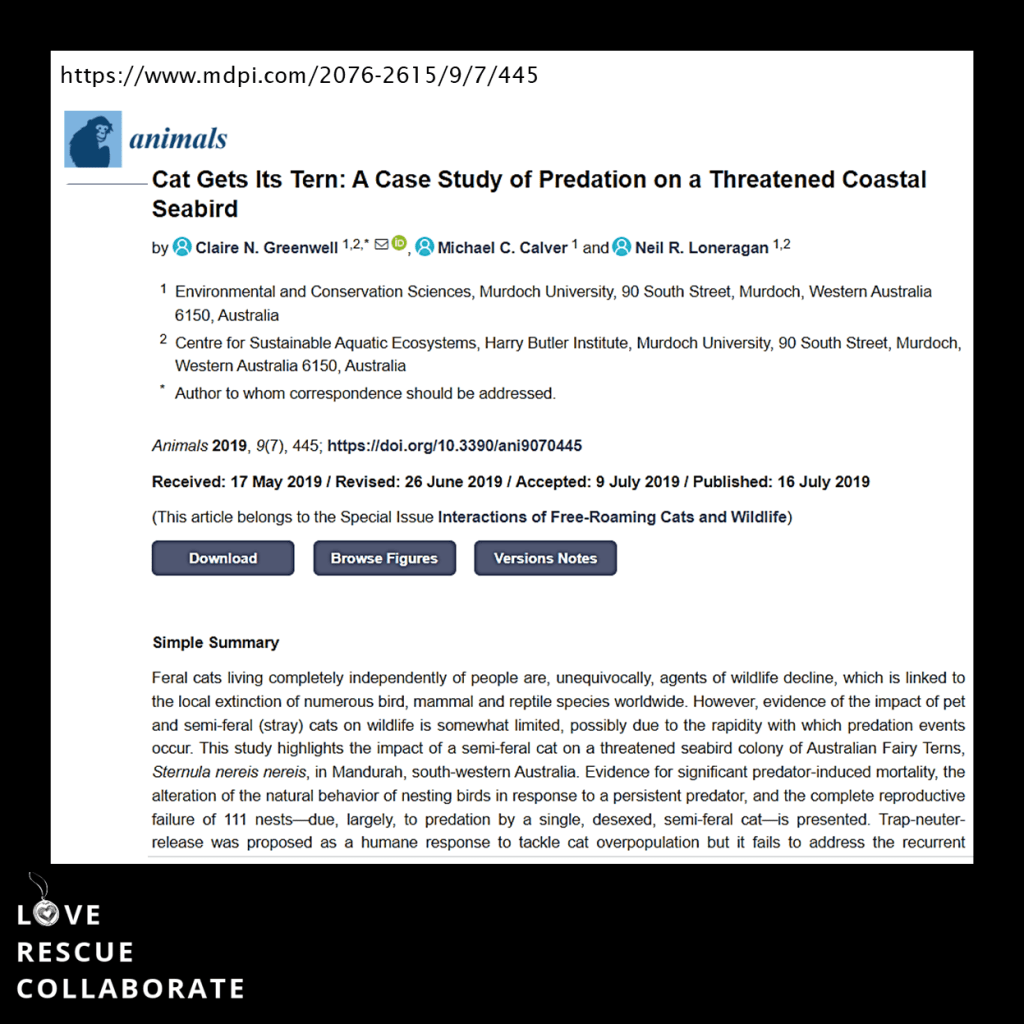
The main observation is that there were two nesting sites, and one site did not record the presence of cats yet it also struggled to achieve meaningful breeding success for the Terns.
That is, there were a number of significant threats to both of the two nesting sites in the largest regional city in Western Australia, described as being similar in urban environment like “the Gold Coast in Eastern Australia” (Wiki).
Yet, the study claims it “demonstrates that desexed, free-roaming cats remain a significant threat to wildlife and can lead to swift population declines and the local extirpation of native species” – but does it? Certainly some cats are hunters, some cats seldom hunt as was shown by the grey cat recorded in the study.
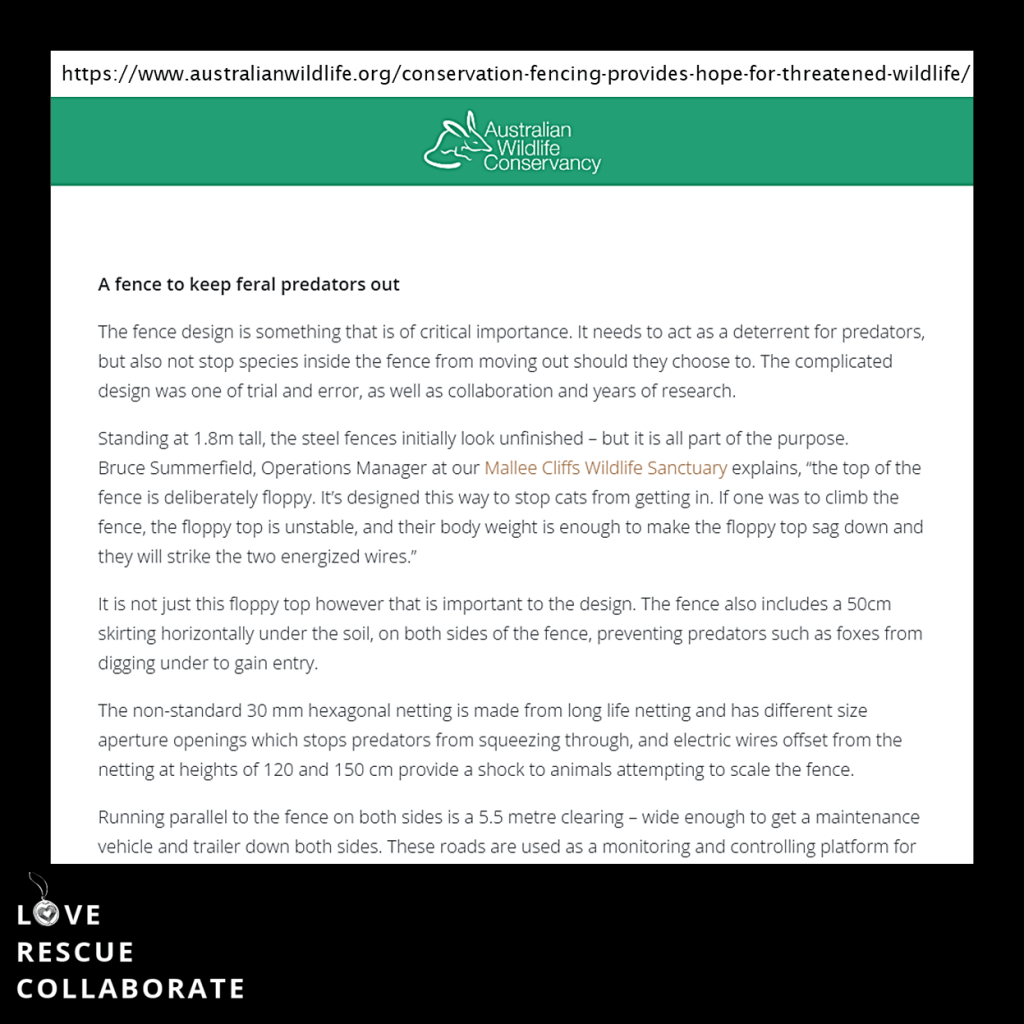
For one of the nesting sites, a 1.2m high fence was erected, and it’s side was covered in shade cloth. Were the choices for this 1.2m fence questionable as:
Why was it so short it was easily scaled by a local cat?
Why didn’t it conform with the proven conservation fencing standards?
Was it a contributing negative factor “for such a rapid effect” by a cat as it enclosed the new borns?
Was it a very poor decision for advancing nesting for a native animal at risk?
THE STUDY – RECOGNISED LIMITATIONS
The study includes “evidence of the impact of pet and semi-feral (stray) cats on wildlife is somewhat limited”.
It is recognised in the study that the findings on the impact of two cats was not the primary focus of the original work “the aim of the study was to encourage breeding by Fairy Terns and not on the potential impacts of domestic cats”.
Further, not one alleged single cat kill was recorded by cameras nor sighted by the adhoc or scheduled human monitoring of the sanctuary and adjacent roped off area. Although the white cat is likely to have harmed the baby terns in the enclosured nesting site, there are other considerations that may have contributed to this.
Additionally, the other nesting site where cats were not observed, appeared to also not succeed in increased breeding. That is, there were other factors limiting successful breeding.
Is the term “semi-feral (stray) cat” open to interpretation? We see social posts with any roaming cat, not just strays, being referenced as a feral cat.
Isn’t a cat either feral or not? Does labelling a roaming cat as a semi-feral, in our opinion:
- attribute legal interpretations and misunderstandings especially to cat haters who will kill/harm a roaming cat?
- include assumptions about the human care which the cat may have been under?
- include assumptions about whether the white cat may be timid or less social due to interactions with humans in general or other factors such as the interactions with the people monitoring during the study who were likely to be hostile to the white cat (Table 2 includes that the white cat was shooed away and chased in separate interactions)?
THE STUDY – DOES IT LACK DETAILED EVIDENCE?
Is the study light on detailed information given a number of considerations in terms of visiting cats who were not a subject under the original study?
- the two nesting sites are close to medium density urban area including a marina and apartment,
- the likely limited size of the sanctuary and the other nesting site in terms of sand area (due to erosion),
- the limited number of parenting birds, and
- the number of potential predators/ disturbances: humans, dogs, natural predators such as kestrels and gulls, two cats from residents (one assumed abandoned), and the potential of other predators such as vermin (urban rats).
It is possible that abandoned cats may kill native animals to survive. In our opinion, in urban areas, abandoned cats are more likely to prey on vermin who are active at night and possibly during the day.
A SUMMARY OF THE SOME OF THE KEY STUDY FEATURES & FINDINGS
- the sanctuary was established on “a parcel of land on Breakwater Parade in the Mandurah Ocean Marina, ‘the sanctuary’… cleared, a 1.2-m-high chain mesh fence lined with shade-cloth was installed to limit human and vehicular traffic”
- a second site included the “beach-nesting colony was roped off by the City of Mandurah on 1 November to deter incursions by beachgoers in an attempt to reduce disturbance of the terns”. Yet, the “beach-nesting colony faced a range of threats, including incursions into the roped area by people and dogs (despite it being a dog-free beach)”
- a grey cat who was recorded which appeared on at least two nights and did not appear to prey on the terns
- a white cat who was recorded and appears to have been attributed to many deaths of terns, although not one “kill” was actually viewed nor recorded, this attribution appears to be based on the remains of birds and chicks (which may have been caused by other animals)
- the only viewed kill was by a kestrel
- there were other predators such as gulls
- at the second site, humans and their unleashed dogs in a nesting area were sighted
- at the second site, there was also a significant loss of nesting/breeding, no cats were sighted nor evidence provided
- at the sanctuary, the decision to only have a fenced area 1.2m high is questioned, the situation of almost presenting the chicks in a concentrated contained (for the chicks) area, well, is this not like setting up a buffet for a coach load of tourists? (a form of entrapment?)
- the decision to shade cloth the sanctuary is questioned, as it appears that “the chicks were silhouetted against the shade-cloth fencing, enabling the kestrel to locate its prey more efficiently” and would this have not also been the case with the chicks inside the sanctuary for all predators?
- the terns most likely selected the nesting sites based on historical use, however, did the study investigate a number of protective responses? “Perhaps the most significant threat faced by the terns was erosion of the beach due to the cessation of the annual sand by-passing scheme in early November. Beach erosion forced several Fairy Terns to abandon their nests.”
THE STUDY CONCLUSION ON CONTESTING TNR – IS THAT SO?
One of the conclusions of the study “Trap-neuter-release programs should be strongly contested” is questionable given that the two nesting sites were at significant risk from multiple threats, one of the nesting sites was unsuccessful due to all other threats as a cat was not present, and one of the cats visiting the sanctuary did not appear to hunt.
The study has classed the white cat as “semi-feral”, and has assumed the white cat was previously owned but not currently owned. However it appears this has not been verified and is assumptions. It is possible that cat owners do desex their cats but choose not to microchip and therefore be held to other government obligations and financial penalties. This question for the white cat on ownership and being classed semi-feral questions the use of the hunting activities of a cat which may or may not have been TNRed.
Isn’t it possible that the white cat may have been owned by an owner who is best addressed with education and cultural change? Rather than impounding and euthanasing?
The study also relies on overseas studies which involve situations on islands. Islands with cat management issues have very specific conditions and attributes, and do not suffer from the “vacuum effect”. Doesn’t the Mandurah situation have its own specific conditions and attributes, as would the city / CBD area too?
The study does not explore where TNR occurs in dense urban areas and Mandurah is rated as the largest regional city in Western Australia. It appears that a native animal at high risk has been surrounded by medium density urban development.
The study includes that TNR “fails to address the recurrent depredations on native wildlife that occur post-release”. Does it appear that the study does not appreciate that a managed TNR program often involves:
- a rehoming initiative for social and easy to adopt cats and kittens ie reducing the numbers of cats and kittens,
- a desexing initiative to decrease the number of cats breeding and kitten numbers,
- a feeding initiative to decrease the scavenging, and potential hunting and instincts, and
- a focus on abandoned social cats who may have become very timid from being in a hostile urban environment; with a safe temporary “home” in a neighbourhood as pounds and shelters have limited capacity and resources, and where often they euthanase the cats who cannot be rapidly adopted.
OVERALL QUESTIONS THAT NEED MORE RESEARCH
It is critical to complete better research on the impact of humans and other animals including cats on our native wildlife. Especially where the species are at high risk. An abandoned pet cat placed in a situation where it needs to survive will take the opportunity to feed on small animals and scraps from urban “rubbish”. The last of our questions include, how is it best to:
- minimise people abandoning pet animals?
- reduce the overall number of pets being so easily bred and given away? and
- reduce the number of pets allowed to roam, whether this be dogs off leash or cats roaming from their properties into any native animal areas (sanctuaries) at high risk?
- develop a holistic approach to all the main threats to our animals at most risk in each local government area, and how does this become integrated in each biodiversity revie and plan?
REFERENCED INFORMATION
2019: CAT GETS ITS TERN: A CASE STUDY OF PREDATION ONA THREATENED COASTAL SEABIRD
https://doi.org/10.3390/ani9070445
CITY OF MANDURAH
https://www.mandurah.wa.gov.au/learn/about-mandurah/tourist-information
WIKI: MANDURAH
https://en.wikipedia.org/wiki/Mandurah
AUSTRALIAN WILDLIFE CONSERVANCY: CONSERVATION FENCING
Conservation fencing provides hope for threatened wildlife
ALLEY CATS RESOURCES: “FERAL vs STRAY vs PET” CATS
https://www.alleycat.org/resources/cat-socialization-continuum-guide/
ALLEY CATS RESOURCES: THE VACUMM EFFECT
https://www.alleycat.org/resources/the-vacuum-effect-why-catch-and-kill-doesnt-work/
 LRC
LRC 