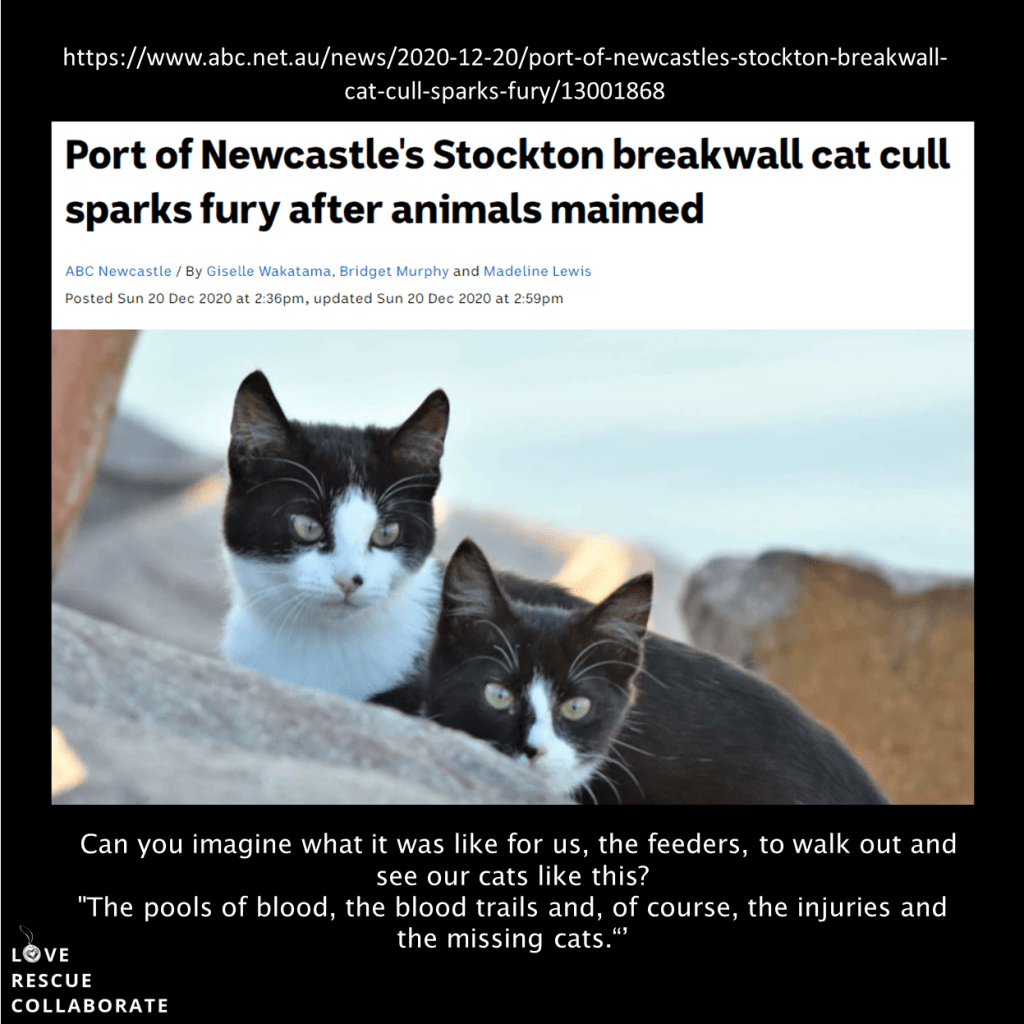
Decision makers for cat management approaches need to consider the potential risks to the carers of cats, that is, when harming roaming cats then those who provide ongoing care for the cats are also harmed. We explore relevant research and the recommendations to incorporate in cat management plans and operational (tactical) activities.
The following is provided based on two items of research, one from Australia based on the Newcastle Port culling/ shooting of cats in a colony and the devastating impact on the people who were caring for these cats , and research from the USA on the benefits of proactive solutions over enforecement for handling animal wlefare issues, especially in low socio economic areas. Topics include:
- RISKS FOR ROAMING CATS
- RISKS FOR CARERS, AUTHORITIES & THEIR CAT MANAGEMENT APPROACHES
- DECISION MAKERS NEED TO CONSIDER SUPPORT SERVICES RATHER THAN ENFORCEMENT
- CAT CARERS AFFECTED BY THE CAT CULLING AT THE PORT OF NEWCASTLE
- THE NEED TO ALIGN ANIMAL CONTROL ENFORCEMENT WITH THE HUMAN SOCIAL JUSTICE MOVEMENT
RISKS FOR ROAMING CATS
Containing cats to owners’ properties is recognised as a way to keep cats safe from others, and to limit a cat from potentially causing a nuisance or harming other animals including wildlife. It is encouraged for all cat owners.
However, we are aware that “door dashers” cats may escape, and some owners are not able to provide enclosures.
Cats found roaming or a colony of cats may be under threat of:
- a council’s “cat management” approach for euthanasing over rehoming, and
- the public who may “take matters into their own hands” when they believe they are acting within the law under any mandatory cat containment legislation / rules.
The latter is a serious risk as “all roaming cats are feral and should be culled” has been quoted many times on social media.
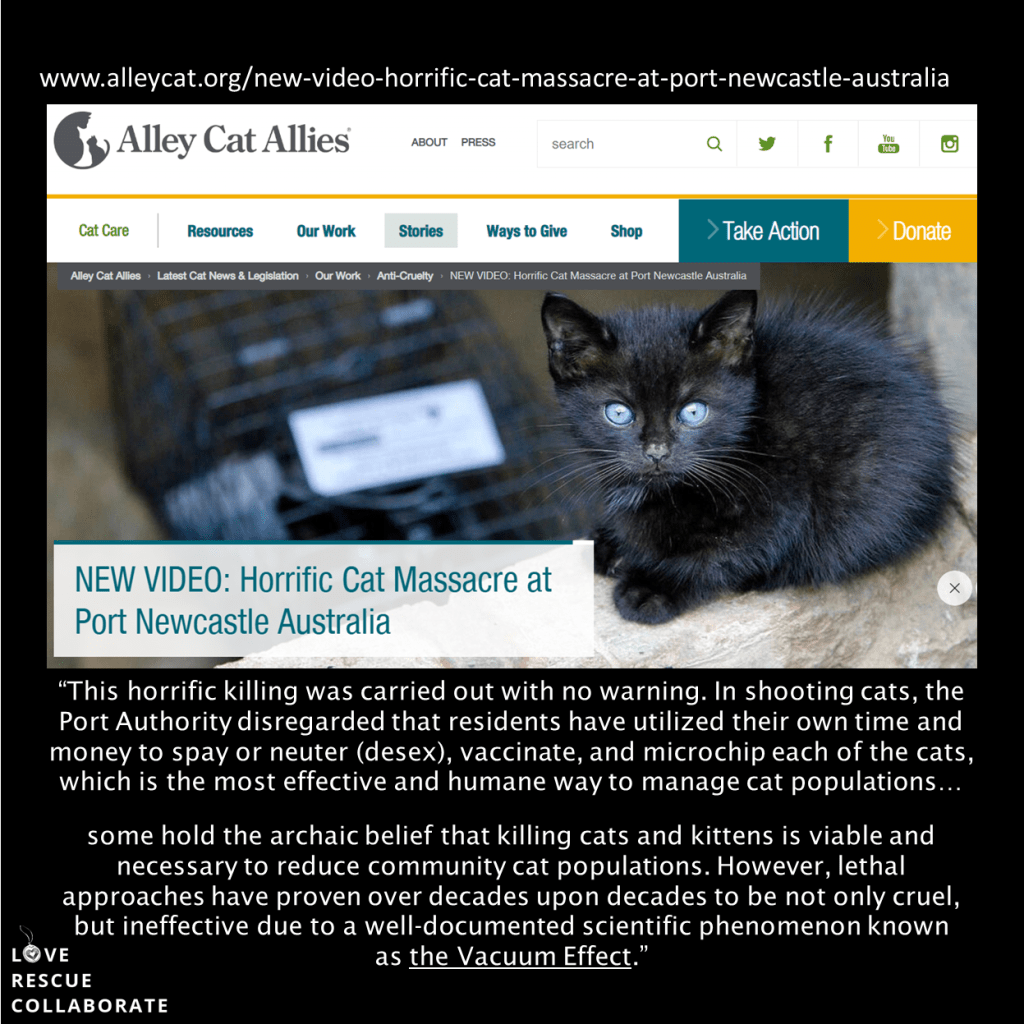
[Reference links are below – eg Alley Cat video on the Port of Newcastle incident shooting cats, and previous LRC posts on the Dark Side of Mandatory Cat Confinement]
RISKS FOR CARERS, AUTHORITIES & THEIR CAT MANAGEMENT APPROACHES

A recent Australian study / research has highlighted the impact to cat carers (eg cat rescue groups) from the Newcastle Port culling/killing of roaming cats, who where in a colony (group) being managed and supported by cat rescuers. This was a shocking incident reported in several media outlets and on social media.
The major finding includes that culling/killing even with humane veterinary techniques will contribute to significant health impacts to the carers, and that this is likely to far outweigh the risks the cats were likely posing to the community and/or wildlife.
More information on this study is summarised below.
Further, this may lead to legal ramifications for the authorities for the cat management approaches based on culling/ killing that may be promoted in the local government area or on a private property.
In our opinion this experience and research is relevant to:
- all roaming cats, be they single, a family unit or a colony of cats,
- all carers, be they individuals, a group of friends or a cat rescue organisation.
Besides the suffering of cats killed “in the field” or removed/ trapped and taken to a pound or vet for euthanasia, one must recognise the significant negative impacts on the people who were caring for these cats. This becomes more intense the larger the number of roaming cats or colonies of cats, who are targeted for removal and death by authorities being local councils, animal welfare organisations providing enforcement services, or owners of private properties.
DECISION MAKERS NEED TO CONSIDER SUPPORT SERVICES RATHER THAN ENFORCEMENT
Another study from USA 2020 recommends that is it far better practice to offer support services to enable solutions rather than brutally enforcing laws/legislation. [reference link below]
It highlights that over enforcement in low socio economic areas, in terms of “higher confiscation, relinquishment, and euthanasia rates, lower return to owner rates, and extended lengths of stay in animal shelters” results in worse health outcomes for the pets in these areas.
That is, for areas of low socio ecomonics, hard enforcement is not beneficial to the health outcomes for animals and their owners, it is better to provide support services to assist with proactive animal welfare services.
More information from this reserach is summarised below.
A prime example in Australia is Banyule Council AMO who setup and operated free desexing in hot spots for years, rather than siezing and destroying animals, and trying to apply penalties. [reference link to Banyule is provided at the end of this post]
CAT CARERS AFFECTED BY THE CAT CULLING AT THE PORT OF NEWCASTLE
Australian based research and findings publish 12 January 2023 based on the Newcastle Port incident. [reference link is below]
MAJOR RECOMMENDATION
For consideration by all authorities/ decision makers:
“the severity of the adverse psychological impacts, and the morbidity rate amongst the cat caregivers we interviewed, was far greater than would be expected as a risk to the community if the cats had remained at the site. We therefore suggest that potential legal ramifications should be considered before authorities intentionally choose a method of management that is likely to inflict substantial harm on community members.”
BACKGROUND on the research
Several experts in veterinary science from multiple universities completed research on the impacts on the people who were caring for a colony of cats
Published recently 12 January 2023, we feel more similar research will be following, the findings should not be a surprise to any reader or people involved in volunteer rescue / carer roles.
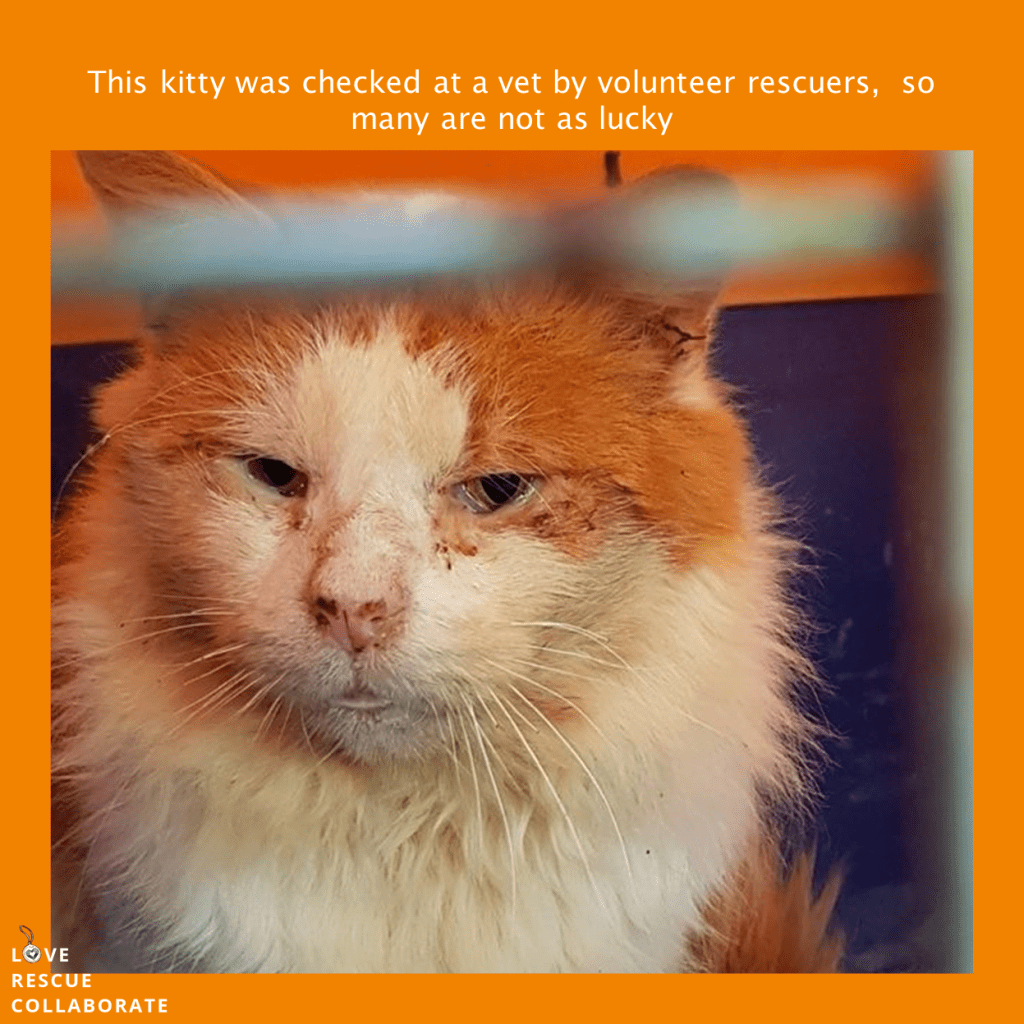
One “aim was to explore caregiver perceptions of the lethal management approach and if psychological impacts were experienced”
“Results demonstrated strong relationships between the caregivers and cats, and negative impacts on caregiver psychological health and quality of life associated with lethal management.”
SEVERE IMPACT on cat carers/ rescuers, included
“The impact on shelter workers of animal euthanasia (killing) is well documented, with participation in this process being associated with negative psychological effects, including depression, traumatic stress, suicide, and substance abuse”
“caregivers described the scene they were met with on the morning after the event using words such as ‘horrific’ and ‘bloodbath’. In response to this event, caregivers described their immediate emotional responses using words such as ‘traumatic’, ‘mortified’, ‘disbelief’, and ‘shock’. Their immediate responses to the cull also included feelings of betrayal”
Long term effects included “The caregivers reported decreased levels of daily functioning and several negative impacts on their wellbeing following the cat culling event. For some, approximately 12 months after the event, these impacts were still felt. Caregivers also spoke about difficulties related to not knowing the fate of some of the cats and being unable to say goodbye”
“As a consequence of feeling betrayed, what was also evident in the caregivers’ discussion was a pervasive distrust of the authorities who organized the event.”
FINDINGS included
“Concern for the welfare of urban stray cats is often centred around a person’s love of animals, sympathy towards cats that may be hungry, injured, or unhealthy, and ethical concerns [69]. Caregivers often provide not only food and water, but also first aid and (self-funded) veterinary attention for cats within their care, including neutering”
“Our study provides further evidence of the positive impacts of human–animal interactions and relationships, but unfortunately also highlights the psychological trauma that can result when the relationship is unexpectedly severed.”
Psychological impacts “the caregivers described the culling event as ‘horrific’ and ‘traumatic’. Since the caregivers were not informed the cull was to occur, they had no opportunity to prepare for the event, so it is perhaps not surprising that the caregivers also described the event as ‘shocking’”… “Killing the cats being cared for after trapping them may on the other hand have similar traumatic impacts if caregivers are not informed or if they disagree with the practice, and/or the fate of the trapped cats remains unknown.”
THE NEED TO ALIGN ANIMAL CONTROL ENFORCEMENT WITH THE HUMAN SOCIAL JUSTICE MOVEMENT
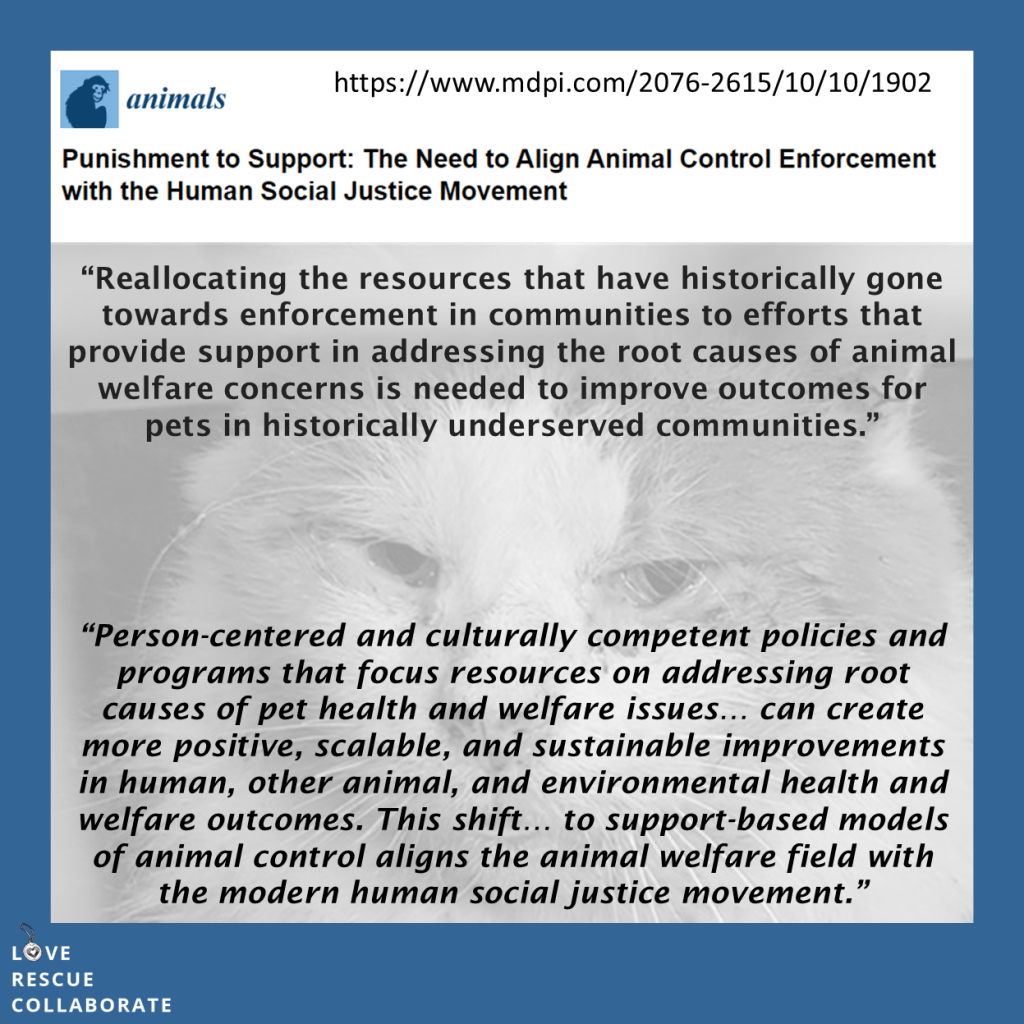
USA based research, publish in 16 October 2020 on proactive people and cultural based approaches for animal welfare initiatives over enforcement approaches. [reference link is below]
MAJOR RECOMMENDATION
“Person-centered and culturally competent policies and programs that focus resources on addressing root causes of pet health and welfare issues as opposed to an emphasis on code enforcement can create more positive, scalable, and sustainable improvements in human, other animal, and environmental health and welfare outcomes. This shift from punishment-oriented approaches to support-based models of animal control aligns the animal welfare field with the modern human social justice movement.”
BACKGROUND
“The current emphasis on enforcement and punishment in animal control policy has disproportionately negative impacts on low-income communities in the United States (US)”
IMPACTS include
“Due to inherent and systemic biases, animal control policies in the US are over-enforced in low-income communities and communities of color, resulting in worse health outcomes for the pets in these communities. These outcomes are exemplified by higher confiscation, relinquishment, and euthanasia rates, lower return to owner rates, and extended lengths of stay in animal shelters.”
“There are substantial barriers to implementing animal control policies that promote One Health and One Welfare, including inherent biases regarding how and why individuals living in poverty may require additional support resources (e.g., they are just “lazy” and need to get a job so they can pay for their pet’s care on their own, rather than relying on government handouts); the animal welfare field’s historic commitment to a specific definition of “responsible pet ownership” that is driven by racism, classism, and the White dominant culture; an absence of strategies for engaging with marginalized populations in a culturally competent manner; over-policing in communities of color; lack of transparency and oversight in data regarding enforcement; lack of a concerted effort to address structural barriers to accessing pet support services; lack of animal control officer training to perform basic animal handling and zoonoses prevention tasks or in de-escalation strategies; and limited funding opportunities for projects aimed at achieving One Health and One Welfare outcomes [4,5,25,26,27,28,29,30]. Without identifying specific strategies for overcoming each of these barriers, the implicit bias that is present in animal control policy will continue, resulting in disproportionately negative impacts on the pet owners of color and their pets that live in low-income communities.”
FINDINGS include
“Policy reform that is informed by the One Health and One Welfare frameworks can provide a more comprehensive approach to maintaining public health and safety that prevents further harm against underserved and socially disadvantaged populations, particularly low-income communities and people of color. Shifting animal control policies from punishment to support is intended to act on the recognition of the physical and emotional benefits of the human–animal bond and incorporating animal control agencies into a more robust system that supports pet ownership [36].”
REFERENCED INFORMATION
The Impact of Lethal, Enforcement-Centred Cat Management on Human Wellbeing: Exploring Lived Experiences of Cat Carers Affected by Cat Culling at the Port of Newcastle
https://www.mdpi.com/2076-2615/13/2/271
Punishment to Support: The Need to Align Animal Control Enforcement with the Human Social Justice Movement
https://www.mdpi.com/2076-2615/10/10/1902
Port of Newcastle’s Stockton breakwall cat cull sparks fury after animals maimed
Alley Cat USA Video of Newcastle Port Shooting
https://www.alleycat.org/new-video-horrific-cat-massacre-at-port-newcastle-australia/
 LRC
LRC 
One thought on “ROAMING CATS, CAT COLONIES, AND THEIR CARERS NEED TO BE SAFE”