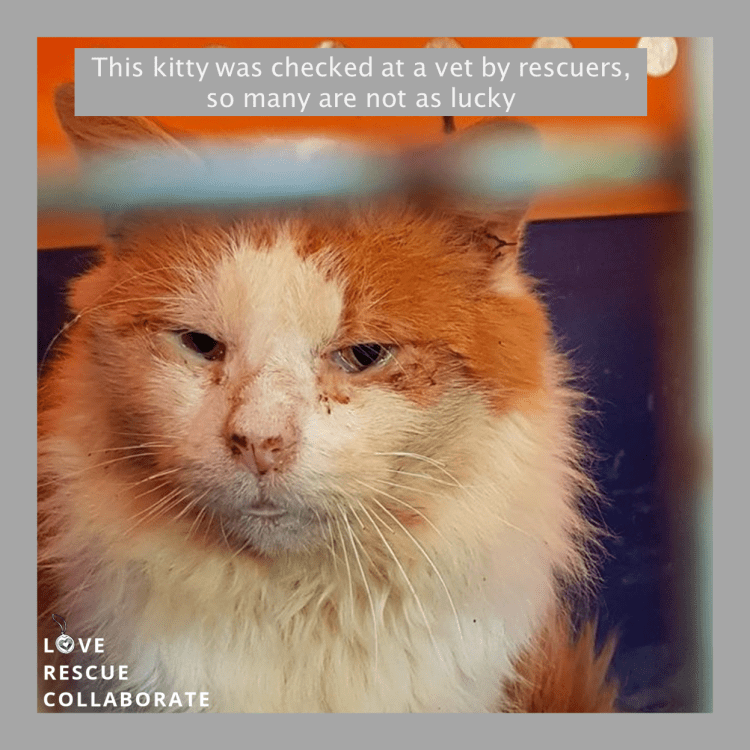
In July 2022 (or perhaps earlier) the NSW state government commenced a review of its practices across councils for rehoming and euthanasia practices for companion animals. This has been a “closed” review for councils, designated rehoming organisations and selected organisations.
Engagement has NOT YET been open to all stakeholders including the public & rescuers and rescue groups who though not designated rehoming organisations, they may include vets, businesses (ABNs), and charities.
This post includes information on:
- Background for the draft report on the review of pound practices
- Recommendations to include small rescuers in the review of the pound practices
- How NSW government charges impact small rescuers
- Free high intensity desexing helps communities & relieves the pressure on small rescuers to achieve fewer unwanted pets each year
- Reducing pound adoption fees has a negative impact by extending holding periods on small rescuers & their animals
A draft report is available for review only by councils, until 28 October 2022.
We have concerns that a broader engagement & consultation has not yet been completed.
When will it be scheduled? and how open to feedback and change will the NSW government & councils be?
Why are small rescuers not involved?
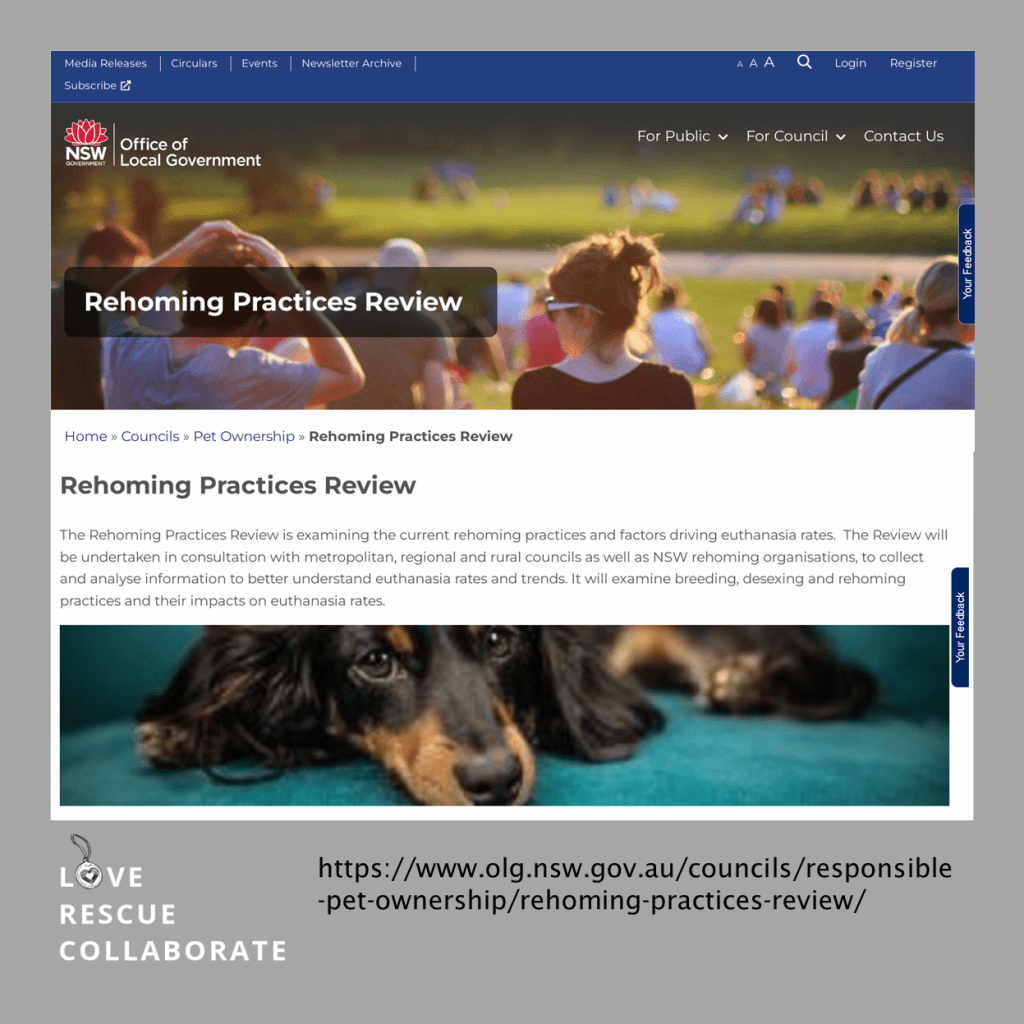
BACKGROUND FOR THE DRAFT REPORT ON REVIEW OF POUND PRACTICES
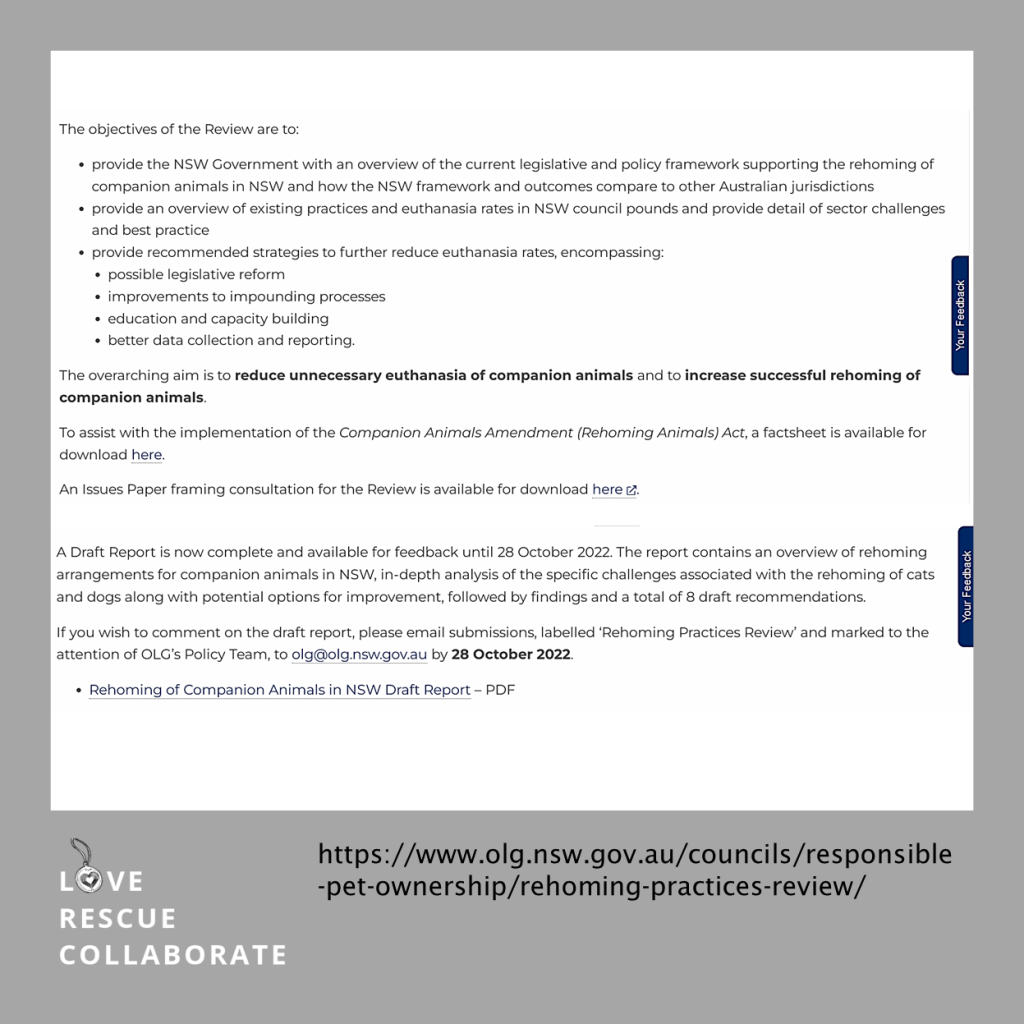
Currently 3 documents are available on the NSW OLG webpage:
the draft report/ findings
a background “Factsheet”
an Issues paper
We will provide copies at the end of this post, as these documents may no longer be available after 28 October on the NSW webpage.
RECOMMENDATION TO INCLUDE SMALL RESCUERS IN THE REVIEW OF THE POUND PRACTICES
It is recommended that a review of council pounds needs to consider the whole system including: the impact of rescuers minimising animals being taken through the council pound systems &; how changes in the pound practices have an impact on small rescuers.
Small rescuers include: vets, businesses with ABNs, registered charities with the ACNC, rescue individuals or groups, and people from the community who take in a cat or dog from the streets.
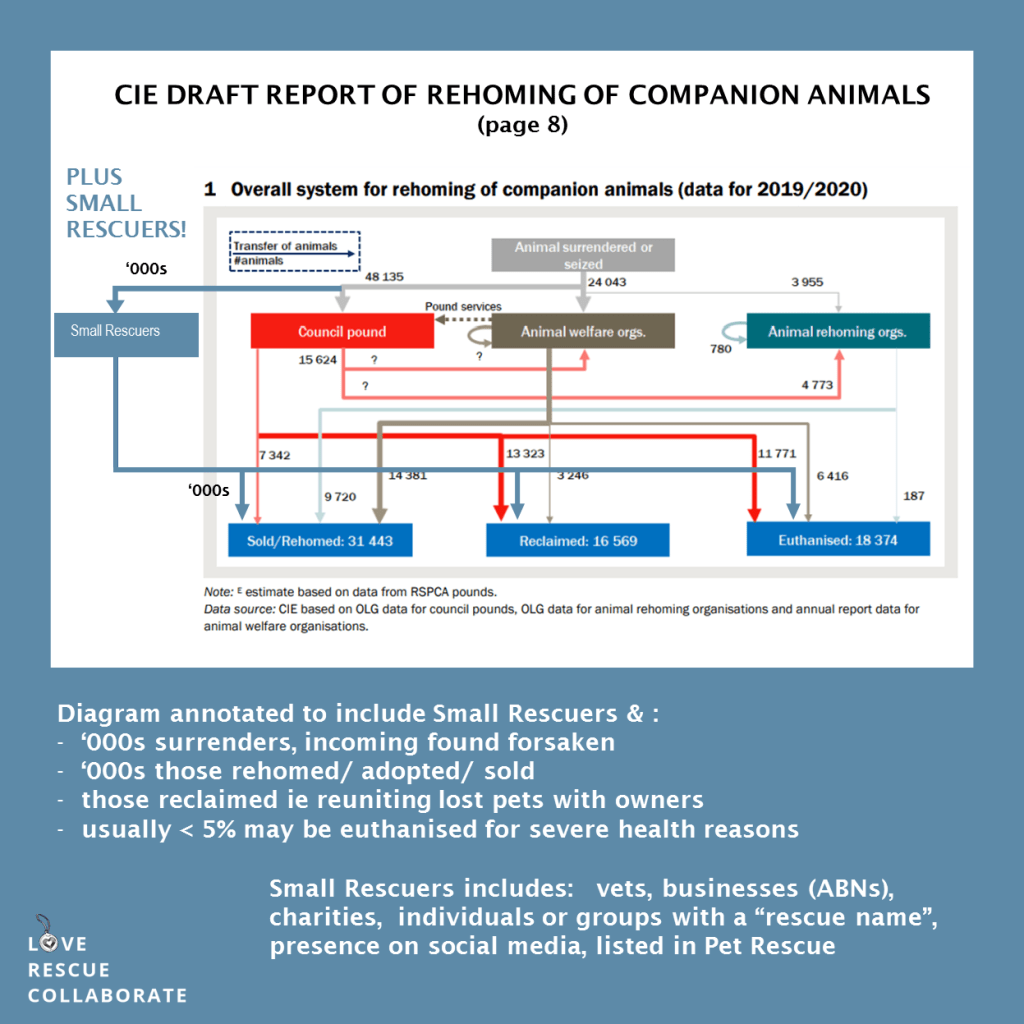
Generally, only few councils offer help to small rescuers, who are vets, residents or small rescue groups, who find and attempt to assist forsaken dogs and cats with feeding, desexing etc, and rehoming.
Small rescuers are a factor in minimising council intake numbers, as well as euthanasia numbers, as if more forsaken / “unowned” pets were taken in to council pounds, then with current capacity limits, many more animals will be euthanised, especially on entry.
- There are literally hundreds of small cat and dog rescues groups across the state, accumulatively rescuing, desexing and rehoming thousands of animals each year.
- It appears that as the NSW state government, nor councils, do not have an explicit line of sight for gathering information and managing the small rescues, then they offer no assistance nor will recognise the effective assistance from volunteer, donation driven people, working to keep animals out of the council pound systems.
These rescue groups/individuals take on the “harder cases”, as the public and the rescuers are very aware of the high euthanasia rates at council pounds and large animal welfare organisations.
Most pounds consider 10% euthanasia rate as “low-kill”. Even 10% euthanasia rates are considered high by small rescue and the public. Small rescues aim for well under 5%.
It is recommended that local government councils increase the designated funding for animal management teams and shelters to enable more animals to be taken in from the public, without increasing euthanasia rates and relieve the pressure on small rescuers and communities.
It is recommended that more detailed information is maintained and reported by council pounds and large animal welfare organisations. For example on the age, breed, physical condition of animals, including incoming, rehomed or euthanased. And a better level of granularity for reasons for euthanasia.
It is also recommended that the NSW state government seeks a method to gather similar information from small rescues in an understanding manner, such as being assessed by the Victorian Government.
HOW NSW GOVERNMENT CHARGES IMPACT SMALL RESCUERS
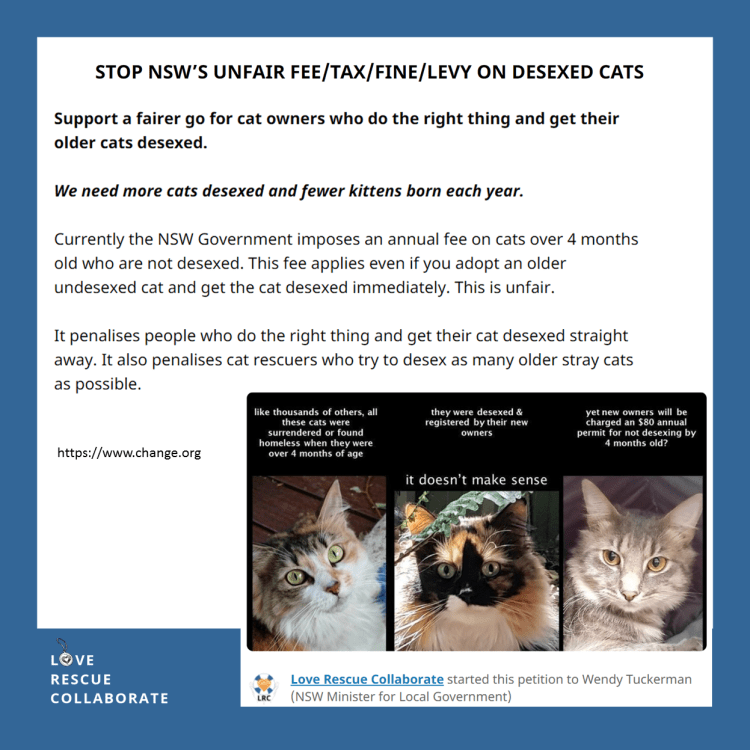
An example of “interactions” is the additional $80 fee introduced in July 2020 by the Office of Local Government for owners of cats not desexed before 4 months of age. This was poorly implemented as it mainly penalised the small rescuers taking in older forsaken cats.
These issues were raised with OLG in 2020 by our team, and others both individuals and organisations. Further a Change.Org petition was raised and sent to the Minister in 2021.
- The additional charge & late fees penalise people who adopt/ take in older cats, as they did not own their new cat before the cat reached 4 months of age (ie the government is penalising the wrong people, ie the new owners instead of the owners at the time).
- The additional $80 fee also has a related late payment charge of $17 and possible further ramifications for new owners of cats.
- It really hits hard the small cat rescue groups who are saving many forsaken cats from the streets or surrendered from owners – the government is raising revenue from hundreds of such cats every year, cats who do not go through the council pound systems and do not cost the NSW government nor councils any funds to desex, register and rehome.
- It fails to motivate some people, who will refuse to microchip and register their cats to avoid being penalised by the government for having undesexed cats.
FREE HIGH INTENSITY DESEXING HELPS COMMUNITIES & RELIEVES PRESSURE ON SMALL RESCUERS TO ACHIEVE FEWER UNWANTED PETS EACH YEAR
It is recommended that free high intensity desexing will benefit council animal management & small rescuers, by minimising the number of kittens/puppies being born every year.
It is recommended that each council/ LGA make assessments and estimates of the forsaken animals (especially cats) in the streets, parks, business area etc to be included in future government models and understandings of the scope of work for animal management.
It is recommended that, where enforcement and penalties etc are handed over to councils, that the cost benefit / business cases by the NSW state government are transparent and shared with communities, as it is likely that more proactive steps such as free mass/ high intensity DESEXING may be the very most useful “intervention” to reduce current and future costs for animal management in each LGA.
REDUCING POUND ADOPTION FEES HAS A NEGATIVE IMPACT ON SMALL RESCUERS & THEIR ANIMALS
It is recommended that governments need to consider before reducing adoption charges in council pounds that this negatively impacts the rescuers and ROs who are not able to dramatically cut their charges. It may help the council pounds clear their shelters, but it stalls adoptions for the animals with small rescuers.
There are a number of approaches to reduce the turnaround time (from intake to adoption) for each animal, that is, to reduce the period of staying in the facility. The most popular and simplest approach tends to be to lower the adoption fees or make these nil.
While this tactic is powerful for council pounds, it has a devastating impact on the animals & rescuers who are not able to respond in the same manner.
it is important to note that when council pounds or large animal welfare organisations do this, it means the animals in Rehoming Organisations or small rescue groups are less likely to be chosen by the public, and these mainly volunteer based groups incur animal stay periods extending, and their costs purely from donations increase substantially.
It is recommended that when a council pound or large animal welfare organisation changes their approaches they need to recognise that the “pain” mainly in terms of costs is transferred to others. There is a holistic system that needs to be considered, no part of the system should operate in isolation and just what is best for the pounds in isolation.
Therefore, if the NSW state government and/or the large animal welfare organisations decide to make such changes, how will they actually achieve more adoptions across all rescuers too? Otherwise, isn’t this just “smoke and mirrors” in marketing for the pounds and large animal welfare organisations? ie to communicate how successful they are by increasing adoptions, while they ignore that the adoptions by ROs and small rescuers “stall”.
REFERENCED INFORMATION
NSW OLG ANNOUNCEMENT OF REVIEW
NSW POUND REVIEW FACTSHEET ON THE REHOMING ACT AMENDMENT
NSW GOVT ISSUES PAPER FOR POUND REVIEW
NSW DRAFT POUND REVIEW REPORT
LRC Change.Org petition to the Minister OLG
 LRC
LRC 