On 14 September 2022, Hornsby Council included in their meeting Item 5, a motion on mandatory cat confinement, to be raised at the upcoming Local Government Conference (October 23 through 25) for consideration by the NSW state government and all councils.
This post includes and summarises the Australian Pet Welfare Foundation (APWF) response “Key issues to consider related to mandated 24/7 cat containment”, including why this approach has not been found to be effective.
[Our own views are included in square brackets such as this sentence.]
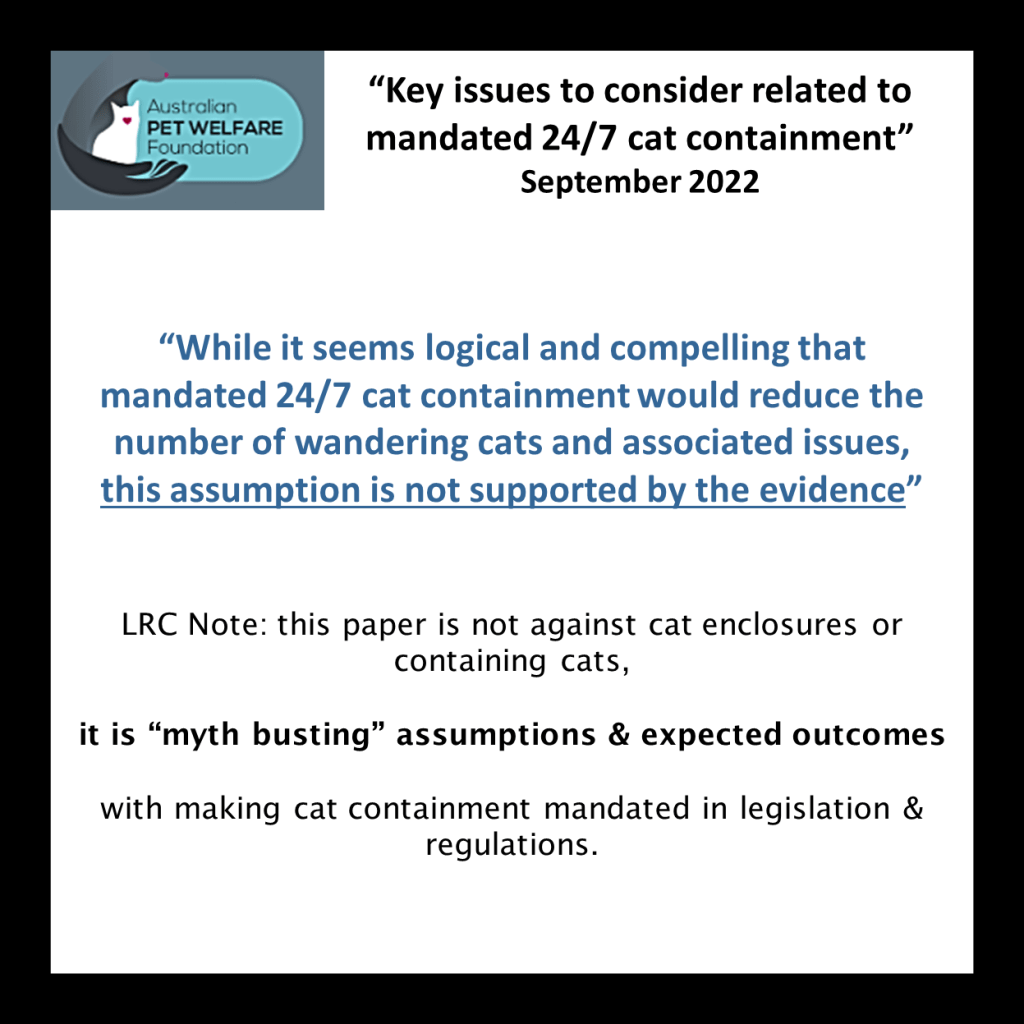
We note that APWF promote, and are not against the use of cat enclosures. [LRC promotes cat enclosures and containment too.]
The key message on mandatory 24/7 containment is the lack of success, and the lack in measureable outcomes to date once implemented and even after 20 years of “application”.
This is supported by evidence from Australian councils and from other countries.
Overview of APWF review & findings
Refer to our Referenced Sources at the end of this post for this document.
- Why is mandated 24/7 containment promoted by some groups?
- Is mandated cat containment effective at reducing wandering cats?
- Why is mandated cat containment not effective at reducing wandering cats?
- Stray cat population (brief background information)
- Mandated cat containment perpetuates the failed Trap, Adopt or Kill approach
- Why is mandated cat containment unfeasible?
- What are the negative consequences of mandated cat containment?
- What are evidence based solutions to reduce wandering cats and related issues?
- What about mandated night curfew?
- Do domestic cats have an impact on wildlife populations?
- Summary
- References
We provide some highlights in this post.
Mandatory 24/7 cat containment legislation does not provide the expected benefits
APWF provides several sources of evidence on the lack of effectiveness at reducing roaming cats, which includes:
- key findings from three Australian councils: Yarra Ranges; Casey; and Hobsons Bay, the latter who, after 20 years, rejected cat curfews/containment in 2014 [LRC understanding is that information from councils is limited due to each council’s available information]
- that a “number of USA jurisdictions have repealed their cat leash laws because they were unenforceable”, and as a result of “more cats being impounded and then killed but without reducing the overall number of roaming cats”,
- RSPCA Australia in 2018 noted: “Overall, councils with cat containment regulations have not been able to demonstrate any measurable reduction in cat complaints or cats wandering at large following the introduction of the regulations”.
APWF summarises “Based on data from councils, 24/7 cat containment regulations would not provide any measurable benefit in reducing complaints, cat impoundments, potential wildlife predation… and would instead increase costs to local governments.”

Why isn’t 24/7 containment an effective approach for wandering cats?
APWF includes, based on studies:
- an owner for the majority of roaming cats cannot be identified to contain the cats
- owners raised inherent challenges including financial costs, property limitations, and concern for the cats’ welfare
- roaming cats without a identified/registered owner, may be supported by “semi owners” who may feed the cat(s) [and possibly desex etc] …but mandatory containment prevents or acts as a disincentive for semi owners to become an identified/registered owners [most likely due to the inherent challenges in our previous summary point]
APWF summarises “Mandated 24/7 cat containment is not an effective strategy to reduce wandering cats” as many do not have an identifiable/registered owner, and some of those cats who do have an owner may be limited to the inherent challenges.
Mandatory cat containment “perpetuates the failed Trap, adopt or kill approach”
Where a cat does not have an identified/registered owner, then these cats are impounded by a council.
Based on information and studies (NSW pound reports, RSPCA and more), APWF includes:

- in areas where there are high populations of roaming cats, then it “results in low-level ad hoc culling, insufficient to override the high cat reproductive rate, immigration of new cats… and increased survival of juveniles”
- this becomes a repeating cycle “without reducing the number of wandering cats over time”

The reasons why mandated 24/7 cat containment is not feasible [nor cost justified]
Based on studies /evidence from Australian councils, RSPCA, and a number of USA sources, APWF includes the combination of key factors:
- enforcement includes trapping resources and labour
- the scope of work is limited in regulations
- it is time and labour consuming (often requiring many days or weeks of effort), requiring more paid staff
- it is costly for facilities eg traps
- for cats without an identifiable/ registered owner the penalties under infringement notices (funding to cover costs) cannot be applied
- trapped cats will increase the incoming impoundments and result in increased return to owner, rehoming or euthanasia rates, and funding for these
- the mental health of AMO staff is at risk with increased negative outcome based workload
APWF summarises “Based on the evidence in Australia and internationally, mandated 24/7 cat containment is essentially unenforceable, rendering [this method] impractical and unfeasible.”
APWF provide 16 negative consequences of mandatory cat containment based on studies/evidence
A summary and grouping of these 16 consequences includes:
- increases in cat complaints, impoundments, euthanasia of healthy treatable cats, costs (#1, #2, #3, #5)
- increases in mental health damage for staff and residents, staff burnout, staff turnover (#4, #6)
- “continuation of the reactive and ineffective typical approach to domestic cats in Australia” (#7)
- creates a disincentive for cat ownership: thereby reducing cat adoptions and rehoming opportunities (#8) [which also prevents companionship for many people]
- creates a major barrier for the semi owners (#9) and proactively responding to reducing the number of roaming cats
- criminalises “door dasher” cats for identified/registered owners for ad hoc occurrences (#10) & increased risk for owned domestic cats being incorrectly impounded & euthanased (#13)
- likely to increase cat surrenders [to council pounds etc] and abandonment [on the streets] (#11) [due to inherent challenges with containing a cat to a property and avoiding future penalties]
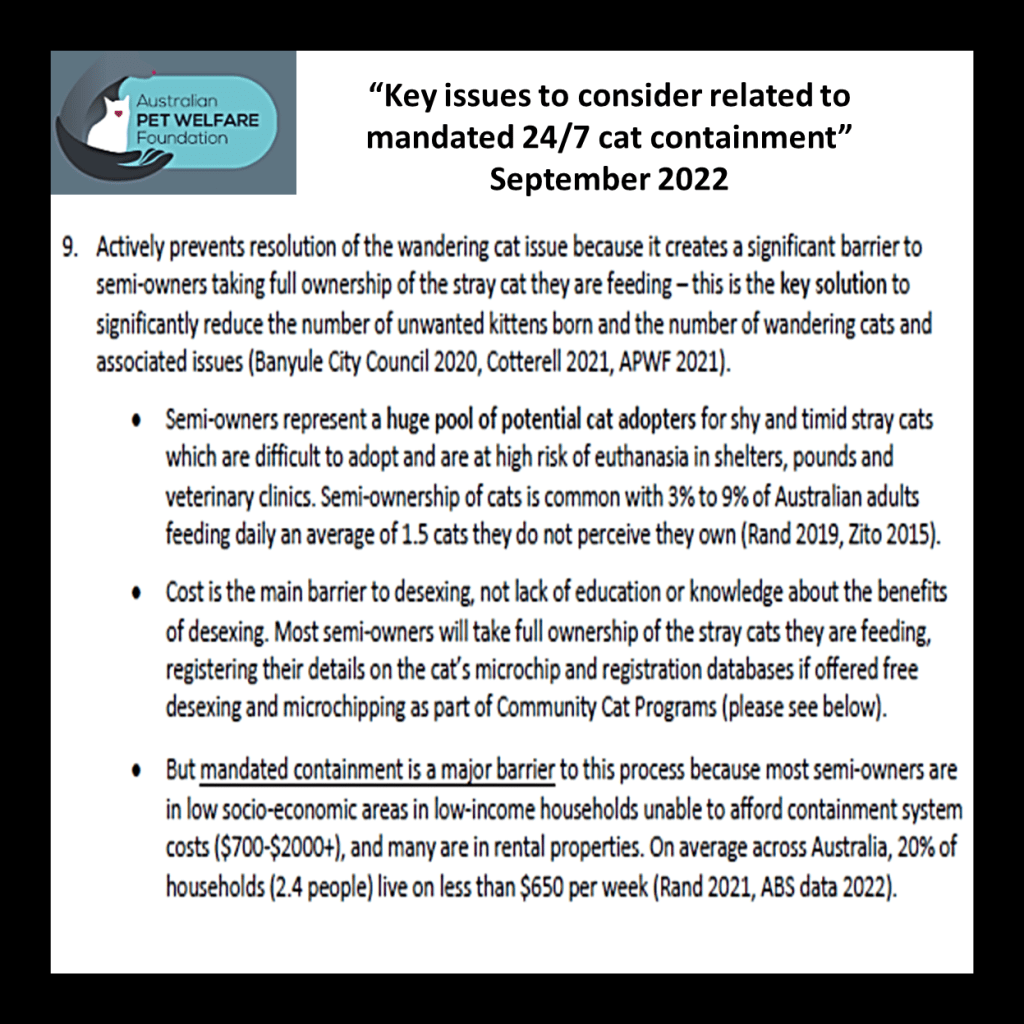
- cats for whom owners are not clearly identified/registered are at significant risk of being euthanased, and there may be a huge emotional (mental health) issue for semi owners (#12)
- potential that for some contained cats, their welfare, quality of life, and health eg “obesity, mobility” etc and behaviour will be compromised, and therefore also may lead to further surrenders or abandonment to the streets [increase in roaming cats] (#14)
- “increases risk of cruelty to cats” (#15)
- Increases the number of roaming cats upon removal of resident dominant cats (#16)
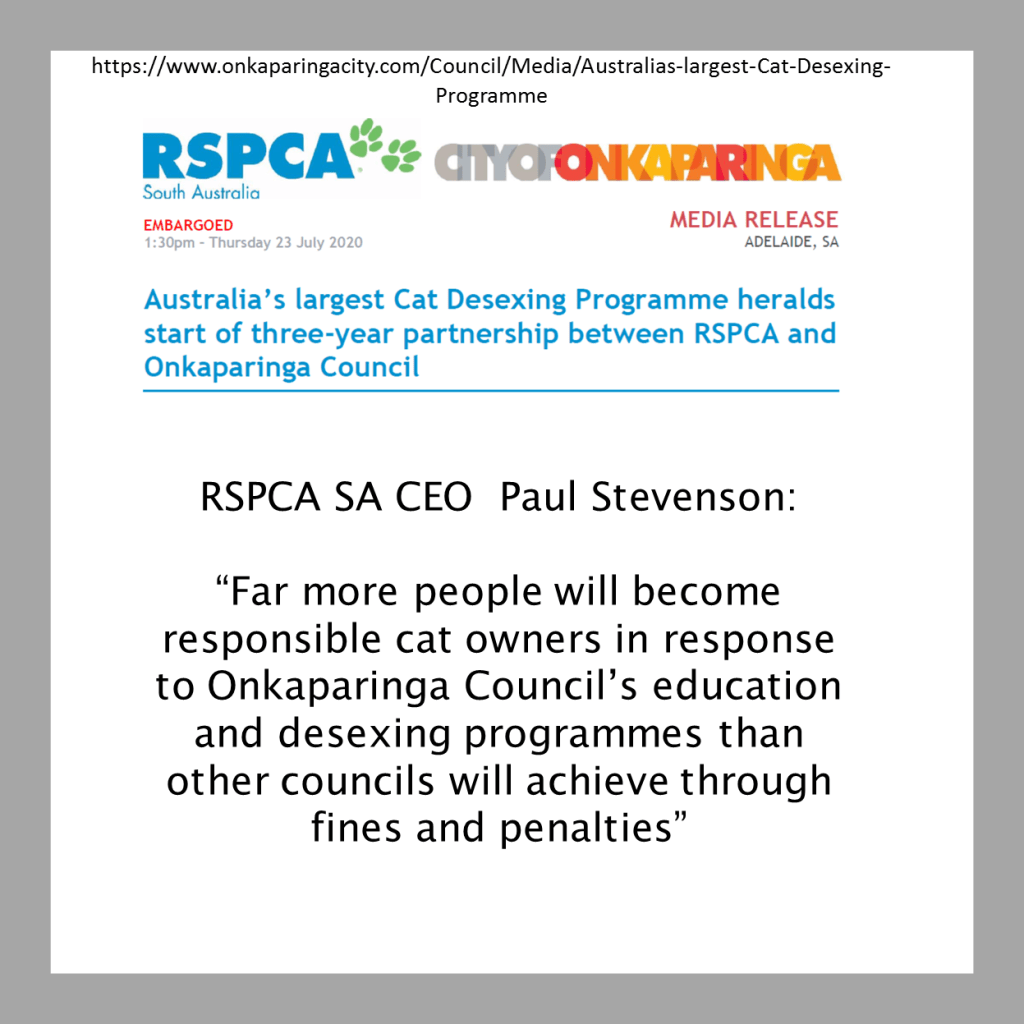
Proactive, evidence based solutions for roaming cats
APWF provides information on these techniques that have been proven successful:
- Community cat programs, where cats are managed, fed, desexed etc in a controlled manner
- Nightly routine “bed time feeding” to effectively bring cats indoors when cats and wildlife re more likely to “mix” – not currently widely promoted
Mandatory Nightly Curfews in legislation
APWF also includes information on why nightly curfews are not effective – mainly due to the same reasons as mandatory cat containment.
Roaming domestic cat impacts on wildlife
APWF includes:
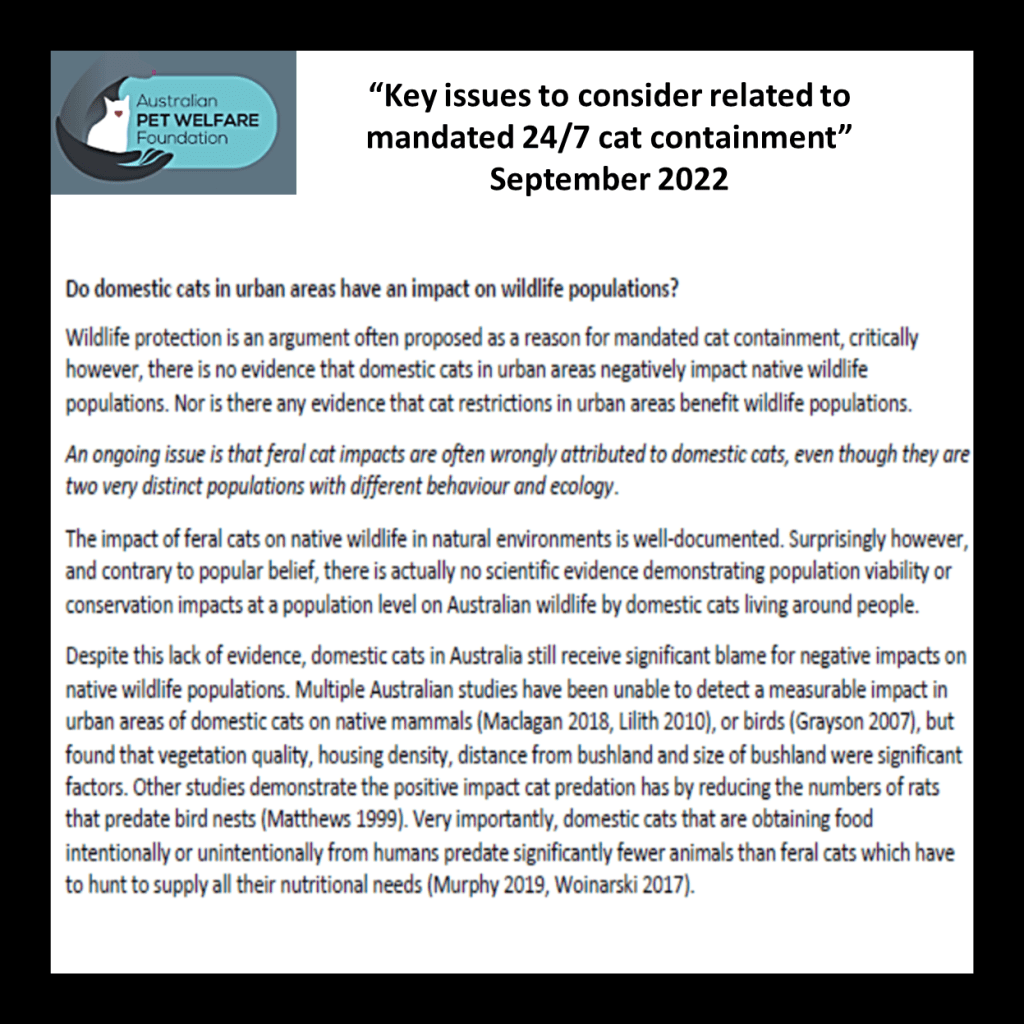
- there is a lack of measurable evidence (scientific studies) on the domestic cat impact in urban areas on wildlife [LRC notes: that we know cats may be hunters as instinctively drawn to especially smaller mammals such as rats and mice]
- there are studies drawing from feral cats which “are often wrongly attributed to domestic cats… even though they have different behaviour and ecology”
concern that similar blame is attributed to domestic cats for negative impact on wildlife, where APWF notes that studies have found:
- other factors such as “vegetation quality, housing density, distance form bushland and size of bushland were significant factors”, and
- domestic cats fed by humans, hunt fewer animals than feral cats
“False blame” appears to be “very dangerous and harmful because it is used as justification for the use of lethal control methods for domestic cats”:
- perpetuating the old method of trap and killing of cats and kittens, and the mental health damage for council staff and community pet owners or rescuers, and
- increasing the risk of and justification for animal cruelty [attacks and killing] by the public.
Therefore, the actual quantifiable impacts on wildlife in terms of populations and species diversity is questionable and needs specific measurement studies, and does not justify mandatory cat containment.
[LRC notes that land clearing and habitat destruction is now recognised as the main risk and concern for wildlife.]
APWF overall summary
- new decisions for domestic cat regulations need to be scientifically evidence based and humane
- proactive proven approaches such as the Community Cat Programs and Bedtime Feeding should be supported

- mandatory cat containment should not be supported
- as it is not an effective approach for roaming cats nor the related issues
- due to the mental health damage to council staff and community residents
- as it acts as a barrier to people taking ownership of roaming unowned cats (the primary solution to roaming cats)
- as it is unenforceable for the majority of roaming cats.
[LRC further notes:
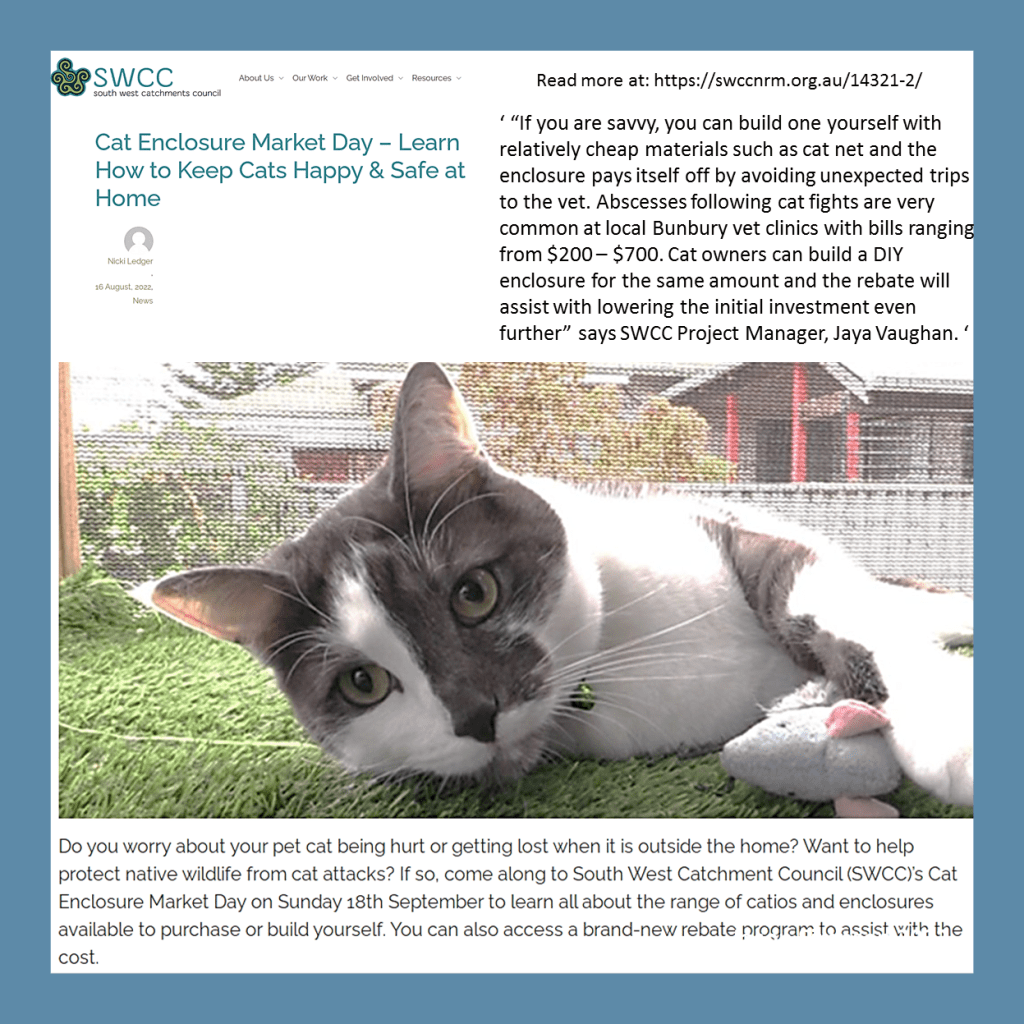
1. Cat enclosures and containment should be better promoted and supported by councils.
Just recently South West Catchments Council (greater Bunbury) has setup a $200 rebate for residents for cat enclosures.
SWCC also ran a “market day” to introduce residents to suppliers.
2. In NSW, 11 councils have been working with the RSPCA Keeping Cats Safe at Home and we are waiting on the outcomes of that program, for which it is expected better promotion of cat containment will be included.]
REFERENCED SOURCES
APWF “Key Issues to Consider related to mandated 24/7 cat containment” which was raised at the Hornsby Council meeting 14 September 2022 APWF Mandated Cat Containment
APFW Community Cat Program News
Community Cat Program News
Hornsby Meeting Agenda
Greater Bunbury Region Cat Enclosure Rebate
https://swccnrm.org.au/our-work/environment/pets/indoor-cats/
 LRC
LRC 
One thought on “APWF Key issues to consider related to mandated 24/7 cat containment”